Hyperliquid turns choppy as whales rotate: Can HYPE stop a fall from $35?

ambcrypto2026-04-03 tarihinde yayınlandı2026-04-03 tarihinde güncellendi

Özet

Hyperliquid's native token HYPE is experiencing volatile price action near $35, driven by conflicting whale activity. Recent on-chain data shows significant transfers, including a $17.18 million withdrawal to a private wallet (suggesting accumulation) closely followed by a $15.52 million sell-off. Despite this, exchange net outflows of $11.7 million over three days and a positive Accumulation/Distribution indicator point to underlying buying pressure and a holding sentiment. Technically, HYPE is testing a key support zone between $33.48–$35.19. Holding this level could lead to a rebound, while a break below may expose lower supports at $29.77–$31.10 and beyond. The token's near-term direction hinges on the balance between whale-driven volatility and sustained accumulation.

Hyperliquid’s native token, HYPE, had posted a strong run in the days leading up to its recent pullback, which left it trading near $35 at press time.

That rally, however, has given way to choppier price action, driven largely by conflicting whale activity against a fragile broader market backdrop.

Whale flows drive market tension

Recent on-chain data highlights the scale of this back-and-forth. Approximately 488,599 HYPE, valued at $17.18 million at the time, moved from FalconX to a newly created wallet.

Transfers of this nature—out of exchanges and into private wallets—typically point to a longer-term holding strategy, as they reduce immediate sell-side liquidity. In isolation, the move leans bullish.

However, the transaction followed closely behind a sizeable sell-off of roughly 450,000 HYPE, worth $15.52 million, executed within a similar window.

While the inflow marginally outweighs the outflow, the proximity of both transactions underscores the indecision among large holders.

Such visibility into whale positioning often shapes broader market behavior. Traders tend to mirror these flows, amplifying short-term volatility as liquidity shifts rapidly between buying and selling pressure.

The accumulation trend holds

Despite the recent sell-side activity, underlying data suggests that accumulation remains intact.

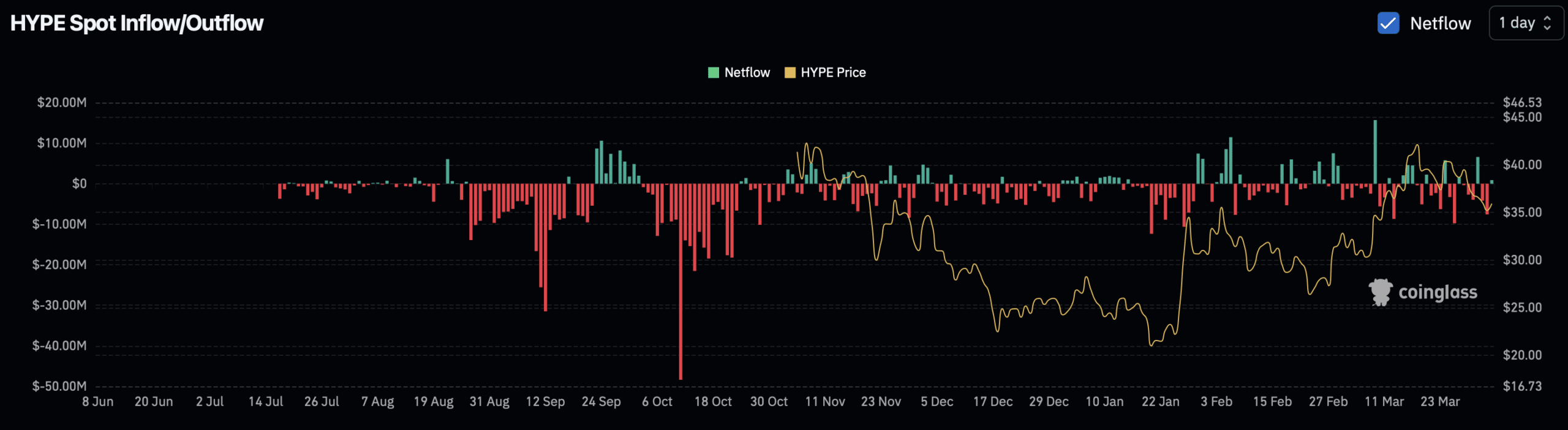
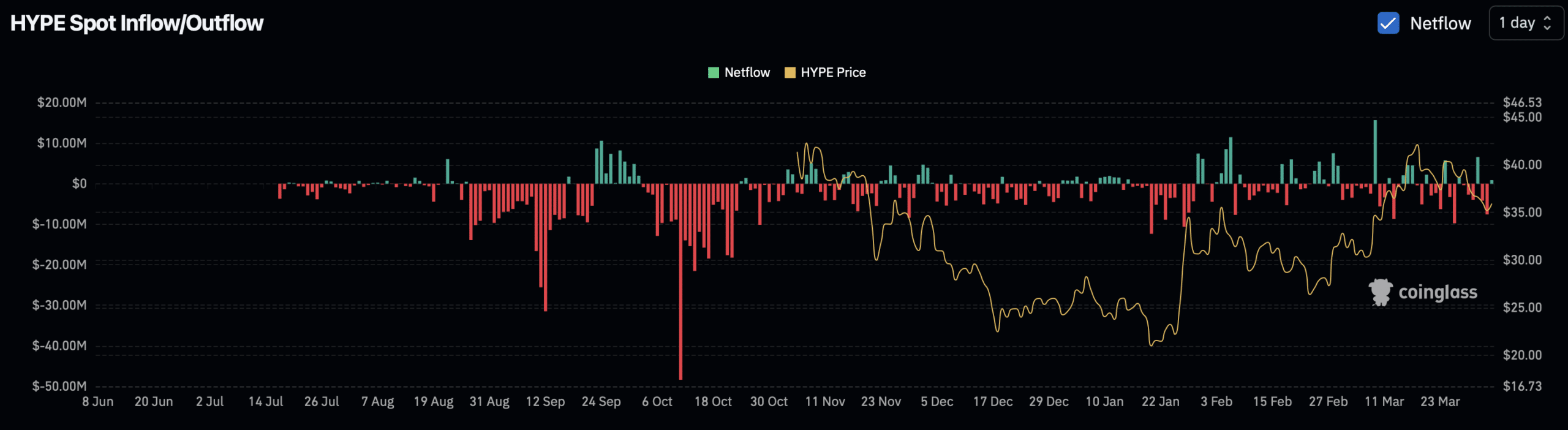
Spot Exchange Netflow—which measures the movement of assets into and out of centralized exchanges—shows that around $11.7 million worth of HYPE has exited exchanges over the past three days.

This trend typically reflects growing investor preference to hold rather than sell.
Source: CoinGlass

The Accumulation/Distribution indicator reinforces this view, with a gradual upward tilt pointing to steady, albeit modest, buying pressure.

This incremental demand has pushed total traded volume to roughly 5 million HYPE, indicating that confidence is beginning to rebuild as the market absorbs recent volatility.

Support levels in focus

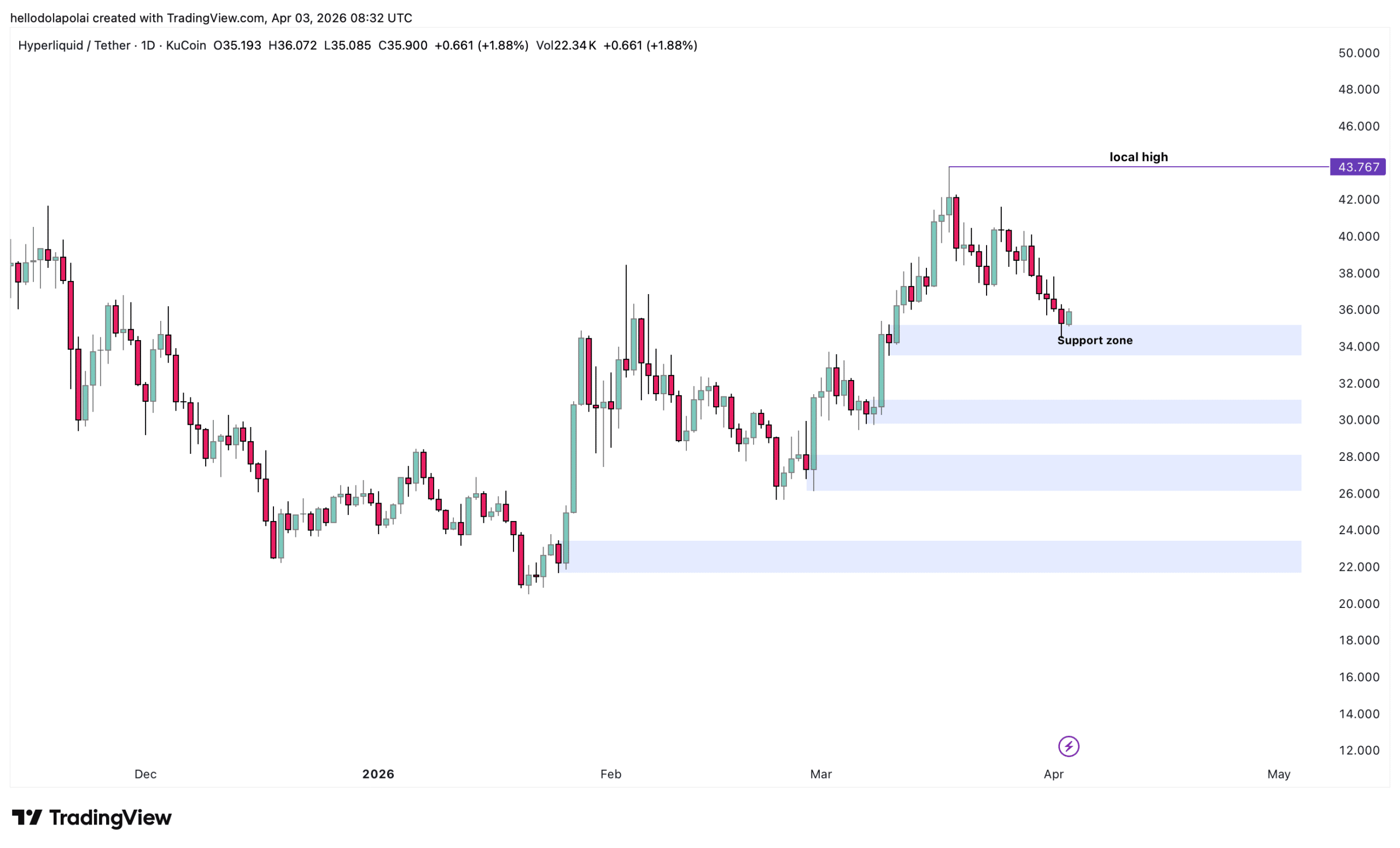
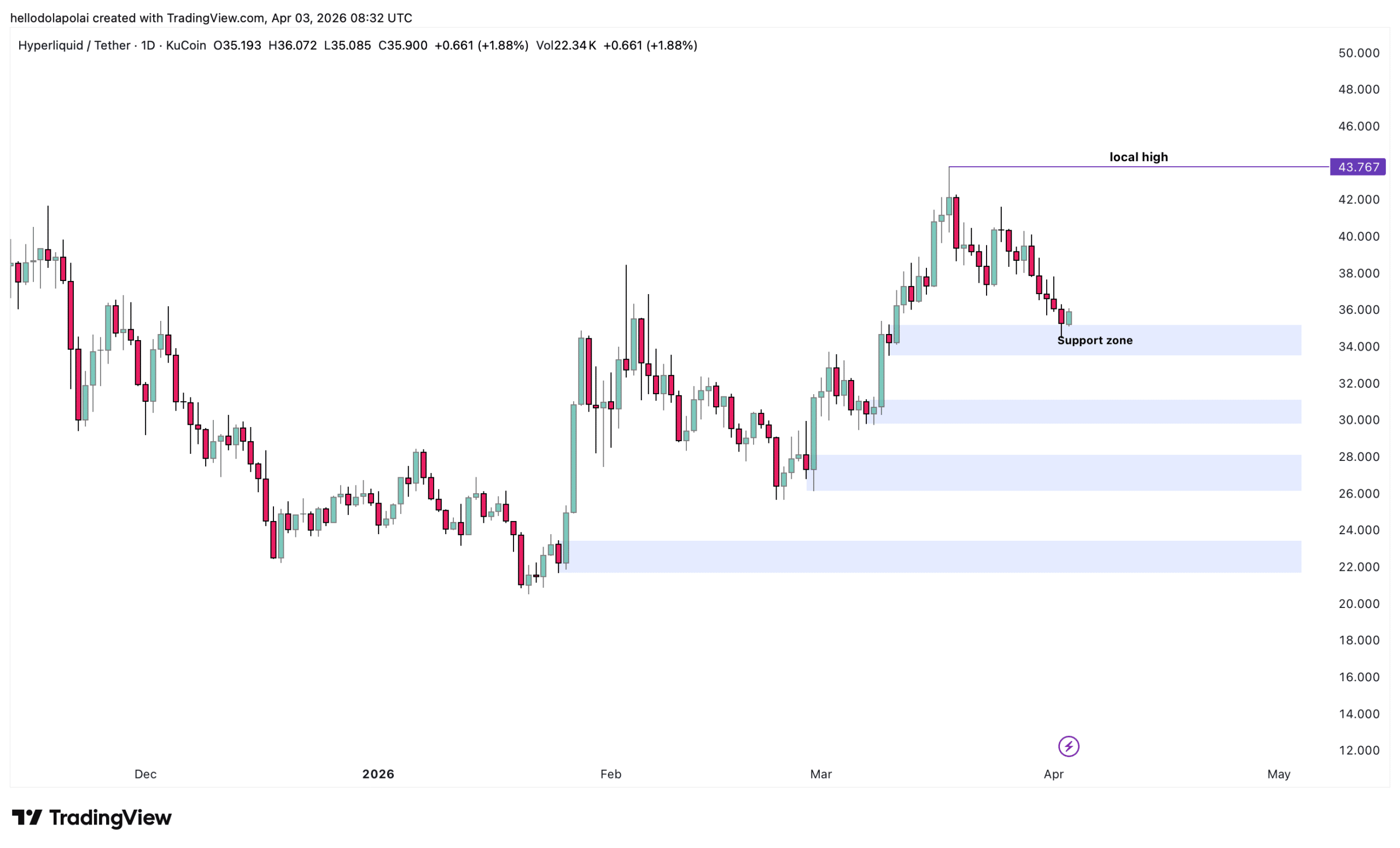
Technically, HYPE has moved into a key support zone that may determine its next direction.

The asset has already reacted to the $33.48–$35.19 range, staging a minor rebound from that level. Holding this zone could provide the foundation for a renewed push higher.

Source: TradingView

Failure to maintain support, however, would expose lower demand zones at $29.77–$31.10, followed by $26.10–$28.10, and ultimately $21.63–$23.43.

Whether HYPE sustains its footing or extends its decline will likely depend on the balance between continued accumulation and persistent whale-driven volatility.


Final Summary

  • Volatility persists as whales rotate positions in quick succession.
  • An $11 million outflow signals gradual accumulation despite recent sell pressure.

İlgili Sorular

QWhat is the main reason for the recent choppy price action in Hyperliquid's HYPE token?

AThe choppy price action is largely driven by conflicting whale activity, with large transfers both into and out of exchanges, against a fragile broader market backdrop.

QWhat does the transfer of 488,599 HYPE from FalconX to a new wallet typically indicate?

AThis type of movement, out of an exchange and into a private wallet, typically points to a longer-term holding strategy, as it reduces immediate sell-side liquidity and is considered a bullish signal in isolation.

QWhat on-chain metric suggests that accumulation of HYPE is still ongoing despite recent selling?

AThe Spot Exchange Netflow metric shows that approximately $11.7 million worth of HYPE has exited centralized exchanges over the past three days, which reflects a growing investor preference to hold rather than sell.
QWhat is the key support price zone that HYPE is currently testing?

AHYPE is currently testing the key support zone in the $33.48 to $35.19 price range.

QWhat are the potential lower demand zones if HYPE fails to hold its current support level?

AIf support fails, the next lower demand zones are at $29.77–$31.10, followed by $26.10–$28.10, and ultimately $21.63–$23.43.

İlgili Okumalar

Claude Opus 4.8 Finds a $4.5 Billion Bug: The AI Era is Mass-Producing Hackers

A researcher discovered a critical "infinite mint" vulnerability in the Zcash cryptocurrency's Orchard protocol using Claude Opus 4.8, leading to a swift fix but also a 50% market drop, erasing billions in value. This incident highlights a new era where powerful, accessible AI models are dramatically lowering the barrier to finding software vulnerabilities. Previously, the security community feared specialized models like Claude Mythos Preview, capable of finding decades-old zero-day exploits. The Zcash case, however, involved a publicly available, general-purpose model. This shift makes advanced security auditing—and attack capabilities—accessible to far more people, not just experts. The mass democratization of vulnerability discovery brings a dual challenge: a flood of low-quality, AI-generated false reports that overwhelm maintainers, and the real, rapid uncovering of deep, dangerous bugs. Open-source projects, often understaffed and unfunded, are particularly vulnerable to this "attention DDoS." The article cites examples like curl shutting down its bug bounty program due to the unsustainable workload. Our perceived digital safety has often been luck, relying on the high cost and effort required to find deeply hidden flaws in complex systems, as seen with historical vulnerabilities like Heartbleed or Baron Samedit. AI changes this cost structure, effectively "mass-producing flashlights" to illuminate every corner of our codebase. While large companies operate extensive security chains involving external white-hat hackers and massive defensive operations, the global cybersecurity workforce faces a severe shortage, especially of experienced personnel capable of analyzing complex threats and coordinating fixes. The core dilemma emerges: AI makes *finding* bugs cheap and scalable, but *fixing* them remains a slow, expensive, and human-intensive process. The article concludes that AI won't destroy the internet but acts as a bright light, revealing that our digital existence is not inherently secure but is precariously maintained by ongoing human effort. The true cost in the AI era may not be discovery, but whether there will be enough people left willing and able to do the hard work of repair.

marsbit4 dk önce

Claude Opus 4.8 Finds a $4.5 Billion Bug: The AI Era is Mass-Producing Hackers

marsbit4 dk önce

Codex Goal Mode Usage Guide: How to Make AI Continuously Pursue a Specific Objective

"Codex Goal Mode: How to Make AI Work Continuously Toward a Specific Goal" OpenAI's Codex "goal mode" (/goal) transforms the AI from a reactive code assistant into a proactive execution agent capable of working autonomously for hours or even days to achieve a defined objective. To maximize its effectiveness, follow these key principles: 1. **Define Clear, Verifiable Exit Criteria:** The goal prompt should be a concise, measurable success condition, not a lengthy specification. Use quantifiable metrics like "reduce build time by 30%" or "achieve 100% test parity." 2. **Provide Initial Guidance and Tools:** Direct Codex toward likely problem areas and specify available tools (e.g., browsers, testing environments) to prevent it from exploring unproductive paths. 3. **Enable Progress Measurement:** Equip Codex with ways to track advancement, such as creating comparison tools for visual tasks or evaluation sets, ensuring it can gauge its own progress. 4. **Use a Realistic Execution Environment:** For tasks like performance optimization, provide access to environments that closely mimic production (e.g., similar configs, databases) to yield valid results. 5. **Be Cautious with Visual Goals:** Avoid vague "pixel-perfect" instructions. Instead, supplement visual references with functional checklists or design system specifications to prevent Codex from obsessing over minor details. 6. **Implement Progress Tracking:** For long-running tasks, have Codex commit code to draft PRs, update progress documents, or send Slack updates to maintain visibility into its work. 7. **Review and Consolidate Results:** Once the goal is met, instruct Codex to review its work, clean up ineffective experimental code, and reflect on what strategies succeeded or failed. Ultimately, using goal mode shifts the developer's role from writing prompts to managing a persistent engineering agent—defining objectives, establishing metrics, configuring environments, and conducting final reviews.

marsbit1 saat önce

Codex Goal Mode Usage Guide: How to Make AI Continuously Pursue a Specific Objective

marsbit1 saat önce

From Ethereum to AI's 'CROPS': What Exactly Is This 'Slow Variable' That Vitalik Has Repeatedly Emphasized?

Recently, Vitalik Buterin has frequently emphasized the concept of "CROPS," first outlined in the Ethereum Foundation's March mandate as core principles guiding its focus: Censorship Resistance, Capture Resistance, Open Source, Privacy, and Security. CROPS represents Ethereum's commitment to providing foundational capabilities for user sovereignty—enabling asset ownership, identity expression, and coordination without reliance on centralized platforms or surrendering ultimate control. This framework is gaining new urgency with the rise of AI, particularly AI agents managing digital assets and automating transactions. While AI offers convenience, it risks centralizing user data, intent, and control if dependent on opaque, centralized services. Vitalik argues for "CROPS AI"—AI that is open, privacy-preserving, secure, and capable of local execution to maintain user agency. He highlights convergence between "CROPS Ethereum access layers" and "CROPS AI," such as using zero-knowledge proofs for private remote LLM calls and Ethereum RPC reads, ensuring users can access services without exposing sensitive information. Ultimately, CROPS is not just an abstract ideal but a practical guide for Ethereum's development and AI integration. It addresses the critical long-term question: as digital systems grow more powerful, how can users retain control over their privacy, assets, and autonomy? In an AI-driven era, these principles may define Ethereum's enduring value—prioritizing verifiable, secure, and user-centric design over short-term optimizations like speed and cost alone.

marsbit1 saat önce

From Ethereum to AI's 'CROPS': What Exactly Is This 'Slow Variable' That Vitalik Has Repeatedly Emphasized?

marsbit1 saat önce

İşlemler

Spot
Futures

Popüler Makaleler

HYPE Nasıl Satın Alınır

HTX.com’a hoş geldiniz! Hyperliquid (HYPE) satın alma işlemlerini basit ve kullanışlı bir hâle getirdik. Adım adım açıkladığımız rehberimizi takip ederek kripto yolculuğunuza başlayın. 1. Adım: HTX Hesabınızı OluşturunHTX'te ücretsiz bir hesap açmak için e-posta adresinizi veya telefon numaranızı kullanın. Sorunsuzca kaydolun ve tüm özelliklerin kilidini açın. Hesabımı Aç2. Adım: Kripto Satın Al Bölümüne Gidin ve Ödeme Yönteminizi SeçinKredi/Banka Kartı: Visa veya Mastercard'ınızı kullanarak anında Hyperliquid (HYPE) satın alın.Bakiye: Sorunsuz bir şekilde işlem yapmak için HTX hesap bakiyenizdeki fonları kullanın.Üçüncü Taraflar: Kullanımı kolaylaştırmak için Google Pay ve Apple Pay gibi popüler ödeme yöntemlerini ekledik.P2P: HTX'teki diğer kullanıcılarla doğrudan işlem yapın.Borsa Dışı (OTC): Yatırımcılar için kişiye özel hizmetler ve rekabetçi döviz kurları sunuyoruz.3. Adım: Hyperliquid (HYPE) Varlıklarınızı SaklayınHyperliquid (HYPE) satın aldıktan sonra HTX hesabınızda saklayın. Alternatif olarak, blok zinciri transferi yoluyla başka bir yere gönderebilir veya diğer kripto para birimlerini takas etmek için kullanabilirsiniz.4. Adım: Hyperliquid (HYPE) Varlıklarınızla İşlem YapınHTX'in spot piyasasında Hyperliquid (HYPE) ile kolayca işlemler yapın.Hesabınıza erişin, işlem çiftinizi seçin, işlemlerinizi gerçekleştirin ve gerçek zamanlı olarak izleyin. Hem yeni başlayanlar hem de deneyimli yatırımcılar için kullanıcı dostu bir deneyim sunuyoruz.

275 Toplam GörüntülenmeYayınlanma 2024.12.11Güncellenme 2026.06.02

HYPE Nasıl Satın Alınır

Tartışmalar

HTX Topluluğuna hoş geldiniz. Burada, en son platform gelişmeleri hakkında bilgi sahibi olabilir ve profesyonel piyasa görüşlerine erişebilirsiniz. Kullanıcıların HYPE (HYPE) fiyatı hakkındaki görüşleri aşağıda sunulmaktadır.

活动图片