Hyperliquid governance vote aims to permanently sideline $1B Assistance Fund

cointelegraph2025-12-17 tarihinde yayınlandı2025-12-17 tarihinde güncellendi

Özet

The Hyper Foundation has proposed a validator vote to formally recognize approximately $1 billion worth of HYPE tokens held in the protocol’s Assistance Fund as permanently inaccessible. These tokens, accumulated through automated conversion of trading fees, are stored in a system address designed without retrieval mechanisms. A "Yes" vote would classify these tokens as burned, excluding them from circulating and total supply calculations. This move aims to clarify HYPE’s true supply amid growing institutional interest, as the protocol has generated around $874 million in fees year-to-date, with 99% routed to the Assistance Fund for token repurchases. The proposal does not reduce existing supply but formalizes the treatment of fee-derived tokens. Hyperliquid remains a major perpetual DEX, with over $205 billion in trading volume in the last 30 days.

The Hyper Foundation proposed a validator vote to formally recognize HYPE tokens held in the Hyperliquid protocol’s Assistance Fund system address as permanently inaccessible, excluding them from the asset’s circulating and total supply.

According to the Foundation, the Assistance Fund is a protocol-level mechanism embedded in the layer-1 network’s execution. It automatically converts trading fees into HYPE tokens and routes them to a designated system address. At the time of writing, the wallet contains about $1 billion in tokens.

The system address was designed without control mechanisms, making the funds irretrievable without a hard fork. “By voting ‘Yes,’ validators agree to treat the Assistance Fund HYPE as burned,” Hyper Foundation wrote.

Native Markets, the issuer of the Hyperliquid-native stablecoin USDH, reminded users that 50% of the stablecoin’s reserve yield is routed to the Assistance Fund and converted into HYPE tokens. “Should this validator vote pass, these contributions will then be formally recognized as burned,” the company wrote.
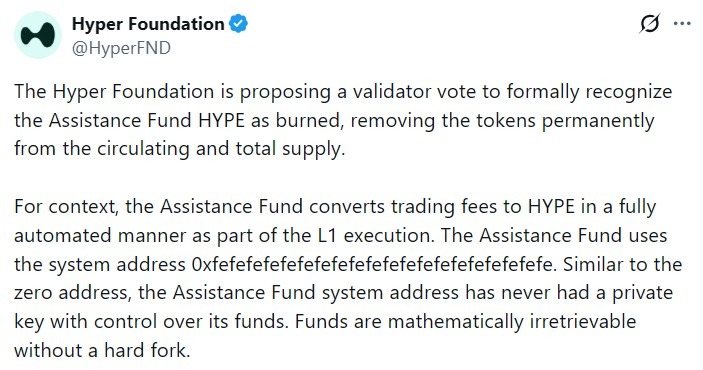
Source: Hyper Foundation

Clarifying supply amid institutional interest

While the proposal uses the term “burned,” it does not reduce the existing supply. Instead, it formalizes how the fee-derived tokens are treated for governance purposes, reducing ambiguity around Hyper’s effective supply.

The distinction has become more relevant as Hyperliquid’s fee-driven model has been attracting institutional attention.

In a research note covering Hyperliquid-focused digital asset treasuries (DATs), financial services firm Cantor Fitzgerald framed Hyperliquid as a protocol that returns nearly all of its fee revenue to tokenholders through automated repurchases.

Cantor estimated that Hyperliquid generated approximately $874 million in fees year-to-date (YTD) as of 2025. The company said 99% of protocol fees are routed through the Assistance Fund mechanism to repurchase HYPE.

The firm characterized the repurchases as a contributor to a declining circulating supply. However, the Hyper Foundation’s proposal drew a clear line by recognizing that the Assistance Fund balances were never intended to be spendable or recoverable.

The vote aims to align supply metrics with protocol design, rather than creating scarcity retroactively.

Related: 1.75M Hyperliquid tokens unlocked today, but was the price impacted?

Hyperliquid volume and HYPE DAT holdings

Hyperliquid remains one of the top contenders in the perpetual decentralized exchange (DEX) space. In the last 30 days, DefiLlama data shows that the protocol recorded over $205 billion in perpetuals trading volume, making it the third-largest perps DEX in the time frame.

Furthermore, a growing ecosystem of DAT companies has emerged around HYPE. According to Cantor, Hyperion DeFi (HYPD) holds about $46 million in HYPE tokens in its treasury, while Hyperliquid Strategies (PURR) holds about $340 million.

Magazine: Ethereum’s Fusaka fork explained for dummies: What the hell is PeerDAS?

İlgili Okumalar

How Many Tokens Away Is Yang Zhilin from the 'Moon Chasing the Light'?

The article explores the intense competition between two leading Chinese AI companies, DeepSeek and Kimi (Moon Dark Side), and the mounting pressure on Yang Zhilin, the founder of Kimi. While DeepSeek re-emerged after 15 months of silence with its powerful V4 model—boasting 1.6 trillion parameters and low-cost, long-context capabilities—Kimi has been focusing on long-context processing and multi-agent systems with its K2.6 model. Yang faces a threefold challenge: technological rivalry, commercialization pressure, and investor expectations. Despite Kimi’s high valuation (reaching $18 billion), its revenue heavily relies on a single product with low paid conversion rates, while DeepSeek’s strategic silence and open-source influence have strengthened its market position and valuation prospects, now targeting over $20 billion. Both companies reflect broader trends in China’s AI ecosystem: Kimi aims for global influence through open-source contributions and agent-based advancements, while DeepSeek prioritizes foundational innovation and hardware independence, notably shifting to Huawei’s chips. Their competition is seen as vital for China’s AI progress, with the gap between top Chinese and U.S. models narrowing to just 2.7% on the Elo rating scale. Ultimately, the article argues that this rivalry, though anxiety-inducing for leaders like Zhilin, is essential for driving innovation and solidifying China’s role in the global AI landscape.

marsbit45 dk önce

How Many Tokens Away Is Yang Zhilin from the 'Moon Chasing the Light'?

marsbit45 dk önce

TechFlow Intelligence Bureau: ChatGPT Helps Amateur Mathematician Crack 60-Year-Old Problem, CFTC Sues New York Regulator Over Coinbase and Gemini

An amateur mathematician, with the assistance of ChatGPT, has solved a combinatorial mathematics puzzle originally proposed by Hungarian mathematician Paul Erdős in the 1960s. This marks another milestone in AI-aided mathematical research, demonstrating the evolving capabilities of large language models in formal reasoning. In other AI developments, OpenAI introduced a new privacy filter tool for enterprise API usage, automatically screening sensitive data. Meanwhile, the Qwen3.6-27B model achieved 100 tokens per second on a single RTX 5090 GPU using quantization, significantly lowering the cost barrier for local AI deployment. In crypto and Web3, the U.S. CFTC sued New York’s financial regulator, challenging its oversight of Coinbase and Gemini—a first-of-its-kind federal-state regulatory clash. Following a vulnerability, KelpDAO and major DeFi protocols established a recovery fund. Tether froze $344 million in assets linked to Iran’s central bank upon U.S. Treasury request, highlighting the centralized control risks in stablecoins. Separately, Litecoin underwent a 3-hour chain reorganization to undo a privacy-layer exploit. In the U.S., former President Trump invoked the Defense Production Act to address power grid bottlenecks affecting AI data centers and dismissed the entire National Science Board, raising concerns over research independence. A retail trader gained 250% on a $600k Intel options bet amid AI-related speculation. Xiaomi announced its first performance electric vehicle, targeting rivals like Tesla. Meanwhile, iPhone users reported devices automatically reinstalling a hidden app daily, suspected to be MDM-related. A Chinese securities report noted that A-share institutional crowding has reached its second-longest streak since 2007, signaling high valuations and potential style rotation. The day’s developments reflect a dual narrative: AI is enabling unprecedented individual breakthroughs, while centralized power structures—whether governmental or corporate—are becoming more assertive, underscoring that decentralization is as much a political-economic challenge as a technical one.

marsbit1 saat önce

TechFlow Intelligence Bureau: ChatGPT Helps Amateur Mathematician Crack 60-Year-Old Problem, CFTC Sues New York Regulator Over Coinbase and Gemini

marsbit1 saat önce

İşlemler

Spot
Futures

Popüler Makaleler

WL Nedir

I. Proje TanıtımıWorldLand, Ethereum ekosistemini geliştirmek için tasarlanmış, Ethereum'un L2 veya yan zinciridir.II. Token Bilgileri1) Temel BilgilerToken adı: WL (WorldLand)III. İlgili BağlantılarWeb sitesi:https://worldland.foundation/Keşif Araçları:https://bscscan.com/address/0x8aaB31fbc69C92fa53f600910Cf0f215531F8239Sosyal Medya:https://x.com/WorldLand_space Not: Proje tanıtımı, resmi proje ekibi tarafından yayımlanan veya sağlanan materyallerden gelmektedir, yalnızca referans amaçlıdır ve yatırım tavsiyesi niteliği taşımaz. HTX, ortaya çıkan doğrudan veya dolaylı kayıplardan sorumluluk kabul etmez.

167 Toplam GörüntülenmeYayınlanma 2026.03.28Güncellenme 2026.03.28

WL Nedir

WL Nasıl Satın Alınır

HTX.com’a hoş geldiniz! WorldLand (WL) satın alma işlemlerini basit ve kullanışlı bir hâle getirdik. Adım adım açıkladığımız rehberimizi takip ederek kripto yolculuğunuza başlayın. 1. Adım: HTX Hesabınızı OluşturunHTX'te ücretsiz bir hesap açmak için e-posta adresinizi veya telefon numaranızı kullanın. Sorunsuzca kaydolun ve tüm özelliklerin kilidini açın. Hesabımı Aç2. Adım: Kripto Satın Al Bölümüne Gidin ve Ödeme Yönteminizi SeçinKredi/Banka Kartı: Visa veya Mastercard'ınızı kullanarak anında WorldLand (WL) satın alın.Bakiye: Sorunsuz bir şekilde işlem yapmak için HTX hesap bakiyenizdeki fonları kullanın.Üçüncü Taraflar: Kullanımı kolaylaştırmak için Google Pay ve Apple Pay gibi popüler ödeme yöntemlerini ekledik.P2P: HTX'teki diğer kullanıcılarla doğrudan işlem yapın.Borsa Dışı (OTC): Yatırımcılar için kişiye özel hizmetler ve rekabetçi döviz kurları sunuyoruz.3. Adım: WorldLand (WL) Varlıklarınızı SaklayınWorldLand (WL) satın aldıktan sonra HTX hesabınızda saklayın. Alternatif olarak, blok zinciri transferi yoluyla başka bir yere gönderebilir veya diğer kripto para birimlerini takas etmek için kullanabilirsiniz.4. Adım: WorldLand (WL) Varlıklarınızla İşlem YapınHTX'in spot piyasasında WorldLand (WL) ile kolayca işlemler yapın.Hesabınıza erişin, işlem çiftinizi seçin, işlemlerinizi gerçekleştirin ve gerçek zamanlı olarak izleyin. Hem yeni başlayanlar hem de deneyimli yatırımcılar için kullanıcı dostu bir deneyim sunuyoruz.

212 Toplam GörüntülenmeYayınlanma 2026.03.28Güncellenme 2026.03.28

WL Nasıl Satın Alınır

BASED Nasıl Satın Alınır

HTX.com’a hoş geldiniz! Based (BASED) satın alma işlemlerini basit ve kullanışlı bir hâle getirdik. Adım adım açıkladığımız rehberimizi takip ederek kripto yolculuğunuza başlayın. 1. Adım: HTX Hesabınızı OluşturunHTX'te ücretsiz bir hesap açmak için e-posta adresinizi veya telefon numaranızı kullanın. Sorunsuzca kaydolun ve tüm özelliklerin kilidini açın. Hesabımı Aç2. Adım: Kripto Satın Al Bölümüne Gidin ve Ödeme Yönteminizi SeçinKredi/Banka Kartı: Visa veya Mastercard'ınızı kullanarak anında Based (BASED) satın alın.Bakiye: Sorunsuz bir şekilde işlem yapmak için HTX hesap bakiyenizdeki fonları kullanın.Üçüncü Taraflar: Kullanımı kolaylaştırmak için Google Pay ve Apple Pay gibi popüler ödeme yöntemlerini ekledik.P2P: HTX'teki diğer kullanıcılarla doğrudan işlem yapın.Borsa Dışı (OTC): Yatırımcılar için kişiye özel hizmetler ve rekabetçi döviz kurları sunuyoruz.3. Adım: Based (BASED) Varlıklarınızı SaklayınBased (BASED) satın aldıktan sonra HTX hesabınızda saklayın. Alternatif olarak, blok zinciri transferi yoluyla başka bir yere gönderebilir veya diğer kripto para birimlerini takas etmek için kullanabilirsiniz.4. Adım: Based (BASED) Varlıklarınızla İşlem YapınHTX'in spot piyasasında Based (BASED) ile kolayca işlemler yapın.Hesabınıza erişin, işlem çiftinizi seçin, işlemlerinizi gerçekleştirin ve gerçek zamanlı olarak izleyin. Hem yeni başlayanlar hem de deneyimli yatırımcılar için kullanıcı dostu bir deneyim sunuyoruz.

229 Toplam GörüntülenmeYayınlanma 2026.03.30Güncellenme 2026.03.30

BASED Nasıl Satın Alınır

Tartışmalar

HTX Topluluğuna hoş geldiniz. Burada, en son platform gelişmeleri hakkında bilgi sahibi olabilir ve profesyonel piyasa görüşlerine erişebilirsiniz. Kullanıcıların A (A) fiyatı hakkındaki görüşleri aşağıda sunulmaktadır.

活动图片














