Hyperliquid at a Crossroads: Following Robinhood or Continuing the Nasdaq Economic Paradigm?

marsbit2025-12-18 tarihinde yayınlandı2025-12-18 tarihinde güncellendi

Özet

Hyperliquid, a decentralized exchange, processes perpetual contract volumes comparable to Nasdaq ($617 billion annualized) but generates significantly lower fee revenue—just 3.9 basis points—compared to retail platforms like Coinbase (35.5 bps) and Robinhood (33.5 bps). This reflects a structural divide: Hyperliquid operates at the low-margin "market layer" (exchange execution), while retail brokers capture higher profits through diversified revenue streams like net interest, subscriptions, and order flow. Hyperliquid’s architecture encourages permissionless third-party frontends (Builder Codes) and product listings (HIP-3), fostering ecosystem growth but risking "commoditization" if external interfaces gain routing power and compress fees. Recent strategic shifts suggest a move to defend its official frontend’s competitiveness and expand beyond trading fees. Initiatives like the native stablecoin USDH (capturing 50% of reserve yields) and portfolio margin lending (10% fee on borrower interest) aim to introduce broker-like revenue pools. The platform now faces a key challenge: balancing its open, modular design with the need to capture higher-margin brokerage economics—potentially requiring tighter integration and control over distribution and user balances to avoid long-term margin compression.

Original Author: shaunda devens

Original Compilation: Saoirse, Foresight News

Hyperliquid's perpetual contract clearing volume has reached Nasdaq levels, yet its economic benefits do not match. Over the past 30 days, the platform cleared perpetual contracts with a notional value of $205.6 billion (annualized to $617 billion on a quarterly basis), but generated only $80.3 million in fee revenue, representing a fee rate of approximately 3.9 basis points.

Its profit model resembles that of a "wholesale trading venue."

In comparison, Coinbase reported a trading volume of $295 billion in Q3 2025, with trading revenue reaching $1.046 billion, implying a fee rate of 35.5 basis points. Robinhood's cryptocurrency business, on the other hand, demonstrates a similar "retail profit model": $80 billion in cryptocurrency notional trading volume generated $268 million in cryptocurrency trading revenue, implying a fee rate of 33.5 basis points; meanwhile, the platform's stock notional trading volume in Q3 2025 was $647 billion.
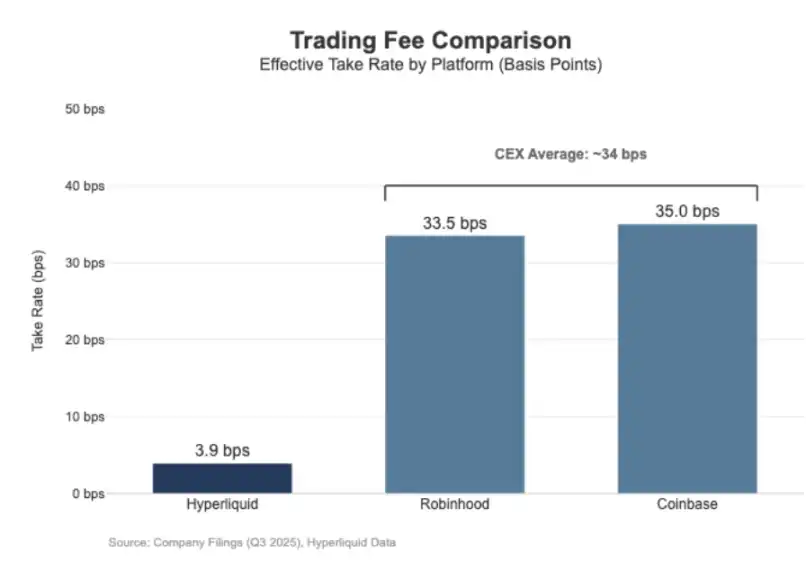
The gap is not only in fee rates—retail platforms have more diverse profit channels. In Q3 2025, Robinhood's transaction-related revenue was $730 million, in addition to $456 million in net interest income and $88 million in other revenue (primarily from Gold subscription services). In contrast, Hyperliquid still relies heavily on trading fees, and at the protocol level, its fee rate structurally remains in the single-digit basis points range.
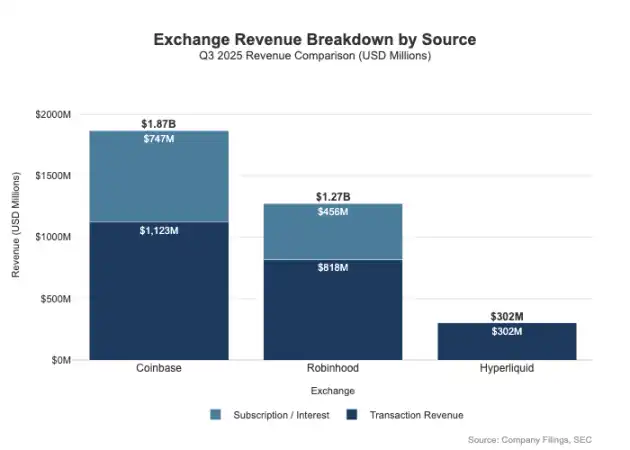
This difference is essentially due to "positioning": Coinbase and Robinhood are "broker/distribution businesses" that profit through balance sheets and subscription services; whereas Hyperliquid is closer to the "exchange level." In traditional market structures, profit pools are distributed across these two levels.

The Divide Between Broker-Dealer and Exchange Models

The core difference in traditional finance (TradFi) lies in the separation of the "distribution end" and the "market end." Retail platforms like Robinhood and Coinbase operate at the "distribution layer," occupying high-margin areas; exchanges like Nasdaq operate at the "market layer"—where pricing power is structurally constrained, and competition in trade execution tends toward a "commoditized economic model" (i.e., profit margins are significantly compressed).

1. Broker-Dealer = Distribution + Customer Balance Sheet

Broker-dealers control customer relationships. Most users do not interact directly with Nasdaq but access the market through brokers: brokers handle account opening, asset custody, margin/risk management, customer support, and tax documentation, then route orders to specific trading venues. This "customer relationship ownership" creates profit opportunities beyond trading:

  • Balance-related: cash sweep spreads, margin lending interest, securities lending income;
  • Service packaging: subscription services, bundled products, card services/advisory services;
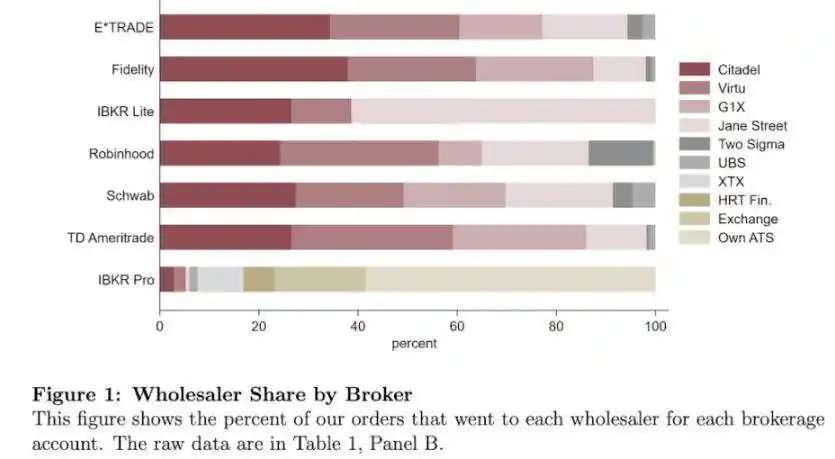
  • Order routing economics: brokers control trading flow and can embed payment sharing or revenue-sharing mechanisms in the routing chain.

This is why brokers can profit more than trading venues: profit pools are concentrated in the "distribution end" and "balance end."

2. Exchange = Order Matching + Rule System + Infrastructure, Fee Rates Capped

Exchanges operate trading venues, with core functions including order matching, setting market rules, ensuring deterministic execution, and providing trading connectivity. Their profit sources include:

  • Trading fees (in highly liquid products, fees are continuously compressed due to competition);
  • Rebates/liquidity incentive programs (to attract liquidity, most public fees often need to be rebated to market makers);
  • Market data services, trading connectivity/server hosting services;
  • Listing services and index licensing fees.

Robinhood's order routing model clearly illustrates this architecture: the broker (Robinhood Securities) controls users and routes orders to third-party market centers, with revenue shared across the routing chain. The "distribution layer" is the high-margin环节—it controls user acquisition and develops diverse profit channels around trade execution (such as payment for order flow, financing business, securities lending, subscription services).
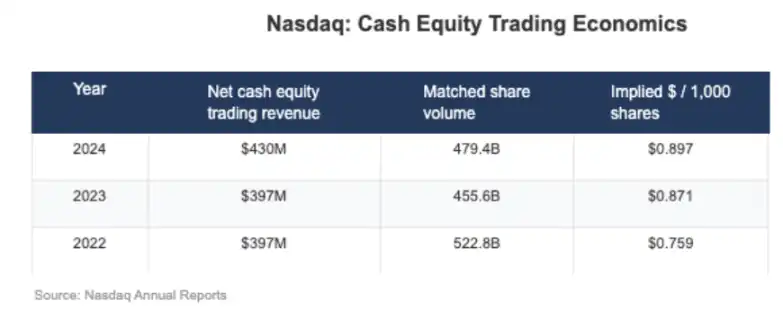
Nasdaq belongs to the "low-margin layer": its core products are "commoditized trade execution" and "order queue access rights," with pricing power mechanically constrained by three factors—the need to rebate fees to market makers to attract liquidity, regulatory caps on access fees, and high elasticity in order routing (users can easily switch to other platforms).

Nasdaq's disclosed data shows that the "implied net cash earnings" per share for its equity business are only at the $0.001 per share (i.e., one-tenth of a cent per share) level.
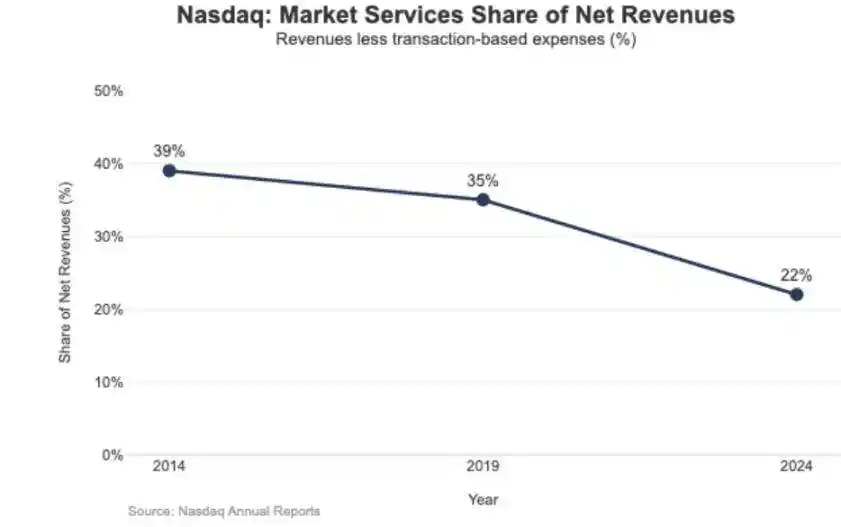
The strategic impact of low margins is also reflected in Nasdaq's revenue structure: in 2024, "Market Services" revenue was $1.02 billion, accounting for only 22% of total revenue of $4.649 billion; this proportion was 39.4% in 2014 and 35% in 2019—this trend indicates that Nasdaq is gradually shifting from "reliance on market trading execution business" to "more sustainable software/data business."

Hyperliquid Positioned at the "Market Layer"

Hyperliquid's actual fee rate of 4 basis points is consistent with its strategic choice to position itself at the "market layer." The platform is building an "on-chain Nasdaq": through high-throughput order matching, margin calculation, and clearing technology stack (HyperCore), adopting a "market maker/taker" pricing model and providing market maker rebates—its core optimization direction is "trade execution quality" and "liquidity sharing," not "retail user profitability."
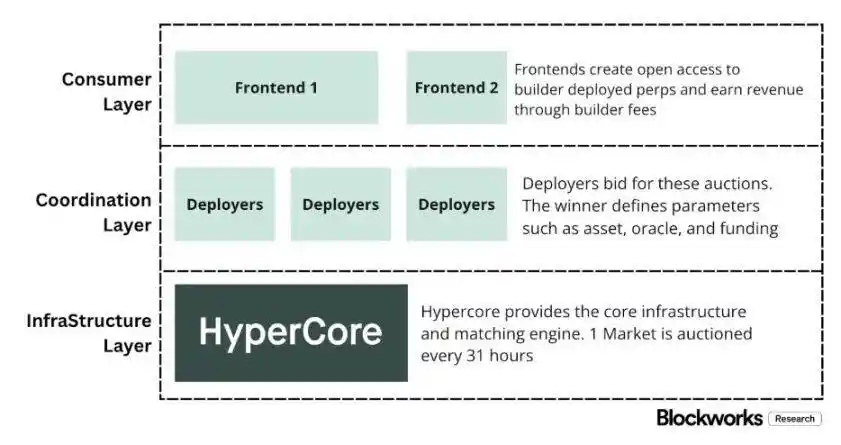
This positioning is reflected in two "TradFi-like" separation designs, which most cryptocurrency trading platforms have not adopted:

1. Permissionless Broker/Distribution Layer (Builder Codes)

"Builder Codes" allow third-party interfaces to connect to the core trading venue and set their own fee standards. Among them, the upper limit for third-party fees on perpetual contracts is 0.1% (10 basis points), 1% for spot, and fees can be set per order—this design creates a "distribution competition market," not a "single APP monopoly."

2. Permissionless Listing/Product Layer (HIP-3)

In traditional finance, exchanges control listing rights and product creation rights; HIP-3 "externalizes" this function: developers can deploy perpetual contracts based on the HyperCore technology stack and API, and independently define and operate trading markets. From an economic perspective, HIP-3 formally establishes a "revenue-sharing mechanism between the trading venue and the product party"—deployers of spot and HIP-3 perpetual contracts can receive 50% of the trading fees generated by the deployed assets.

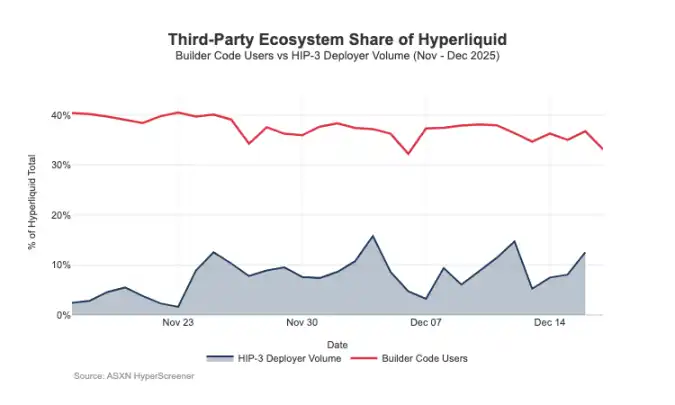
"Builder Codes" have already achieved results on the distribution end: as of mid-December, about 1/3 of users trade through third-party frontends, not the official interface.
However, this architecture also brings foreseeable pressure on the trading venue's fee revenue:

  1. Pricing compression: Multiple frontends share the same backend liquidity, and competition forces the "total cost" to the minimum; moreover, fees can be adjusted per order, further pushing pricing toward the bottom line;
  2. Loss of profit channels: Frontends control user account opening, service packaging, subscriptions, and trading processes, occupying the high-margin space of the "broker layer," while Hyperliquid only retains the low-margin income of the "trading venue layer";
  3. Strategic routing risk: If frontends develop into "cross-platform order routers," Hyperliquid will be forced into "wholesale execution competition"—needing to reduce fees or increase rebates to retain trading flow.

Through HIP-3 and Builder Codes, Hyperliquid has actively chosen a "low-margin market layer" positioning, while allowing a "high-margin broker layer" to form on top of it. If frontends continue to expand, they will gradually control "user-side pricing," "user retention channels," and "routing话语权," which will structurally pressure Hyperliquid's fee rates in the long run.

Defending Distribution Rights, Expanding Non-Exchange Profit Pools

The core risk Hyperliquid faces is the "commoditization trap": if third-party frontends can consistently attract users with prices lower than the official interface and eventually achieve "cross-platform routing," the platform will be forced to shift to a "wholesale execution economic model" (i.e., continuously narrowing profit margins).

Recent design adjustments indicate that Hyperliquid is trying to avoid this outcome while broadening its revenue sources beyond trading fees.

1. Distribution Defense: Maintaining the Economic Competitiveness of the Official Interface

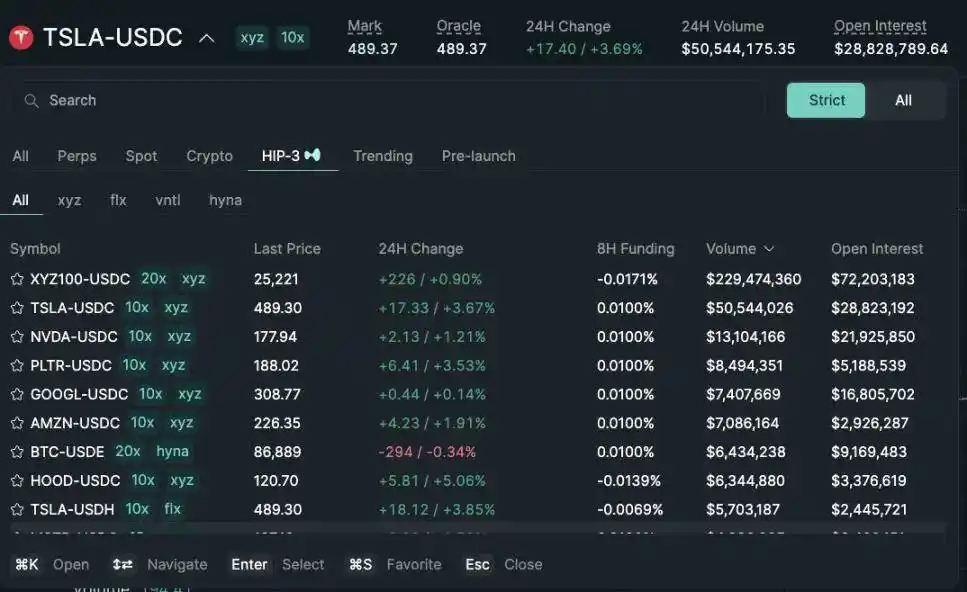
Previously, Hyperliquid proposed that "staking HYPE tokens could enjoy up to a 40% fee discount"—this design would have structurally allowed third-party frontends to be "cheaper than the official interface." After canceling the proposal, external distribution channels lost the direct subsidy for "pricing below the official interface." Meanwhile, HIP-3 markets were initially only available through "developer distribution" and were not displayed on the official frontend; currently, these markets have been included in the official frontend's "strict list." This series of actions sends a clear signal: Hyperliquid retains the permissionless nature at the "developer layer" but is unwilling to compromise on "core distribution rights."
2. Stablecoin USDH: Shifting from "Trading Profit" to "Fund Pool Profit"

The core purpose of launching USDH is to recapture the "stablecoin reserve收益" that was previously flowing out. According to the public mechanism, reserve收益 are allocated 50% to Hyperliquid and 50% to USDH ecosystem development. Additionally, the design of "USDH trading markets enjoying fee discounts" further strengthens this logic: Hyperliquid is willing to sacrifice "single-trade profit compression" in exchange for "larger-scale, more stable fund pool profit"—essentially adding a "quasi-annuity income stream" that can grow based on the "monetary base" (not just relying on trading volume).

3. Portfolio Margin: Introducing "Institutional Broker-Style Financing Economics"

The "portfolio margin" mechanism unifies the margin calculation for spot and perpetual contracts, allows risk exposure hedging, and introduces "native lending loops." Hyperliquid charges "10% of the borrower's interest"—this design gradually ties the protocol's economic model to "leverage usage" and "interest rates," closer to the profit logic of a "broker/institutional broker" rather than a pure exchange model.

Hyperliquid's Path Toward a Broker Economic Model

Hyperliquid's trading throughput has reached "mainstream trading venue levels," but its profit model remains at the "market layer": nominal trading volume is huge, but the actual fee rate is only in the single-digit basis points. The gap with Coinbase and Robinhood is structural: retail platforms are at the "broker layer," controlling user relationships and balances, achieving high margins through diverse profit pools like "financing, idle funds, subscriptions"; pure trading venues focus on "trade execution as the core product," and due to liquidity competition and routing elasticity, "trade execution" inevitably becomes commoditized, with profit margins continuously compressed—Nasdaq is a classic example of this constraint in traditional finance.

Hyperliquid initially deeply fit the "trading venue prototype": by separating "distribution (Builder Codes)" and "product creation (HIP-3)," it rapidly drove ecosystem expansion and market coverage. But the cost of this architecture is "economic benefit outflow": if third-party frontends control "comprehensive pricing" and "cross-platform routing rights," Hyperliquid will face the risk of "becoming a wholesale channel, clearing trading flow with low margins."

However, recent actions indicate that the platform is consciously shifting toward "defending distribution rights" and "broadening revenue structure" (no longer relying solely on trading fees). For example, no longer subsidizing "external frontend price competition," incorporating HIP-3 markets into the official frontend, and adding "balance sheet-style profit pools." The launch of USDH is a typical case of incorporating "reserve收益" into the ecosystem (including 50% sharing and fee discounts); portfolio margin introduces "financing economics" by "charging 10% of borrower interest."

Currently, Hyperliquid is gradually moving toward a "hybrid model": based on the "trade execution channel,"叠加 "distribution defense" and "fund pool-driven profit pools." This transformation both reduces the risk of "falling into the wholesale low-margin trap" and moves closer to a "broker-style revenue structure" without abandoning the core advantages of "unified execution and clearing."

Looking ahead to 2026, the core question Hyperliquid faces is: How to move toward a "broker-style economy" without breaking the "outsourcing-friendly model"? USDH is the most direct test case—its current supply is about $100 million, this scale indicates: if the platform does not control "distribution rights," the expansion speed of "outsourced issuance" will be very slow. A more obvious alternative would have been "official interface default settings," such as automatically converting the approximately $4 billion USDC base funds into the native stablecoin (similar to Binance's model of automatically converting USDC to BUSD).

If Hyperliquid wants to capture "broker-level profit pools," it must take "broker-style actions": strengthen control, deepen the integration of self-operated products and the official interface, and clarify boundaries with ecosystem teams (avoiding internal competition over "distribution rights" and "fund balances").


İlgili Sorular

QWhat is the core difference in profitability between Hyperliquid and retail platforms like Coinbase and Robinhood?

AThe core difference lies in their business model layers. Hyperliquid operates at the 'market layer' (exchange level) with a low-margin, commodity-like execution model, earning primarily from transaction fees at a low rate of ~3.9 bps. In contrast, Coinbase and Robinhood operate at the 'broker/distribution layer,' controlling customer relationships and generating high-margin revenue from diverse sources like net interest income, subscription services, and order flow payments, not just transaction fees.

QHow does Hyperliquid's Builder Codes feature contribute to a structural pressure on its fee income?

ABuilder Codes allow third-party frontends to access Hyperliquid's core exchange and set their own fees, creating a competitive distribution market. This competition drives the 'all-in cost' for users down to a minimum. Since these frontends control user onboarding, service packaging, and potentially cross-platform order routing, they capture the high-margin 'broker layer' profits. This leaves Hyperliquid with only the low-margin 'exchange layer' revenue, putting long-term structural pressure on its fee rates.

QWhat recent strategic adjustments has Hyperliquid made to defend its distribution rights and broaden its revenue streams?

AHyperliquid has made several adjustments: 1) It scrapped a proposal for staking-based fee discounts that would have allowed third-party frontends to be structurally cheaper than its official interface. 2) It integrated HIP-3 perpetual markets into its official frontend's 'strict list' to maintain control. 3) It launched the USDH stablecoin to capture a share (50%) of reserve yields, creating an annuity-like income stream. 4) It introduced portfolio margin feature, charging 10% of borrower interest, moving towards a broker-like financing economy.

QAccording to the article, what is the fundamental risk Hyperliquid faces known as the 'commoditization trap'?

AThe 'commoditization trap' is the risk that if third-party frontends can consistently attract users with lower prices than Hyperliquid's official interface and eventually develop into cross-platform order routers, Hyperliquid would be forced into a 'wholesale execution economic model.' In this scenario, it would have to compete solely on low fees and high rebates to retain trading flow, leading to perpetually compressed profit margins, much like traditional exchanges such as Nasdaq.

QHow does the USDH stablecoin represent a shift in Hyperliquid's economic model beyond transaction fees?

AUSDH represents a shift from pure 'transaction profitability' to 'balance sheet profitability.' The mechanism allocates 50% of the reserve yields from the stablecoin's collateral to the Hyperliquid protocol, creating a new, more stable revenue stream tied to the size of the monetary base (USDH supply) rather than being solely dependent on trading volume. Additionally, offering fee discounts for USDH trading pairs shows a willingness to compress per-trade profits to incentivize the growth of this new capital pool-based income.

İlgili Okumalar

SharpLink CEO: How to Understand Ethereum Developers Just Exceeded 1 Million?

SharpLink CEO reflects on the milestone of Ethereum surpassing 1 million historical developers, emphasizing that this figure represents the largest pool of technical talent ever assembled around an open, permissionless blockchain network. While approximately 232,000 developers remain active, the key question for the crypto industry is not which chain is fastest, but where the best builders choose to build long-term. Ethereum's advantage lies in a decade-long accumulation of infrastructure, standards, tools, liquidity, and a cohesive culture, making it the default operating system for programmable finance. This developer base is tackling complex challenges: the Glamsterdam upgrade aims to enhance scalability while preserving core principles; synchronous composability seeks to unify Rollup ecosystems; and significant efforts are underway for post-quantum security. Ethereum's deeper network effects stem from composability and shared standards (like the EVM and Solidity), creating a flywheel of more developers, tools, and liquidity. Three reinforcing strengths cement Ethereum's lead: credible neutrality (secured by ~900k validators), a modular architecture with interconnected Rollups, and a culture that attracts top researchers. The ecosystem is consolidating as the trusted coordination layer for internet-native finance, favored by large institutions valuing security and liquidity. The future of Ethereum is being built by this global community of founders and architects.

链捕手9 dk önce

SharpLink CEO: How to Understand Ethereum Developers Just Exceeded 1 Million?

链捕手9 dk önce

A Clod of Chinese Soil Chokes Two Japanese Giants

"Chinese Soil Chokes Japanese Giants" The production of a key electronic specialty gas, tungsten hexafluoride (WF6), vital for manufacturing AI chips, was halted by two leading Japanese producers—Kanto Denka and Central Glass. Their shutdown was not due to a technological failure but a sudden, critical shortage of a raw material they had long taken for granted: ultra-high-purity (6N-grade) tungsten powder, which is almost entirely sourced from China. Following a quiet Chinese export announcement in January 2026, tungsten powder shipments to Japan dropped to zero for months. Despite frantic efforts, Japanese companies found no viable alternative; imported powder was three times more expensive and lacked the required purity. Their existing stockpiles were exhausted by mid-2026. WF6 is essential for depositing tungsten into the microscopic contact holes of High Bandwidth Memory (HBM) chips, which are crucial for advanced processors like those from Nvidia. While Japanese firms had mastered producing ultra-pure WF6 gas, their entire supply chain relied on China's 6N tungsten powder—a dependency now revealed as a fatal vulnerability. China's dominance in this "soil" results from decades of painstaking R&D by companies like Xiamen Tungsten and China Tungsten & Hightech. They overcame immense technical hurdles, such as separating chemically similar molybdenum from tungsten, to achieve mass production of the world's purest tungsten powder. With their primary suppliers gone, Kanto Denka and Central Glass announced a permanent halt to WF6 production starting July 1, 2026. This immediately created a supply crisis for major semiconductor manufacturers like Samsung and SK Hynix, forcing them to urgently seek and certify new Chinese suppliers for WF6 itself. The reversal marks a dramatic shift: China has moved from exporting low-value raw materials to controlling the high-purity foundation of a critical global tech supply chain, upending a long-established industrial hierarchy.

marsbit40 dk önce

A Clod of Chinese Soil Chokes Two Japanese Giants

marsbit40 dk önce

Without Tencent, What's Left for Suiyuan?

The article centers on the crucial question posed in the title: what is Seyond Technology really worth if its dominant customer, Tencent, were to stop purchasing its AI chips? As the last of China's "Four AI Chip Dragons" to secure approval for a public listing, Seyond's IPO filing reveals a profound and controversial dependency. In 2025, 74.9% to over 80% of its revenue came from Tencent. The piece argues that this extreme customer concentration is not merely a vulnerability but a strategic outcome of China's AI industry evolution. It contrasts Seyond's path with its peers (Moore Thread, Biren Technology, and MetaX), noting that while others raced to market with ambitious stories, Seyond focused first on securing and delivering for a major client. Its explosive revenue growth—with Q1 2026 up 1474.85% year-on-year—is driven by concentrated orders from Tencent, which itself faces massive, escalating AI compute demands for products like its Yuanbao and Hunyuan models. The relationship is framed as a deliberate, symbiotic cultivation of a supply chain. As both a major shareholder (20.26%) and primary client, Tencent is actively fostering Seyond to build a controllable, stable alternative to NVIDIA, similar to how global tech giants historically nurtured key suppliers. The high switching costs—involving software stacks and deployed systems—create a deep "ecological moat" for Seyond within Tencent's ecosystem. The analysis positions the AI chip landscape in three tiers: NVIDIA as the global leader, Huawei's Ascend as the state-backed player, and commercial firms like Seyond competing for market orders. Seyond is increasingly seen as "Tencent's compute foundation," with its product roadmap closely aligned with the tech giant's needs. The conclusion is that the industry's metric for success is shifting from fundraising and technical specs to real orders, delivery capability, and ecosystem binding. Seyond's value, therefore, lies not just in its chips but in holding a massive, multi-year procurement order from China's largest internet company—a tangible asset arguably more telling than any technical whitepaper in the current climate. The core insight is that for domestic chips, the ultimate challenge isn't just catching up technologically with NVIDIA, but earning the trust, scenarios, and recurring orders from a major anchor client.

marsbit1 saat önce

Without Tencent, What's Left for Suiyuan?

marsbit1 saat önce

İşlemler

Spot
Futures

Popüler Makaleler

ATWO Nedir

I. Proje TanıtımıArena Two, hayranların gerçek zamanlı etkinlik sonuçlarında aktif, tokenleştirilmiş bir rol oynamasına olanak tanıyan merkeziyetsiz bir etkileşimli platformdur. Hayranları pasif izleyicilere indirgeyen geleneksel yayıncılık modellerinin aksine, Arena Two, hayranların doğrudan gerçek zamanlı oy kullanmalarını ve sahadaki sonuçları etkilemelerini sağlamak için blok zinciri teknolojisini kullanır.II. Token BilgileriToken adı: ATWO(Arena Two)III. İlgili BağlantılarWeb sitesi:https://arenatwo.com/Keşif araçları:https://basescan.org/token/0x499D35eBE6cEe9B2Ac35Fd003fcBbeeB9CFc7B32Twitter:https://x.com/arenatwoXNot: Proje tanıtımı, resmi proje ekibi tarafından yayınlanan veya sağlanan materyallerden gelmektedir ve yalnızca referans amaçlıdır, yatırım tavsiyesi niteliği taşımaz. HTX, ortaya çıkan doğrudan veya dolaylı kayıplardan sorumluluk kabul etmez.

274 Toplam GörüntülenmeYayınlanma 2026.05.18Güncellenme 2026.06.02

ATWO Nedir

ATWO Nasıl Satın Alınır

HTX.com’a hoş geldiniz! Arena Two (ATWO) satın alma işlemlerini basit ve kullanışlı bir hâle getirdik. Adım adım açıkladığımız rehberimizi takip ederek kripto yolculuğunuza başlayın. 1. Adım: HTX Hesabınızı OluşturunHTX'te ücretsiz bir hesap açmak için e-posta adresinizi veya telefon numaranızı kullanın. Sorunsuzca kaydolun ve tüm özelliklerin kilidini açın. Hesabımı Aç2. Adım: Kripto Satın Al Bölümüne Gidin ve Ödeme Yönteminizi SeçinKredi/Banka Kartı: Visa veya Mastercard'ınızı kullanarak anında Arena Two (ATWO) satın alın.Bakiye: Sorunsuz bir şekilde işlem yapmak için HTX hesap bakiyenizdeki fonları kullanın.Üçüncü Taraflar: Kullanımı kolaylaştırmak için Google Pay ve Apple Pay gibi popüler ödeme yöntemlerini ekledik.P2P: HTX'teki diğer kullanıcılarla doğrudan işlem yapın.Borsa Dışı (OTC): Yatırımcılar için kişiye özel hizmetler ve rekabetçi döviz kurları sunuyoruz.3. Adım: Arena Two (ATWO) Varlıklarınızı SaklayınArena Two (ATWO) satın aldıktan sonra HTX hesabınızda saklayın. Alternatif olarak, blok zinciri transferi yoluyla başka bir yere gönderebilir veya diğer kripto para birimlerini takas etmek için kullanabilirsiniz.4. Adım: Arena Two (ATWO) Varlıklarınızla İşlem YapınHTX'in spot piyasasında Arena Two (ATWO) ile kolayca işlemler yapın.Hesabınıza erişin, işlem çiftinizi seçin, işlemlerinizi gerçekleştirin ve gerçek zamanlı olarak izleyin. Hem yeni başlayanlar hem de deneyimli yatırımcılar için kullanıcı dostu bir deneyim sunuyoruz.

190 Toplam GörüntülenmeYayınlanma 2026.05.18Güncellenme 2026.06.02

ATWO Nasıl Satın Alınır

ZEST Nedir

I. Proje Tanıtımı1. Zest Protocol Nedir?Zest Protocol, kullanıcıların BTC ile getiri kazanmasına veya BTC'yi teminat göstererek varlık ödünç almasına olanak tanıyan, Stacks Layer 2 üzerinde inşa edilmiş Bitcoin yerel bir kredi protokolüdür. Protokolün akıllı sözleşmeleri Clarity dilinde yazılmıştır, tamamen zincir üzerinde çalışır ve açık kaynaklıdır; tasarımı Aave v3'ten ilham alınarak yapılmıştır. Zest, şu anda 800'den fazla BTC'nin yatırıldığı ve zirve TVL'sinin 100 milyon doları aştığı Stacks'teki en büyük DeFi protokolüdür. Mayıs 2026'da protokol, Stacks'tan Bitcoin ana ağına kredi verme yeteneklerini genişleten Bitcoin Teminat Kasaları'nı tanıttı. Bu, kullanıcıların BTC'yi Bitcoin ağından çıkarmadan stabilcoin ödünç almasına olanak tanır ve kendine ait saklama ile kredi vermeyi mümkün kılar.2. Zest Protocol Nasıl Çalışır?Zest Protocol, iki piyasadan oluşmaktadır. Stacks piyasası, kullanıcıların sBTC, STX ve USDC gibi varlıkları yatırarak getiri kazanmasına veya aşırı teminatlı krediler almasına olanak tanıyan Aave v3 üzerine inşa edilmiştir. Varsayılan maksimum LTV %50'dir (%70 sBTC için). Bitcoin piyasası, yeni başlatılan Bitcoin Teminat Kasaları aracılığıyla çalışır. Kullanıcılar, Bitcoin zincirinde kendine ait saklama kasalarında BTC'yi kilitleyerek stabilcoin ödünç alırlar. Teminat, tüm süreç boyunca Bitcoin ana ağında kalır ve kullanıcılar pozisyon tasfiye edilmedikçe saklama hakkını korur.3. Zest Protocol'ü Kim Kurdu?Tycho Onnasch (Kurucu Ortak): Oxford Üniversitesi'nden mezun. Stacks Açık İnternet Vakfı için araştırma ve hibe çalışmalarında yer aldı. Trust Machines'da eski yönetici ve Deedmob'un kurucusu. LinkedIn Profili: https://www.linkedin.com/in/tychokoonnasch/.Fernando Foy (Kurucu Ortak): Daha önce Objectif Emploi'de IT danışmanlığı yaptı. LinkedIn Profili: https://www.linkedin.com/in/fernando-foy/.Emil E. (Kurucu Ortak): Warwick Üniversitesi'nden Fizik alanında Yüksek Lisans derecesine sahiptir. Trust Machines'da eski mühendislik ortağı, Web3 projeleri için tam yığın geliştirici ve HSBC'de veri bilimcisi olarak çalıştı. LinkedIn Profili: https://www.linkedin.com/in/emil-e-49771a145/.Finansman Detayları: Mayıs 2024'te, Zest Protocol, Tim Draper liderliğindeki 3.5 milyon dolarlık bir tohum finansmanı turunun tamamlandığını duyurdu; Binance Labs, Flow Traders, Trust Machines ve diğerlerinin katılımıyla.4. $ZEST Tokenomikası$ZEST, Zest Protocol'ün yerel token'ıdır ve toplam arzı 1 milyar token ile sabit olup enflasyon mekanizması yoktur.Topluluk (27.83%): Airdrop'lar ve kullanıcı teşvikleri için kullanılır;Eko Sistem Gelişimi (24.82%): Likidite, ortaklıklar, pazarlama, borsa listelemeleri vb. için kullanılır;Yatırımcılar (22.35%): Zest Protocol'ün erken gelişimini destekleyen yatırımcı taraflarını destekler;Takım (25%): Ana katkıda bulunanlar için ayrılmıştır.Vesting Takvimi: Takım ve Yatırımcı token'ları, 1 yıllık bir kilitlenme süresine tabi olup ardından 3 yıl boyunca lineer olarak serbest bırakılacaktır.5. Anahtar Dönüm Noktalarının Zaman Çizelgesi2022: Zest Protocol resmi olarak kuruldu.Mart 2024: Güvenlik denetimi tamamlandı ve Stacks kredi piyasası ana ağda başlatıldı.Şubat 2026'da, Stacks Market V2 başlatıldı ve Risk Grupları tanıtıldı.Mayıs 2026'da, Bitcoin Teminat Kasaları tanıtıldı ve şu anda operasyonel bir ana ağ prototipi mevcuttur. Bu, kullanıcıların kendine ait saklama BTC'lerini Bitcoin L1 üzerinde teminat olarak kullanarak EVM zincirlerinde stabilcoin ödünç almalarını sağlar; köprüleme, sarma ve üçüncü taraf saklama işlemlerini sona erdirir. Bu dağıtım iki aşamaya ayrılmıştır. Aşama 1: BTC hareketini kısıtlamak için önceden imzalanmış işlemleri kullanır; Aşama 2: Doğrulama için BitVM kullanır. II. Token BilgisiToken adı: ZEST(Zest Protocol)III. İlgili BağlantılarWeb sitesi:https://www.zestprotocol.com/Keşif Araçları:https://bscscan.com/token/0x5506599c722389a60580b5213ea1da60d64754a1Twitter:https://twitter.com/ZestProtocolNot: Proje tanıtımı, resmi proje ekibi tarafından yayımlanan veya sağlanan materyallerden alınmıştır, yalnızca referans amaçlıdır ve yatırım tavsiyesi niteliği taşımaz. HTX, sonuçlanan doğrudan veya dolaylı kayıplardan sorumluluk kabul etmez.

195 Toplam GörüntülenmeYayınlanma 2026.05.19Güncellenme 2026.06.02

ZEST Nedir

Tartışmalar

HTX Topluluğuna hoş geldiniz. Burada, en son platform gelişmeleri hakkında bilgi sahibi olabilir ve profesyonel piyasa görüşlerine erişebilirsiniz. Kullanıcıların A (A) fiyatı hakkındaki görüşleri aşağıda sunulmaktadır.

活动图片













