Hyperliquid at a Crossroads: Following Robinhood or Continuing the Nasdaq Economic Paradigm?

marsbit2025-12-18 tarihinde yayınlandı2025-12-18 tarihinde güncellendi

Özet

Hyperliquid, a decentralized exchange, processes perpetual contract volumes comparable to Nasdaq ($617 billion annualized) but generates significantly lower fee revenue—just 3.9 basis points—compared to retail platforms like Coinbase (35.5 bps) and Robinhood (33.5 bps). This reflects a structural divide: Hyperliquid operates at the low-margin "market layer" (exchange execution), while retail brokers capture higher profits through diversified revenue streams like net interest, subscriptions, and order flow. Hyperliquid’s architecture encourages permissionless third-party frontends (Builder Codes) and product listings (HIP-3), fostering ecosystem growth but risking "commoditization" if external interfaces gain routing power and compress fees. Recent strategic shifts suggest a move to defend its official frontend’s competitiveness and expand beyond trading fees. Initiatives like the native stablecoin USDH (capturing 50% of reserve yields) and portfolio margin lending (10% fee on borrower interest) aim to introduce broker-like revenue pools. The platform now faces a key challenge: balancing its open, modular design with the need to capture higher-margin brokerage economics—potentially requiring tighter integration and control over distribution and user balances to avoid long-term margin compression.

Original Author: shaunda devens

Original Compilation: Saoirse, Foresight News

Hyperliquid's perpetual contract clearing volume has reached Nasdaq levels, yet its economic benefits do not match. Over the past 30 days, the platform cleared perpetual contracts with a notional value of $205.6 billion (annualized to $617 billion on a quarterly basis), but generated only $80.3 million in fee revenue, representing a fee rate of approximately 3.9 basis points.

Its profit model resembles that of a "wholesale trading venue."

In comparison, Coinbase reported a trading volume of $295 billion in Q3 2025, with trading revenue reaching $1.046 billion, implying a fee rate of 35.5 basis points. Robinhood's cryptocurrency business, on the other hand, demonstrates a similar "retail profit model": $80 billion in cryptocurrency notional trading volume generated $268 million in cryptocurrency trading revenue, implying a fee rate of 33.5 basis points; meanwhile, the platform's stock notional trading volume in Q3 2025 was $647 billion.
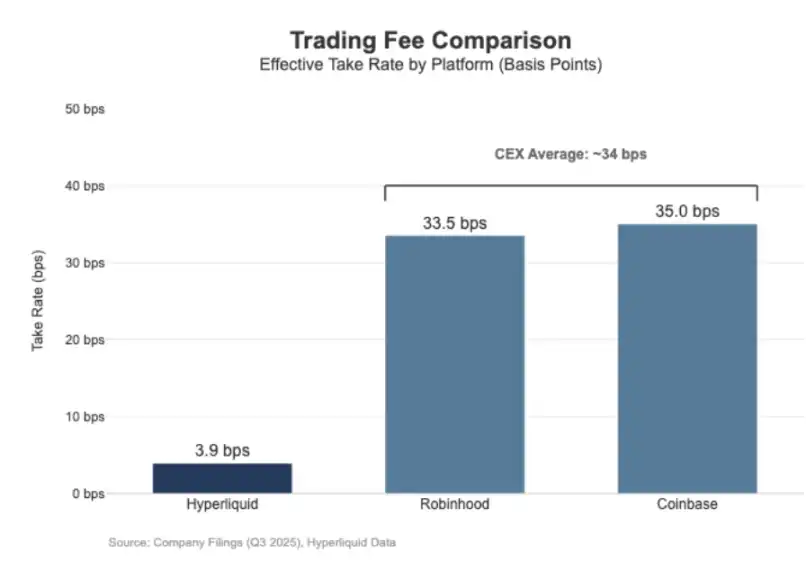
The gap is not only in fee rates—retail platforms have more diverse profit channels. In Q3 2025, Robinhood's transaction-related revenue was $730 million, in addition to $456 million in net interest income and $88 million in other revenue (primarily from Gold subscription services). In contrast, Hyperliquid still relies heavily on trading fees, and at the protocol level, its fee rate structurally remains in the single-digit basis points range.
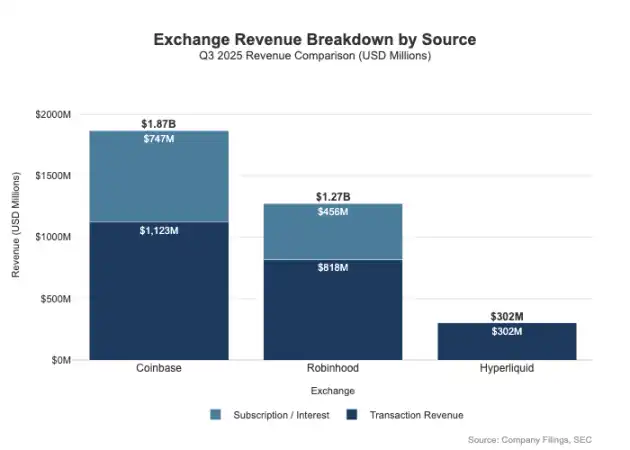
This difference is essentially due to "positioning": Coinbase and Robinhood are "broker/distribution businesses" that profit through balance sheets and subscription services; whereas Hyperliquid is closer to the "exchange level." In traditional market structures, profit pools are distributed across these two levels.

The Divide Between Broker-Dealer and Exchange Models

The core difference in traditional finance (TradFi) lies in the separation of the "distribution end" and the "market end." Retail platforms like Robinhood and Coinbase operate at the "distribution layer," occupying high-margin areas; exchanges like Nasdaq operate at the "market layer"—where pricing power is structurally constrained, and competition in trade execution tends toward a "commoditized economic model" (i.e., profit margins are significantly compressed).

1. Broker-Dealer = Distribution + Customer Balance Sheet

Broker-dealers control customer relationships. Most users do not interact directly with Nasdaq but access the market through brokers: brokers handle account opening, asset custody, margin/risk management, customer support, and tax documentation, then route orders to specific trading venues. This "customer relationship ownership" creates profit opportunities beyond trading:

  • Balance-related: cash sweep spreads, margin lending interest, securities lending income;
  • Service packaging: subscription services, bundled products, card services/advisory services;
  • Order routing economics: brokers control trading flow and can embed payment sharing or revenue-sharing mechanisms in the routing chain.

This is why brokers can profit more than trading venues: profit pools are concentrated in the "distribution end" and "balance end."

2. Exchange = Order Matching + Rule System + Infrastructure, Fee Rates Capped

Exchanges operate trading venues, with core functions including order matching, setting market rules, ensuring deterministic execution, and providing trading connectivity. Their profit sources include:

  • Trading fees (in highly liquid products, fees are continuously compressed due to competition);
  • Rebates/liquidity incentive programs (to attract liquidity, most public fees often need to be rebated to market makers);
  • Market data services, trading connectivity/server hosting services;
  • Listing services and index licensing fees.

Robinhood's order routing model clearly illustrates this architecture: the broker (Robinhood Securities) controls users and routes orders to third-party market centers, with revenue shared across the routing chain. The "distribution layer" is the high-margin环节—it controls user acquisition and develops diverse profit channels around trade execution (such as payment for order flow, financing business, securities lending, subscription services).
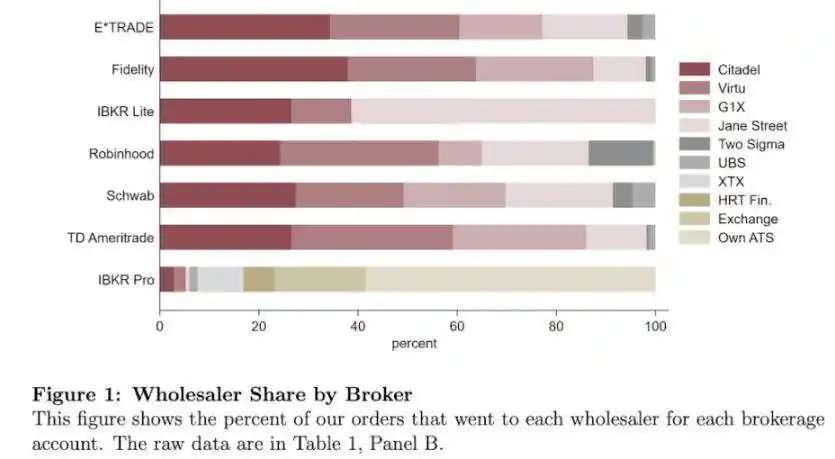
Nasdaq belongs to the "low-margin layer": its core products are "commoditized trade execution" and "order queue access rights," with pricing power mechanically constrained by three factors—the need to rebate fees to market makers to attract liquidity, regulatory caps on access fees, and high elasticity in order routing (users can easily switch to other platforms).

Nasdaq's disclosed data shows that the "implied net cash earnings" per share for its equity business are only at the $0.001 per share (i.e., one-tenth of a cent per share) level.
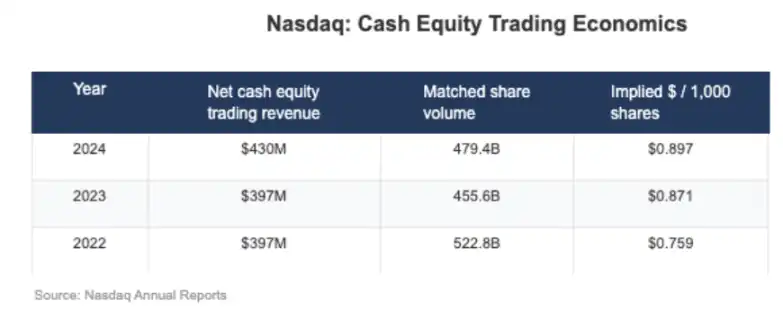
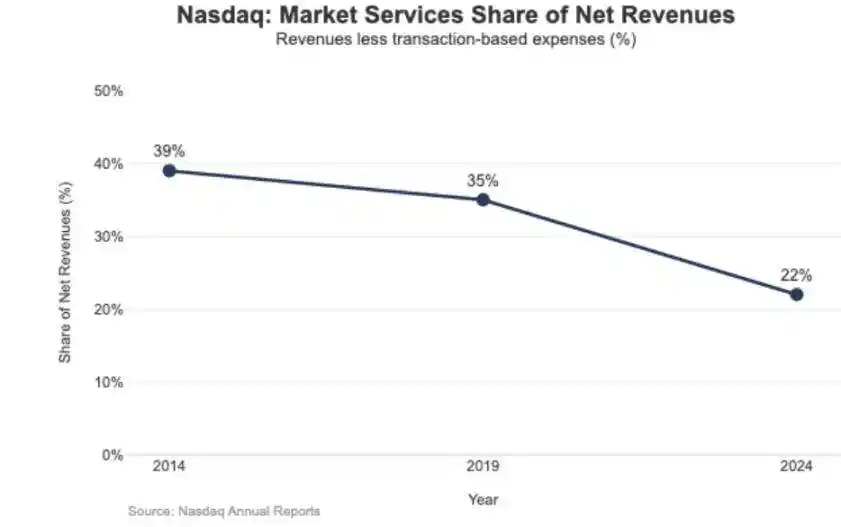
The strategic impact of low margins is also reflected in Nasdaq's revenue structure: in 2024, "Market Services" revenue was $1.02 billion, accounting for only 22% of total revenue of $4.649 billion; this proportion was 39.4% in 2014 and 35% in 2019—this trend indicates that Nasdaq is gradually shifting from "reliance on market trading execution business" to "more sustainable software/data business."

Hyperliquid Positioned at the "Market Layer"

Hyperliquid's actual fee rate of 4 basis points is consistent with its strategic choice to position itself at the "market layer." The platform is building an "on-chain Nasdaq": through high-throughput order matching, margin calculation, and clearing technology stack (HyperCore), adopting a "market maker/taker" pricing model and providing market maker rebates—its core optimization direction is "trade execution quality" and "liquidity sharing," not "retail user profitability."
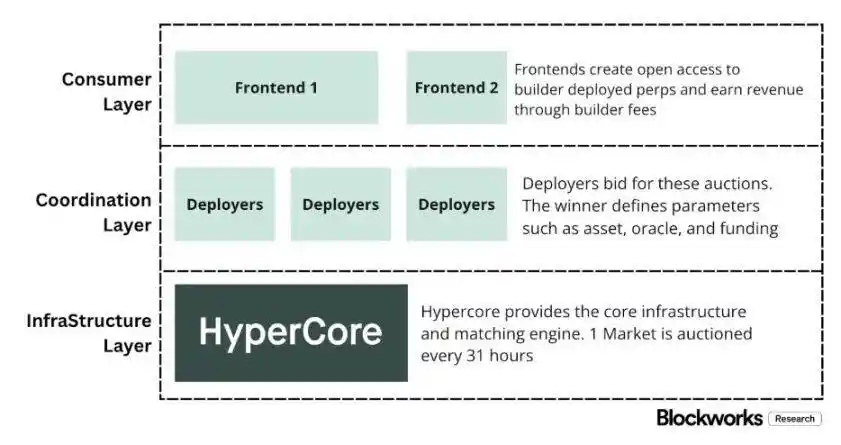
This positioning is reflected in two "TradFi-like" separation designs, which most cryptocurrency trading platforms have not adopted:

1. Permissionless Broker/Distribution Layer (Builder Codes)

"Builder Codes" allow third-party interfaces to connect to the core trading venue and set their own fee standards. Among them, the upper limit for third-party fees on perpetual contracts is 0.1% (10 basis points), 1% for spot, and fees can be set per order—this design creates a "distribution competition market," not a "single APP monopoly."

2. Permissionless Listing/Product Layer (HIP-3)

In traditional finance, exchanges control listing rights and product creation rights; HIP-3 "externalizes" this function: developers can deploy perpetual contracts based on the HyperCore technology stack and API, and independently define and operate trading markets. From an economic perspective, HIP-3 formally establishes a "revenue-sharing mechanism between the trading venue and the product party"—deployers of spot and HIP-3 perpetual contracts can receive 50% of the trading fees generated by the deployed assets.

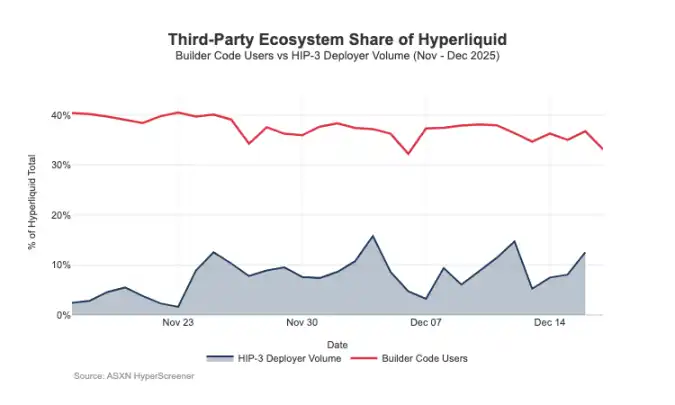
"Builder Codes" have already achieved results on the distribution end: as of mid-December, about 1/3 of users trade through third-party frontends, not the official interface.
However, this architecture also brings foreseeable pressure on the trading venue's fee revenue:

  1. Pricing compression: Multiple frontends share the same backend liquidity, and competition forces the "total cost" to the minimum; moreover, fees can be adjusted per order, further pushing pricing toward the bottom line;
  2. Loss of profit channels: Frontends control user account opening, service packaging, subscriptions, and trading processes, occupying the high-margin space of the "broker layer," while Hyperliquid only retains the low-margin income of the "trading venue layer";
  3. Strategic routing risk: If frontends develop into "cross-platform order routers," Hyperliquid will be forced into "wholesale execution competition"—needing to reduce fees or increase rebates to retain trading flow.

Through HIP-3 and Builder Codes, Hyperliquid has actively chosen a "low-margin market layer" positioning, while allowing a "high-margin broker layer" to form on top of it. If frontends continue to expand, they will gradually control "user-side pricing," "user retention channels," and "routing话语权," which will structurally pressure Hyperliquid's fee rates in the long run.

Defending Distribution Rights, Expanding Non-Exchange Profit Pools

The core risk Hyperliquid faces is the "commoditization trap": if third-party frontends can consistently attract users with prices lower than the official interface and eventually achieve "cross-platform routing," the platform will be forced to shift to a "wholesale execution economic model" (i.e., continuously narrowing profit margins).

Recent design adjustments indicate that Hyperliquid is trying to avoid this outcome while broadening its revenue sources beyond trading fees.

1. Distribution Defense: Maintaining the Economic Competitiveness of the Official Interface

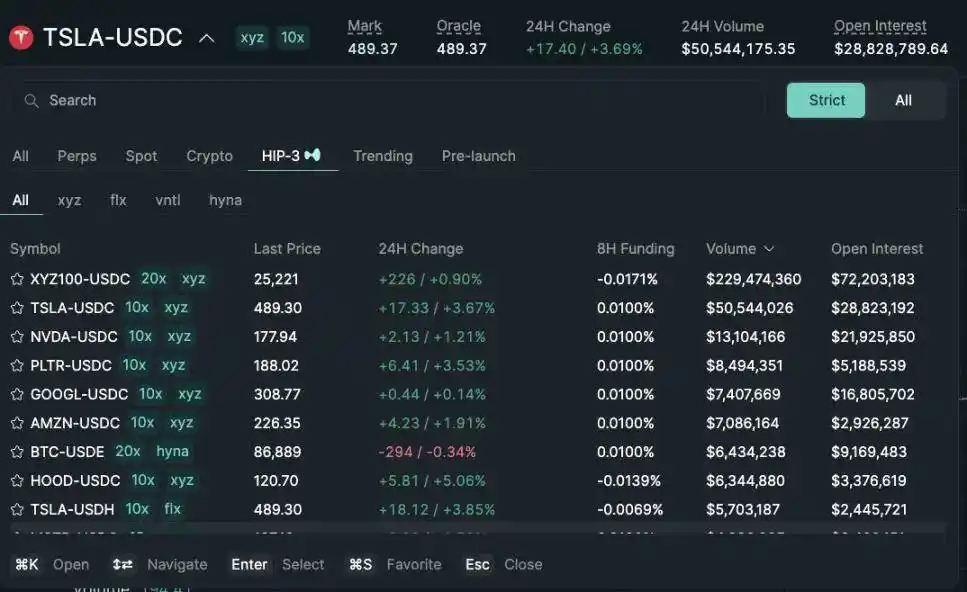
Previously, Hyperliquid proposed that "staking HYPE tokens could enjoy up to a 40% fee discount"—this design would have structurally allowed third-party frontends to be "cheaper than the official interface." After canceling the proposal, external distribution channels lost the direct subsidy for "pricing below the official interface." Meanwhile, HIP-3 markets were initially only available through "developer distribution" and were not displayed on the official frontend; currently, these markets have been included in the official frontend's "strict list." This series of actions sends a clear signal: Hyperliquid retains the permissionless nature at the "developer layer" but is unwilling to compromise on "core distribution rights."
2. Stablecoin USDH: Shifting from "Trading Profit" to "Fund Pool Profit"

The core purpose of launching USDH is to recapture the "stablecoin reserve收益" that was previously flowing out. According to the public mechanism, reserve收益 are allocated 50% to Hyperliquid and 50% to USDH ecosystem development. Additionally, the design of "USDH trading markets enjoying fee discounts" further strengthens this logic: Hyperliquid is willing to sacrifice "single-trade profit compression" in exchange for "larger-scale, more stable fund pool profit"—essentially adding a "quasi-annuity income stream" that can grow based on the "monetary base" (not just relying on trading volume).

3. Portfolio Margin: Introducing "Institutional Broker-Style Financing Economics"

The "portfolio margin" mechanism unifies the margin calculation for spot and perpetual contracts, allows risk exposure hedging, and introduces "native lending loops." Hyperliquid charges "10% of the borrower's interest"—this design gradually ties the protocol's economic model to "leverage usage" and "interest rates," closer to the profit logic of a "broker/institutional broker" rather than a pure exchange model.

Hyperliquid's Path Toward a Broker Economic Model

Hyperliquid's trading throughput has reached "mainstream trading venue levels," but its profit model remains at the "market layer": nominal trading volume is huge, but the actual fee rate is only in the single-digit basis points. The gap with Coinbase and Robinhood is structural: retail platforms are at the "broker layer," controlling user relationships and balances, achieving high margins through diverse profit pools like "financing, idle funds, subscriptions"; pure trading venues focus on "trade execution as the core product," and due to liquidity competition and routing elasticity, "trade execution" inevitably becomes commoditized, with profit margins continuously compressed—Nasdaq is a classic example of this constraint in traditional finance.

Hyperliquid initially deeply fit the "trading venue prototype": by separating "distribution (Builder Codes)" and "product creation (HIP-3)," it rapidly drove ecosystem expansion and market coverage. But the cost of this architecture is "economic benefit outflow": if third-party frontends control "comprehensive pricing" and "cross-platform routing rights," Hyperliquid will face the risk of "becoming a wholesale channel, clearing trading flow with low margins."

However, recent actions indicate that the platform is consciously shifting toward "defending distribution rights" and "broadening revenue structure" (no longer relying solely on trading fees). For example, no longer subsidizing "external frontend price competition," incorporating HIP-3 markets into the official frontend, and adding "balance sheet-style profit pools." The launch of USDH is a typical case of incorporating "reserve收益" into the ecosystem (including 50% sharing and fee discounts); portfolio margin introduces "financing economics" by "charging 10% of borrower interest."

Currently, Hyperliquid is gradually moving toward a "hybrid model": based on the "trade execution channel,"叠加 "distribution defense" and "fund pool-driven profit pools." This transformation both reduces the risk of "falling into the wholesale low-margin trap" and moves closer to a "broker-style revenue structure" without abandoning the core advantages of "unified execution and clearing."

Looking ahead to 2026, the core question Hyperliquid faces is: How to move toward a "broker-style economy" without breaking the "outsourcing-friendly model"? USDH is the most direct test case—its current supply is about $100 million, this scale indicates: if the platform does not control "distribution rights," the expansion speed of "outsourced issuance" will be very slow. A more obvious alternative would have been "official interface default settings," such as automatically converting the approximately $4 billion USDC base funds into the native stablecoin (similar to Binance's model of automatically converting USDC to BUSD).

If Hyperliquid wants to capture "broker-level profit pools," it must take "broker-style actions": strengthen control, deepen the integration of self-operated products and the official interface, and clarify boundaries with ecosystem teams (avoiding internal competition over "distribution rights" and "fund balances").


Trend Kriptolar

İlgili Sorular

QWhat is the core difference in profitability between Hyperliquid and retail platforms like Coinbase and Robinhood?

AThe core difference lies in their business model layers. Hyperliquid operates at the 'market layer' (exchange level) with a low-margin, commodity-like execution model, earning primarily from transaction fees at a low rate of ~3.9 bps. In contrast, Coinbase and Robinhood operate at the 'broker/distribution layer,' controlling customer relationships and generating high-margin revenue from diverse sources like net interest income, subscription services, and order flow payments, not just transaction fees.

QHow does Hyperliquid's Builder Codes feature contribute to a structural pressure on its fee income?

ABuilder Codes allow third-party frontends to access Hyperliquid's core exchange and set their own fees, creating a competitive distribution market. This competition drives the 'all-in cost' for users down to a minimum. Since these frontends control user onboarding, service packaging, and potentially cross-platform order routing, they capture the high-margin 'broker layer' profits. This leaves Hyperliquid with only the low-margin 'exchange layer' revenue, putting long-term structural pressure on its fee rates.

QWhat recent strategic adjustments has Hyperliquid made to defend its distribution rights and broaden its revenue streams?

AHyperliquid has made several adjustments: 1) It scrapped a proposal for staking-based fee discounts that would have allowed third-party frontends to be structurally cheaper than its official interface. 2) It integrated HIP-3 perpetual markets into its official frontend's 'strict list' to maintain control. 3) It launched the USDH stablecoin to capture a share (50%) of reserve yields, creating an annuity-like income stream. 4) It introduced portfolio margin feature, charging 10% of borrower interest, moving towards a broker-like financing economy.

QAccording to the article, what is the fundamental risk Hyperliquid faces known as the 'commoditization trap'?

AThe 'commoditization trap' is the risk that if third-party frontends can consistently attract users with lower prices than Hyperliquid's official interface and eventually develop into cross-platform order routers, Hyperliquid would be forced into a 'wholesale execution economic model.' In this scenario, it would have to compete solely on low fees and high rebates to retain trading flow, leading to perpetually compressed profit margins, much like traditional exchanges such as Nasdaq.

QHow does the USDH stablecoin represent a shift in Hyperliquid's economic model beyond transaction fees?

AUSDH represents a shift from pure 'transaction profitability' to 'balance sheet profitability.' The mechanism allocates 50% of the reserve yields from the stablecoin's collateral to the Hyperliquid protocol, creating a new, more stable revenue stream tied to the size of the monetary base (USDH supply) rather than being solely dependent on trading volume. Additionally, offering fee discounts for USDH trading pairs shows a willingness to compress per-trade profits to incentivize the growth of this new capital pool-based income.

İlgili Okumalar

Real-life 'Black Mirror' Pumpfun Go: 40 Yuan to Lick Toilets, 14,000 USD for a Logo Tattoo on the Forehead

The article discusses the controversial new platform "Pumpfun Go," a bounty task platform launched by the meme coin platform Pump.fun. Its slogan is "Pay anyone to do anything." The platform allows users to anonymously post tasks with cryptocurrency rewards, which are held in escrow until completion and verification. The piece highlights extreme and disturbing tasks that have gained notoriety, such as licking a gas station toilet floor for roughly $5.63, eating live insects, getting a company logo tattooed on one's forehead for $14,000, and even a now-removed $700,000 bounty for suicide. These tasks are often linked to promoting specific meme coins by generating shocking, attention-grabbing content. While some tasks involve community-building or charity, critics, including New York Governor Kathy Hochul, condemn the platform for exploiting economic desperation and encouraging humiliating or dangerous behavior. They argue it mirrors dystopian narratives from shows like "Black Mirror" and movies like "Nerve," where online dares escalate for viewers' entertainment. Supporters and some participants counter that the platform provides much-needed income opportunities for the financially struggling. One user claimed the bounty money far exceeded his monthly salary. The article concludes by questioning the morality of a system where the wealthy pay for spectacle and the poor trade dignity for survival, reflecting a long history of public consumption of others' suffering. It suggests hope may lie in future technological abundance freeing people from such desperate choices.

marsbit5 dk önce

Real-life 'Black Mirror' Pumpfun Go: 40 Yuan to Lick Toilets, 14,000 USD for a Logo Tattoo on the Forehead

marsbit5 dk önce

Faked Trades, Clone Websites, 1105 Videos: Polymarket Under CFTC Scrutiny

The U.S. Commodity Futures Trading Commission (CFTC) has launched a wide-ranging investigation into prediction market platform Polymarket. The probe, triggered by a Wall Street Journal report, focuses on allegations of systematic marketing fraud. The report revealed Polymarket allegedly hired dozens of student content creators to post over 1,100 videos showing fake, profitable trades on cloned websites, without disclosing the paid relationships. These videos, with over 140 million views, were pivotal to user growth. Simultaneously, the National Association of Consumer Advocates (NACA) filed a lawsuit in Washington D.C., accusing Polymarket and its executives of deceptive advertising targeting college students. The suit details off-campus promotions and payments made through the CMO's personal PayPal account to influencers who failed to disclose sponsorships. The investigation places CFTC Chairman Michael Selig in a difficult position, as he has been a vocal advocate for prediction markets and is currently suing multiple states to assert federal jurisdiction over them. This case tests the CFTC's dual role as both promoter and enforcer. This marks Polymarket's second major clash with the CFTC. After a 2022 settlement and U.S. ban, it regained approval to operate in September 2025, secured a $20 billion investment, and saw its valuation soar. The current crisis, compounded by a recent $3.1 million front-end supply chain attack, represents the platform's most severe multi-front challenge since its founding.

Foresight News6 dk önce

Faked Trades, Clone Websites, 1105 Videos: Polymarket Under CFTC Scrutiny

Foresight News6 dk önce

Real-Life 'Black Mirror' Pumpfun Go: 40 Yuan to Lick a Toilet, $14,000 to Tattoo a Logo on Your Forehead

Pumpfun Go, a bounty task platform launched by the meme coin platform Pump.fun, is facing intense controversy. The platform's slogan "Pay anyone to do anything" has manifested in real-world tasks where participants perform increasingly extreme or demeaning acts for cryptocurrency rewards. These tasks range from licking a gas station toilet floor for roughly $5.63 to getting a permanent "bounty.fun" logo tattooed on one's forehead for $14,000. Other completed challenges include eating live insects and quitting a job on camera. The highest-value active bounty offers approximately $560,000 for climbing Mount Everest and placing a bet on a specified platform. While some tasks involve promoting meme coins or community events, the platform has drawn widespread criticism for incentivizing the exploitation of economic desperation. Participants, often citing "we need money" as their motivation, complete these tasks for sums that can far exceed their regular income. Critics, including New York Governor Kathy Hochul, have condemned Pumpfun Go as a dystopian system that commodifies human dignity and preys on the vulnerable. Supporters argue it provides a novel income opportunity for those in need. The debate highlights deeper societal issues around power, inequality, and the historical human fascination with spectacles of humiliation. The platform's existence raises questions about the ethical limits of anonymous online markets and the persistent reality where financial need forces individuals to trade their dignity for survival.

Odaily星球日报13 dk önce

Real-Life 'Black Mirror' Pumpfun Go: 40 Yuan to Lick a Toilet, $14,000 to Tattoo a Logo on Your Forehead

Odaily星球日报13 dk önce

İşlemler

Spot

Popüler Makaleler

NASDAQ100 Nasıl Satın Alınır

HTX.com’a hoş geldiniz! Nasdaq-100 Index (NASDAQ100) satın alma işlemlerini basit ve kullanışlı bir hâle getirdik. Adım adım açıkladığımız rehberimizi takip ederek kripto yolculuğunuza başlayın. 1. Adım: HTX Hesabınızı OluşturunHTX'te ücretsiz bir hesap açmak için e-posta adresinizi veya telefon numaranızı kullanın. Sorunsuzca kaydolun ve tüm özelliklerin kilidini açın. Hesabımı Aç2. Adım: Kripto Satın Al Bölümüne Gidin ve Ödeme Yönteminizi SeçinKredi/Banka Kartı: Visa veya Mastercard'ınızı kullanarak anında Nasdaq-100 Index (NASDAQ100) satın alın.Bakiye: Sorunsuz bir şekilde işlem yapmak için HTX hesap bakiyenizdeki fonları kullanın.Üçüncü Taraflar: Kullanımı kolaylaştırmak için Google Pay ve Apple Pay gibi popüler ödeme yöntemlerini ekledik.P2P: HTX'teki diğer kullanıcılarla doğrudan işlem yapın.Borsa Dışı (OTC): Yatırımcılar için kişiye özel hizmetler ve rekabetçi döviz kurları sunuyoruz.3. Adım: Nasdaq-100 Index (NASDAQ100) Varlıklarınızı SaklayınNasdaq-100 Index (NASDAQ100) satın aldıktan sonra HTX hesabınızda saklayın. Alternatif olarak, blok zinciri transferi yoluyla başka bir yere gönderebilir veya diğer kripto para birimlerini takas etmek için kullanabilirsiniz.4. Adım: Nasdaq-100 Index (NASDAQ100) Varlıklarınızla İşlem YapınHTX'in spot piyasasında Nasdaq-100 Index (NASDAQ100) ile kolayca işlemler yapın.Hesabınıza erişin, işlem çiftinizi seçin, işlemlerinizi gerçekleştirin ve gerçek zamanlı olarak izleyin. Hem yeni başlayanlar hem de deneyimli yatırımcılar için kullanıcı dostu bir deneyim sunuyoruz.

36 Toplam GörüntülenmeYayınlanma 2026.06.18Güncellenme 2026.06.18

NASDAQ100 Nasıl Satın Alınır

RE Nedir

I. Proje Tanıtımı1. Re Protokolü Nedir?Re Protokolü, stabilcoin sermayesini düzenlenmiş gerçek dünya reasürans pazarlarına bağlayan merkeziyetsiz bir reasürans protokolüdür. Kullanıcılar, Sigorta Sermaye Katmanı (ICL) akıllı sözleşmesine stabilcoin yatırır. Yatırılan fonlar, tamamen teminatlandırılmış reasürans sözleşmelerini desteklemek için kullanılır ve yatıranlar karşılığında ödüller kazanır. Getiri, hem zincir içi hem de zincir dışı kaynaklardan ve ayrıca token'a özel farklardan elde edilir. Protokol, Ethereum, Avalanche ve Arbitrum dahil olmak üzere birden fazla zincirde çalışmaktadır.2. Re Protokolü Nasıl Çalışır?Kullanıcılar, ICL akıllı sözleşmelerine onaylı varlıklar (örneğin USDC, USDe, sUSDe) yatırarak iki getiri getiren token'dan birini basarlar. Fonlar günlük olarak Fireblocks saklama kasasına toplanır, çoklu imza kontrolü altında tutulur ve bakiyeler günlük olarak Chainlink oracle'larına yayınlanır. Lisanslı reasürans şirketleri, bir Fazla Notası uyarınca fon çektiğinde, sermayenin bir kısmı ABD merkezli §114 reasürans güven hesaplarına aktarılır ve bu, reasürans şirketinin poliçeleri için uyumlu teminat olarak hizmet eder. Reasürans sözleşmeleri olgunlaştıkça ve aktüeryal ekip sermaye serbest bıraktıkça, likidite protokole geri akar, reUSD geri ödemelerini destekler ve her iki token için getiri birikir.Protokol, sermaye yapısındaki farklı dilimlere karşılık gelen iki token sunmaktadır:reUSD (Basis-Plus, Kıdemli Dilim): Getiri, bir karışık oran (SOFR ve 7 günlük sUSDe oranının ağırlıklı ortalaması) artı 250 baz puan farktır. Daha yüksek likidite sunar ve kapasite mevcut olduğunda anlık geri ödemeyi destekler.reUSDe (Sigorta Alfa, Genç Dilim): Getiri, aynı karışık oran artı 850 baz puan farktır ve kıdemli dilimden önce kayıpları absorbe etme karşılığında sunulur. Geri ödemeler üç aylıktır. reUSDe'nin en az 40 gün minimum tutma süresi vardır.Sermaye Koruma Katmanları: Reasürans şirketinin kendi öz sermayesi önce kayıpları absorbe eder, ardından reUSDe gelir, reUSD ise altındaki iki katman tarafından korunan en kıdemli dilimdir.3. Re Protokolünü Kim Kurdu?Karn Saroya, Kurucu Ortak ve CEO, MIT'den mezun olmuştur. Daha önce, girişim destekli sigorta teknolojisi platformu Cover'ı (lisanslı bir aracılık, daha sonra faaliyetlerini durdurdu) kurmuş ve daha önce moda uygulaması Stylekick'i (2015'te Shopify tarafından satın alındı) kurmuştur. Ayrıca daha önce finansal hizmetler danışmanlığı alanında çalışmıştır.Finansman Detayları:Eylül 2022: Re, Tribe Capital tarafından yönetilen 14 milyon dolarlık bir Seed turunu tamamladı (Tribe Crypto Labs aracılığıyla kuluçkaya alınmıştır) ve Framework Ventures, Morgan Creek Digital, Defy VC, Stratos, Exor, SiriusPoint ve diğerlerinin katılımıyla gerçekleşmiştir.Mayıs 2024: Electric Capital tarafından yönetilen 7 milyon dolarlık bir finansman turunu tamamladı.4. Re Protokolü TokenomisiRE, Re Protokolü'nün yönetim token'ıdır ve toplamda 1 milyar token ile sabit bir arzı vardır, enflasyonist bir mekanizma yoktur ve sürekli bir basım planı yoktur. Token, piyasa erişimi, teşvik bütçeleri, staking ve delege etme, komiteler, protokol yükseltmeleri ve paylaşılan dayanıklılık sermayesini kapsayan stake-to-vote modeli aracılığıyla yönetişim için kullanılır.Token dağılımı:Ekosistem (yüzde 50): Staking ödülleri, yönetişim katılımı, likidite, entegrasyonlar, hibe, piyasa genişlemesi ve ekosistem büyümesi için kullanılır. TGE'de 159.6 milyon token dolaşımda olup, geri kalanı 48 ay boyunca lineer olarak vestinge tabi olacaktır.Temel Katkıda Bulunanlar (yüzde 20): Protokolü, yönetişim sistemlerini, entegrasyonları, risk çerçevelerini ve piyasa altyapısını inşa eden temel katkıda bulunanlar ve danışmanları içerir; 12 aylık bir cliff ve ardından 36 aylık lineer vesting uygulanır.Yatırımcılar (yüzde 17): Stratejik destekçiler; 12 aylık bir cliff ve ardından 36 aylık lineer vesting uygulanır.Ekosistem Geliştirme Rezervi (yüzde 13): Gelecek katkılar ve katkıda bulunanlar için uzun vadeli rezerv.5. Anahtar Dönüm Noktalarının Zaman ÇizelgesiEylül 2022: Re, 14 milyon dolarlık bir Seed turunu tamamladı, halka açıldı ve ilk blockchain destekli reasürans protokolü olarak kendini konumlandırdı, başlangıçta Avalanche üzerinde inşa edildi.Mayıs 2024: Electric Capital tarafından yönetilen 7 milyon dolarlık bir finansman turunu tamamladı.18 Haziran 2026: $RE token resmi olarak piyasaya sürüldü.​II. Token BilgisiToken adı: RE(Re)III. İlgili BağlantılarWeb sitesi: https://re.xyz/Keşif Araçları: https://etherscan.io/token/0x526526528f35ac738177003b8773b402b8df8143Twitter: https://twitter.com/reNot: Proje tanıtımı, resmi proje ekibi tarafından yayımlanan veya sağlanan materyallerden alınmıştır, yalnızca referans amaçlıdır ve yatırım tavsiyesi niteliğinde değildir. HTX, doğrudan veya dolaylı olarak ortaya çıkan herhangi bir kayıptan sorumluluk kabul etmez.

251 Toplam GörüntülenmeYayınlanma 2026.06.18Güncellenme 2026.06.29

RE Nedir

RE Nasıl Satın Alınır

HTX.com’a hoş geldiniz! Re (RE) satın alma işlemlerini basit ve kullanışlı bir hâle getirdik. Adım adım açıkladığımız rehberimizi takip ederek kripto yolculuğunuza başlayın. 1. Adım: HTX Hesabınızı OluşturunHTX'te ücretsiz bir hesap açmak için e-posta adresinizi veya telefon numaranızı kullanın. Sorunsuzca kaydolun ve tüm özelliklerin kilidini açın. Hesabımı Aç2. Adım: Kripto Satın Al Bölümüne Gidin ve Ödeme Yönteminizi SeçinKredi/Banka Kartı: Visa veya Mastercard'ınızı kullanarak anında Re (RE) satın alın.Bakiye: Sorunsuz bir şekilde işlem yapmak için HTX hesap bakiyenizdeki fonları kullanın.Üçüncü Taraflar: Kullanımı kolaylaştırmak için Google Pay ve Apple Pay gibi popüler ödeme yöntemlerini ekledik.P2P: HTX'teki diğer kullanıcılarla doğrudan işlem yapın.Borsa Dışı (OTC): Yatırımcılar için kişiye özel hizmetler ve rekabetçi döviz kurları sunuyoruz.3. Adım: Re (RE) Varlıklarınızı SaklayınRe (RE) satın aldıktan sonra HTX hesabınızda saklayın. Alternatif olarak, blok zinciri transferi yoluyla başka bir yere gönderebilir veya diğer kripto para birimlerini takas etmek için kullanabilirsiniz.4. Adım: Re (RE) Varlıklarınızla İşlem YapınHTX'in spot piyasasında Re (RE) ile kolayca işlemler yapın.Hesabınıza erişin, işlem çiftinizi seçin, işlemlerinizi gerçekleştirin ve gerçek zamanlı olarak izleyin. Hem yeni başlayanlar hem de deneyimli yatırımcılar için kullanıcı dostu bir deneyim sunuyoruz.

84 Toplam GörüntülenmeYayınlanma 2026.06.18Güncellenme 2026.06.29

RE Nasıl Satın Alınır

Tartışmalar

HTX Topluluğuna hoş geldiniz. Burada, en son platform gelişmeleri hakkında bilgi sahibi olabilir ve profesyonel piyasa görüşlerine erişebilirsiniz. Kullanıcıların A (A) fiyatı hakkındaki görüşleri aşağıda sunulmaktadır.

活动图片