Hurun Report Interview with Justin Sun: New Paradigms of Value Circulation under the Web3 Transformation Cycle

marsbit2026-05-29 tarihinde yayınlandı2026-05-29 tarihinde güncellendi

Özet

In a deep-dive interview with *Hurun Report*, Justin Sun, founder of TRON, outlines his vision for Web3's evolution from proof-of-concept to global adoption, emphasizing stablecoins as the cornerstone for building a new paradigm of value transfer. Sun defines the core mission as enabling low-cost, efficient global fund movement for anyone, anywhere, regardless of bank access. He argues that sustainable blockchain projects must be driven by genuine demand and usage, with stablecoin payments currently representing the most mature and scalable application. Citing TRON's position as a leading stablecoin network with over $86.3 billion in USDT circulation, he attributes this growth to real-world use in cross-border transfers, savings, and payments, viewing it as a "natural replacement" for traditional financial infrastructure's inefficiencies. On strategy, Sun advocates for a methodology combining data-driven iteration, rapid execution, and user-centricity. He highlights the pivotal decision to partner with Tether on TRC-20 USDT as a calculated move that capitalized on stablecoins' long-term trend and network effects. While Web3 is inherently global, Sun stresses the critical importance of local compliance and cultural adaptation for successful market entry. Looking ahead, Sun identifies the convergence of AI and blockchain as a key frontier. He sees AI as fundamentally reshaping thinking and decision-making, with blockchain providing decentralized infrastructure for AI, while ...

Against the backdrop of the Web3 industry entering deep waters and the accelerated restructuring of global financial infrastructure, blockchain is transitioning from early exploration to large-scale application. As an authoritative institution with extensive influence in the business and investment fields, an in-depth interview by the renowned magazine Hurun Report is regarded as a significant industry bellwether. Recently, in an exclusive interview with Hurun Report, Justin Sun, founder of TRON, systematically elaborated his judgments on industry evolution and long-term value around core issues such as stablecoin payments, globalization paths, and the AI integration trend. His perspectives also reflect the crucial phase where Web3 infrastructure is moving from "feasibility validation" to "global adoption."
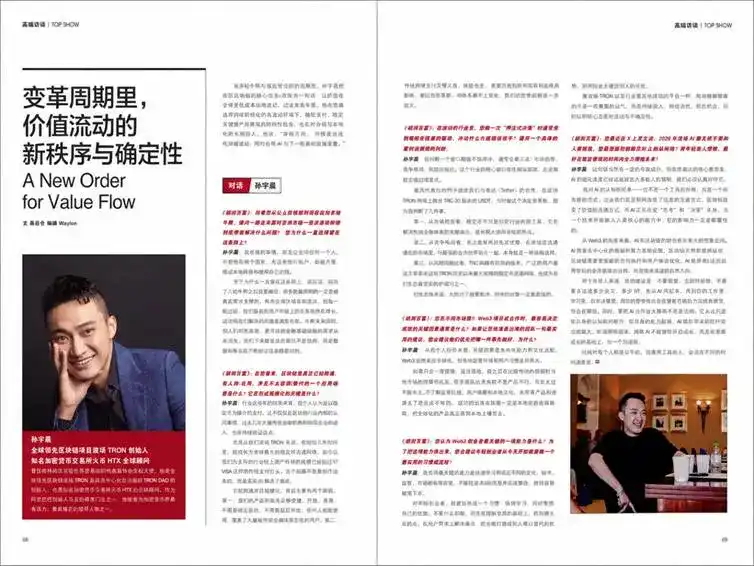
Stablecoins Build a Global Value Circulation Network, Web3 Infrastructure Enters Scaling Phase

In the Hurun Report interview, Justin Sun succinctly summarized his long-term core objective: "To enable anyone in the world, regardless of location or bank account access, to transfer and use their funds with low cost and high efficiency." This statement fundamentally reveals the value essence of blockchain technology — building an open and inclusive Internet of Value.

He further pointed out that after experiencing multiple bull and bear cycles, projects capable of enduring cycles must be built on real demand and practical usage. The sustained growth in on-chain user scale and transaction volume is an important basis for his judgment on industry direction. Against this backdrop, the on-chain payment system with stablecoins at its core has become the most mature and scalable application scenario.

In the Hurun Report interview, Justin Sun mentioned that TRON has rapidly developed into one of the world's largest stablecoin circulation networks, with its on-chain asset transfer volume even surpassing that of some traditional payment networks. This growth is not driven by short-term market sentiment but by continuous usage from real users in scenarios like cross-border transfers, value storage, and daily payments. Official data shows that the circulating supply of USDT on the TRON network currently exceeds $86.3 billion, reflecting robust network effects driven by genuine user demand.

In terms of structural advantages, the scalability of stablecoin payments benefits from two factors: on one hand, blockchain networks possess openness and permissionless characteristics, enabling them to reach user groups inaccessible to traditional financial systems; on the other hand, limitations in efficiency, cost, and user experience within traditional cross-border payment systems provide significant substitution space for new-generation infrastructure. Sun believes this trend is essentially a "natural substitution" of existing financial systems by technological advancement, rather than short-term competition.

Globalization Strategy and Technological Integration Advance in Tandem, Building Long-Term Competitive Advantage for Web3

When discussing enterprise growth and strategic decision-making, Sun presented a highly systematic methodology in the Hurun Report interview. He summarized the success factors as the combination of "data-driven iteration, rapid execution, and user-centric orientation," emphasizing that in a rapidly changing technological environment, single-dimensional capabilities can hardly sustain long-term competitiveness; instead, efficient trial-and-error and precise decision-making must be achieved through the synergy of these three.

At the organizational level, he proposed a management framework of "clear direction, layered support, and a sense of ownership among all members" to prevent deviation and loss of control during rapid expansion. This organizational structure emphasizing flatness and agility is seen as an important foundation for Web3 enterprises to maintain competitiveness in a highly uncertain environment.

Regarding specific key strategic decisions, Sun reflected on the case of TRON's collaboration with Tether to launch TRC-20 USDT in the Hurun Report interview. He stated that this decision was based on a comprehensive judgment of market trends, competitive landscape, and risk-reward ratio: stablecoins represent a long-term trend in financial system evolution, leading assets exhibit significant network effects, and the upside potential in this field far outweighs potential risks. This partnership has proven to be a major growth engine for the TRON ecosystem and has constructed its core competitive moat in the stablecoin domain.

Regarding global expansion, Sun emphasized that while Web3 has inherent cross-border attributes, its actual implementation still heavily depends on local compliance and cultural adaptation. In the Hurun Report interview, he noted that different markets have significant differences in regulatory frameworks, user habits, and business environments, and a project's success often hinges on the depth of understanding these differences and the ability to build local partnership networks.

Furthermore, Sun expressed clear judgment regarding AI technology development. He stated in the interview that AI is not merely a tool upgrade but a reconstruction of "thinking and decision-making capabilities." Its integration with blockchain in areas like data, computing power, and intelligent execution will be an important direction for the next phase of technological evolution. Blockchain provides decentralized infrastructure for AI, while AI enhances the intelligence and user experience of blockchain systems; the fusion of the two possesses long-term strategic value.

Addressing industry participants and young entrepreneurs, the core advice Sun offered in the Hurun Report interview is: in a highly uncertain environment, continuous learning and rapid adaptation are the most crucial capabilities. Simultaneously, one should focus investments and build irreplaceable core strengths based on an understanding of the industry's overall picture, rather than dispersing resources across multiple tracks.

Transitioning from early-stage technical validation and market exploration, to the large-scale application phase represented by stablecoins, and extending towards AI integration and global compliant implementation. In this process, TRON is continuously advancing the realization and evolution of the Internet of Value through infrastructure capabilities, globalization strategy, and technological foresight.


İlgili Okumalar

Bitwise: Crypto Becomes a Contrarian Investment, Three Logics to Understand the Current Market

**Summary** Matt Hougan, Bitwise's CIO, analyzes the current crypto market through three key lenses, arguing it has shifted from a momentum-driven to a contrarian investment. **1) Crypto Becomes a Contrarian Play:** The market is weak, with major assets like Bitcoin and Ethereum down significantly. Capital has moved to hot sectors like AI, leaving crypto as an "unloved" asset class. This transforms crypto investing from trend-following to a test of patience and fundamental analysis. Investors now favor projects with solid fundamentals (e.g., Hyperliquid) over speculative ones. **2) Regulatory Overhang:** The uncertain fate of the U.S. CLARITY Act, a major crypto regulatory framework, is a key headwind. With its passage in 2024 seen as far from guaranteed (estimates range from 30-55%), institutional capital remains on the sidelines, choosing less risky alternatives like AI stocks. The market needs clarity—whether the bill passes or fails—more than any specific outcome to move decisively. **3) Capital Rotates to New Fundamentals:** This cycle differs from past bear markets where money fled to Bitcoin. Now, capital seeks smaller assets with strong use cases. While major cryptos fell in May 2024, tokens like Hyperliquid (+72%), Zcash (+50%), and XLM (+44%) rallied on their specific fundamentals. This rotation confirms the new contrarian, fundamentals-driven logic and signals the bear market may be in its later stages. **Conclusion:** Short-term pressure persists due to regulatory uncertainty and competition from AI narratives. Investing in crypto now requires a contrarian mindset—acting against the crowd and focusing on fundamental value. Patience and targeting high-quality projects based on their merits are essential for capturing long-term gains.

marsbit18 dk önce

Bitwise: Crypto Becomes a Contrarian Investment, Three Logics to Understand the Current Market

marsbit18 dk önce

ChatGPT Might Be Disappearing Soon

OpenAI announced at its "Intelligence at Work" event that its coding assistant, Codex, will be fully integrated into the ChatGPT app within weeks. This move marks a strategic shift from a conversational AI (Chat) towards a unified "agentic" platform capable of execution. Codex, originally launched to compete with Anthropic's Claude Code, has grown rapidly to 5 million weekly active users, with 20% being non-developers like analysts and designers. Its enterprise revenue now constitutes 40% of OpenAI's total. The integration is the first step in creating a super-app combining ChatGPT (interface), Codex (execution engine), and the Atlas browser (web access). OpenAI also unveiled new Codex features: specialized Agent plugins for six professional roles, an "Annotations" tool for direct document editing, and a "Sites" function to turn work into shareable web apps. Internally, this reflects a power shift; the Codex team now leads core product strategy. While the ChatGPT brand remains for its vast user base, the platform's future is focused on autonomous agents that perform tasks, not just chat. The article notes that competition with Claude Code pushed OpenAI's development, with Codex competing on cost-effectiveness and accessibility rather than raw coding quality. It concludes that the essence of "ChatGPT" is evolving from a chatbot into an AI agent platform, with the name potentially becoming a legacy symbol of its original function.

marsbit28 dk önce

ChatGPT Might Be Disappearing Soon

marsbit28 dk önce

WWDC26 Ultimate Preview: The All-New Siri is the Main Course, iOS 27 is Another Year of Refinements

Apple has confirmed WWDC26 will begin on June 8, with the keynote at 10 AM PT (1 AM Beijing Time, June 9). This year's focus is expected to shift significantly from routine OS updates to Apple's progress in AI, particularly a major overhaul of Siri. Reports indicate the highlight will be a new Siri, reportedly powered by Google's Gemini technology. This upgraded assistant is expected to appear as a lightweight bubble from the Dynamic Island and be accessible via a unified "Search or Ask" system-wide entry point. It aims to deeply integrate with iOS 27, iPadOS 27, and macOS 27, accessing personal data like messages, photos, and documents, with a potential standalone Siri app also in development. For iOS 27, leaks suggest incremental improvements rather than major redesigns. Key updates may include a redesigned, more customizable Camera app, enhanced photo editing tools within the Photos app, and potential early system optimizations for a future foldable iPhone. The update is also rumored to prioritize bug fixes, stability, and performance optimization. iPadOS 27 is anticipated to focus on improving productivity features like window management, file systems, and external display support to better utilize the iPad's hardware. macOS 27 is seen as a core platform for Apple Intelligence, likely receiving an optimized Siri, new AI features, and continued refinement of the "Liquid Glass" design language. Notably, macOS 27 may finally drop support for Intel-based Macs. The overarching theme for WWDC26 is whether Apple can effectively integrate AI across its ecosystem. The success of the new Siri and Apple Intelligence will be judged on their ability to move beyond standalone features and become a cohesive, context-aware system layer that understands user workflows across iPhone, iPad, Mac, and other devices, while maintaining Apple's emphasis on privacy and stability. The conference represents Apple's critical attempt to catch up and redefine the AI assistant experience after a perceived slow start in the generative AI era.

marsbit53 dk önce

WWDC26 Ultimate Preview: The All-New Siri is the Main Course, iOS 27 is Another Year of Refinements

marsbit53 dk önce

İşlemler

Spot
Futures

Popüler Makaleler

SUN Nasıl Satın Alınır

HTX.com’a hoş geldiniz! SUN (SUN) satın alma işlemlerini basit ve kullanışlı bir hâle getirdik. Adım adım açıkladığımız rehberimizi takip ederek kripto yolculuğunuza başlayın. 1. Adım: HTX Hesabınızı OluşturunHTX'te ücretsiz bir hesap açmak için e-posta adresinizi veya telefon numaranızı kullanın. Sorunsuzca kaydolun ve tüm özelliklerin kilidini açın. Hesabımı Aç2. Adım: Kripto Satın Al Bölümüne Gidin ve Ödeme Yönteminizi SeçinKredi/Banka Kartı: Visa veya Mastercard'ınızı kullanarak anında SUN (SUN) satın alın.Bakiye: Sorunsuz bir şekilde işlem yapmak için HTX hesap bakiyenizdeki fonları kullanın.Üçüncü Taraflar: Kullanımı kolaylaştırmak için Google Pay ve Apple Pay gibi popüler ödeme yöntemlerini ekledik.P2P: HTX'teki diğer kullanıcılarla doğrudan işlem yapın.Borsa Dışı (OTC): Yatırımcılar için kişiye özel hizmetler ve rekabetçi döviz kurları sunuyoruz.3. Adım: SUN (SUN) Varlıklarınızı SaklayınSUN (SUN) satın aldıktan sonra HTX hesabınızda saklayın. Alternatif olarak, blok zinciri transferi yoluyla başka bir yere gönderebilir veya diğer kripto para birimlerini takas etmek için kullanabilirsiniz.4. Adım: SUN (SUN) Varlıklarınızla İşlem YapınHTX'in spot piyasasında SUN (SUN) ile kolayca işlemler yapın.Hesabınıza erişin, işlem çiftinizi seçin, işlemlerinizi gerçekleştirin ve gerçek zamanlı olarak izleyin. Hem yeni başlayanlar hem de deneyimli yatırımcılar için kullanıcı dostu bir deneyim sunuyoruz.

626 Toplam GörüntülenmeYayınlanma 2024.12.12Güncellenme 2025.03.21

SUN Nasıl Satın Alınır

Tartışmalar

HTX Topluluğuna hoş geldiniz. Burada, en son platform gelişmeleri hakkında bilgi sahibi olabilir ve profesyonel piyasa görüşlerine erişebilirsiniz. Kullanıcıların SUN (SUN) fiyatı hakkındaki görüşleri aşağıda sunulmaktadır.

活动图片












