HSBC, Standard Chartered To Receive First Stablecoin Licenses In Hong Kong – Report

bitcoinist2026-03-14 tarihinde yayınlandı2026-03-14 tarihinde güncellendi

Özet

Hong Kong is expected to issue its first stablecoin licenses within two weeks, with HSBC and Standard Chartered reportedly among the first recipients. The Hong Kong Monetary Authority (HKMA) is prioritizing institutions already authorized to issue banknotes, favoring them for their strong capital base and ability to ensure safety and adoption. The Stablecoins Ordinance, enacted last August, requires any issuer of fiat-referenced stablecoins, especially HKD-denominated tokens, to obtain a license. Standard Chartered, in a joint venture with Animoca Brands and HKT, plans to issue an HKD-pegged stablecoin and has participated in the HKMA’s sandbox program. HSBC, though not part of the sandbox, has engaged with digital asset players and focused on tokenization projects. The move comes as China tightens restrictions on virtual assets and tokenization domestically, positioning Hong Kong as a regulated testing ground for financial innovation and a gateway for Chinese assets on the blockchain.

Hong Kong is expected to grant the first batch of stablecoin issuer licenses within two weeks, reportedly choosing HSBC and Standard Chartered as the first companies to obtain the long-awaited approval.

HSBC, Standard Chartered Lead Hong Kong’s Stablecoin Race

On Friday, Bloomberg reported that HSBC, Hong Kong’s largest bank by assets, and a joint venture led by Standard Chartered are set to be among the first companies to receive the Hong Kong Monetary Authority’s (HKMA) stablecoin licenses this month.

Authorities are reportedly prioritizing institutions already authorized to issue banknotes and will approve the two banks in the first batch, according to people familiar with the matter. Notably, the HKMA favors bank-led stablecoin issuers due to their robust capital base and ability to ensure greater safety while facilitating wider adoption, the sources affirmed.

Last month, the financial authority’s Chief Executive, Eddie Yue, announced it would grant the first, limited batch of stablecoin provider licenses in March as the review of 36 applications was nearly completed.

The HKMA enacted the Stablecoins Ordinance last August, which directs any individual or entity seeking to issue any fiat-referenced stablecoin (FRS) in Hong Kong, or any Hong Kong Dollar (HKD)-denominated token, to obtain a license from the financial regulator.

The number of licenses and the timetable had not yet been finalized and were subject to change. However, sources suggested March 24 as a possible date, as revealed by the South China Morning Post (SCMP), which first broke the news.

Industry sources suggested that Hong Kong’s licensing regime will initially prioritize the local currency. Standard Chartered has already announced plans to issue a Hong Kong dollar-pegged token.

The London-based bank, alongside Animoca Brands and Hong Kong Telecommunications (HKT), formed a joint venture last year to apply for a license to issue a HKD-denominated stablecoin.

Since 2024, the trio has been part of the financial authority’s stablecoin issuer sandbox program, which enabled limited-scale tests of these tokens across various scenarios, including e-commerce payments, cross-border trade settlements, and tokenized asset trading.

RD Technologies, a Hong Kong-based fintech firm founded by former HKMA CEO Norman Chan Tak-lam, and JD Coinlink, the fintech arm of Chinese e-commerce giant JD.com, also started testing HKD-pegged tokens under the regulator’s sandbox program last year.

Meanwhile, HSBC’s potential approval has reportedly surprised the industry, given the bank’s absence from the HKMA-led sandbox. HSBC has focused on tokenization projects, including tokenized deposits.

However, the bank had reportedly been actively engaged with local and global players in the digital-asset space and is committed to playing a central role in Hong Kong’s evolving financial ecosystem.

A ‘Testing Ground’ For Mainland Financial Innovation

Hong Kong’s expected approvals come amid China’s recent decision to explicitly prohibit onshore tokenization of real-world assets (RWAs), intensify scrutiny of related offshore activities, and prohibit the issuance of yuan-pegged offshore stablecoins without authorization.

Last month, Chinese authorities reaffirmed their long‐standing ban on virtual assets, saying that domestic companies and overseas entities under their control are prohibited from issuing virtual currencies abroad without official approval.

As reported by Bitcoinist, legal experts have suggested that Hong Kong’s ambitions to establish itself as a leading regulated hub for stablecoins were at risk of being hindered by the People’s Bank of China’s explicit crackdown on the sector.

Nonetheless, experts also believe Hong Kong could serve as a testing ground for financial innovations, given competition with the US and favorable conditions for the internationalization of the yuan, the SCMP noted.

“Hong Kong is a testing field for Chinese assets and money to go abroad on the blockchain,” Raymond Chan, chairman of the Greater Bay Area FinTech League, told the news outlet. “We are the firewall defending against challenges that may disrupt the market in China, thanks to our full set of regulations.”
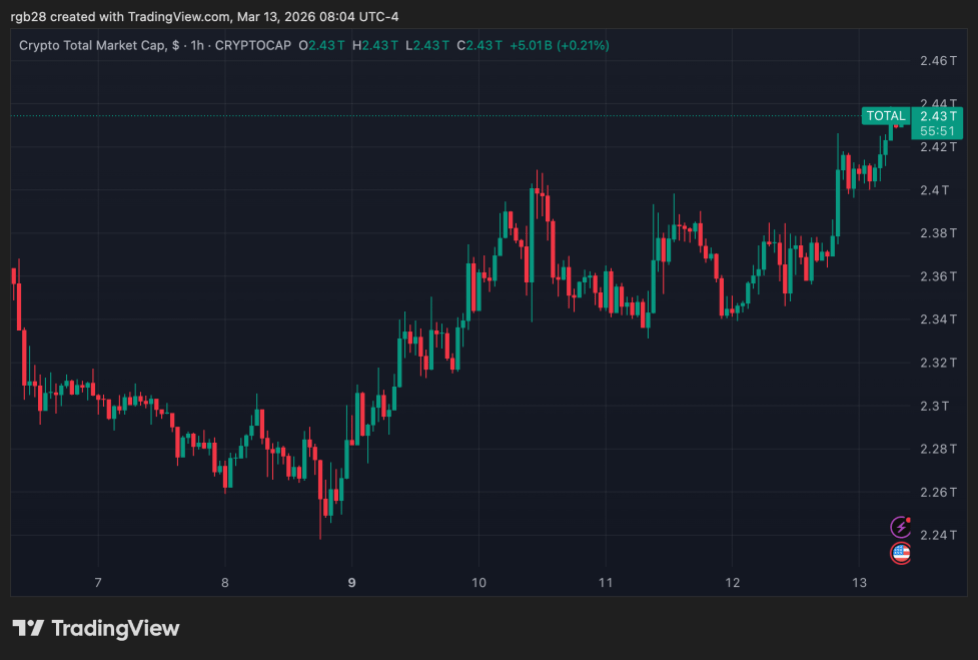
The total crypto market capitalization is at $2.43 trillion in the one-week chart. Source: TOTAL on TradingView


İlgili Sorular

QWhich two companies are reportedly set to receive the first stablecoin licenses from the HKMA?

AHSBC and a joint venture led by Standard Chartered.

QWhat is the primary reason the HKMA favors bank-led stablecoin issuers, according to the report?

ADue to their robust capital base and ability to ensure greater safety while facilitating wider adoption.

QWhat type of stablecoin will the licensing regime initially prioritize?

AThe local currency, specifically the Hong Kong dollar (HKD).

QWhat role is Hong Kong expected to play for mainland China in the context of financial innovation, according to experts cited in the article?

AHong Kong is expected to serve as a testing ground or 'testing field' for financial innovations and for Chinese assets to go abroad on the blockchain.

QWhat was the name of the HKMA program that allowed companies to test stablecoins in a limited capacity?

AThe HKMA's stablecoin issuer sandbox program.

İlgili Okumalar

Interview with Robinhood Executive: Meme + Tokenized US Stocks as "Barbell" Customer Acquisition Strategy, All Business Lines Achieve Hundreds of Millions in Revenue

Interview with Robinhood executive Johann Kerbrat reveals the company's "barbell" customer acquisition strategy for its new Robinhood Chain, combining meme tokens with tokenized stocks. Three weeks after mainnet launch, the chain has seen over $3B in weekly DEX volume and 105M transactions. Kerbrat explains the logic behind the permissionless chain: meme tokens attract DeFi users, while tokenized real-world assets (RWA), currently over 90 US stocks and ETFs accessible in 120+ countries, serve global users. The goal is to bring Robinhood's 27 million funded accounts on-chain by simplifying DeFi with a user-friendly interface, exemplified by features like Robinhood Earn which offers yield without requiring wallet management. Built on Arbitrum's technology stack for its speed, low cost, and Ethereum's security, the chain focuses on financial products like Earn, spot trading, and perpetuals. Kerbrat downplays direct competition with platforms like Base, emphasizing the goal of expanding the overall market for on-chain assets. He details selective partnerships (e.g., Morpho, Lighter) based on compliance, unique UX, and differentiation. While regulatory clarity is pending for US perpetuals, the expansion continues via Bitstamp in Europe. Finally, Kerbrat positions Robinhood as a "super app" integrating stocks, options, crypto, banking, and AI trading, with all major business lines generating hundreds of millions in revenue. For the chain, current priority is driving adoption over maximizing gas fee revenue.

marsbit2 saat önce

Interview with Robinhood Executive: Meme + Tokenized US Stocks as "Barbell" Customer Acquisition Strategy, All Business Lines Achieve Hundreds of Millions in Revenue

marsbit2 saat önce

Fidelity Q3 Report: BTC, ETH, and SOL Continue to Build Bottoms; How Much Further Will This Crypto Bear Market Go?

Fidelity's Q3 Crypto Signal Report analyzes the current bear market, noting Bitcoin (BTC), Ethereum (ETH), and Solana (SOL) are in a prolonged bottoming phase. Key indicators like the weighted Net Unrealized Profit/Loss (NUPL) have turned negative (-0.01), signaling the market is slightly below its aggregate cost basis, with BTC acting as the primary stabilizing asset. BTC's dominance has risen to 68%, indicating a lack of capital rotation to other digital assets. Performance has been weak across the board, with BTC, ETH, and SOL down significantly year-to-date. Market sentiment is depressed, exacerbated by substantial outflows from spot ETPs and a challenging macro environment. The report compares the current ~203-day downtrend to historical ~300-day bottoming cycles, suggesting the process may be two-thirds complete, with late 2026 as a potential timeframe to monitor. For Bitcoin, NUPL at 0.09 indicates cautious sentiment, while momentum signals remain negative. The Yardstick metric points to potential undervaluation relative to network security (hashrate). Ethereum's NUPL is deep in the "capitulation" zone at -0.43, a historically positive signal for future returns, though its momentum and network fee revenue are negative. Solana shows the deepest NUPL at -0.72 but demonstrates relative resilience in on-chain activity and stablecoin transfer volume. The report concludes that while several metrics are near historical capitulation levels, a definitive market bottom has not yet been established. The path forward likely involves continued consolidation, with BTC's relative strength and fundamental on-chain usage for ETH and SOL providing key areas for investor observation.

marsbit2 saat önce

Fidelity Q3 Report: BTC, ETH, and SOL Continue to Build Bottoms; How Much Further Will This Crypto Bear Market Go?

marsbit2 saat önce

İşlemler

Spot
活动图片