How Wagyu Is Changing the Monero Narrative: One Tool Lifting Years of Price Suppression

比推2026-01-14 tarihinde yayınlandı2026-01-14 tarihinde güncellendi

Özet

Wagyu, a new exchange tool, is breaking years of price suppression on Monero (XMR) by addressing a critical flaw in its acquisition process. Since 2018, despite strong demand, XMR's price remained stagnant, primarily because major exchanges delisted it, forcing over 60% of users to rely on instant swap services. These offshore services charged exorbitant fees (effectively 3-4%) and often froze funds under "AML checks," creating constant sell pressure as they immediately converted XMR profits to stablecoins. This parasitic cycle drained an estimated $30,000-$100,000 daily from the market. Wagyu v2 routes orders to Hyperliquid, providing exchange-level pricing and near-zero fees, eliminating the need for exploitative swap services. By removing this sell pressure and allowing true price discovery, Wagyu has already processed millions in trades, contributing to XMR's recent breakout above $600. The tool is effectively saving Monero by connecting genuine demand directly to real market liquidity.

Written by: PerpetualCow.hl

Compiled by: AididiaoJP, Foresight News

Original Title: How Wagyu Is Saving Monero: How One Tool Is Breaking Years of Price Suppression?


A few days ago, I exposed the trillion-dollar instant exchange industry. Today, I'm connecting the dots that haven't been pieced together yet on Crypto Twitter.

Since 2018, while almost every other cryptocurrency has been surging, the price of Monero (XMR) has been stuck in a range.

Most attribute this to exchange delistings, regulatory pressure, or the narrative that 'privacy coins are dead.'

They are all wrong.

To understand what's happening, you must first delve deep into the history of Monero XMR, including all the exchange delistings, and how most people actually buy this coin.

The Real Demand for Monero XMR

People have always wanted Monero, not just for privacy, but because it's seen as a store of value alternative to Bitcoin, like a 21st-century Swiss bank account.

Its utility didn't change just because exchanges got scared of regulation and delisted it.

This can be compared to illegal drug trade: when it's impossible to buy from a legitimate pharmacy, addicts will seek out more dubious channels, paying a higher price to get what they need.

As a result, the demand for Monero flowed to instant exchange services, not centralized exchanges.

Think from the perspective of an average user in 2024:

You want to buy Monero, but Binance just delisted it, and Coinbase won't touch it. Other small exchanges that still trade Monero are likely to freeze your funds for dealing with this coin.
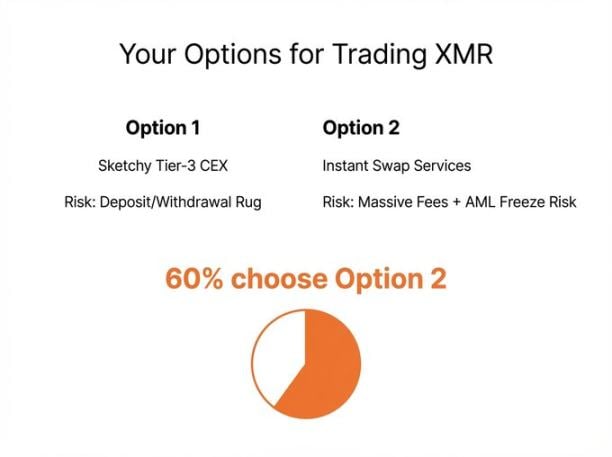
You only have two choices:

Find a third-rate exchange that still lists Monero and pray they don't run off with the money.

Use an instant exchange service, pay high fees, and pray they don't freeze your funds indefinitely under the pretext of 'AML review'.

Over 60% of users chose the second path.

These services became the de facto on/off ramps for the Monero ecosystem.

They are, of course, unregulated and offer terrible exchange rates, but users have no other choice.

After all legitimate exchanges abandoned Monero, the instant exchange industry became the only channel, absorbing all Monero trading volume.

Tracking the Flow of Funds

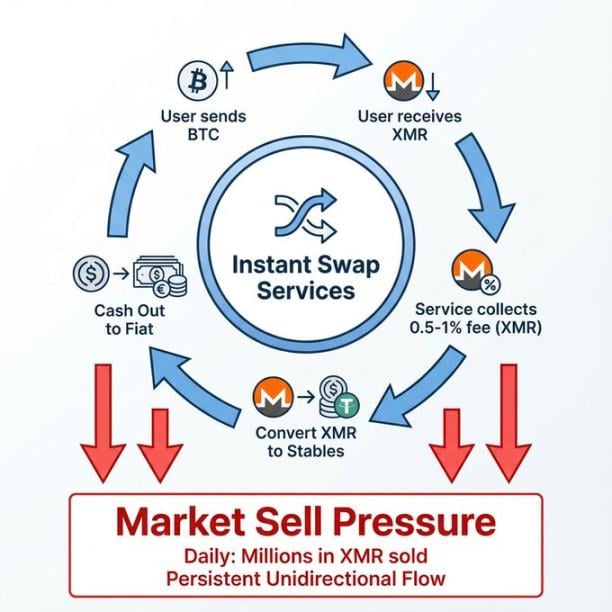
All instant exchange services operate the same way:

The user sends Bitcoin and receives Monero, with the service secretly charging a 3-4% fee (while ostensibly only charging 0.5-1%).

But these fees are priced in Monero.

So how do these service providers handle the Monero they receive?

They don't hold it long-term; they are not believers. These are offshore companies chasing fiat profits, who immediately convert Monero to stablecoins and cash out.

Just like that, millions of dollars worth of Monero are sold into the market every day.

In market microstructure terms, this creates a persistent one-way outflow of funds. Regardless of overall market conditions, these services are constantly selling. While this is just their business model, the impact on price is devastating.
Quantifying the Capital Drain

In my previous article, I estimated the instant exchange industry handles about $1.5 trillion in transactions annually (across all chains), and that's just the on-chain verifiable part.

Monero's volume is invisible due to its privacy features, but industry estimates suggest it accounts for about 20% of total instant exchange flow.

Assume $30 billion worth of Monero is exchanged through these services annually.

Conservatively, the actual figure might be half of that, around $15 billion.

At an average fee of 0.75% (most actually charge 1%), the Monero fees collected annually are worth about $112.5 million.

All of this Monero is sold into the market.

This means over $300,000 in passive selling pressure every day. It's like an invisible pump constantly draining value from Monero.

And this is a conservative estimate. If Monero truly accounts for 20% of the volume and fees are 1%, that's $300 million annually, approaching $1 million in daily selling pressure.

But it doesn't end there; there's also the 'AML Trap'.

The AML Trap

This is the 'dirty secret' I exposed in my last article: these services, while advertising 'No KYC', arbitrarily freeze user funds under the pretext of 'AML review'.

It's estimated that 2-5% of transactions through instant exchange services get frozen. The rate is higher for large transactions.

This creates a vicious cycle:

Small transactions go through but are charged fees 10-20 times higher than normal

Large transactions are completely frozen, often permanently

Only a fraction of the actual buying demand actually reaches the market
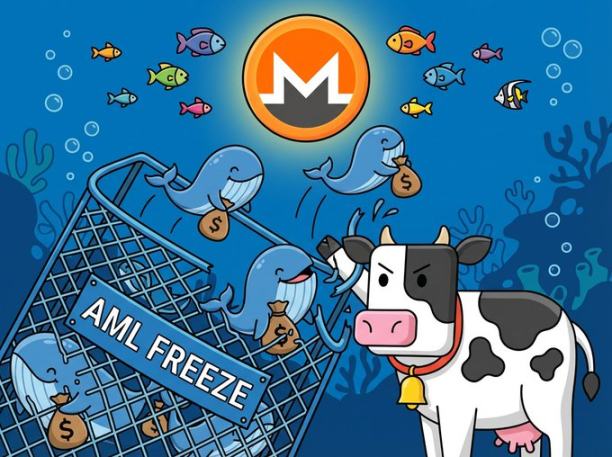
This creates the most brutal price discovery barrier: buyers who could actually influence the price are systematically excluded from the market.

The real demand for Monero has always been far higher than its price reflects. The instant exchange industry either extracts from this demand or outright chokes it off.

A Captive Market

Let me be clear about this vicious cycle:

The instant exchange industry did not win the market through competitiveness. They gained a monopoly position when all exchanges delisted Monero, and then proceeded to extract the maximum possible from users who had nowhere else to go.
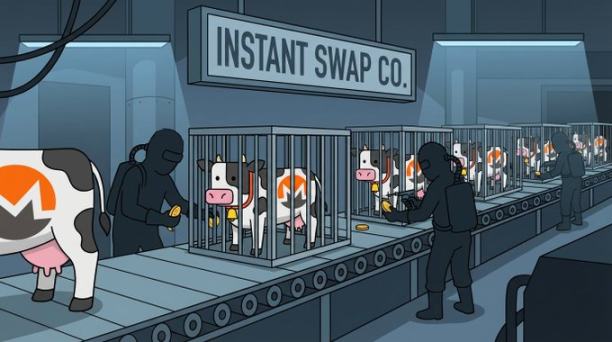
1% fees plus terrible exchange rates, plus random fund freezes.

Users tolerate it because they have no choice, and these service providers know it.

This is what happens when an entire asset class is forced into a single channel controlled by anonymous offshore operators: they extract with an uncompetitive product.

Every cent they extract turns into selling pressure on Monero.

Wagyu's Solution

Two days ago, Wagyu v2 launched.
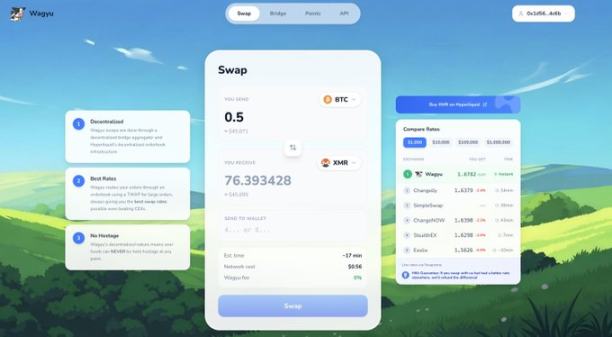
The core idea is simple: let Monero users enjoy the same pricing level as exchange traders.

When you exchange through Wagyu, your order is routed to @Hyperliquidx—where the most competitive market makers in crypto compete for orders.

These are the same market makers that provide liquidity for Binance, Bybit, and OKX, offering tiny spreads.

The result: you get exchange-level prices and fees. No more 1% or 0.5%, but ultra-low rates like professional traders.

For the first time since Monero was delisted from exchanges, users don't have to get 'ripped off' just for using their own assets.
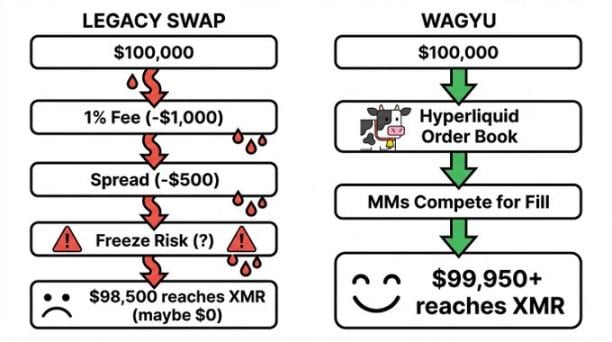
A single $100,000 transaction prevents over $1,000 in selling pressure from hitting the market.

Within 48 hours of launch, Wagyu v2 has already processed millions in exchanges, offering the best market prices:
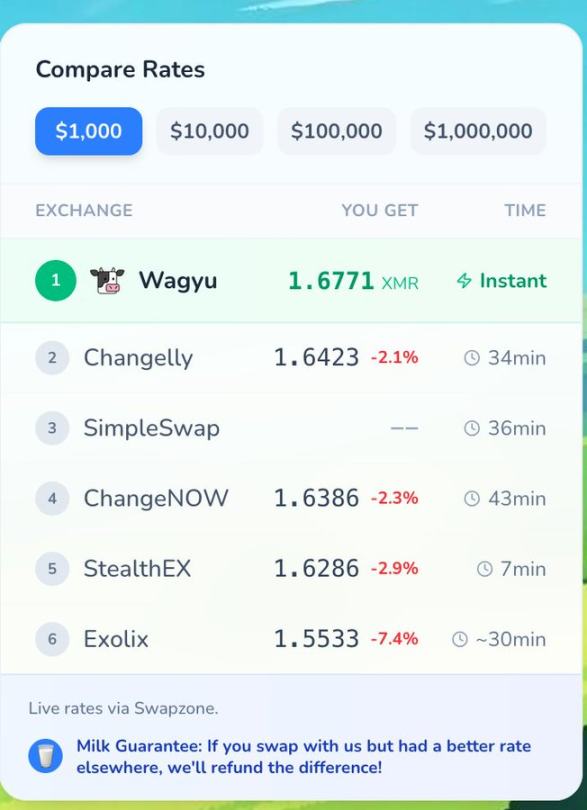
Trades that would have gone through traditional services, been charged over 1% in fees, and caused the market to instantly absorb tens of thousands in selling pressure, are now happening through Wagyu.

$1 million exchange through traditional services = $10,000 worth of Monero sold

The same $1 million exchange through Wagyu = Zero forced selling

Multiply this effect by every large Monero buyer who discovers they no longer have to be 'robbed'.

Reversing the Vicious Cycle

For years, Monero has been trapped in a negative feedback loop:
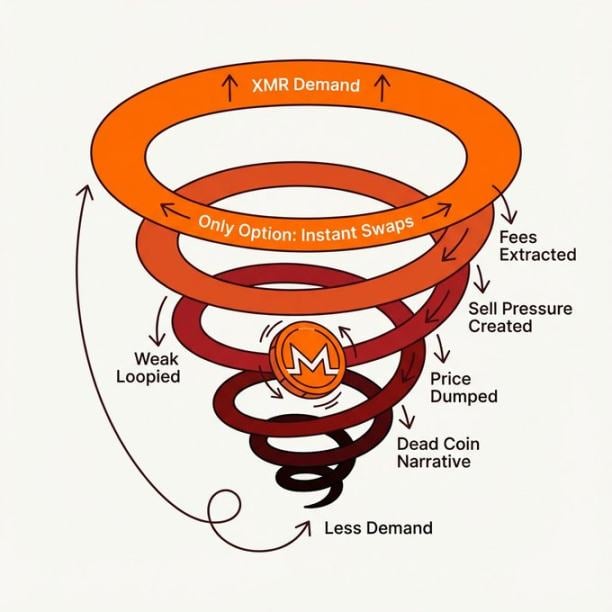
The instant exchange industry acted as a value extraction layer, sitting between buyers and the real price. They intercepted demand, extracted profits, and distorted price signals. Users couldn't bypass them because there was no alternative.

Now, that has changed.

Just two days after launch, volume is already migrating to Wagyu. People are realizing they can get Binance-level pricing for an asset Binance won't even list, and the word is spreading fast.

The cycle is reversing:
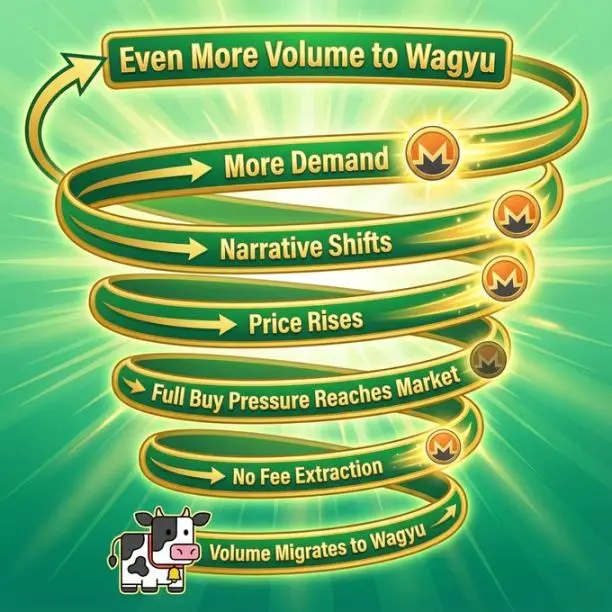
It's no coincidence that Monero broke through $600 and began its first price discovery in years.

Wagyu Is Saving Monero

I'm not going to be modest about this:

Every exchange made through Wagyu instead of a traditional service is real buying pressure that reaches the market.

Every million-dollar trade that flows through us means over $10,000 won't be sold onto other holders.

We are not extracting from the Monero ecosystem; we are plugging it directly into real liquidity.

The parasitic layer that has suppressed Monero for years has finally met its competitor. And we are not competing on their terms—we are making their entire model obsolete.

When users can get exchange-level pricing with zero freeze risk through Wagyu, who will pay 1% fees to anonymous offshore services that might freeze their funds?

No one will.

What This Means

I'm not here to give price predictions. I don't know if Monero will go to $1,000, $2,000, or fall back to $400.

But I know for sure: for the first time since being delisted from exchanges, demand for Monero can truly translate into price.

We've been live for only two days and are already processing millions in trades—trades that would have continuously 'bled' the market.

With the 'ceiling' removed, Monero at $600 is still undervalued. At least now, the market will truly decide its value.

Price discovery is finally possible, and Wagyu is making it happen.


Twitter:https://twitter.com/BitpushNewsCN

Bitpush TG Group:https://t.me/BitPushCommunity

Bitpush TG Subscription: https://t.me/bitpush

Original link:https://www.bitpush.news/articles/7602589

Trend Kriptolar

İlgili Sorular

QWhat is the main reason the author argues that Monero's price was suppressed for years?

AThe author argues that Monero's price was suppressed due to the parasitic extraction by instant exchange services, which acted as the primary on/off-ramp after centralized exchanges delisted XMR. These services charged high fees (effectively 3-4%) and immediately sold the XMR fees for stablecoins, creating constant sell pressure of an estimated $30,000 to $100,000 daily.

QHow did the instant exchange industry impact Monero's price discovery according to the article?

AThe instant exchange industry severely distorted Monero's price discovery by intercepting demand, charging exorbitant fees, and systematically freezing large transactions. This created a one-way outflow of value, preventing genuine buy-side demand from reaching the market and influencing the price.

QWhat solution does Wagyu v2 provide to the problem described in the article?

AWagyu v2 routes user orders to the Hyperliquid exchange, where professional market makers provide highly competitive, exchange-level pricing and minimal fees. This allows users to trade XMR without the excessive fees and freezing risks of traditional instant exchanges, eliminating the forced selling pressure those services created.

QWhat was the estimated annual volume of Monero processed by instant exchanges, and what was the resulting sell pressure?

AThe article estimates that instant exchanges processed approximately $150 billion to $300 billion in annual Monero volume. With an average fee of 0.75% to 1%, this resulted in $112.5 million to $300 million worth of XMR being sold annually, creating a daily sell pressure of over $300,000 to nearly $1 million.

QHow does the author describe the change in the market cycle for Monero after the introduction of Wagyu?

AThe author states that the negative feedback loop, where instant exchanges extracted value and suppressed the price, is now reversing. With Wagyu providing a efficient, non-extractive on-ramp, genuine buy-side demand can finally reach the market, allowing for true price discovery for the first time since XMR was delisted from major exchanges.

İlgili Okumalar

7 Months After the Collapse of Huiwang, Southeast Asia's Escrow Platforms Undergo a Major Reshuffle

Following the collapse of Huione Pay—dubbed the "Alipay of Southeast Asia"—seven months ago, the region's underground financial guarantee platform sector is undergoing a significant reshuffle. This power vacuum has been swiftly filled by emerging platforms such as XinBi, Tiger/Navigator, JinBei (renamed JinBo), Dali/Tiancheng, and FullyLight. These platforms, operating largely via Telegram and offering services like escrow for illicit transactions, have absorbed the vast user base and markets left behind by Huione. While positioning themselves as "trust intermediaries," their primary clientele consists of networks involved in online scams, money laundering, illegal gambling, and even human trafficking. For instance, the Tiger/Navigator platform explicitly provides "escrow" services for kidnapping-for-ransom operations ("强押车交易"). Data underscores the immense scale: Huione alone processed over $103 billion in cryptocurrency payments and facilitated over $31 billion through its escrow market before its downfall, linking it to Cambodia's notorious Prince Group. Since its collapse, competitors have seen explosive growth. For example, the XinBi platform has accumulated over $1.6 billion in total USDT revenue, while platforms like NewPay, OkPay (under Dali), and FullyLight Wallet collectively processed over $4.8 billion in USDT in a single year. This ecosystem thrives in regions like Cambodia and Myanmar, where regulatory gaps allow these platforms to act as critical financial infrastructure for sprawling cybercrime industries, from scam compounds to online casinos. The article concludes that the moniker "Southeast Asian Alipay" is a misnomer, obscuring the platforms' fundamental role in enabling serious criminal enterprises rather than representing legitimate financial innovation.

Odaily星球日报4 dk önce

7 Months After the Collapse of Huiwang, Southeast Asia's Escrow Platforms Undergo a Major Reshuffle

Odaily星球日报4 dk önce

The Changing Landscape: What Are Crypto VCs Experiencing?

Title: The Shifting Landscape of Crypto Venture Capital The era of dedicated crypto venture capital funds is undergoing a significant transformation. Once essential for navigating the sector's complexity and high risk, these specialized funds are now facing an identity crisis as the market matures. This shift mirrors historical patterns in other specialized investment classes like cleantech and SPACs, where initial information advantages dissipate as technologies become mainstream and integrated into existing industry frameworks. The article argues that crypto is reaching a critical inflection point, transitioning from a "building phase" to an "integration phase." Major players like Stripe, BlackRock, and Visa now engage with crypto not for its novel mechanics but as a foundational financial infrastructure. Their needs—regulatory compliance, banking partnerships, distribution channels—align with traditional fintech, a domain easily understood by large, generalist funds like Sequoia and Founders Fund. This evolution creates a "barbell effect" within the VC landscape. On one end are massive, diversified platforms that can incorporate crypto as one vertical among many. On the other are small, nimble funds focused on niche, experimental projects. The middle ground—medium-sized dedicated crypto funds—is being squeezed out. Their typical fund size makes it impossible to generate sufficient returns solely from early-stage crypto bets, yet they cannot compete with giants for later-stage deals. Consequently, leading crypto-native firms like Paradigm and Framework Ventures are expanding into AI, robotics, and other sectors, driven partly by LP pressure for better returns amid a broader VC DPI crisis. Others, like Dragonfly and a16z, have narrowed their crypto focus predominantly to financial infrastructure like stablecoins, reframing the sector's core narrative. For crypto entrepreneurs, this consolidation presents challenges. While generalist funds offer larger checks and broader resources, crypto projects now compete fiercely with AI for attention and capital within these firms. Furthermore, the long-term, non-commercial foundational work that built the ecosystem—funded by dedicated crypto VCs—is less likely to attract generalist capital focused on direct returns. The conclusion is that "crypto investor" as a standalone category is becoming obsolete, akin to "internet investor." Crypto is becoming a baseline infrastructure layer. The future will see a barbell structure: large-scale growth financing handled by generalist funds, while pioneering, speculative projects are funded by small, specialized vehicles. The dedicated crypto funds of the 2017-2021 boom, which incubated core infrastructure, are giving way to this new, bifurcated reality.

Foresight News21 dk önce

The Changing Landscape: What Are Crypto VCs Experiencing?

Foresight News21 dk önce

As Consensus Accelerates, What Are Young Investors Betting On?

Title: As Consensus Forms Faster, What Are Young Investors Betting On? In the rapid evolution of tech investment, a new generation of young investors is navigating a landscape where AI, robotics, commercial aerospace, and quantum computing are advancing simultaneously. Traditional investment logic based on financial models is giving way to a need for deep technical understanding and the ability to act before industry consensus forms. An analysis of trends from the "WAIC FUTURE TECH" list of young investment leaders reveals key shifts in focus. The first major trend is the movement of AI from the digital screen into the physical world. Investment is shifting from large language models and chatbots towards embodied AI, robotics, AI hardware, and edge computing. While demonstrations generate excitement, the real challenge lies in achieving scalable, reliable, and cost-effective delivery in complex real-world environments like factories and logistics. Success depends not just on algorithms but on the integration of sensors, actuators, and control systems. Second, the competitive focus for large models is moving beyond raw capability toward building an "intelligence flywheel." The goal is to create self-reinforcing systems where user interaction generates data, improving the model, which in turn enhances the user experience and attracts more engagement. Companies that successfully embed AI into workflows to create these closed-loop systems can build lasting value that isn't easily erased by the next model upgrade. Third, facing a potential bottleneck in high-quality human-generated data, investors are looking at new underlying technologies. Reinforcement learning and self-play, as demonstrated by AlphaGo Zero, offer paths for AI to generate its own experience. Scientific foundation models, which aim to build general AI capabilities for fields like life sciences and materials discovery, represent a non-consensus direction that could unlock new frontiers of knowledge and data. Finally, in deep-tech areas like quantum computing, commercial aerospace, and space-based infrastructure, patient capital is essential. These fields have long, uncertain development and validation cycles involving complex engineering, supply chains, and regulations. Investment here requires a long-term view, focusing on foundational team capabilities and the eventual emergence of market demand, even if commercial returns are distant. Collectively, these trends illustrate how young investors are adapting to a new era. They are learning to make earlier, technically-informed judgments, balance hype with real-world viability, and provide the patient capital needed to build the deep-tech foundations of the future.

marsbit49 dk önce

As Consensus Accelerates, What Are Young Investors Betting On?

marsbit49 dk önce

İşlemler

Spot

Popüler Makaleler

ONE Nasıl Satın Alınır

HTX.com’a hoş geldiniz! Harmony (ONE) satın alma işlemlerini basit ve kullanışlı bir hâle getirdik. Adım adım açıkladığımız rehberimizi takip ederek kripto yolculuğunuza başlayın. 1. Adım: HTX Hesabınızı OluşturunHTX'te ücretsiz bir hesap açmak için e-posta adresinizi veya telefon numaranızı kullanın. Sorunsuzca kaydolun ve tüm özelliklerin kilidini açın. Hesabımı Aç2. Adım: Kripto Satın Al Bölümüne Gidin ve Ödeme Yönteminizi SeçinKredi/Banka Kartı: Visa veya Mastercard'ınızı kullanarak anında Harmony (ONE) satın alın.Bakiye: Sorunsuz bir şekilde işlem yapmak için HTX hesap bakiyenizdeki fonları kullanın.Üçüncü Taraflar: Kullanımı kolaylaştırmak için Google Pay ve Apple Pay gibi popüler ödeme yöntemlerini ekledik.P2P: HTX'teki diğer kullanıcılarla doğrudan işlem yapın.Borsa Dışı (OTC): Yatırımcılar için kişiye özel hizmetler ve rekabetçi döviz kurları sunuyoruz.3. Adım: Harmony (ONE) Varlıklarınızı SaklayınHarmony (ONE) satın aldıktan sonra HTX hesabınızda saklayın. Alternatif olarak, blok zinciri transferi yoluyla başka bir yere gönderebilir veya diğer kripto para birimlerini takas etmek için kullanabilirsiniz.4. Adım: Harmony (ONE) Varlıklarınızla İşlem YapınHTX'in spot piyasasında Harmony (ONE) ile kolayca işlemler yapın.Hesabınıza erişin, işlem çiftinizi seçin, işlemlerinizi gerçekleştirin ve gerçek zamanlı olarak izleyin. Hem yeni başlayanlar hem de deneyimli yatırımcılar için kullanıcı dostu bir deneyim sunuyoruz.

558 Toplam GörüntülenmeYayınlanma 2024.12.12Güncellenme 2026.06.02

ONE Nasıl Satın Alınır

Tartışmalar

HTX Topluluğuna hoş geldiniz. Burada, en son platform gelişmeleri hakkında bilgi sahibi olabilir ve profesyonel piyasa görüşlerine erişebilirsiniz. Kullanıcıların ONE (ONE) fiyatı hakkındaki görüşleri aşağıda sunulmaktadır.

活动图片













