How to Quickly Get Started in the Base Ecosystem?

marsbit2026-05-22 tarihinde yayınlandı2026-05-22 tarihinde güncellendi

Özet

The Base ecosystem is booming. For newcomers, learning how to quickly get up to speed is key. This guide suggests using advanced features of on-chain trading terminals like GMGN to efficiently understand the ecosystem. Start by checking the top profit addresses on Base via GMGN's "Explore" function. Analyzing the recent profitable trades of these addresses reveals current trends. For example, one top address made significant profits from the meme coin $TSG. Investigate such tokens by visiting their social pages to understand the narrative—$TSG gained traction due to influencers promoting a specific slogan. Follow these influencers and use GMGN's monitoring tools to track their activity and set alerts for key terms, preparing for potential second-wave opportunities. Another profitable address held $LFI long-term. Research such projects on sites like BlockBeats to grasp deeper narratives, such as RWA or AI themes like "vvv" and $aeon on Base. The process can also be reversed: use platforms like DexScreener to see top-traded Base tokens, then analyze them via GMGN. The ultimate goals are to identify the chain's main narratives, build a database of profitable addresses and influencers for ongoing tracking, and anticipate key turning points for tokens. Leveraging these tools helps newcomers navigate Base efficiently without wasting time browsing social media aimlessly.

The Base ecosystem has been heating up lately, with concepts like "vvv" and $aeon emerging. However, if you're a newcomer to the Base ecosystem, you might face some confusion about "how to get started quickly," such as which people to follow and what the latest popular concepts in the ecosystem are.

The functionality of on-chain trading terminals is now quite advanced. We often use terminals like gmgn for buying and selling on-chain. But by leveraging other features of these trading terminals, we can also use them to quickly get up to speed with a new ecosystem.

Take gmgn as an example. Its "Explore" function includes a profit ranking for addresses on the Base chain. I directly observe the recent profitable targets of these addresses to gain a preliminary understanding of the current ecosystem dynamics.

These 2 addresses are the top 2 in terms of 30-day profit. They both have the "Sniper" label. The first impression is that these are fast-in, fast-out type of players, who typically profit from trading fast-paced meme coins. Therefore, I hope to see the current popular trends of meme coins in the Base ecosystem through these 2 addresses.

Then, let's look in detail at the profit sources of these 2 addresses. First, the address at the top of the screenshot has nearly 130,000 in profit, of which 108,000 comes from $TSG.

Click into the details page of this token, and use the social media button on the page to jump to the token's X page.
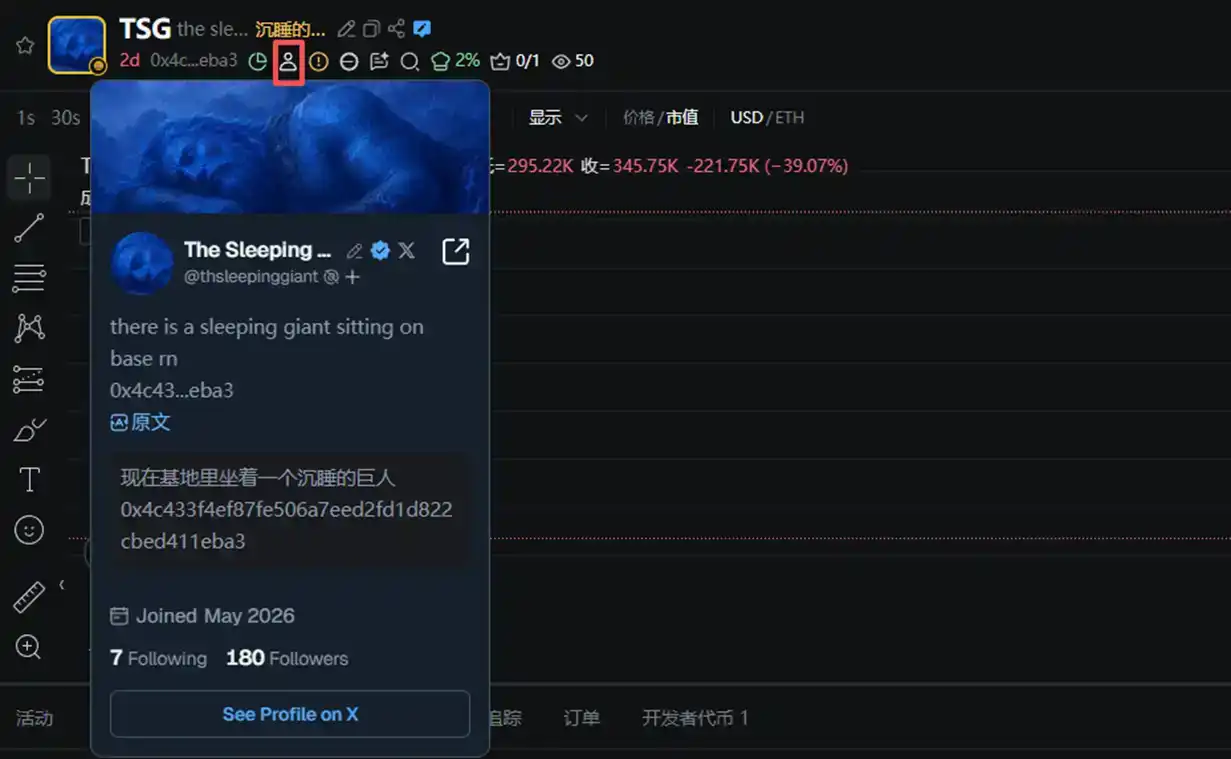
First, skim through the content on the X page's profile, including the CA and other details, to confirm that the redirected X account indeed corresponds to this token. Then, scrolling through the tweets reveals that this is a meme coin. The reason it became popular is that the following influential figures all mentioned a slogan: "there is a sleeping giant sitting on base rn."
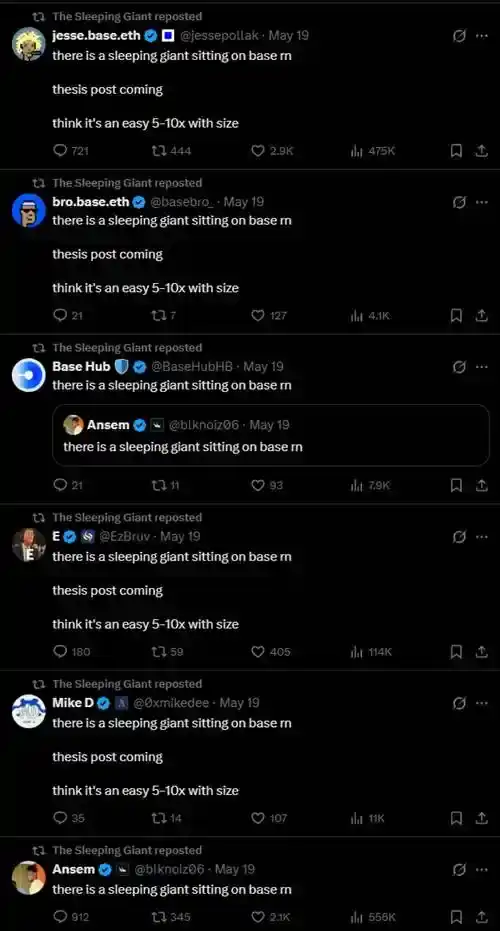
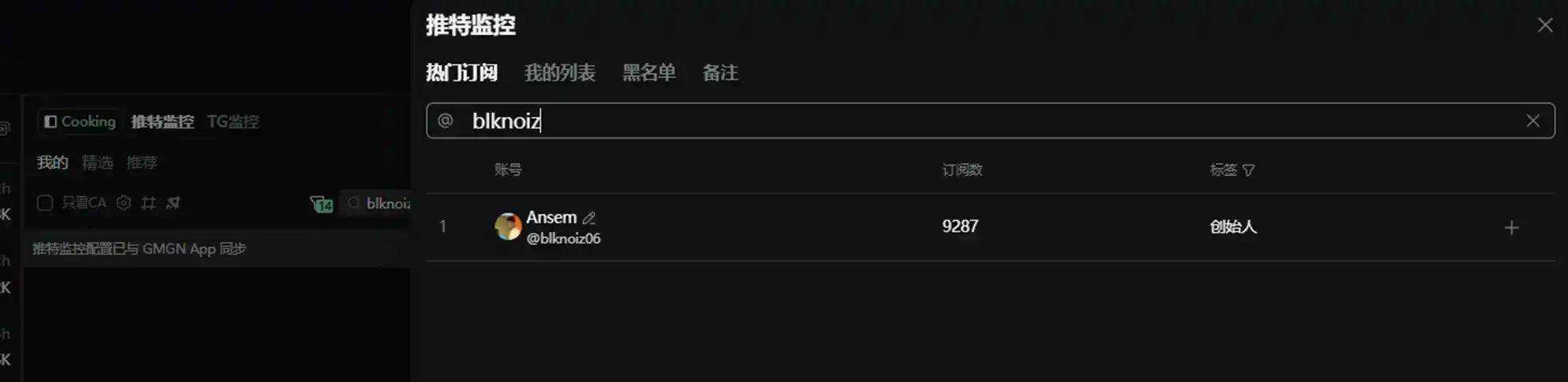
Through the screenshot above, we can follow all the influencers who retweeted the official $TSG tweet. Here, we can again use gmgn's tracking function to add these accounts to Twitter monitoring, allowing gmgn to push their content in real-time.
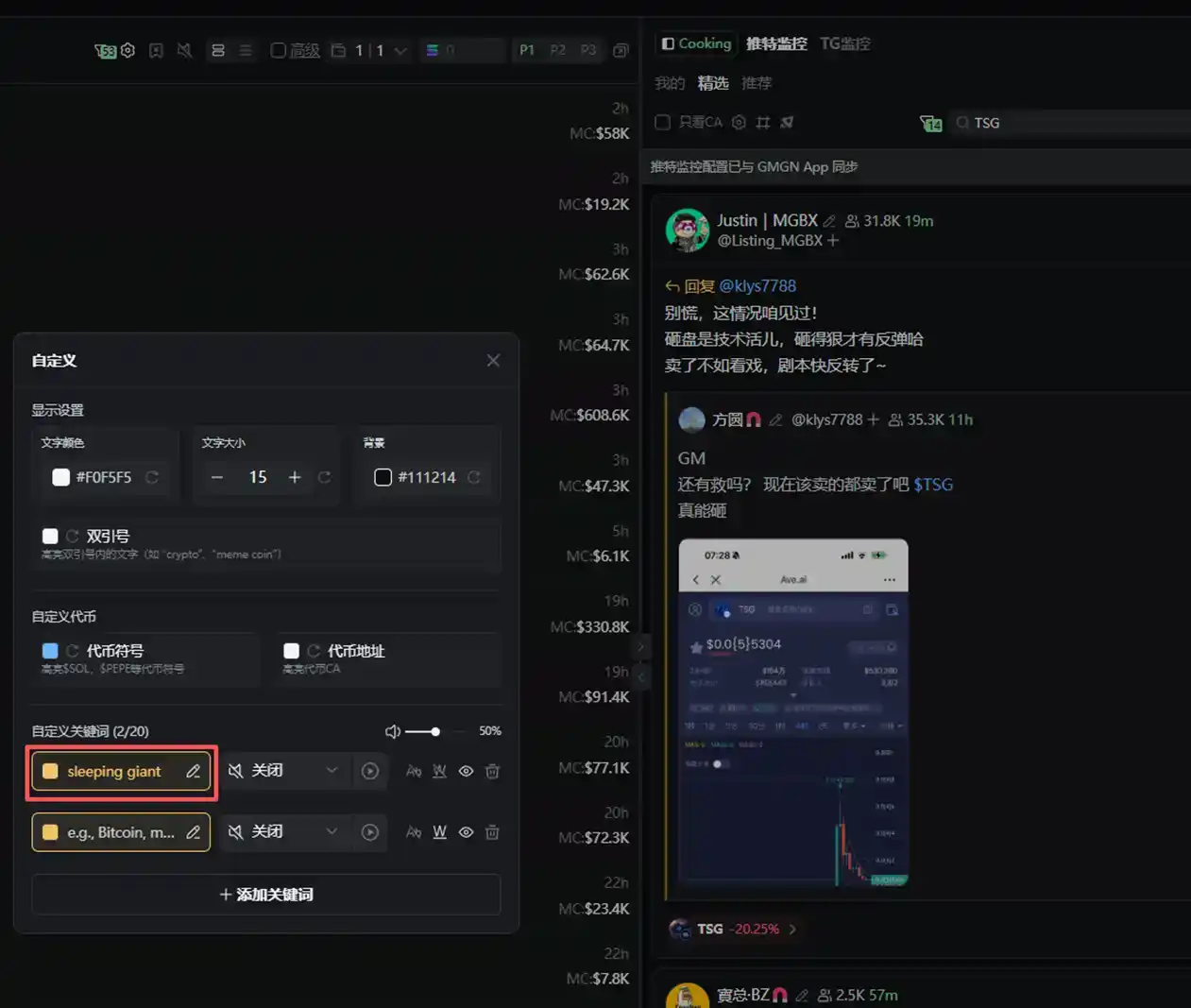
This $TSG once surged to a market cap of 7 million dollars but then fell significantly after the rapid rise. At this point, we can also consider that if these influencers mention this concept again, it might present a re-entry opportunity. Using the monitoring function again, we can set up a related keyword for more precise monitoring notifications.
Finally, let's go back and check the entry point of this high-profit $TSG address. The buy-in price was indeed very low, achieving high profits through sniping.
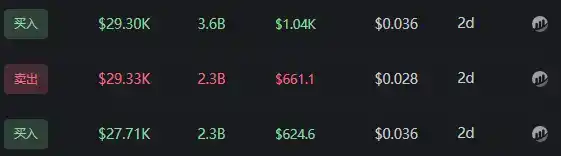
By this point, we have gained:

- A high-profit address with a style of early, low-price, fast sniping. We can mark this address on gmgn, for example, as "TSG 100K Profit Sniper," and continuously track it. If more aggressive, we can use gmgn to do a small copy trade on this address and continuously monitor the profit/loss situation of the copy trade, stopping the copy strategy when the address's win rate drops.

- The popular meme trend on Base. We can see that this coin gained attention because famous people teamed up to shout a slogan. We add these people to our tweet tracking list. Furthermore, we can delve into these celebrities' tweet interactions and follow lists to expand our list of influencers in the Base ecosystem.

- A potential second-phase opportunity, assuming the slogan is mentioned again, the price could rebound quickly.

Then let's look at the second address. This address has currently profited over 170,000 dollars on $LFI, with a holding period of 19 days, indicating it's a long-term play.

So now we can consider what its narrative is, and whether we can identify the current thematic focus of the Base ecosystem through this token's narrative. Here, we can directly search for LFI on LianDong:
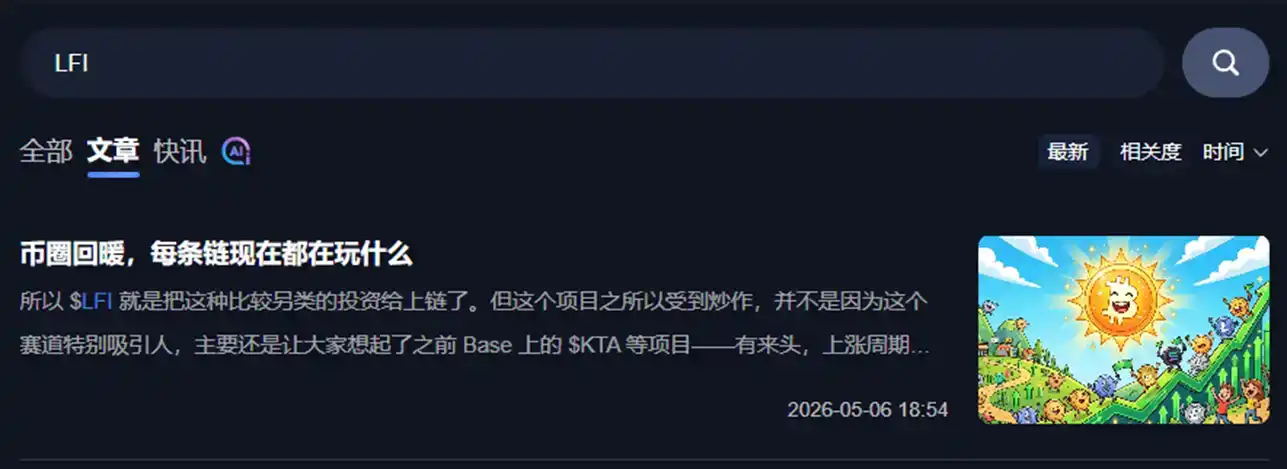
By reading articles on LianDong, we can quickly understand what these projects are about, as well as deeper on-chain trends. For example, LFI represents RWA + Team Background Play, and AI on Base chain has concepts like "vvv" and aeon, etc.

Of course, the above operations can also be reversed. For instance, you could first switch to Base chain tokens on dexscreener and skim through the tokens with the highest 24-hour trading volume, then use gmgn to check profitable addresses, analyze narratives, etc.

The ultimate goal is consistent:

- Clarify the main narratives on the Base chain.

- Expand the database of high-profit addresses and influencers, tag the styles of these addresses/personas for easy categorization and tracking to stay updated on the latest changes.

- For coins that have already risen/fallen, consider potential upcoming key turning points, and use corresponding tools for tracking.

With the now well-developed supporting features of trading terminals, we no longer need to feel lost about how to start with a new ecosystem or spend a lot of time aimlessly browsing X and Farcaster. I hope this article is helpful for you who have just entered the Base ecosystem.


İlgili Sorular

QAccording to the article, what is the primary function of the 'Explore' feature on the gmgn trading terminal for users new to the Base ecosystem?

AThe 'Explore' feature on the gmgn trading terminal allows users to view profit leaderboards for addresses on the Base chain. By observing the recent profitable trades of top-performing addresses, new users can quickly gain an initial understanding of the current trends and popular projects within the ecosystem.

QHow did the meme coin $TSG gain popularity according to the investigation in the article?

A$TSG gained popularity because influential figures on social media collectively promoted it using a specific phrase: 'there is a sleeping giant sitting on base rn (Base上现在有一个沉睡的巨人).' This coordinated mention by multiple influencers helped drive attention and popularity to the token.

QWhat practical steps does the article suggest after identifying influential people associated with a trending project like $TSG?

AThe article suggests two main steps: 1) Follow all the influential accounts that retweeted the project's official posts. 2) Use the monitoring/tracking features of tools like gmgn to add these accounts to a watchlist for real-time push notifications of their content, allowing for timely updates on ecosystem developments.

QWhat is the key difference in trading style between the two top profit addresses analyzed in the article, based on their holdings in $TSG and $LFI?

AThe first address, which profited from $TSG, employed a 'sniper' style, characterized by fast, early entry at a very low price for quick profits. The second address, which profited from $LFI, demonstrated a long-term holding strategy, as indicated by its 19-day holding period for that asset.

QWhat are the three final goals the article states for effectively using trading terminals to understand a new ecosystem like Base?

AThe three final goals are: 1) To clarify the main narrative trends on the Base chain. 2) To expand a database of highly profitable addresses and influential figures, categorizing them by style for targeted tracking. 3) To identify potential future turning points (key nodes) for tokens that have already risen or fallen, and use appropriate tools to monitor these developments.

İlgili Okumalar

Crypto Primary Market Investment and Financing Forward-Looking Weekly Report | Stablecoin Regulation Nears Implementation, ETF Funds Continue to Withdraw, Capital Begins Betting on Payment and Cash Flow

Crypto Market Weekly Report (Jun 1-7, 2026): Capital Shifts Focus to Payments & Cash Flow Market data indicates a significant divergence: while traditional institutional funds continue exiting via BTC and ETH ETFs (recording net outflows of $1.72B and $168M this week, respectively), stablecoin supply continues growing. This suggests capital is shifting from speculative asset allocation toward defensive positioning within on-chain liquidity, awaiting new, concrete opportunities. This trend is reflected in venture capital focus. Weekly fundraising fell 27% to $302M, with investments concentrating on infrastructure with tangible revenue potential: 1. **Stablecoin Infrastructure (28% of funding):** Projects like M0 Protocol ($35M raise) are gaining attention as regulatory clarity (e.g., the GENIUS Act) nears, shifting the focus from legitimacy to building payment and settlement networks. 2. **AI Agent Infrastructure (26%):** Investments are moving from conceptual AI Agents towards the execution and economic layers required for a functional "Agent economy." Key raises include OpenRouter ($40M) and Halliday ($20M). 3. **Real World Assets (RWA) (18%):** The search for on-chain yield and cash flow drives continued interest in RWA platforms like Ondo Finance. Security threats are evolving from smart contract exploits toward key management failures, permission control issues, and regulatory execution risks (e.g., court-ordered asset freezes). **Key Takeaways:** The investment thesis is shifting from narrative-driven bets to revenue and cash-flow-generating protocols. Future attention should be on the progression of stablecoin regulations, the commercial validation of AI Agent economies, and the performance of high-revenue protocols like derivatives platforms.

marsbit7 dk önce

Crypto Primary Market Investment and Financing Forward-Looking Weekly Report | Stablecoin Regulation Nears Implementation, ETF Funds Continue to Withdraw, Capital Begins Betting on Payment and Cash Flow

marsbit7 dk önce

Buy an NFT First to Get a Ticket? The Largest World Cup Ticket Slump in History

"Ticketing Woes for 2026 World Cup: NFT 'Right-to-Buy' and High Prices Dampen Sales" Despite anticipation for the 2026 FIFA World Cup, with 48 teams and 104 matches across North America, the tournament faces significant unsold tickets, with approximately 180,000 group-stage tickets still available for resale just before kick-off. This unexpected shortfall is attributed to FIFA's controversial new ticketing strategy, which includes an NFT-based "Right-to-Buy" (RTB) system and opaque, dynamic pricing. FIFA introduced RTBs as digital collectibles (NFTs) sold on its FIFA Collect platform. An RTB grants the holder only the right to purchase a ticket for a specific match later, not the ticket itself. This two-step process, criticized for selling "scarcity" first, saw RTBs priced from tens to hundreds of dollars, generating millions in revenue for FIFA. With many tickets remaining available on official channels, the value of these prepaid purchase rights is now being questioned. Compounding the issue are ticket prices, reported to be 2 to 4 times higher than the 2022 Qatar World Cup, and up to 7 times more for marquee matches. FIFA employed dynamic pricing, common in U.S. sports, but lacked transparency on seat availability and exact locations during sales, frustrating global fans facing high travel costs. This has drawn scrutiny from regulators in New York and New Jersey. FIFA's official resale platform also drew criticism for imposing high fees—roughly 10% on sellers and 17% on buyers, allowing FIFA to profit further from secondary market transactions. While FIFA President Gianni Infantino states over 6 million tickets have been sold, the situation highlights a potential disconnect between fan enthusiasm and willingness to pay under an aggressive commercial model.

marsbit15 dk önce

Buy an NFT First to Get a Ticket? The Largest World Cup Ticket Slump in History

marsbit15 dk önce

Dialogue with Morgan Stanley Executive: Wall Street Isn't Rejecting Bitcoin, It's Just Waiting for the Right Time

In a podcast interview, Amy Oldenburg, Head of Digital Asset Strategy at Morgan Stanley, discusses Wall Street's evolving stance on Bitcoin, explaining the bank's measured approach and the road ahead. Oldenburg, with 26 years at Morgan Stanley, traces her perspective to witnessing transformative tech cycles and her experience in emerging markets, where she observed the need for alternative financial systems like mobile money (e.g., M-Pesa). This background informs her view of Bitcoin's value proposition. She clarifies that Morgan Stanley is "client-driven." Regulatory hurdles, particularly as a bank holding company under Federal Reserve oversight, initially slowed their entry. While the firm couldn't act as quickly as independent asset managers, persistent client demand and a changing regulatory environment led to offerings like their low-fee Bitcoin ETP (MSBT). They are now gradually rolling out spot Bitcoin trading on their E*Trade platform. Regarding advisor adoption, Oldenburg cites a "lack of education" as the primary barrier. Morgan Stanley recommends a 0-2% allocation for more conservative portfolios and 2-4% for aggressive ones, but price volatility and confusion about its place in asset allocation persist. She notes competition for investor attention from AI and commodities. Addressing Bitcoin's price stagnation despite institutional buying, Oldenburg points to a confluence of factors: competing investment narratives (AI, quantum computing) and the complex financial landscape. She suggests a catalyst for Bitcoin as a neutral reserve asset might require a "slow-burn crisis" that exposes fragility in traditional systems. For wider bank adoption, including holding Bitcoin on balance sheets, she identifies the need for regulatory clarity to reduce punitive capital treatment and for the asset to be usable as collateral within financial ecosystems. Looking ahead, Oldenburg predicts steady, moderate adoption growth through 2030 rather than an explosive "J-curve." She emphasizes the importance of differentiating Bitcoin from other crypto assets and expresses concern that the core cypherpunk ethos of self-custody is being diluted as traditional finance enters the space. She concludes that the digital asset field remains in its early stages with significant innovation, like AI agents and micropayments, still to come.

marsbit36 dk önce

Dialogue with Morgan Stanley Executive: Wall Street Isn't Rejecting Bitcoin, It's Just Waiting for the Right Time

marsbit36 dk önce

İşlemler

Spot
Futures
活动图片




