How the Stablecoin Yield Debate Is Stalling U.S. Crypto Regulatory Legislation?

比推2026-03-17 tarihinde yayınlandı2026-03-17 tarihinde güncellendi

Özet

The debate over whether stablecoin issuers should be allowed to offer yield to users has become a central obstacle to U.S. cryptocurrency regulatory legislation, particularly the Senate’s CLARITY Act. Banking industry groups are pressuring lawmakers to prohibit yield on stablecoins, arguing it could draw deposits away from banks—especially smaller community banks—and reduce lending capacity. In contrast, crypto firms argue that incentives could help digital dollars compete with traditional payment systems. A Congressional Research Service report highlighted legal ambiguities in the current draft of the GENIUS Act, which entities may distribute returns. While the White House attempted a compromise—allowing limited rewards for specific uses like peer-to-peer payments but not for idle funds—banks rejected the proposal, stalling negotiations. Time is a critical factor: if the CLARITY Act does not advance by late April or early May, its chances of passing in 2026 drop significantly. If Congress fails to act, regulators such as the OCC may impose restrictions administratively. The outcome will influence not only stablecoin policy but also broader crypto market structure, including how tokens are classified. Failure could leave the industry dependent on regulatory guidance and real-world adoption rather than legislative certainty.

Author: Oluwapelumi Adejumo

Compiled by: Saoirse, Foresight News

Original title: The Battle Over Stablecoin Yields Stalls U.S. Crypto Regulatory Legislation


This legislation, backed by the President and aimed at establishing more comprehensive regulatory rules for the U.S. cryptocurrency market, is approaching a political deadline at the congressional level. Meanwhile, the banking industry is pressuring lawmakers and regulators to prohibit stablecoin companies from offering yields similar to bank deposit interest.

This game has become one of the core unresolved issues on the crypto agenda in Washington. The focus of the controversy is: Should dollar-pegged stablecoins focus solely on payment and settlement functions, or can they add wealth management attributes that compete with bank accounts and money market funds?

The market structure bill in the Senate, named the "CLARITY Act," has stalled due to a breakdown in negotiations surrounding so-called "stablecoin yields."

Industry insiders and lobbyists say that if the bill is to have a realistic chance of passage before the election year schedule tightens, the practical window for advancing the bill will be from late April to early May.

Congressional Research Service Sharpens the Legal Debate

The Congressional Research Service's (CRS) framing of the issue is narrower than the public debate.

In a March 6th report, the CRS noted that the "GENIUS Act" prohibits stablecoin issuers from paying yields directly to users, but for what it calls the "three-party model"—where intermediaries like exchanges stand between the issuer and the end-user—the act does not fully clarify its legality.

The CRS stated that the bill does not explicitly define "holder," leaving room for debate over whether intermediaries can still pass on economic benefits to their customers. This ambiguity is precisely why the banking industry wants Congress to re-clarify the issue in the broader market structure bill.

Banks argue that even limited yield incentives could make stablecoins a strong competitor to bank deposits, particularly impacting regional and community banks.

However, crypto companies argue that incentives tied to payments, wallet usage, or network activity can help digital dollars compete with traditional payment channels and potentially elevate their status in mainstream finance.

This divergence also reflects differing perceptions of the future positioning of stablecoins.
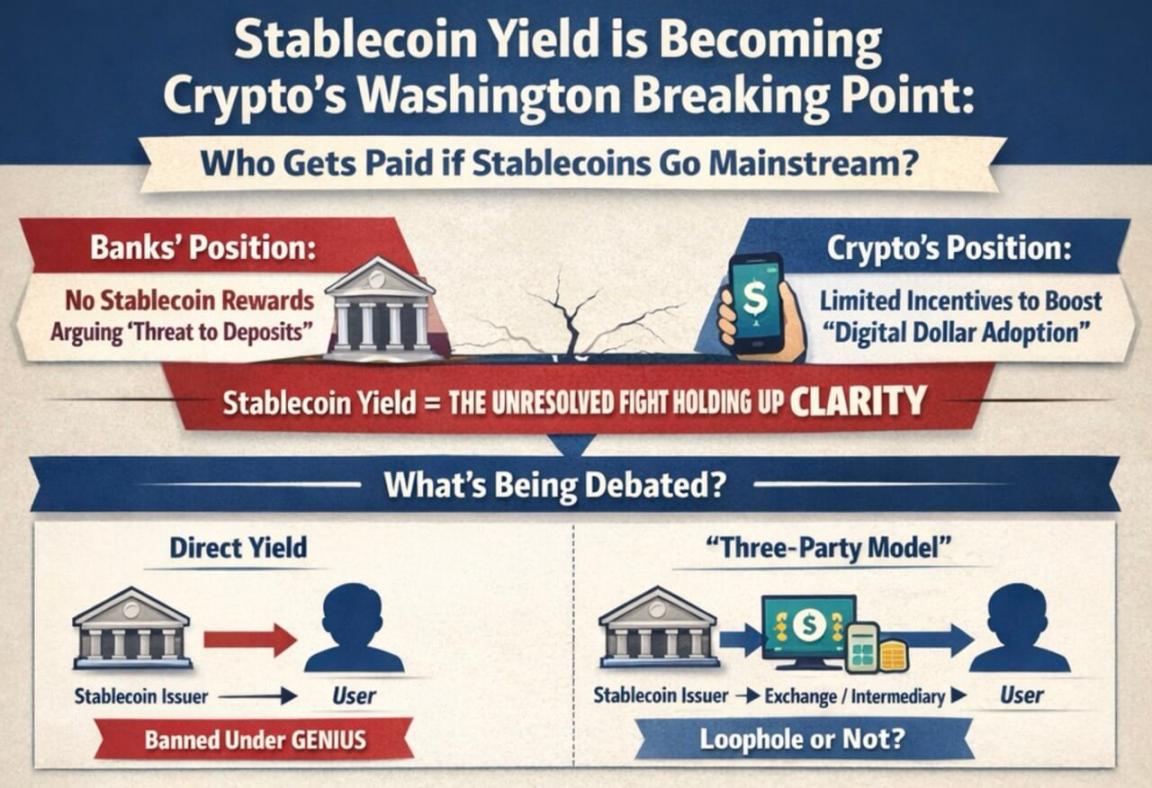
An infographic shows that as the scale of digital dollar usage continues to expand, banks and crypto companies have serious disagreements on the question of "who should stablecoin yields belong to."

If legislators primarily view stablecoins as payment tools, the rationale for imposing stricter limits on related rewards becomes stronger. Conversely, if legislators see them as part of a major shift in the way value flows on digital platforms, the argument for supporting limited incentives is more justified.

Banking associations have urged lawmakers to close what they call "regulatory loopholes" before such reward mechanisms become more widespread. Banks claim that allowing rewards on idle balances would cause depositors to move funds out of banks, thereby weakening the core funding source for loans to families and businesses.

Standard Chartered estimated in January that by the end of 2028, stablecoins could drain about $500 billion in deposits from the U.S. banking system, with small and medium-sized banks facing the greatest pressure.
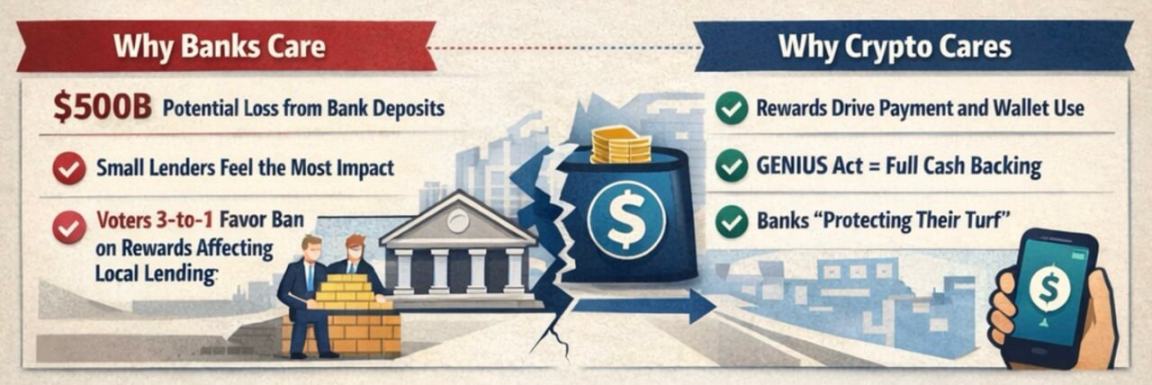
An infographic contrasts why banks and cryptocurrencies are concerned about the stablecoin bill, showing deposit outflows, impact on lenders, cash-back rewards, and banking protectionism.

Banks are also trying to demonstrate to lawmakers that their position has public support. The American Bankers Association recently released a poll result:

  • When the question mentioned that "allowing stablecoin yields could reduce the funds banks have available to lend, affecting communities and economic growth," respondents supported a congressional ban on stablecoin yields by a 3:1 ratio;

  • By a 6:1 ratio, respondents believed that stablecoin-related legislation should be cautious to avoid disrupting the existing financial system, especially community banks.

But the crypto industry counters that banks are simply trying to protect their own funding models by restricting competition from digital dollars.

Industry figures, including Coinbase CEO Brian Armstrong, argue that under the "GENIUS Act," reserve requirements for stablecoin issuers are stricter than for banks—issued stablecoins must be fully backed by cash or cash equivalents.

Trading Volume Scale Raises the Stakes in Washington Game

Market size has made this yield debate impossible to dismiss as a niche issue.

Boston Consulting Group estimated that the total settlement volume of stablecoins last year was approximately $62 trillion. After excluding bot trading, internal exchange transfers, and other activities, the real economic activity was only about $4.2 trillion.

The huge gap between surface trading volume and actual economic use also explains why the "yield" debate has become so critical.

If stablecoins remain primarily a tool for trading and market structure settlement, it's easier for lawmakers to define them as payment instruments; but if yield mechanisms turn stablecoins into a cash storage tool widely used in user apps, the pressure on banks will rise rapidly.

To this end, the White House earlier this year attempted to broker a compromise: allowing limited yields in specific scenarios like peer-to-peer payments, but prohibiting returns on idle funds. Crypto companies accepted this framework, but banks rejected it, leading to a complete deadlock in Senate negotiations.

Even if Congress does not act, regulators may step in to tighten yield models.

The Office of the Comptroller of the Currency (OCC), in a proposed rule implementing the "GENIUS Act," suggested: if a stablecoin issuer provides funds to an affiliate or third party, which then pays yields to stablecoin holders, this would be considered a disguised payment of prohibited yields.

This means that if Congress cannot legislate a clear stance, the executive branch may define the boundaries through regulatory rules.

Time Running Out in Congress

The current博弈 (game/struggle) is playing out on two tracks:

  • Congress debates whether to solve the problem through statute;

  • Regulators define the boundaries of corporate behavior within the existing legal framework.

For the Senate bill, time itself is the biggest pressure.

Galaxy Digital Head of Research Alex Thorn wrote on social media:

If the "CLARITY Act" does not pass committee review by the end of April, the probability of passage in 2026 will be extremely low. The bill must be sent to the full Senate for a vote in early May. Legislative time is running out, and the probability of passage decreases with each passing day.

He also cautioned that even if the yield dispute is resolved, a breakthrough for the bill is hardly assured:

It is currently believed externally that the stablecoin yield dispute is holding up the "CLARITY Act." But even if a compromise is reached on the yield issue, the bill would likely still face other obstacles.

These obstacles could include DeFi regulation, regulatory agency authority, and even ethical issues.

Before the November midterm elections, crypto regulation is likely to become a larger political battlefield. This adds urgency to the current impasse—once delayed, the bill faces a more crowded political schedule and a more difficult legislative environment.

Prediction markets also reflect shifting sentiment. In early January, Polymarket gave the bill an ~80% chance of passing; after recent setbacks (including Armstrong calling the current version unworkable), the probability has dropped to near 50%.

Kalshi data shows a mere 7% chance the bill passes before May, and a 65% chance it passes by year's end.

Bill Failure Would Cede More Decision-Making to Regulators and Markets

The impact of failure extends far beyond the yield debate. The core purpose of the "CLARITY Act" is to define whether crypto tokens are securities, commodities, or another category, providing a clear legal framework for market regulation.

If the bill is shelved, the entire industry will rely more heavily on regulatory guidance, interim rules, and future political changes.

This is also one reason the market is highly focused on the bill's fate. Bitwise CIO Matt Hougan said earlier this year that the "CLARITY Act" would codify the current crypto-friendly regulatory environment into law; otherwise, future administrations could reverse existing policies.

He wrote that if the bill fails, the crypto industry will enter a period of "proving itself," needing three years to make itself indispensable to ordinary people and traditional finance.

Under this logic, future growth would rely less on the expectation of "legislation landing" and more on whether products like stablecoins and asset tokenization can truly achieve mass adoption.

This presents the market with two distinct paths:

  • Bill passes → Investors price in the growth of stablecoins and tokenization early;

  • Bill fails → Future growth relies more on actual adoption, while facing uncertainty from potential policy shifts in Washington.
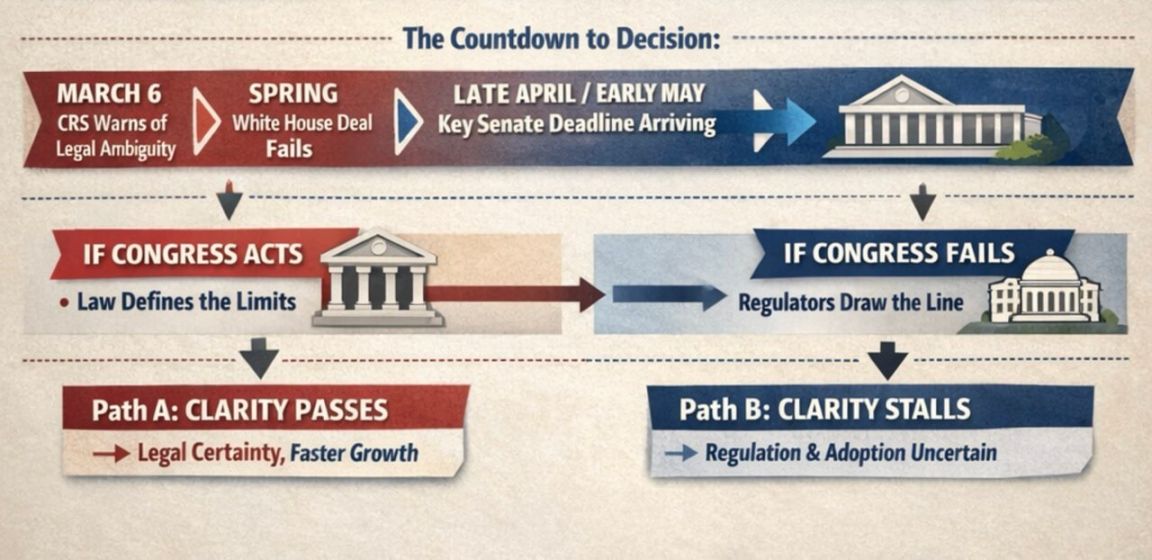
A flowchart shows the countdown to the Senate stablecoin decision, with deadlines on March 6th and late April/early May leading to two paths: if Congress acts, it brings regulatory clarity and faster growth; if Congress fails to act, uncertainty follows.

At this stage, the next move is up to Washington. If senators can restart this market structure bill this spring, lawmakers can still personally define: to what extent stablecoins can transfer value to users, and how broad a crypto regulatory framework can be written into statute. If not, regulators are clearly prepared to draw at least some of the rules themselves.

Regardless of the outcome, this debate has long surpassed "whether stablecoins belong in the financial system," and delves into: how stablecoins will operate within the system, and who will benefit from their development.


Twitter:https://twitter.com/BitpushNewsCN

Bitpush TG Discussion Group:https://t.me/BitPushCommunity

Bitpush TG Subscription: https://t.me/bitpush

Original link:https://www.bitpush.news/articles/7620501

İlgili Sorular

QWhat is the core controversy that is stalling the US crypto regulatory legislation, specifically the CLARITY Act?

AThe core controversy is whether stablecoin issuers should be allowed to offer yield or interest-like rewards to users. The banking industry is pressuring lawmakers to ban such yields, arguing they would compete with traditional bank deposits and harm lending capabilities, especially for community banks. The crypto industry argues these incentives are necessary for stablecoins to compete with traditional payment systems and gain mainstream adoption.

QAccording to the Congressional Research Service (CRS) report, what legal ambiguity exists in the GENIUS Act regarding stablecoin yields?

AThe CRS report pointed out that the GENIUS Act prohibits stablecoin issuers from paying yields directly to users. However, it does not clearly define the 'holder' of a stablecoin, leaving a legal ambiguity for a 'three-party model' where an intermediary, like an exchange, stands between the issuer and the end user. This loophole could allow intermediaries to potentially pass on economic benefits to their customers, which is a key concern the banking industry wants addressed.

QWhat is the estimated potential impact on US bank deposits by 2028, as cited by Standard Chartered, if stablecoin yields are permitted?

AStandard Chartered estimated in January that stablecoins could drain approximately $500 billion in deposits in the US banking system by the end of 2028, with smaller, community banks facing the most significant pressure.

QWhat are the two potential paths for the market if the CLARITY Act fails to pass according to the article?

AIf the CLARITY Act passes, investors would price in the expected growth of stablecoins and tokenization sooner. If it fails, future growth would depend more on the actual, large-scale adoption of products like stablecoins and asset tokenization, while also facing uncertainty from potential shifts in Washington's policy direction.

QHow did the prediction market probabilities for the passage of the crypto market structure bill change from January to the time of the article's writing?

AIn early January, the prediction market Polymarket gave the bill an approximately 80% chance of passing. After recent setbacks, including statements from industry leaders that the current version was unworkable, the probability had fallen to around 50%. Data from Kalshi showed a mere 7% chance of passage by May and a 65% chance by the end of the year.

İlgili Okumalar

Coinbase Vice President: The Wars Over Cryptocurrency Regulation Are Over

Coinbase's new Vice President, Ryan VanGrak, declared that regulatory wars in the cryptocurrency sector are over. Since taking office on July 9, 2026, he has shifted the company's approach from litigation and sanctions to focusing on growth and innovation. The industry can now concentrate on development rather than fighting for its right to exist. He highlighted that the Digital Asset Market Clarity Act (CLARITY Act), which aims to establish a clear federal regulatory framework dividing oversight between the SEC and CFTC, has gained significant momentum. This framework is intended to provide proper supervision, investor protection, and maintain U.S. leadership in digital assets. VanGrak's appointment marks a strategic shift from a "wartime" to a "peacetime" advisor, replacing former Chief Legal Officer Paul Grewal, who oversaw major litigation, including a dismissed 2023 SEC lawsuit. With his background at Citadel Securities and the SEC, VanGrak brings deep regulatory and institutional finance expertise as Coinbase expands beyond a simple exchange into a broader financial services provider, offering stocks, futures, prediction markets, and AI tools. For investors, bipartisan support for crypto legislation like the CLARITY Act represents a major shift from the enforcement-focused environment of 2023-2024. Lawmakers are now focused on *how* to regulate crypto, not *if* it should exist. However, risks remain, as the bill's passage is not yet guaranteed.

cryptonews.ru34 dk önce

Coinbase Vice President: The Wars Over Cryptocurrency Regulation Are Over

cryptonews.ru34 dk önce

Deep Dive into FWA: An Intriguing Experiment Turning NFTs into "On-Chain Gachapon"

A Deep Dive into FWA: The “On-Chain Gacha” Experiment for NFTs Fake World Assets (FWA), created by TokenWorks, introduces an innovative “NFT gacha machine” fully operating on-chain. Users can deposit eligible NFTs paired with ETH (called Backing) to create a Position, acting as a prize pool. Others can then pay a uniform Acquisition Price for a chance to win a random NFT from the pool. The core mechanism features a reverse probability system: Positions with lower Backing have a higher chance of being selected, serving as common prizes, while high-Backing Positions are rare “jackpots.” The acquisition price is calculated based on the harmonic mean of all Backings, keeping entry costs low. When a Position is won, the purchaser must choose: keep the NFT or accept the Standing Bid (85% of the Backing, claimable in ETH or $FWA tokens), returning the NFT to the original depositor. The protocol involves two main roles. Depositors provide liquidity (NFT + ETH), earning a share of fees from each draw, distributed equally per active Position, plus potential $FWA rewards. Purchasers pay to spin the gacha, receiving $FWA rewards for participation. A special “Crown” reward goes to the Position with the highest Backing. The $FWA token has a fixed supply and is initially obtainable only through protocol participation (depositing or purchasing), with external buying disabled early on to reduce sell pressure. Its value is supported by a built-in buy pressure: when purchasers opt for the $FWA settlement on a Standing Bid, the protocol uses the backing ETH to buy $FWA from the market. Revenue for the protocol comes from a 1% fee on each draw, a 1% settlement fee when an NFT is kept, and the 15% discount from Standing Bid settlements (currently allocated to the protocol). The design cleverly blends Uniswap-style liquidity provision, gacha mechanics, and tokenomics to create a novel, self-regulating marketplace for NFT liquidity and engagement.

marsbit48 dk önce

Deep Dive into FWA: An Intriguing Experiment Turning NFTs into "On-Chain Gachapon"

marsbit48 dk önce

10,000 Scientists Get 1 Year of Free Access: OpenAI Brings the Scientific Research Pipeline into ChatGPT

OpenAI has launched the "ChatGPT for Academic Researchers" program, offering free one-year access to its flagship models for 100,000 university researchers globally, with 10,000 spots available this summer. Selected institutions include prestigious centers like ENS Paris and the IAS at Princeton. The initiative provides an integrated research workspace within ChatGPT, bundling tools like ChatGPT, ChatGPT Work, and Codex, along with expanded Deep Research capabilities, higher usage limits, and specialized tools for life sciences. The suite connects to platforms like Zotero and GitHub, aiming to streamline the entire research workflow from literature review and coding to data analysis and manuscript drafting. OpenAI notes that about 1.3 million people already use ChatGPT weekly for advanced science and math. The program targets building long-term user dependency by embedding these tools into daily research habits. However, access comes with limitations: it does not include API credits or model weights, and eligibility is restricted to verified academic researchers from supported countries. This approach contrasts with Anthropic's "AI for Science" program, which offers API credits but not an integrated workspace. Both companies emphasize preventing misuse by withholding model weights, a point of contention for AI researchers seeking transparency. The core strategy remains clear: provide a powerful, integrated environment to foster user reliance ahead of the post-free period.

marsbit53 dk önce

10,000 Scientists Get 1 Year of Free Access: OpenAI Brings the Scientific Research Pipeline into ChatGPT

marsbit53 dk önce

What's Going On with Gigadevice? Major Shareholder Cashes Out 44 Billion, Then Announces 20 Billion Buyback

Gigadevice Innovation, a leading Chinese memory chip company, has executed a controversial financial maneuver. The company's controlling shareholder and chairman, Zhu Yiming, sold approximately 44 billion RMB worth of his shares between early May and mid-June 2026, capitalizing on a soaring stock price that peaked at 846.66 RMB on June 29th. Following a subsequent stock crash—plummeting to around 350 RMB in 22 trading days and erasing over 330 billion RMB in market value—Zhu announced a combined "market rescue" plan on July 29th. This plan includes his personal commitment to buy back at least 1 billion RMB in shares and a company proposal to repurchase 1 to 2 billion RMB worth of stock. This sequence of high-selling followed by a low-buying plan has confused and unsettled many of the company's 240,000 retail investors. The stock's dramatic decline was attributed to several factors: the successful IPO of its sister company, Changxin Technologies, which ended Gigadevice's status as a primary investment proxy for the domestic memory sector; a Morgan Stanley report warning of a potential peak in the memory chip cycle; and a severe loss of market confidence triggered by the chairman's massive sell-off. While the sell-off was procedurally compliant, its timing has been criticized. The company's fundamentals appear strong, with preliminary H1 2026 results showing revenue up 177% year-on-year to 11.5 billion RMB and net profit skyrocketing 1099% to 6.9 billion RMB, driven by a boom in memory chips and MCU demand. However, a significant portion (2.05 billion RMB) of this profit came from non-recurring gains like securities investment, and the memory industry is notoriously cyclical. Analysts highlight the company's role in the domestic substitution of niche DRAM and NOR Flash memory, with some maintaining bullish price targets. Yet, the recent events underscore key risks: its fabless model creates dependency on foundries like Changxin, and the chairman's actions have raised serious questions about management's alignment with minority shareholders. The promised buybacks cannot commence until December 13th due to a mandatory six-month cooling-off period following an insider sale, leaving the stock vulnerable in the interim.

marsbit53 dk önce

What's Going On with Gigadevice? Major Shareholder Cashes Out 44 Billion, Then Announces 20 Billion Buyback

marsbit53 dk önce

İşlemler

Spot
活动图片