How the $900 Billion Anthropic Was Built?

链捕手2026-05-13 tarihinde yayınlandı2026-05-13 tarihinde güncellendi

Özet

Anthropic, the AI startup behind Claude, is reportedly in early talks to raise at least $30 billion in new funding, targeting a valuation exceeding $900 billion. This would propel it past OpenAI's recent $852 billion valuation. The funding round is expected to close by late May 2026. The company's valuation surge is driven by extraordinary revenue growth, reportedly reaching an annualized $30 billion by March 2026 from $1 billion in December 2024. However, OpenAI questions this figure, suggesting a net revenue closer to $22 billion after cloud platform fees. Despite high revenue, Anthropic's gross margin is reportedly around 40%, and it is not yet profitable, with breakeven projected for 2028. A significant portion of the new capital would fund massive, pre-committed computing infrastructure with partners like Amazon, Google, and Microsoft. This highlights a new AI financing model where high valuations fuel compute spending, which in turn requires even higher future valuations to sustain. Notably, many early-stage investors are reportedly sitting out this round. Bankers privately estimate a potential IPO valuation between $400-500 billion, creating a rare scenario where the final private funding round valuation ($900B+) could far exceed the expected public market debut. Anthropic is targeting an IPO between October 2026 and the first half of 2027. Its public listing is poised to be a critical test for the entire AI sector's valuation logic, potentially validating or chall...

By Su Yang

Edited by Xu Qingyang

Bloomberg, citing informed sources, revealed that AI startup Anthropic is in early-stage talks with investors, aiming to raise at least $30 billion in new funding at a valuation exceeding $900 billion.

Informed sources disclosed that this round of financing is expected to be completed as early as the end of May 2026, although the deal is not yet finalized, and no term sheet has been signed.

If the financing succeeds, Anthropic will not only surpass OpenAI (valued at $852 billion in March) but also challenge the market capitalizations of tech giants like Apple and Microsoft. It is noteworthy that early investors who backed the company have largely chosen to sit on the sidelines for this round.

Anthropic CEO Dario Amodei. This image was generated by AI.

01 $30 Billion in Annual Revenue and 40% Gross Margin

Why can a company's valuation skyrocket 15-fold in 14 months? The answer seems obvious: growth rate.

According to publicly reported data, Anthropic's annualized revenue surged from $1 billion in December 2024 to $30 billion by the end of March 2026. This means that over consecutive years, it has maintained a growth rate exceeding 10x.

This growth curve may be unprecedented in enterprise software history.

Eight of the top ten companies on the Fortune Global 500 list are already Anthropic's clients. Over 1,000 enterprise accounts spend more than $1 million annually on Claude. In particular, its developer-facing coding product, Claude Code, launched in May 2025, reached an annualized revenue of $2.5 billion by February 2026, with enterprise subscriptions quadrupling within the first six weeks of the year.

Calculated with a $900 billion valuation and $30 billion in annualized revenue, the price-to-sales ratio is approximately 30x. This multiple sounds extreme, but supporters' calculations bet on the future. They believe a company growing 10x annually cannot be valued conventionally. Its pricing logic assumes it can maintain a similar compound growth rate until 2028, making the current valuation reasonable in hindsight.

Regarding Anthropic's revenue, competitor OpenAI has raised its own doubts, suggesting that the $30 billion annualized revenue reported by Anthropic uses gross revenue accounting. That is, when customers use its models through platforms like Amazon Web Services or Google Cloud, it records the total end consumption as revenue and then lists the fees paid to the cloud platforms as expenses.

OpenAI estimates that after deducting these intermediary fees, Anthropic's true annual revenue is closer to $22 billion. This $8 billion gap is purely a methodological choice, but it will become a focal point for market and regulatory scrutiny during an IPO.

More noteworthy than revenue accounting are the costs.

Documents show that Anthropic plans to spend approximately $19 billion in 2026 on training and inference computing, a figure almost equivalent to its annual revenue. More critically, due to inference costs exceeding expectations by 23%, its business gross margin has been compressed to about 40%, a level far below that of most mature enterprise software companies.

Anthropic is not yet profitable and is expected to break even only by 2028. For a company nearing a trillion-dollar valuation, this combination of financial metrics is indeed unusual.

02 Valuation-Driven Computing Arms Race

Why does Anthropic need to raise so much money?

Nominally, it's for development and expansion, but in essence, this $30 billion financing is primarily to pay for the computing infrastructure it has already committed to but has not yet built. This appears to be a model completely different from traditional tech finance.

In the past, startups raised funds to refine products, expand markets, and then gradually match valuations with growth. But in the AI era, startups need to first raise funds at an extremely high valuation, use that money to lock in massive future computing power, and then hope this computing power drives a leap in model capabilities, leading to revenue growth that ultimately justifies the high valuation.

It's like the chicken-and-egg debate.

Now, valuations drive computing commitments, and these commitments require the next, even higher valuation to fund them. This cycle is constantly accelerating. Anthropic is the ultimate embodiment of this model.

Once this cycle starts, it's hard to stop. It can propel a company to the clouds or plunge it into an abyss in an instant.
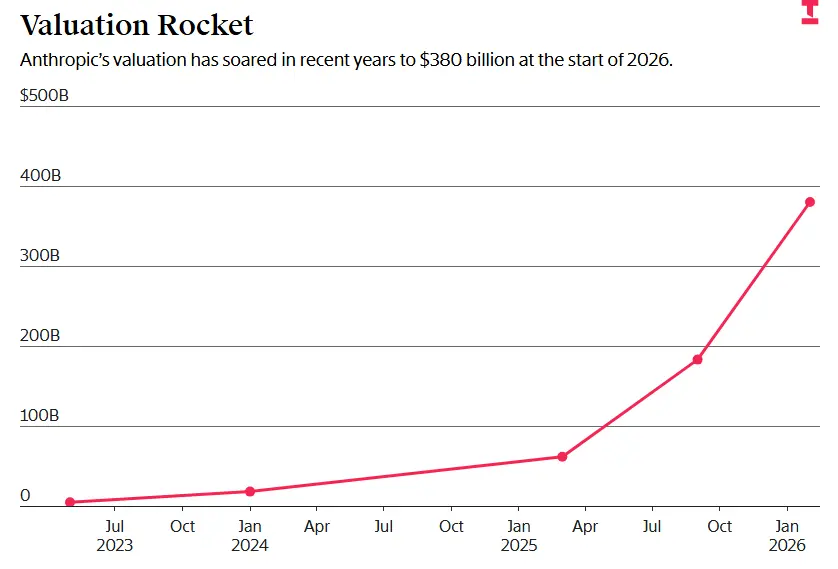
Anthropic's valuation surged to $380 billion in early 2026.

Shortly after the company completed its last $30 billion funding round, Anthropic CEO Dario Amodei told Fortune magazine that if AI progress were delayed by 12 months, Anthropic would go bankrupt.

For a company valued at $900 billion, the distance between "extraordinary success" and "operational bankruptcy" might be just a few bad quarters.

This precarious balance may be why sensitive early investors have largely refrained from participating in this round.

03 Early Investors Collectively Wait-and-See

According to Forbes, some of Anthropic's early backers—those who invested at a $4.1 billion valuation in 2023 or a $61.5 billion valuation in March 2025—have almost no willingness to participate in this round.

The reason is simple. Bankers privately estimate that if Anthropic goes public as early as October 2026, its public market valuation might land between $400 billion and $500 billion. This means that if someone invests at a $900 billion valuation in the final private round, theoretically, before the shares even unlock and become tradable, that investment would already be underwater on paper.

Such an inversion, where late-stage private valuations are significantly higher than expected IPO valuations, is extremely rare in the history of tech financing.

It's a signal, indicating either that this company is severely overvalued in the private market, or that the public market will offer a completely different pricing. Either possibility is fraught with uncertainty.

And that decisive event on the horizon is the IPO itself.

We previously mentioned the key figure behind Anthropic's IPO and financing—the company's financial helmsman, Krishna Rao.

The Information reported that at the time, Anthropic's computing lifeline was essentially tied to Google alone. Rao felt this was untenable—you can't put all your eggs in one basket. He championed a new strategy internally and among investors: computing suppliers must be diversified.

According to The Information citing informed sources, Rao discussed this strategy in depth with investor Byron Deeter of Bessemer Venture Partners. Deeter later commented that it was Rao who made the company realize that having multiple partners would allow for faster development.

Looking back now, Anthropic moved faster than OpenAI. They have already signed deep agreements with all three cloud computing giants: Amazon, Google, and Microsoft. At the chip level, they have also incorporated NVIDIA GPUs, Google's self-developed TPUs, and Amazon's chips, forming a diversified supply network.

But signing agreements is not enough; the core is ensuring suppliers actually deliver the computing resources. In late 2025, Rao spearheaded two major deals: one committing $30 billion to use Microsoft's cloud servers running NVIDIA chips, and another securing up to 1 million Google TPUs.

By early April 2026, Anthropic went further, signing new agreements with Broadcom and Google, locking in several gigawatts of data center power supply capacity. These moves are no longer simply "buying" computing power but are large-scale "reservations" of future infrastructure.

Since joining, Rao has helped the company complete multiple funding rounds totaling $60 billion. By January of this year, the company's valuation had risen to $380 billion.

It can be said that under Rao's forceful drive, Anthropic's computing infrastructure and financial firepower have reached unprecedented scale.

04 Is There a Bubble? The Answer in Six Months

Following the current pace, if this round of financing proceeds as intended, Anthropic is expected to seek an IPO between October 2026 and the first half of 2027. Goldman Sachs, JPMorgan Chase, and Morgan Stanley are reportedly in discussions about the matter.

At that time, the market's core focus will no longer be "Can Anthropic sustain growth?" but will turn into a public referendum on the entire AI industry's valuation logic over the past three years: Was the private market's pricing of AI correct?

Ultra-large-scale corporate capital expenditure commitments, multi-year computing reservation contracts, 40% gross margins, the debate between gross and net revenue accounting, and that accelerating "valuation-computing-revaluation" cycle—all these complex issues that could be ambiguously handled in the private market will, at the IPO, be placed under the public market's microscope.

If the public market is willing to give Anthropic a valuation of $1 trillion or even higher, then the entry price at a $900 billion valuation might look like a generous early bet. But if the market only offers $500 billion, the situation for the last batch of private investors would be very awkward.

A third possibility, perhaps with more profound implications, is that Anthropic's IPO will serve as a key data point to validate or disprove the entire AI finance structural hypothesis.

Remember Michael Burry, the inspiration behind *The Big Short*, who recently warned about "tech stocks" and "chip stocks" bubbles in his paid newsletter again. Once the AI finance hypothesis is disproven during Anthropic's listing, it could be the moment the bubble bursts.

So, whether for Anthropic itself or for the entire AI industry accustomed to soaring valuations over the past three years, the stress test has just begun, and will soon be given the most real, most ruthless pricing by a stock trend curve.

Special contributor Jin Lu also contributed to this article.

İlgili Sorular

QAccording to the article, what is Anthropic's current annualized revenue and how does it compare to OpenAI's reported revenue?

AAccording to the article, Anthropic's annualized revenue has surged to $30 billion as of March 2026. OpenAI estimates that Anthropic's real net revenue, after deducting payments to cloud platforms, is closer to $22 billion, questioning the $30 billion figure which uses gross revenue accounting.

QWhat is the primary purpose of Anthropic's new $30 billion funding round as described in the text?

AThe primary purpose of the $30 billion funding round is to pay for the massive computing infrastructure that Anthropic has already committed to but has not yet built. This is part of a 'valuation-computing-valuation' cycle where high valuations fund future compute resources.

QWhy are many of Anthropic's early-stage investors reportedly not participating in the new $30 billion funding round?

AEarly-stage investors are hesitant because bankers privately estimate that Anthropic's public market valuation upon an IPO could be between $400 and $500 billion. Investing at a $900 billion valuation in the final private round could mean immediate paper losses once the company goes public at a lower valuation.

QWhat key financial challenge regarding costs does Anthropic face, according to the article?

AAnthropic plans to spend about $19 billion on training and inference compute in 2026, which is almost equivalent to its full-year revenue. Due to inference costs exceeding expectations by 23%, its gross margin is compressed to around 40%, which is lower than most mature enterprise software companies. The company is not yet profitable.

QWho is identified as a key figure behind Anthropic's financing and compute strategy, and what was his major contribution?

AKrishna Rao, Anthropic's financial leader, is identified as the key figure. He advocated for and executed a strategy of diversifying compute suppliers beyond just Google, securing deals with Amazon, Google, and Microsoft, and locking in large-scale, long-term compute and power infrastructure commitments.

İlgili Okumalar

$30 Billion DeFi Capital Exodus: LayerZero Stumbles, Chainlink Feasts

Following the major DeFi security incident involving Kelp DAO, a significant migration of funds is underway from the cross-chain protocol LayerZero to Chainlink's CCIP (Cross-Chain Interoperability Protocol). Over $30 billion in Total Value Locked (TVL) from protocols like Kelp DAO, Solv Protocol, Re, and Tydro has moved to Chainlink in the past week, driven by security concerns. LayerZero is facing a severe trust crisis after the attack. Initially denying responsibility, LayerZero Labs has now issued a public apology, acknowledging management oversights. These include a vulnerable "1/1" single-node configuration for its Decentralized Verification Network (DVN) and past misuse of a multi-signature wallet by a team member. The protocol's weekly bridge volume has slumped to near-historic lows of around $470 million. In contrast, Chainlink is experiencing a surge in adoption and activity. Its independent active addresses recently hit multi-month highs, and whales have been accumulating LINK tokens. Beyond DeFi, Chainlink is securing partnerships with traditional finance giants like DTCC, European stock exchange operator SIX Group, and asset manager Amundi. While LayerZero has announced security upgrades—such as migrating to stronger multi-signature configurations and developing a second DVN client—and contributed to a rescue fund, the event underscores that security is becoming a decisive competitive factor as DeFi matures.

marsbit21 dk önce

$30 Billion DeFi Capital Exodus: LayerZero Stumbles, Chainlink Feasts

marsbit21 dk önce

The $13 Trillion Repo Market Is Quietly Being Rewritten by Blockchain

The $13 trillion repurchase agreement (repo) market, a crucial artery for global short-term funding, is experiencing a significant transformation through blockchain technology. After years of limited impact in finance, blockchain is finding substantial adoption in repo transactions. Major institutions like JPMorgan Chase, HSBC, and Broadridge are deploying tokenized repo platforms, with daily volumes already reaching tens of billions of dollars. Traditional repo markets operate with fixed hours, rely on intermediaries, and involve manual, time-consuming processes. Tokenized repos, by contrast, use blockchain to create digital tokens representing cash and securities collateral. This enables near-instantaneous settlement, 24/7 trading, automated execution, and enhanced auditability. The key drivers for adoption include maturing technology, more receptive regulators, and growing client recognition of tangible benefits like reduced operational friction and capital efficiency. Analyses, such as one from Broadridge, indicate that moving a portion of repo activity onto blockchain can significantly reduce a bank's required liquidity buffers, potentially freeing up billions in capital. The infrastructure is also seen as foundational for a future of round-the-clock trading for traditional assets. Challenges remain, including the existence of fragmented blockchain networks, the need for stress testing under extreme market conditions, and the loss of operational flexibility compared to manual processes. However, the industry consensus is that these are implementation hurdles. Tokenized repo has moved beyond pilot stages to become one of blockchain's most concrete and impactful applications in traditional finance, marking a pivotal shift in how a core market functions.

marsbit21 dk önce

The $13 Trillion Repo Market Is Quietly Being Rewritten by Blockchain

marsbit21 dk önce

From Gas Limit to 'Keyed Nonces', How to Understand the Next Step in Ethereum Scalability?

Ethereum’s scalability efforts are shifting toward a user-centric approach—focusing not only on higher TPS, but on translating technical upgrades into lower costs, smoother operations, and better wallet experiences. Two recent developments highlight this direction: - **Raising the Gas Limit to 200 million**: Following the Fusaka upgrade that increased it to 60 million, a consensus has formed around a potential future increase to 200 million. This would boost Ethereum’s execution capacity, but it is planned alongside other upgrades—such as ePBS, Block-Level Access Lists (BAL), and EIP-8037—to manage state growth and keep node operation viable for average participants. - **Keyed Nonces (EIP-8250)**: This proposal aims to improve how transactions are queued. Instead of a single linear nonce per account, it introduces multiple independent nonce domains. This prevents different types of transactions—such as private payments, session keys, or batch operations—from blocking each other. Vitalik Buterin views this as a foundational step toward better privacy support and more flexible state scalability. Together, these upgrades are part of a broader move to push complexity from wallets, DApps, and relays back into the protocol layer. For everyday users, this means future Ethereum interactions could become less congested, more intuitive, and safer—especially as core improvements in account abstraction, cross-L2 interoperability, and node decentralization continue to progress. Ultimately, Ethereum is evolving to handle not just more transactions, but more varied and complex on-chain use cases while preserving its decentralized foundation.

marsbit44 dk önce

From Gas Limit to 'Keyed Nonces', How to Understand the Next Step in Ethereum Scalability?

marsbit44 dk önce

Leaving OpenAI, How Much Has Their Net Worth Increased?

Former OpenAI employees have collectively accrued near-trillion dollar valuations through ventures and investments, charting AI's future. The article highlights two main paths: founding high-value companies like Anthropic and Perplexity, or applying insider insights as investors. Leopold Aschenbrenner exemplifies the investor path. After being fired from OpenAI, he leveraged firsthand knowledge of AI's massive energy demands to make hugely successful public market bets on nuclear and fuel cell companies, practicing "cross-industry cognitive arbitrage." Other alumni, like the Zero Shot VC fund founders, use their technical foresight for early-stage investing. Their key advantage lies not just in picking winners, but in knowing which technical approaches are likely dead ends—a "veto list" derived from internal OpenAI experience. Angel investing within the network, as seen with Mira Murati and Sam Altman, operates on deep, pre-existing understanding of a founder's capabilities, reducing due diligence to near zero. This creates an ecosystem bound by a shared belief in AGI's imminent arrival, differing from networks like the "PayPal Mafia" which were built on shared past struggles. The shift of these builders to investors signals a profound conviction: their situational awareness of the AI landscape is now so clear that deploying capital based on that judgment is more efficient than building themselves. They are allocating bets on the future they helped shape from the inside.

marsbit55 dk önce

Leaving OpenAI, How Much Has Their Net Worth Increased?

marsbit55 dk önce

İşlemler

Spot
Futures
活动图片