How Do Stablecoins Touch the Most Profitable Nerve of Banks?

比推2026-01-19 tarihinde yayınlandı2026-01-19 tarihinde güncellendi

Özet

U.S. banks are fiercely opposing interest-bearing stablecoins, not because they cause deposit outflows, but because they threaten the core profitability of large commercial banks. When funds flow into stablecoins like USDC, the money eventually returns to the banking system as reserves held in cash or short-term liquid assets. The real concern is the total amount of deposits, but a shift in deposit structure. Large U.S. banks rely heavily on "low-rate banking," where they hold massive amounts of non-interest or ultra-low-interest transaction deposits (used for payments, transfers, and settlements). These deposits are extremely cheap for banks, costing only 0-11 basis points in interest, while the Fed funds rate is 3.5%-3.75%. This spread, along with transaction fees, generates over $360 billion in annual revenue for banks. Interest-bearing stablecoins directly compete with these transaction deposits. If stablecoins offer yield, users may move funds from traditional bank transaction accounts into stablecoins for both utility and returns. Although the money remains in the banking system, stablecoin issuers would likely place most reserves in higher-yielding non-transaction accounts, forcing banks to pay market rates for these funds. This erodes banks' profit margins and reduces their fee income from payment services. The battle over the CLARITY法案 revolves around this profit redistribution. Banks want to ban all forms of yield on stablecoins to protect their lucrative l...

Author: Azuma

Original Title: Why Must Banks Kill Stablecoin Yields?


With Coinbase's temporary "betrayal" and the postponement of the Senate Banking Committee's review, the Cryptocurrency Market Structure Act (CLARITY) has once again fallen into a phase of stagnation.

  • Odaily Note: For previous developments, refer to "The Biggest Variable in the Post-Crypto Market: Can the CLARITY Act Pass the Senate?" and "CLARITY Review Suddenly Postponed: Why Is the Industry So Divided?".

Based on current market debates, the biggest point of contention surrounding CLARITY has focused on "yield-bearing stablecoins." Specifically, last year's GENIUS Act, to gain support from the banking industry, explicitly prohibited yield-bearing stablecoins. However, the Act only stipulated that stablecoin issuers cannot pay holders "any form of interest or yield," but did not restrict third parties from providing yields or rewards. The banking industry is very dissatisfied with this "workaround" and is attempting to overturn it in CLARITY, banning all types of yield-bearing pathways. This has drawn strong opposition from some cryptocurrency groups, represented by Coinbase.

Why are banks so opposed to yield-bearing stablecoins, insisting on blocking all yield pathways? The goal of this article is to answer this question in detail by dissecting the profit models of large U.S. commercial banks.

Bank Deposit Outflows? Pure Nonsense

In statements opposing yield-bearing stablecoins, the most common reason cited by banking representatives is "concern that stablecoins will cause bank deposit outflows." — Bank of America CEO Brian Moynihan said in a conference call last Wednesday: "Up to $6 trillion in deposits (about 30% to 35% of all U.S. commercial bank deposits) could migrate to stablecoins, thereby restricting banks' ability to lend to the overall U.S. economy... Yield-bearing stablecoins could accelerate deposit outflows."

However, anyone with a basic understanding of how stablecoins operate can see that this statement is highly deceptive and misleading. Because when $1 flows into a stablecoin system like USDC, that $1 does not disappear into thin air. Instead, it is placed in the reserve treasury of stablecoin issuers like Circle and ultimately flows back into the banking system in the form of cash deposits or other short-term liquid assets (such as Treasury bonds).
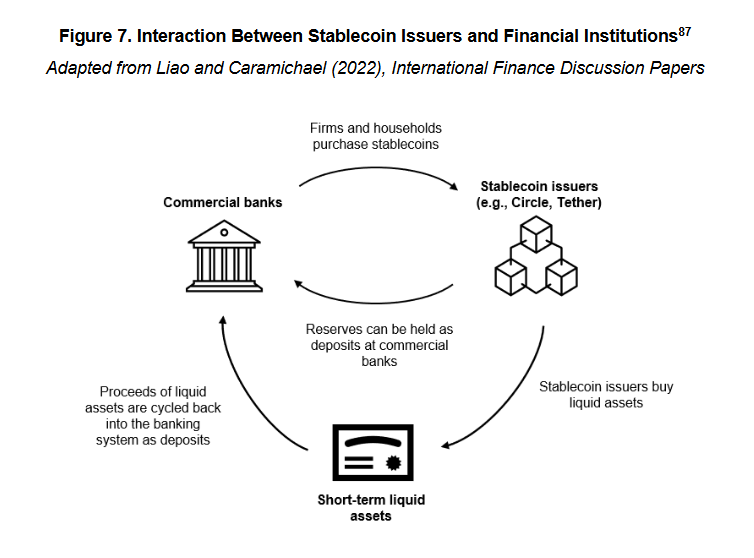
  • Odaily Note: Stablecoins backed by crypto assets, futures hedging, algorithmic mechanisms, etc., are not considered here. Firstly, because such stablecoins account for a small proportion; secondly, because these stablecoins do not fall under the discussion scope of compliant stablecoins under the U.S. regulatory framework — last year's GENIUS Act clearly defined reserve requirements for compliant stablecoins, limiting reserve assets to cash, short-term Treasury bonds, or central bank deposits, which must be segregated from operational funds.

So the facts are clear: stablecoins do not cause bank deposit outflows because the funds always flow back to banks and can be used for credit intermediation. This is determined by the business model of stablecoins and has little to do with whether they yield interest or not.

The real key issue lies in the change in deposit structure after the funds flow back.

The Cash Cow of American Banks

Before analyzing this change, we need to briefly introduce how large U.S. banks make money from interest.

Van Buren Capital General Partner Scott Johnsson cited a paper from the University of California, Los Angeles, stating that since the 2008 financial crisis damaged the banking industry's credibility, U.S. commercial banks have diverged into two distinct forms in their deposit-taking business — high-interest banks and low-interest banks.
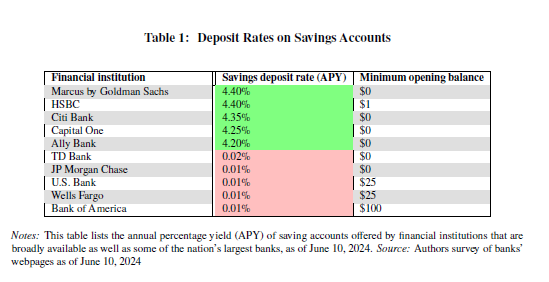
High-interest banks and low-interest banks are not formal regulatory classifications but common terms in market discourse — manifested in the fact that the deposit interest spread between high-interest banks and low-interest banks has reached more than 350 basis points (3.5%).

Why is there such a significant interest spread for the same deposit? The reason is that high-interest banks are mostly digital banks or banks whose business structure focuses on wealth management and capital market businesses (e.g., Capital One). They rely on high interest rates to attract deposits to support their credit or investment businesses. Conversely, low-interest banks are mainly national large commercial banks that hold the real power in the banking industry, such as Bank of America, JPMorgan Chase, and Wells Fargo. They have a vast retail client base and payment networks, allowing them to maintain extremely low deposit costs through customer stickiness, brand effect, and branch convenience, without needing to compete for deposits with high interest rates.

From the perspective of deposit structure, high-interest banks generally focus on non-transactional deposits, i.e., deposits主要用于储蓄或获取利息回报的存款 — such funds are more sensitive to interest rates and are more costly for banks; low-interest banks generally focus on transactional deposits, i.e., deposits主要用于支付、转账、结算的存款 — the characteristics of such funds are high stickiness, frequent流动性, and very low interest rates, making them the most valuable liabilities for banks.
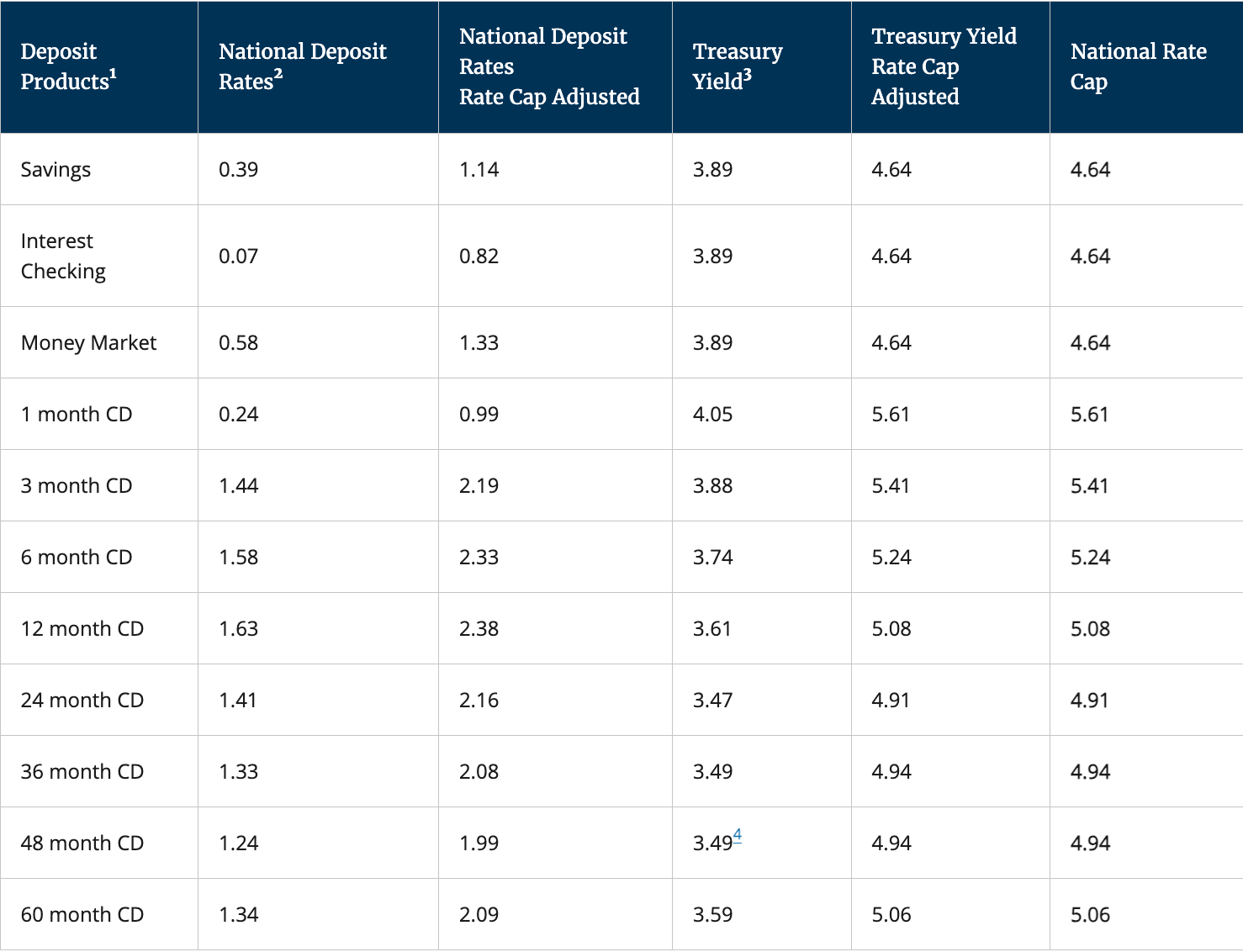
Latest data from the Federal Deposit Insurance Corporation (FDIC) shows that as of mid-December 2025, the average annual interest rate for U.S. savings accounts was only 0.39%.

Note, this is the data after including the impact of high-interest banks. Since mainstream U.S. banks predominantly follow the low-interest model, the actual interest they pay depositors is far lower than this level — Galaxy founder and CEO Mike Novogratz直言 stated in an interview with CNBC that large banks pay depositors almost no interest (about 1 – 11 basis points), while the同期 Federal Reserve benchmark rate was between 3.50% and 3.75%. This spread brings huge profits.
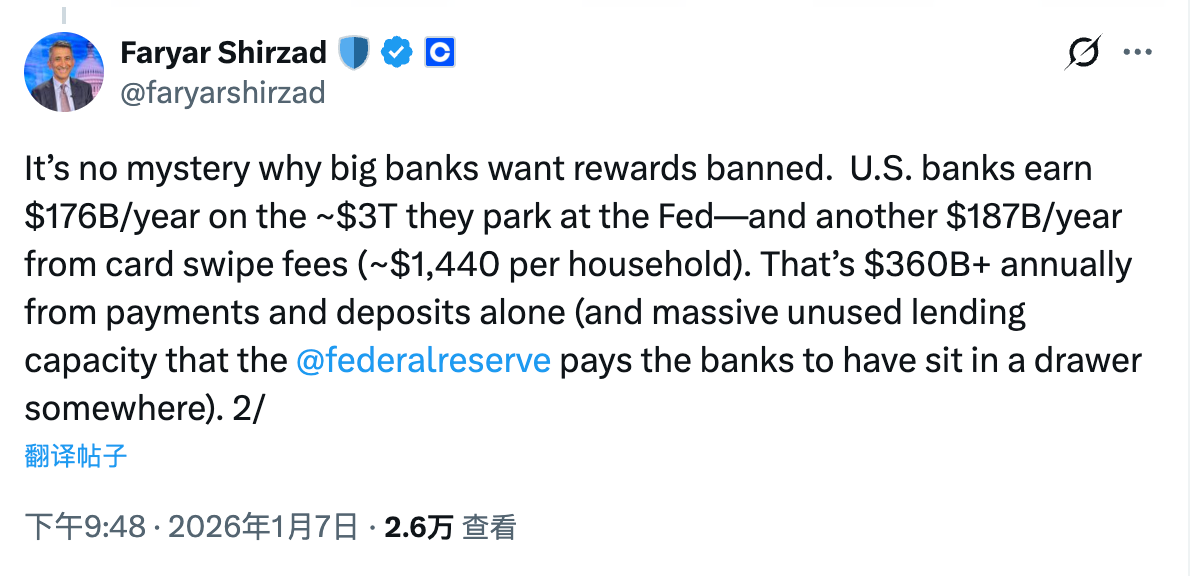
Coinbase Chief Compliance Officer Faryar Shirzad calculated a clearer account — U.S. banks can profit $176 billion annually from approximately $3 trillion in funds deposited with the Federal Reserve. Additionally, they earn $187 billion annually from transaction fees charged to depositors. Just the deposit spread and payment transaction环节 generate over $360 billion in revenue annually.

The Real Change: Deposit Structure and Profit Distribution

Back to the topic, what changes will the stablecoin system bring to the bank deposit structure? How will yield-bearing stablecoins助推 this trend? The logic is actually quite simple. What are the use cases for stablecoins? The answers无非是支付、转账、结算......等等, doesn't this sound familiar!

As mentioned earlier, these functions are the core utilities of transactional deposits, which are both the main deposit type for large banks and their most valuable liabilities. Therefore, the banking industry's real concern about stablecoins is — stablecoins, as a new transaction medium, can directly compete with transactional deposits in terms of use cases.

If stablecoins did not have yield-bearing functionality, it might be manageable. Considering the usage barriers and the slight interest advantage of bank deposits (a mosquito's leg is still meat), the actual threat stablecoins pose to this core stronghold of large banks is not significant. But once stablecoins are given the feasibility of yielding interest, driven by the interest spread, more and more funds might shift from transactional deposits to stablecoins. Although these funds will still ultimately flow back into the banking system, stablecoin issuers,出于利润考虑, will inevitably invest most of the reserve funds into non-transactional deposits, only needing to retain a certain proportion of cash reserves to handle daily redemptions. This is the so-called change in deposit structure — the funds remain in the banking system, but bank costs will increase significantly (the interest spread is compressed), and revenue from transaction fees will also shrink substantially.

At this point, the essence of the problem is very clear. The reason banks are疯狂 opposing yield-bearing stablecoins has never been about "whether the total amount of deposits within the banking system will decrease," but about the potential change in deposit structure and the resulting profit redistribution issue.

In the era without stablecoins, and especially without yield-bearing stablecoins, large U.S. commercial banks firmly controlled this source of "zero-cost or even negative-cost" funding — transactional deposits. They could earn risk-free profits through the spread between deposit rates and benchmark rates, and also continuously charge fees for basic financial services like payments, settlement, and clearing, thereby building an extremely solid闭环 that几乎不需要与储户分享收益.

The emergence of stablecoins essentially dismantles this闭环. On the one hand, stablecoins highly compete with transactional deposits functionally, covering core scenarios like payments, transfers, and settlement; on the other hand, yield-bearing stablecoins further introduce the variable of yield, making transactional funds, which were originally not sensitive to interest rates,开始具备了重新定价的可能.

In this process, funds do not leave the banking system, but banks may lose control over the profits from these funds — liabilities that were almost zero-cost are forced to transform into liabilities that require paying market-based yields; payment fees that were previously独占 by banks也开始被分流 to stablecoin issuers, wallets, and protocol layers.

This is the change that the banking industry truly cannot accept. Understanding this, it is not difficult to understand why yield-bearing stablecoins have become the most intense and最难妥协的争议焦点 in the CLARITY approval process.


Twitter:https://twitter.com/BitpushNewsCN

Bitpush TG Discussion Group:https://t.me/BitPushCommunity

Bitpush TG Subscription: https://t.me/bitpush

Original link:https://www.bitpush.news/articles/7604157

İlgili Sorular

QWhat is the core reason why banks are strongly opposed to interest-bearing stablecoins?

AThe core reason is not that stablecoins cause an outflow of deposits from the banking system, but that they threaten to change the deposit structure and redistribute profits. Interest-bearing stablecoins could shift low-cost, non-interest-bearing transactional deposits (a major source of profit for large banks) into higher-cost, interest-bearing deposits, compressing the banks' interest margin and reducing their fee income from payment services.

QHow do interest-bearing stablecoins potentially impact the profitability of large U.S. commercial banks?

AThey threaten profitability by compressing the net interest margin. Large banks currently pay near-zero interest on a massive base of transactional deposits while earning much higher returns (e.g., the Fed funds rate) on those funds. If these deposits move to interest-bearing stablecoins, the banks would be forced to hold the returning funds as higher-cost liabilities, significantly reducing this profit stream. They would also lose associated transaction fee revenue.

QWhat is the key difference between 'high-interest banks' and 'low-interest banks' as described in the article?

A'High-interest banks' are typically digital or wealth-management-focused banks that rely on offering higher interest rates to attract deposits, which are primarily non-transactional (savings) deposits. 'Low-interest banks' are large national commercial banks that leverage their vast customer base, brand, and payment networks to maintain a large base of low-cost, sticky transactional deposits, paying very little interest (near 0%) on them.

QAccording to the article, why is the argument that stablecoins cause 'bank deposit outflows' misleading?

AIt is misleading because when money flows into a compliant stablecoin like USDC, the U.S. dollars are not removed from the banking system. Instead, they are placed into the stablecoin issuer's reserve treasury, which ultimately holds the funds as cash deposits or short-term liquid assets (e.g., Treasury bills) within the traditional banking system, ready for lending and other banking activities.

QWhat two major revenue streams for large U.S. banks are directly threatened by the rise of stablecoins, particularly interest-bearing ones?

AThe two major threatened revenue streams are: 1) The massive profit from the spread between the near-zero interest paid on transactional deposits and the higher returns earned on those funds (estimated at $176 billion annually). 2) The fee income generated from payment, settlement, and clearing services associated with those transactional deposits (estimated at $187 billion annually).

İlgili Okumalar

The "Impossible Triad" Is Fundamentally a Pseudo-Problem

The article argues that blockchain's fundamental limitation is not the scalability trilemma (decentralization, scalability, security), which has been largely solved, but the lack of **privacy** and, until recently, clear **legitimacy**. Blockchain is described as a slow, expensive, globally shared computer whose core value is censorship resistance and verifiability. While ideal for native digital assets like money (e.g., stablecoins), its default transparency acts as a **tax**, exposing all transactions and enabling MEV extraction, which deters serious institutional capital. Simultaneously, its permissionless nature created regulatory ambiguity. The piece contends that **privacy** is the missing critical feature. It rejects the false choice between total transparency and complete anonymity. Modern cryptography (like zero-knowledge proofs) enables **compliant privacy**: users can prove facts (solvency, KYC status, compliance) without revealing the underlying sensitive data (specific holdings, identities). This preserves auditability for regulators and eliminates the leak of financial information. With recent regulatory progress (e.g., the GENIUS Act) addressing legitimacy, adding default, provably compliant privacy becomes a pure upgrade. It transforms blockchain from a costly, public ledger into a confidential settlement layer, finally bridging the gap to mainstream institutional and individual adoption of on-chain finance.

链捕手10 saat önce

The "Impossible Triad" Is Fundamentally a Pseudo-Problem

链捕手10 saat önce

Optical Chips: Collective Capacity Expansion

The global optical chip industry is experiencing a massive wave of expansion driven by surging AI data center demand. Major players across the US, Japan, Europe, and China are aggressively investing to ramp up production capacity. In the US, Coherent is expanding its 6-inch Indium Phosphide (InP) semiconductor fab in Texas, supported by CHIPS Act funding and a $2 billion strategic investment from NVIDIA. Lumentum is building a new factory for InP optical devices, and Nokia is scaling its advanced photonic chip packaging and testing capabilities. NVIDIA's investments aim to secure future supply of critical lasers and optical interconnect products for AI infrastructure. Japan's JX Advanced Metals, a leading InP substrate supplier, plans a multi-billion yen investment to increase its capacity 7-10 times, strengthening its grip on the crucial upstream materials market. In Europe, IQE and Tower Semiconductor settled a patent dispute and signed a multi-year InP epitaxial wafer supply agreement, highlighting that next-generation silicon photonics platforms will integrate high-performance InP components. STMicroelectronics and Sivers Semiconductors are also expanding silicon photonics production and partnerships. China is rapidly building out its domestic supply chain. Dongshan Precision's subsidiary, Source Photonics, announced a $12 billion project to expand optical chip and module production. Companies like Sanan Optoelectronics and Yunnan Germanium are scaling up InP chip manufacturing and substrate production, moving towards vertical integration from materials to modules. While debate continues around the exact future architecture—whether CPO (Co-Packaged Optics), NPO, or pluggables will dominate—analysts like Morgan Stanley argue the underlying driver is unchangeable: the explosive growth in bandwidth demand. This will inevitably increase the volume of optical engines, lasers, and related content per GPU, regardless of the final technical path. The competition for "more light" in the AI era has intensified into a global, full-chain capacity race.

marsbit13 saat önce

Optical Chips: Collective Capacity Expansion

marsbit13 saat önce

Stablecoins Finally Find Real Yield: An In-Depth Look at On-Chain Reinsurance Re | A Conversation with Re Founder Karan Saroya

Stablecoin Real Yield Found: A Deep Dive into On-Chain Reinsurance with Re's Karan Saroya As stablecoin supply exceeds $170 billion, the search for sustainable, non-speculative yield intensifies. Re, an on-chain reinsurance platform, provides an answer: connecting stablecoin capital to the trillion-dollar traditional reinsurance market. Re operates as a regulated reinsurer, accepting stablecoin deposits as collateral to back US insurance companies. These insurers pay premiums, generating yield that flows back to on-chain depositors. Currently supporting 35 insurers and underwriting $500 million, Re projects scaling to over $1 billion soon. Key insights from a Bankless podcast with founder Karan Saroya and investor Avichal of Electric Capital: 1. **Uncorrelated, Real-World Yield:** Re offers stablecoin holders access to reinsurance returns (targeting 12-14%+), an asset class entirely separate from crypto or equity markets. 2. **Operational Efficiency via Smart Contracts:** Re replaces traditional, labor-intensive capital fundraising with smart contracts, allowing a ~12-person team to compete with industry giants. 3. **Regulatory Leverage:** For every $1 of collateral, regulations allow backing $5-7 in written premiums. This leverage amplifies returns from the underlying risk-free rate. 4. **DeFi Integration:** Depositors receive receipt tokens, which can be used in protocols like Morpho for "looping," potentially pushing yields to 18-20%+. 5. **The "DeFi Mullet" Model:** A compliant front-end (regulated reinsurer) paired with a decentralized back-end (smart contracts, DeFi capital markets). 6. **RE Governance Token:** Modeled on Lloyd's of London, the token governs the central capital pool's allocation, counterparty acceptance, and parameters. 7. **Real Economic Impact:** Capital funds real-world productivity (factories, clinics, businesses) via insurance, moving beyond crypto's internal loops. The discussion highlights a pivotal moment: DeFi's supply-side infrastructure is now met by real demand for productive yield, potentially kickstarting a flywheel where vast on-chain stablecoin capital seeks these real-world returns.

链捕手14 saat önce

Stablecoins Finally Find Real Yield: An In-Depth Look at On-Chain Reinsurance Re | A Conversation with Re Founder Karan Saroya

链捕手14 saat önce

İşlemler

Spot
Futures
活动图片