How Do Chinese AI Models Use Tokens to 'Export' Electricity?

比推2026-02-26 tarihinde yayınlandı2026-02-26 tarihinde güncellendi

Özet

The article explores how Chinese AI models are effectively "exporting" electricity globally through token consumption. In 2026, data from OpenRouter shows that Chinese models account for 61% of the top ten models' token usage, with MiniMax M2.5, Kimi K2.5, and Zhipu GLM-5 leading. This shift is driven by the rise of tools like OpenClaw, which exponentially increases token usage, and the significantly lower cost of Chinese models compared to Western alternatives (e.g., MiniMax at $0.3 per million input tokens vs. Claude Opus at $5). The core idea is that token consumption represents the export of computational power and electricity. When a developer overseas sends an API request, it is processed in Chinese data centers using China’s cheaper electricity (about 40% lower than the U.S.), without the power physically leaving the country. This creates a form of invisible, tariff-free "export" of energy. The trend mirrors Bitcoin mining, where China once dominated by converting cheap electricity into digital value, but AI tokens offer more utility and deeper integration into global workflows. However, challenges like data sovereignty and chip restrictions remain. Ultimately, the token economy is becoming a new frontier in U.S.-China tech competition, with Chinese models gaining influence by embedding into developers' systems worldwide.

Author: Black Lobster, Deep Tide TechFlow

Original Title: Token Exports: Selling China's Electricity to the World


In the summer of 1858, a copper-core cable was laid across the Atlantic seabed, connecting London and New York.

The significance of this event was never about transmission speed but about power dynamics. Whoever laid the submarine cables could control the flow of information. The British Empire, with its global telegraph network, held intelligence from colonies, cotton prices, and war news in its grasp.

The empire's strength was not just its fleet but also that cable.

Over 160 years later, this logic is replaying in an unexpected way.

In 2026, Chinese large models are quietly dominating the global developer market. The latest data from OpenRouter shows that Chinese models account for 61% of the token consumption among the top ten models on the platform, with the top three all from China. API requests from developers in San Francisco, Berlin, and Singapore are crossing the Pacific submarine cables to data centers in China, where computing power is consumed, electricity flows, and results are sent back.

The electricity never leaves China's power grid, but its value is delivered cross-border through tokens.

The Great Migration of AI Models

On February 24, 2026, OpenRouter released weekly data: the total token consumption of the top ten models was about 8.7 trillion, with Chinese models accounting for 5.3 trillion, or 61%. MiniMax M2.5 topped the list with 2.45 trillion tokens, followed by Kimi K2.5 and Zhipu GLM-5, all from China.
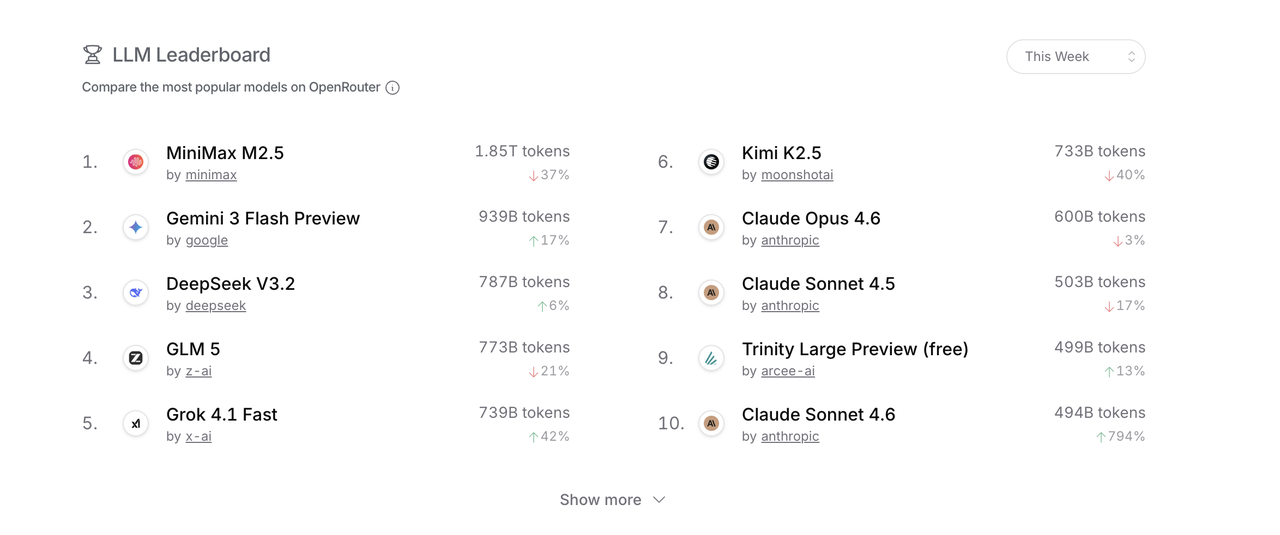
Latest data as of February 26

This is no coincidence; a fuse has been lit.

Earlier this year, OpenClaw emerged, an open-source tool that allows AI to truly work, directly controlling computers, executing commands, and handling complex workflows in parallel. Its GitHub stars surpassed 210,000 within weeks.

John, a finance professional, installed OpenClaw immediately, connected it to the Anthropic API, and began automatically monitoring stock information and generating trading signals. A few hours later, he stared at his account balance in disbelief: dozens of dollars, gone.

This is the new reality brought by OpenClaw. In the past, chatting with AI consumed a few thousand tokens per conversation, with negligible costs. With OpenClaw, AI runs dozens of subtasks in the background, repeatedly calling context and iterating cycles. Token consumption isn't linear; it's exponential. The bill accelerates like a car with the hood open, the fuel gauge dropping, unstoppable.

A "clever trick" soon spread among developer communities: using OAuth tokens to directly connect Anthropic or Google subscription accounts to OpenClaw, turning the "unlimited" monthly quota into free fuel for AI agents. This became a common method for many developers.

Official countermeasures followed.

On February 19, Anthropic updated its terms, explicitly prohibiting the use of Claude subscription credentials for third-party tools like OpenClaw. To access Claude functionality, users must use the API billing channel. Google went further, widely banning subscription accounts that accessed Antigravity and Gemini AI Ultra via OpenClaw.

"The world has suffered long under tyranny." John immediately switched to domestic large models.

On OpenRouter, the domestic model MiniMax M2.5 scores 80.2% on software engineering tasks, while Claude Opus 4.6 scores 80.8%, a negligible difference. But the prices are worlds apart: the former charges $0.3 per million input tokens, while the latter charges $5, a difference of about 17 times.

John switched over. His workflow continued to run, and his bill shrank by an order of magnitude. This migration is happening globally.

OpenRouter's COO, Chris Clark, put it bluntly: Chinese open-source models are capturing a significant market share because they account for an unusually high proportion of the agent workflows run by U.S. developers.

Electricity Exports

To understand the essence of token exports, one must first understand the cost structure of a token.

It seems light—one token is roughly equivalent to 0.75 English words. An ordinary conversation with AI consumes only a few thousand tokens. But when these tokens stack up in trillions, the underlying physical reality becomes heavy.

Breaking down the cost of a token, there are only two core components: computing power and electricity.

Computing power is the depreciation of GPUs. Buying an NVIDIA H100 costs about $30,000, and its lifespan, converted to each inference, is the depreciation cost. Electricity is the fuel for data centers to operate continuously. A GPU consumes about 700 watts at full load, and with cooling systems, the electricity bill for a large AI data center can easily exceed hundreds of millions of dollars annually.

Now, map this physical process.

A U.S. developer in San Francisco sends an API request. The request travels from California via Pacific submarine cables to a data center in China. GPU clusters start working, electricity flows from China's grid to those chips, inference is completed, and results are sent back. The entire process takes maybe a second or two.

Electricity never leaves China's power grid, but its value, through tokens, completes cross-border delivery.

Here's something miraculous that ordinary trade cannot achieve: tokens have no physical form, do not need to pass through customs, are not subject to tariffs, and are almost invisible in any current trade statistics. China exports a vast amount of computing power and electricity services, but in official commodity trade data, it is nearly invisible.

Tokens have become derivatives of electricity. Token exports are essentially electricity exports.

This is also thanks to China's relatively low electricity prices, which are about 40% lower than those in the U.S. This is a physical cost difference that competitors cannot easily replicate.

Additionally, Chinese AI models have algorithmic and "internal competition" advantages.

DeepSeek V3's MoE architecture activates only part of the parameters during inference, with independent tests showing its inference cost is about 36 times lower than GPT-4o. MiniMax M2.5 similarly activates only 10B of its 229B total parameters.

At the top layer is internal competition. Alibaba, ByteDance, Baidu, Tencent, Moon Dark Side, Zhipu, MiniMax... over a dozen companies are competing on the same track, driving prices below reasonable profit margins. Losing money to gain traction is already the industry norm.

Looking closely, this mirrors China's manufacturing exports: leveraging supply chain advantages and internal competition to drastically lower token prices.

From Bitcoin to Tokens

Before tokens, there was another form of electricity export.

Around 2015, power station managers in Sichuan, Yunnan, and Xinjiang began receiving strange visitors.

These people rented abandoned factories, filled them with dense rows of machines, and kept them running 24/7. The machines produced nothing but continuously solved a mathematical problem, occasionally mining a Bitcoin from this endless calculation.

This was the first-generation form of electricity exports: converting cheap hydropower and wind power, via mining machines' hash computations, into globally circulating digital assets, which were then cashed out into dollars on exchanges.

Electricity never crossed any border, but its value, embodied in Bitcoin, flowed to the global market.

During those years, China's computing power once accounted for over 70% of global Bitcoin mining power. China's hydropower and coal power, in this roundabout way, participated in a global redistribution of capital.

In 2021, this came to an abrupt halt. Regulatory crackdowns followed, miners scattered, and computing power migrated to Kazakhstan, Texas, and Canada.

But the logic itself never disappeared; it was just waiting for a new shell. Until ChatGPT emerged, large models began competing, and former Bitcoin mining farms transformed into AI data centers. Mining machines became computing GPUs, and the Bitcoin produced became tokens. The only constant was electricity.

Bitcoin exports and token exports are structurally similar in underlying logic, but tokens hold more commercial value today.

Bitcoin mining is pure mathematical computation, producing Bitcoin as a financial asset. Its value comes from scarcity and market consensus, unrelated to "what was computed." The computing power itself is unproductive, more like a byproduct of a trust mechanism.

Large model inference is different. GPUs consume electricity to produce real cognitive services: code, analysis, translation, creativity. The value of tokens comes directly from their utility to users. This is a deeper embedding; once a developer's workflow relies on a model, the cost of switching increases over time.

Of course, there is another key difference: Bitcoin mining was driven out of China, while token exports are actively chosen by global developers.

Token War

The submarine cable laid in 1858 represented the British Empire's sovereignty over the information highway. Whoever owned the infrastructure could define the rules of the game.

Token exports are also an undeclared war, full of resistance.

Data sovereignty is the first barrier. An API request from a U.S. developer processed by a Chinese data center means data physically flows through China. For individual developers and small applications, this isn't an issue. But for enterprise-sensitive data, financial information, and government compliance scenarios, this is a hard stop. This is why Chinese models have the highest penetration in development tools and personal applications but almost no presence in core enterprise systems.

The chip ban is the second barrier. China's AI development faces export controls on NVIDIA's high-end GPUs. MoE architecture and algorithmic optimization can only partially offset this disadvantage; the ceiling still exists.

But the current resistance is just the prologue; a larger battlefield is forming.

Tokens and AI models have become a new strategic dimension in the U.S.-China rivalry, comparable to semiconductors and the internet in the 20th century, or even closer to an older analogy: the space race.

In 1957, the Soviet Union launched Sputnik 1, shocking the U.S., which then launched the Apollo program, investing resources equivalent to hundreds of billions of dollars today to ensure it did not fall behind in the space race.

The logic of the AI race is strikingly similar but will be far more intense than the space race. Space is physical, something ordinary people don't feel. AI渗透的是经济的毛细血管,渗透到每一行代码、每一份合同、每一个政府决策系统的背后,都可能运行着某个国家的大模型. Whose model becomes the default infrastructure choice for global developers gains structural influence over the global digital economy.

This is what truly worries Washington about China's token exports.

When a developer's codebase, agent workflows, and product logic are built around a Chinese model's API, migration costs rise exponentially over time. Even if the U.S. legislates restrictions, developers will resist with their feet, just as no programmer can abandon GitHub today.

Today's token exports may be just the opening chapter of this long game. Chinese large models claim no intent to颠覆什么; they simply deliver services to every global developer with an API key at a lower price.

This time, those laying the cables are the engineering teams writing code in Hangzhou, Beijing, and Shanghai, and the GPU clusters running day and night in a southern province.

This rivalry has no countdown; it happens 24 hours a day, measured in tokens, on every developer's terminal.


Twitter:https://twitter.com/BitpushNewsCN

Bitpush TG Discussion Group:https://t.me/BitPushCommunity

Bitpush TG Subscription: https://t.me/bitpush

Original link:https://www.bitpush.news/articles/7614803

İlgili Sorular

QWhat is the core concept behind China's AI models 'exporting' power through tokens, as described in the article?

AThe core concept is that while the physical electricity never leaves China's grid, its value is delivered cross-border through AI-generated tokens. When global developers use Chinese AI models via API requests, the computation (and thus power consumption) occurs in Chinese data centers, but the resulting tokens—representing cognitive services like code, analysis, or translation—are transmitted back to users worldwide. This effectively 'exports' the value of China's cheap electricity without the power itself crossing any borders, bypassing traditional trade mechanisms like tariffs.

QAccording to the article, what event in early 2026 acted as a catalyst for the massive migration of global developers to Chinese AI models?

AThe catalyst was the release of 'OpenClaw,' an open-source tool that allows AI to directly control computers and execute complex workflows. This caused token consumption to become exponential rather than linear. When Anthropic and Google banned the use of subscription credentials for OpenClaw, developers sought cheaper alternatives. They migrated en masse to Chinese models like MiniMax M2.5, which offered comparable performance to models like Claude Opus but at a fraction of the cost (e.g., $0.3 per million input tokens vs. $5).

QHow does the article compare the historical export of Bitcoin's hashing power to the current export of AI tokens?

AThe article draws a parallel, stating both are forms of 'power export.' From around 2015, China used cheap hydropower and coal power to mine Bitcoin, converting electricity into a globally traded digital asset without the power physically leaving the grid. This was shut down in 2021. The logic now repeats with AI: GPU clusters in data centers consume Chinese electricity to produce valuable tokens (cognitive services) for global users. The key difference is that Bitcoin mining produced a financial asset based on scarcity, while AI tokens produce utility (e.g., code, analysis), creating deeper user dependency. Bitcoin mining was driven out of China, but token export is being actively chosen by global developers.

QWhat are the two main components of a token's cost structure, as explained in the article?

AThe two main cost components are computing power (算力) and electricity (电力). Computing power refers to the depreciation and amortization of GPUs (e.g., an Nvidia H100 costs about $30,000, and its lifespan cost per inference is the depreciation cost). Electricity is the fuel for data center operation, with a single GPU consuming about 700 watts at full load, plus cooling costs, leading to annual power bills for large AI data centers that can easily exceed hundreds of millions of dollars.

QWhat major challenges or 'walls' does the article identify for China's AI models in the global 'Token War'?

AThe article identifies two major 'walls' or challenges: 1. Data Sovereignty: API requests processed in Chinese data centers mean data flows through China physically. This is a significant concern for enterprises handling sensitive data, financial information, or government compliance, limiting Chinese model adoption in core systems despite high penetration in developer tools. 2. Chip Ban: Export controls on high-end Nvidia GPUs create a hardware disadvantage for Chinese AI development. While architectural optimizations like MoE (Mixture of Experts) can partially offset this, a ceiling on performance and capability remains.

İlgili Okumalar

Must-Watch Events Next Week|CLARITY Act Could Face Senate Vote; SpaceX, Circle to Report Earnings (8.3-8.9)

**Summary: Key Events and Developments to Watch (August 3-9)** The upcoming week is marked by significant financial disclosures, key legislative deadlines, and notable product updates. **Major Financial Events:** Several companies are scheduled to release their Q2 2026 earnings. American Bitcoin (ABTC) will report on August 3, followed by SpaceX and Hut 8 Mining Corp. on August 4, and Circle on August 5. Notably, a significant portion of SpaceX shares (up to 12% of total shares) will be unlocked on August 6 following their earnings release. **Key Legislative Deadline:** The U.S. Senate faces an August 7 deadline to secure 60 votes for the CLARITY Act, a bipartisan bill aiming to establish a federal regulatory framework for cryptocurrencies. The Senate may hold a full vote on the bill during the week. **Economic Data:** The U.S. July Non-Farm Payrolls report will be released on August 7, providing crucial labor market data. **Technology & Product Updates:** * **Shutdowns:** DeFi portfolio tracker Zapper and wallet app Ctrl Wallet will cease operations on August 3. * **Upgrades:** LayerZero will deprecate its v1 relayers on August 3. XRP Ledger's new version 3.3.0, featuring five new functions, is expected next week. * **AI:** Elon Musk announced that the advanced Grok 4.6 AI model is set for release around August 7. * **Bitcoin:** The BIP-110 forced signaling for a potential Bitcoin network change is scheduled to begin around August 8. **Other Notable Events:** Chinese robotics firm Unitree Tech has set its preliminary price inquiry for its IPO for August 5. South Korean exchange Upbit will delist AQT and AERGO tokens on August 3.

marsbit21 dk önce

Must-Watch Events Next Week|CLARITY Act Could Face Senate Vote; SpaceX, Circle to Report Earnings (8.3-8.9)

marsbit21 dk önce

Stocks Are Plummeting More Sharply Than Cryptocurrencies. Where Has the Money Gone?

Stock Markets Plunge Deeper Than Cryptocurrencies: Where Did the Money Go? In late July, Seoul's Kospi index triggered circuit breakers for two consecutive days, plummeting over 40% from its June high. The collapse was led by heavyweight stocks like SK Hynix, whose record profits still disappointed investors, and devastating leveraged ETFs, with one major product losing over 83% of its value. This signaled a global, forced deleveraging targeting the most crowded trades. Interestingly, while stocks exhibited extreme volatility akin to crypto markets, Bitcoin rose nearly 15% in July after a prior steep drop. Analysis shows the money fleeing equities did not flow into Bitcoin. Instead, Bitcoin had already absorbed its sell-off in May-June, when U.S. spot Bitcoin ETFs saw historic outflows. The true safe-haven beneficiary was gold, whose price rose over 20% year-on-year, highlighting a decoupling between Bitcoin and gold as "digital gold." The sell-off was a targeted unwinding of leveraged positions in tech and semiconductors, accelerated by broker-dealer risk management and shifts in the AI narrative, including new competition from Chinese memory chipmakers. The retreat path was clear: from high-valuation tech stocks to cash and U.S. Treasuries, then to gold. For Bitcoin to attract sustained institutional inflows, conditions like eased global liquidity pressure, a "soft-landing" Fed rate cut, and U.S. regulatory clarity via legislation like the stalled CLARITY Act are needed. Currently, Bitcoin is not a safe haven but an already-cleared asset. Its low correlation with tech stocks, however, makes it a potential diversification play for institutional portfolios once the storm passes. The money isn't here yet, but the positioning is underway.

marsbit21 dk önce

Stocks Are Plummeting More Sharply Than Cryptocurrencies. Where Has the Money Gone?

marsbit21 dk önce

In Conversation with Ray Dalio: We Are Currently in an AI Bubble, with 1% of My Portfolio in Bitcoin

Ray Dalio, founder of Bridgewater Associates, warns in an interview that the current AI boom shows classic bubble characteristics, which could lead to significant economic downturns as seen in past cycles like 1929 or 2000. He explains that speculative enthusiasm, fueled by debt and overvaluation, often precedes a crash when rising rates or taxation force asset sales, causing widespread losses and recession. Dalio also outlines his "Big Cycle" theory, describing an approximate 80-year pattern where widening wealth gaps, massive government deficits, and shifting geopolitical power (like China's rise) create internal conflict and global instability. He emphasizes that we are in a late-cycle, transitional phase where traditional powers like the US and UK face decline. For personal wealth protection, Dalio advises diversification beyond cash into assets like stocks, bonds, real estate, and particularly gold, which he prefers over Bitcoin. While he holds about 1% of his portfolio in Bitcoin as a non-printable hard asset, he views gold as more secure from technological or governmental threats. Regarding AI's impact, Dalio believes it will disproportionately benefit capital owners, worsening inequality by replacing both physical and cognitive labor. He suggests that human intuition and emotional intelligence, combined with AI, will be key for future workers. On taxation, Dalio argues that wealth taxes are impractical and risk triggering asset sell-offs, reducing productive investment. He points to the UK as a cautionary example of debt, low productivity, and political strife. Geopolitically, Dalio foresees a more regionalized world, with the US showing weakness in prolonged conflicts like with Iran, akin to past imperial declines. The ideal outcome, he suggests, is coexisting powerful blocs (e.g., Americas, China-Asia Pacific) without major war.

marsbit4 saat önce

In Conversation with Ray Dalio: We Are Currently in an AI Bubble, with 1% of My Portfolio in Bitcoin

marsbit4 saat önce

Daily 7.2 Trillion KRW: Foreign Capital's Record Net Buying on Friday! Wall Street Says Headwinds for Korean Stock Fund Flows Have Subsided

South Korean stock market sees a dramatic shift in fund flows. On July 31, foreign investors made a record net purchase of approximately KRW 7.2 trillion in KOSPI stocks, marking a fundamental reversal from the persistent large-scale net outflows seen in previous months. This contributed to a significant narrowing of foreign net selling in July to KRW 9.8 trillion, down sharply from KRW 48.4 trillion in June and KRW 44.5 trillion in May. Simultaneously, domestic institutional pressure eased. South Korean pension funds and asset managers turned to a net buying position in July, purchasing KRW 1.0 trillion worth of KOSPI shares, contrasting with net sales in May and June. Market volatility is expected to be dampened by new financial regulations. Effective July 31, the Financial Services Commission tightened access for retail investors to single-stock leveraged ETFs by raising the minimum cash deposit requirement. Trading volumes for these products subsequently dropped to about 50% of their monthly average. Citigroup Research maintains its year-end KOSPI target of 10,000 points. The firm cites several supportive factors: the substantial easing of headwinds from capital outflows, a robust fundamental outlook for the semiconductor sector, historically low market valuations, strong economic fundamentals, and the potential for policy support from financial authorities if needed.

marsbit4 saat önce

Daily 7.2 Trillion KRW: Foreign Capital's Record Net Buying on Friday! Wall Street Says Headwinds for Korean Stock Fund Flows Have Subsided

marsbit4 saat önce

İşlemler

Spot
活动图片





