How Do Chinese AI Models Use Tokens to 'Export' Electricity?

比推2026-02-26 tarihinde yayınlandı2026-02-26 tarihinde güncellendi

Özet

The article explores how Chinese AI models are effectively "exporting" electricity globally through token consumption. In 2026, data from OpenRouter shows that Chinese models account for 61% of the top ten models' token usage, with MiniMax M2.5, Kimi K2.5, and Zhipu GLM-5 leading. This shift is driven by the rise of tools like OpenClaw, which exponentially increases token usage, and the significantly lower cost of Chinese models compared to Western alternatives (e.g., MiniMax at $0.3 per million input tokens vs. Claude Opus at $5). The core idea is that token consumption represents the export of computational power and electricity. When a developer overseas sends an API request, it is processed in Chinese data centers using China’s cheaper electricity (about 40% lower than the U.S.), without the power physically leaving the country. This creates a form of invisible, tariff-free "export" of energy. The trend mirrors Bitcoin mining, where China once dominated by converting cheap electricity into digital value, but AI tokens offer more utility and deeper integration into global workflows. However, challenges like data sovereignty and chip restrictions remain. Ultimately, the token economy is becoming a new frontier in U.S.-China tech competition, with Chinese models gaining influence by embedding into developers' systems worldwide.

Author: Black Lobster, Deep Tide TechFlow

Original Title: Token Exports: Selling China's Electricity to the World


In the summer of 1858, a copper-core cable was laid across the Atlantic seabed, connecting London and New York.

The significance of this event was never about transmission speed but about power dynamics. Whoever laid the submarine cables could control the flow of information. The British Empire, with its global telegraph network, held intelligence from colonies, cotton prices, and war news in its grasp.

The empire's strength was not just its fleet but also that cable.

Over 160 years later, this logic is replaying in an unexpected way.

In 2026, Chinese large models are quietly dominating the global developer market. The latest data from OpenRouter shows that Chinese models account for 61% of the token consumption among the top ten models on the platform, with the top three all from China. API requests from developers in San Francisco, Berlin, and Singapore are crossing the Pacific submarine cables to data centers in China, where computing power is consumed, electricity flows, and results are sent back.

The electricity never leaves China's power grid, but its value is delivered cross-border through tokens.

The Great Migration of AI Models

On February 24, 2026, OpenRouter released weekly data: the total token consumption of the top ten models was about 8.7 trillion, with Chinese models accounting for 5.3 trillion, or 61%. MiniMax M2.5 topped the list with 2.45 trillion tokens, followed by Kimi K2.5 and Zhipu GLM-5, all from China.
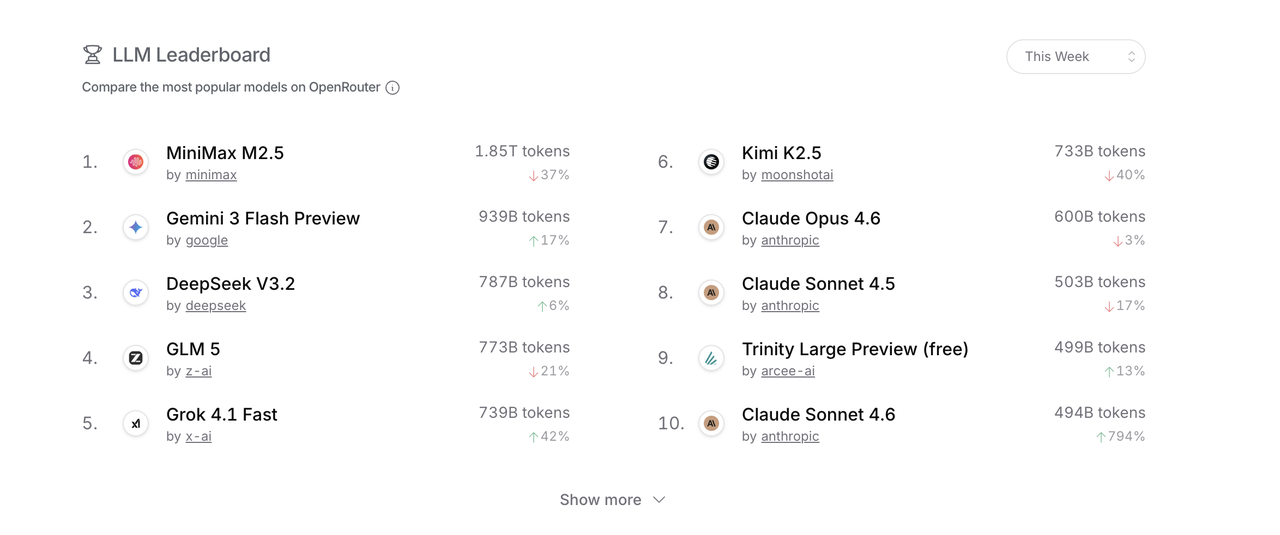
Latest data as of February 26

This is no coincidence; a fuse has been lit.

Earlier this year, OpenClaw emerged, an open-source tool that allows AI to truly work, directly controlling computers, executing commands, and handling complex workflows in parallel. Its GitHub stars surpassed 210,000 within weeks.

John, a finance professional, installed OpenClaw immediately, connected it to the Anthropic API, and began automatically monitoring stock information and generating trading signals. A few hours later, he stared at his account balance in disbelief: dozens of dollars, gone.

This is the new reality brought by OpenClaw. In the past, chatting with AI consumed a few thousand tokens per conversation, with negligible costs. With OpenClaw, AI runs dozens of subtasks in the background, repeatedly calling context and iterating cycles. Token consumption isn't linear; it's exponential. The bill accelerates like a car with the hood open, the fuel gauge dropping, unstoppable.

A "clever trick" soon spread among developer communities: using OAuth tokens to directly connect Anthropic or Google subscription accounts to OpenClaw, turning the "unlimited" monthly quota into free fuel for AI agents. This became a common method for many developers.

Official countermeasures followed.

On February 19, Anthropic updated its terms, explicitly prohibiting the use of Claude subscription credentials for third-party tools like OpenClaw. To access Claude functionality, users must use the API billing channel. Google went further, widely banning subscription accounts that accessed Antigravity and Gemini AI Ultra via OpenClaw.

"The world has suffered long under tyranny." John immediately switched to domestic large models.

On OpenRouter, the domestic model MiniMax M2.5 scores 80.2% on software engineering tasks, while Claude Opus 4.6 scores 80.8%, a negligible difference. But the prices are worlds apart: the former charges $0.3 per million input tokens, while the latter charges $5, a difference of about 17 times.

John switched over. His workflow continued to run, and his bill shrank by an order of magnitude. This migration is happening globally.

OpenRouter's COO, Chris Clark, put it bluntly: Chinese open-source models are capturing a significant market share because they account for an unusually high proportion of the agent workflows run by U.S. developers.

Electricity Exports

To understand the essence of token exports, one must first understand the cost structure of a token.

It seems light—one token is roughly equivalent to 0.75 English words. An ordinary conversation with AI consumes only a few thousand tokens. But when these tokens stack up in trillions, the underlying physical reality becomes heavy.

Breaking down the cost of a token, there are only two core components: computing power and electricity.

Computing power is the depreciation of GPUs. Buying an NVIDIA H100 costs about $30,000, and its lifespan, converted to each inference, is the depreciation cost. Electricity is the fuel for data centers to operate continuously. A GPU consumes about 700 watts at full load, and with cooling systems, the electricity bill for a large AI data center can easily exceed hundreds of millions of dollars annually.

Now, map this physical process.

A U.S. developer in San Francisco sends an API request. The request travels from California via Pacific submarine cables to a data center in China. GPU clusters start working, electricity flows from China's grid to those chips, inference is completed, and results are sent back. The entire process takes maybe a second or two.

Electricity never leaves China's power grid, but its value, through tokens, completes cross-border delivery.

Here's something miraculous that ordinary trade cannot achieve: tokens have no physical form, do not need to pass through customs, are not subject to tariffs, and are almost invisible in any current trade statistics. China exports a vast amount of computing power and electricity services, but in official commodity trade data, it is nearly invisible.

Tokens have become derivatives of electricity. Token exports are essentially electricity exports.

This is also thanks to China's relatively low electricity prices, which are about 40% lower than those in the U.S. This is a physical cost difference that competitors cannot easily replicate.

Additionally, Chinese AI models have algorithmic and "internal competition" advantages.

DeepSeek V3's MoE architecture activates only part of the parameters during inference, with independent tests showing its inference cost is about 36 times lower than GPT-4o. MiniMax M2.5 similarly activates only 10B of its 229B total parameters.

At the top layer is internal competition. Alibaba, ByteDance, Baidu, Tencent, Moon Dark Side, Zhipu, MiniMax... over a dozen companies are competing on the same track, driving prices below reasonable profit margins. Losing money to gain traction is already the industry norm.

Looking closely, this mirrors China's manufacturing exports: leveraging supply chain advantages and internal competition to drastically lower token prices.

From Bitcoin to Tokens

Before tokens, there was another form of electricity export.

Around 2015, power station managers in Sichuan, Yunnan, and Xinjiang began receiving strange visitors.

These people rented abandoned factories, filled them with dense rows of machines, and kept them running 24/7. The machines produced nothing but continuously solved a mathematical problem, occasionally mining a Bitcoin from this endless calculation.

This was the first-generation form of electricity exports: converting cheap hydropower and wind power, via mining machines' hash computations, into globally circulating digital assets, which were then cashed out into dollars on exchanges.

Electricity never crossed any border, but its value, embodied in Bitcoin, flowed to the global market.

During those years, China's computing power once accounted for over 70% of global Bitcoin mining power. China's hydropower and coal power, in this roundabout way, participated in a global redistribution of capital.

In 2021, this came to an abrupt halt. Regulatory crackdowns followed, miners scattered, and computing power migrated to Kazakhstan, Texas, and Canada.

But the logic itself never disappeared; it was just waiting for a new shell. Until ChatGPT emerged, large models began competing, and former Bitcoin mining farms transformed into AI data centers. Mining machines became computing GPUs, and the Bitcoin produced became tokens. The only constant was electricity.

Bitcoin exports and token exports are structurally similar in underlying logic, but tokens hold more commercial value today.

Bitcoin mining is pure mathematical computation, producing Bitcoin as a financial asset. Its value comes from scarcity and market consensus, unrelated to "what was computed." The computing power itself is unproductive, more like a byproduct of a trust mechanism.

Large model inference is different. GPUs consume electricity to produce real cognitive services: code, analysis, translation, creativity. The value of tokens comes directly from their utility to users. This is a deeper embedding; once a developer's workflow relies on a model, the cost of switching increases over time.

Of course, there is another key difference: Bitcoin mining was driven out of China, while token exports are actively chosen by global developers.

Token War

The submarine cable laid in 1858 represented the British Empire's sovereignty over the information highway. Whoever owned the infrastructure could define the rules of the game.

Token exports are also an undeclared war, full of resistance.

Data sovereignty is the first barrier. An API request from a U.S. developer processed by a Chinese data center means data physically flows through China. For individual developers and small applications, this isn't an issue. But for enterprise-sensitive data, financial information, and government compliance scenarios, this is a hard stop. This is why Chinese models have the highest penetration in development tools and personal applications but almost no presence in core enterprise systems.

The chip ban is the second barrier. China's AI development faces export controls on NVIDIA's high-end GPUs. MoE architecture and algorithmic optimization can only partially offset this disadvantage; the ceiling still exists.

But the current resistance is just the prologue; a larger battlefield is forming.

Tokens and AI models have become a new strategic dimension in the U.S.-China rivalry, comparable to semiconductors and the internet in the 20th century, or even closer to an older analogy: the space race.

In 1957, the Soviet Union launched Sputnik 1, shocking the U.S., which then launched the Apollo program, investing resources equivalent to hundreds of billions of dollars today to ensure it did not fall behind in the space race.

The logic of the AI race is strikingly similar but will be far more intense than the space race. Space is physical, something ordinary people don't feel. AI渗透的是经济的毛细血管,渗透到每一行代码、每一份合同、每一个政府决策系统的背后,都可能运行着某个国家的大模型. Whose model becomes the default infrastructure choice for global developers gains structural influence over the global digital economy.

This is what truly worries Washington about China's token exports.

When a developer's codebase, agent workflows, and product logic are built around a Chinese model's API, migration costs rise exponentially over time. Even if the U.S. legislates restrictions, developers will resist with their feet, just as no programmer can abandon GitHub today.

Today's token exports may be just the opening chapter of this long game. Chinese large models claim no intent to颠覆什么; they simply deliver services to every global developer with an API key at a lower price.

This time, those laying the cables are the engineering teams writing code in Hangzhou, Beijing, and Shanghai, and the GPU clusters running day and night in a southern province.

This rivalry has no countdown; it happens 24 hours a day, measured in tokens, on every developer's terminal.


Twitter:https://twitter.com/BitpushNewsCN

Bitpush TG Discussion Group:https://t.me/BitPushCommunity

Bitpush TG Subscription: https://t.me/bitpush

Original link:https://www.bitpush.news/articles/7614803

İlgili Sorular

QWhat is the core concept behind China's AI models 'exporting' power through tokens, as described in the article?

AThe core concept is that while the physical electricity never leaves China's grid, its value is delivered cross-border through AI-generated tokens. When global developers use Chinese AI models via API requests, the computation (and thus power consumption) occurs in Chinese data centers, but the resulting tokens—representing cognitive services like code, analysis, or translation—are transmitted back to users worldwide. This effectively 'exports' the value of China's cheap electricity without the power itself crossing any borders, bypassing traditional trade mechanisms like tariffs.

QAccording to the article, what event in early 2026 acted as a catalyst for the massive migration of global developers to Chinese AI models?

AThe catalyst was the release of 'OpenClaw,' an open-source tool that allows AI to directly control computers and execute complex workflows. This caused token consumption to become exponential rather than linear. When Anthropic and Google banned the use of subscription credentials for OpenClaw, developers sought cheaper alternatives. They migrated en masse to Chinese models like MiniMax M2.5, which offered comparable performance to models like Claude Opus but at a fraction of the cost (e.g., $0.3 per million input tokens vs. $5).

QHow does the article compare the historical export of Bitcoin's hashing power to the current export of AI tokens?

AThe article draws a parallel, stating both are forms of 'power export.' From around 2015, China used cheap hydropower and coal power to mine Bitcoin, converting electricity into a globally traded digital asset without the power physically leaving the grid. This was shut down in 2021. The logic now repeats with AI: GPU clusters in data centers consume Chinese electricity to produce valuable tokens (cognitive services) for global users. The key difference is that Bitcoin mining produced a financial asset based on scarcity, while AI tokens produce utility (e.g., code, analysis), creating deeper user dependency. Bitcoin mining was driven out of China, but token export is being actively chosen by global developers.

QWhat are the two main components of a token's cost structure, as explained in the article?

AThe two main cost components are computing power (算力) and electricity (电力). Computing power refers to the depreciation and amortization of GPUs (e.g., an Nvidia H100 costs about $30,000, and its lifespan cost per inference is the depreciation cost). Electricity is the fuel for data center operation, with a single GPU consuming about 700 watts at full load, plus cooling costs, leading to annual power bills for large AI data centers that can easily exceed hundreds of millions of dollars.

QWhat major challenges or 'walls' does the article identify for China's AI models in the global 'Token War'?

AThe article identifies two major 'walls' or challenges: 1. Data Sovereignty: API requests processed in Chinese data centers mean data flows through China physically. This is a significant concern for enterprises handling sensitive data, financial information, or government compliance, limiting Chinese model adoption in core systems despite high penetration in developer tools. 2. Chip Ban: Export controls on high-end Nvidia GPUs create a hardware disadvantage for Chinese AI development. While architectural optimizations like MoE (Mixture of Experts) can partially offset this, a ceiling on performance and capability remains.

İlgili Okumalar

7 Months After the Collapse of Huiwang, Southeast Asia's Escrow Platforms Undergo a Major Reshuffle

Following the collapse of Huione Pay—dubbed the "Alipay of Southeast Asia"—seven months ago, the region's underground financial guarantee platform sector is undergoing a significant reshuffle. This power vacuum has been swiftly filled by emerging platforms such as XinBi, Tiger/Navigator, JinBei (renamed JinBo), Dali/Tiancheng, and FullyLight. These platforms, operating largely via Telegram and offering services like escrow for illicit transactions, have absorbed the vast user base and markets left behind by Huione. While positioning themselves as "trust intermediaries," their primary clientele consists of networks involved in online scams, money laundering, illegal gambling, and even human trafficking. For instance, the Tiger/Navigator platform explicitly provides "escrow" services for kidnapping-for-ransom operations ("强押车交易"). Data underscores the immense scale: Huione alone processed over $103 billion in cryptocurrency payments and facilitated over $31 billion through its escrow market before its downfall, linking it to Cambodia's notorious Prince Group. Since its collapse, competitors have seen explosive growth. For example, the XinBi platform has accumulated over $1.6 billion in total USDT revenue, while platforms like NewPay, OkPay (under Dali), and FullyLight Wallet collectively processed over $4.8 billion in USDT in a single year. This ecosystem thrives in regions like Cambodia and Myanmar, where regulatory gaps allow these platforms to act as critical financial infrastructure for sprawling cybercrime industries, from scam compounds to online casinos. The article concludes that the moniker "Southeast Asian Alipay" is a misnomer, obscuring the platforms' fundamental role in enabling serious criminal enterprises rather than representing legitimate financial innovation.

Odaily星球日报37 dk önce

7 Months After the Collapse of Huiwang, Southeast Asia's Escrow Platforms Undergo a Major Reshuffle

Odaily星球日报37 dk önce

The Changing Landscape: What Are Crypto VCs Experiencing?

Title: The Shifting Landscape of Crypto Venture Capital The era of dedicated crypto venture capital funds is undergoing a significant transformation. Once essential for navigating the sector's complexity and high risk, these specialized funds are now facing an identity crisis as the market matures. This shift mirrors historical patterns in other specialized investment classes like cleantech and SPACs, where initial information advantages dissipate as technologies become mainstream and integrated into existing industry frameworks. The article argues that crypto is reaching a critical inflection point, transitioning from a "building phase" to an "integration phase." Major players like Stripe, BlackRock, and Visa now engage with crypto not for its novel mechanics but as a foundational financial infrastructure. Their needs—regulatory compliance, banking partnerships, distribution channels—align with traditional fintech, a domain easily understood by large, generalist funds like Sequoia and Founders Fund. This evolution creates a "barbell effect" within the VC landscape. On one end are massive, diversified platforms that can incorporate crypto as one vertical among many. On the other are small, nimble funds focused on niche, experimental projects. The middle ground—medium-sized dedicated crypto funds—is being squeezed out. Their typical fund size makes it impossible to generate sufficient returns solely from early-stage crypto bets, yet they cannot compete with giants for later-stage deals. Consequently, leading crypto-native firms like Paradigm and Framework Ventures are expanding into AI, robotics, and other sectors, driven partly by LP pressure for better returns amid a broader VC DPI crisis. Others, like Dragonfly and a16z, have narrowed their crypto focus predominantly to financial infrastructure like stablecoins, reframing the sector's core narrative. For crypto entrepreneurs, this consolidation presents challenges. While generalist funds offer larger checks and broader resources, crypto projects now compete fiercely with AI for attention and capital within these firms. Furthermore, the long-term, non-commercial foundational work that built the ecosystem—funded by dedicated crypto VCs—is less likely to attract generalist capital focused on direct returns. The conclusion is that "crypto investor" as a standalone category is becoming obsolete, akin to "internet investor." Crypto is becoming a baseline infrastructure layer. The future will see a barbell structure: large-scale growth financing handled by generalist funds, while pioneering, speculative projects are funded by small, specialized vehicles. The dedicated crypto funds of the 2017-2021 boom, which incubated core infrastructure, are giving way to this new, bifurcated reality.

Foresight News55 dk önce

The Changing Landscape: What Are Crypto VCs Experiencing?

Foresight News55 dk önce

As Consensus Accelerates, What Are Young Investors Betting On?

Title: As Consensus Forms Faster, What Are Young Investors Betting On? In the rapid evolution of tech investment, a new generation of young investors is navigating a landscape where AI, robotics, commercial aerospace, and quantum computing are advancing simultaneously. Traditional investment logic based on financial models is giving way to a need for deep technical understanding and the ability to act before industry consensus forms. An analysis of trends from the "WAIC FUTURE TECH" list of young investment leaders reveals key shifts in focus. The first major trend is the movement of AI from the digital screen into the physical world. Investment is shifting from large language models and chatbots towards embodied AI, robotics, AI hardware, and edge computing. While demonstrations generate excitement, the real challenge lies in achieving scalable, reliable, and cost-effective delivery in complex real-world environments like factories and logistics. Success depends not just on algorithms but on the integration of sensors, actuators, and control systems. Second, the competitive focus for large models is moving beyond raw capability toward building an "intelligence flywheel." The goal is to create self-reinforcing systems where user interaction generates data, improving the model, which in turn enhances the user experience and attracts more engagement. Companies that successfully embed AI into workflows to create these closed-loop systems can build lasting value that isn't easily erased by the next model upgrade. Third, facing a potential bottleneck in high-quality human-generated data, investors are looking at new underlying technologies. Reinforcement learning and self-play, as demonstrated by AlphaGo Zero, offer paths for AI to generate its own experience. Scientific foundation models, which aim to build general AI capabilities for fields like life sciences and materials discovery, represent a non-consensus direction that could unlock new frontiers of knowledge and data. Finally, in deep-tech areas like quantum computing, commercial aerospace, and space-based infrastructure, patient capital is essential. These fields have long, uncertain development and validation cycles involving complex engineering, supply chains, and regulations. Investment here requires a long-term view, focusing on foundational team capabilities and the eventual emergence of market demand, even if commercial returns are distant. Collectively, these trends illustrate how young investors are adapting to a new era. They are learning to make earlier, technically-informed judgments, balance hype with real-world viability, and provide the patient capital needed to build the deep-tech foundations of the future.

marsbit1 saat önce

As Consensus Accelerates, What Are Young Investors Betting On?

marsbit1 saat önce

İşlemler

Spot
活动图片





