How Do 99% of Non-Profit Web3 Projects Survive?

marsbit2026-01-09 tarihinde yayınlandı2026-01-09 tarihinde güncellendi

Özet

99% of Web3 projects lack cash flow and survive by relying on token sales and external funding rather than actual revenue. These projects often prioritize early token generation events (TGE) and aggressive fundraising over product development, leading to inflated valuations unsupported by real economic activity. The core issue is the "runway period"—the time a project can operate without revenue. Without sustainable income, projects eventually exhaust their resources and fail. Even marketing efforts become short-term fixes that can't compensate for a non-viable product. A comparison with the top 1% of profitable Web3 projects—which maintain reasonable price-to-earnings (P/E) ratios—highlights the unsustainable valuations of the remaining 99%. The system incentivizes founders to exit early via token unlocks and sales, regardless of project success, while investors bear the losses. This creates a distorted cycle where financial engineering outweighs genuine value creation.

Original Author: Ryan Yoon, Tiger Research

Original Compilation: Saoirse, Foresight News

99% of Web3 projects have no cash income, yet many companies still invest huge amounts of money in marketing and events every month. This article will delve into the survival rules of these projects and the truth behind "burning money".

Core Points

  • 99% of Web3 projects lack cash flow, and their cost expenditures rely on tokens and external funds, not product sales.
  • Premature listing (token issuance) leads to a surge in marketing expenditures, which in turn weakens the competitiveness of the core product.
  • The reasonable price-to-earnings ratio (P/E) of the top 1% of projects proves that the remaining projects lack actual value support.
  • Early token generation events (TGE) allow founders to "exit and cash out" regardless of the project's success or failure, creating a distorted market cycle.
  • The "survival" of 99% of projects essentially stems from a system defect built on investor losses rather than corporate profits.

Prerequisite for Survival: Verified Revenue Ability

"The prerequisite for survival is having verified revenue ability"—this is the most core warning in the current Web3 field. As the market matures, investors no longer blindly chase vague "visions". If a project cannot attract real users and actual sales, token holders will quickly sell and leave.

The key issue is the "fund turnover period", which is the time a project can maintain operations in a non-profit state. Even without sales, costs such as wages and server fees still need to be paid monthly, and teams without income have almost no legal channels to maintain operating funds.

Financing costs without income:

However, this "survival by tokens and external funds" model is only a stopgap measure. There is a clear upper limit to assets and token supply. Eventually, projects that exhaust all funding sources either cease operations or quietly exit the market.
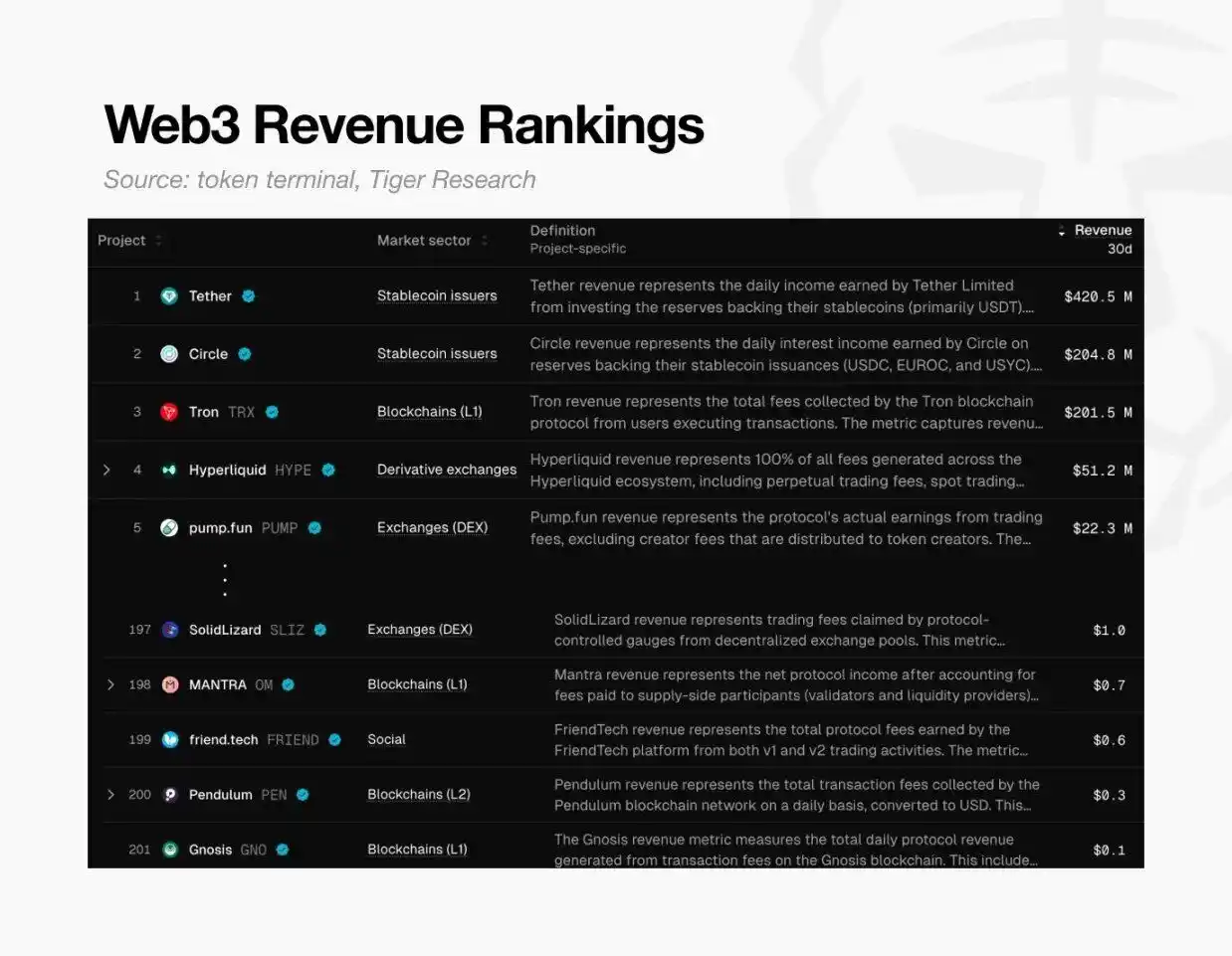
Web3 Revenue Ranking Table, Source: token terminal and Tiger Research

This crisis is universal. According to Token Terminal data, globally, only about 200 Web3 projects have achieved an income of $0.10 in the past 30 days.

This means that 99% of projects do not even have the ability to pay their own basic costs. In short, almost all cryptocurrency projects have failed to verify the feasibility of their business models and are gradually declining.

High Valuation Trap

This crisis was largely predetermined. Most Web3 projects completed their listing (token issuance) based solely on "vision", without even launching an actual product. This is in stark contrast to traditional enterprises—traditional enterprises must first prove their growth potential before an initial public offering (IPO); in the Web3 field, teams instead have to prove the rationality of their high valuation after listing (token generation event TGE).

But token holders will not wait indefinitely. As new projects emerge daily, if a project fails to meet expectations, holders will quickly sell and leave. This puts pressure on the token price, thereby threatening the project's survival. Therefore, most projects invest more funds in short-term hype rather than long-term product development. Obviously, if the product itself lacks competitiveness, even the most intensive marketing will eventually fail.

At this point, the project falls into a "dilemma trap":

  • If only focus on product development: It takes a lot of time, and during this period, market attention will gradually fade, and the fund turnover period will continue to shorten;
  • If only focus on short-term hype: The project becomes empty and lacks actual value support.

Both paths ultimately lead to failure—the project cannot prove the rationality of its initial high valuation and eventually collapses.

See the Truth of 99% of Projects Through the Top 1%

However, 1% of top projects have proven the feasibility of the Web3 model with huge revenues.

We can judge the value of major profitable projects such as Hyperliquid and Pump.fun through their price-to-earnings ratio (PER). The price-to-earnings ratio is calculated as "market capitalization ÷ annual income", and this indicator can reflect whether the project valuation is reasonable relative to actual income.

Price-to-earnings ratio comparison: Top Web3 projects (2025):
Note: Hyperliquid's sales are annualized estimates based on performance since June 2025.

The data shows that the price-to-earnings ratio of profitable projects ranges from 1x to 17x. Compared with the average price-to-earnings ratio of the S&P 500 index of about 31x, these top Web3 projects are either "undervalued relative to sales" or "have excellent cash flow conditions".

The fact that top projects with actual returns can maintain a reasonable price-to-earnings ratio makes the valuation of the remaining 99% of projects untenable—it directly proves that the high valuation of most projects in the market lacks a basis in actual value.

Can This Distorted Cycle Be Broken?

Why can projects with no sales still maintain valuations of billions of dollars? For many founders, product quality is only a secondary factor—Web3's distorted structure makes "quick exit and cash out" much easier than "building a real enterprise".

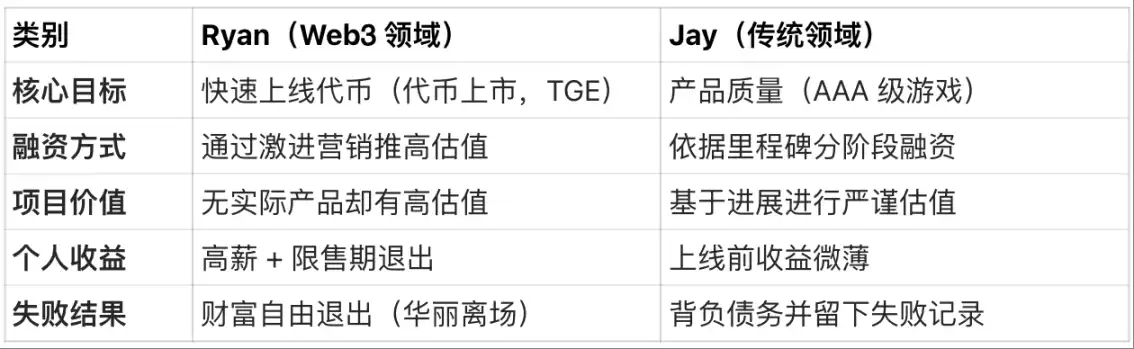
The cases of Ryan and Jay can explain this well: both launched AAA-level game projects, but the final outcomes were completely different.

Founder differences: Web3 vs. traditional model comparison

Ryan: Chose TGE, abandoned deep development

He chose a path centered on "profit": obtaining early funds by selling NFTs before the game was launched; then, while the product was still in a rough development stage, he held a token generation event (TGE) based solely on an aggressive roadmap and completed the listing on a medium-sized exchange.

After listing, he maintained the token price through hype, buying time for himself. Although the game was eventually launched late, the product quality was extremely poor, and holders sold and left. Ryan finally resigned on the grounds of "taking responsibility", but he was the real winner of this game—

On the surface, he pretended to focus on work, but in reality, he received a high salary while making huge profits by selling unlocked tokens. Regardless of the project's final success or failure, he quickly accumulated wealth and exited the market.

In contrast, Jay: Followed the traditional path, focused on the product itself

He prioritized product quality over short-term hype. But the AAA-level game development takes years, during which his funds were gradually exhausted, and he fell into a "fund turnover crisis".

In the traditional model, founders have to wait until the product is launched and sales are achieved before they can get considerable returns. Although Jay raised funds through multiple rounds of financing, he eventually shut down the company before the game was developed due to lack of funds. Unlike Ryan, Jay not only did not get any profit, but also was burdened with huge debts and left a record of failure.

Who is the Real Winner?

Neither case produced a successful product, but the winner is clear: Ryan accumulated wealth by utilizing Web3's distorted valuation system, while Jay lost everything in the process of trying to build a quality product.

This is the cruel reality of the current Web3 market: using excessive valuation to exit early is much easier than building a sustainable business model; and ultimately, the cost of this "failure" is all borne by investors.

Back to the initial question: "How do 99% of non-profit Web3 projects survive?"

This cruel reality is the most honest answer to that question.

İlgili Sorular

QAccording to the article, what is the main reason 99% of Web3 projects can survive without cash flow?

AThey rely on token sales and external funding rather than product revenue to cover their costs.

QWhat is the 'two-way trap' that unprofitable Web3 projects face after their Token Generation Event (TGE)?

AIf they focus only on product development, they lose market attention and their runaway period shortens. If they focus only on short-term hype, the project becomes hollow with no real value.

QHow does the Price-to-Earnings Ratio (P/E) of the top 1% of profitable Web3 projects reveal the truth about the other 99%?

AThe reasonable P/E ratios of the profitable top 1% prove that the high valuations of the other 99% of projects lack a foundation in real value.

QWhat key incentive does the article suggest drives founders to conduct an early TGE, even if their product is not ready?

AThe distorted structure of Web3 allows founders to achieve a 'quick exit and cash out' by selling their unlocked tokens for massive profits, regardless of the project's ultimate success or failure.

QIn the comparison of the two founders, Ryan and Jay, who was the 'winner' and what does this reveal about the current Web3 market?

ARyan was the winner because he accumulated wealth by exploiting the Web3 system, while Jay lost everything trying to build a quality product. This reveals that it is easier to exit using inflated valuations than to build a sustainable business, with the cost of failure borne by investors.

İlgili Okumalar

Bank of Japan Signals Interest Rate Hike Despite Keeping Them at 1%

The Bank of Japan (BOJ) kept its benchmark interest rate at 1% on July 31, as widely expected, following a June hike to a 31-year high. The decision passed with an 8-1 vote, with board member Hajime Takata again dissenting in favor of a hike to 1.25%. Despite holding rates steady, the BOJ signaled a hawkish tilt, warning that underlying inflation is likely to accelerate and exceed 2% from the latter half of the fiscal year. While it slightly lowered its core inflation forecast for FY2026, officials expressed stronger confidence that an overshoot will occur later, driven by yen weakness, corporate pricing behavior, and lingering energy shock effects. Markets were focused on the BOJ's forward guidance. Analysts noted the central bank appeared to balance short-term caution with a long-term warning of tighter policy. Governor Kazuo Ueda faces the challenge of reconciling a government reluctant to tighten further with bond markets already pricing in additional hikes, with the timing of the next move debated. Adding complexity, the BOJ reportedly intervened in currency markets hours before the rate decision, buying yen to support the currency which had fallen to 40-year lows against the dollar. Yen weakness stems from the wide U.S.-Japan interest rate gap, high fuel prices, and market skepticism about the pace of BOJ policy normalization. The yield on Japan's 10-year government bonds fell to 2.8%, indicating investor expectations for future monetary tightening.

cryptonews.ru6 dk önce

Bank of Japan Signals Interest Rate Hike Despite Keeping Them at 1%

cryptonews.ru6 dk önce

Why Are Leveraged ETFs like 7709 Inherently Negative EV Products?

This article argues that the SK H力士 2x Leveraged ETF (7709) is fundamentally a negative expected value (EV) product, rather than simply a "double SK H力士" investment. Its core issue stems from its daily rebalancing mechanism to maintain a 2x leverage target. After a price move, the fund must buy more after a rise or sell after a fall to readjust its leverage, creating a systematic pattern of buying high and selling low. This introduces a "delay loss": it always reacts to past price changes, missing potential gains from adjusting earlier during an uptrend and suffering greater losses from adjusting later during a downtrend. While more frequent intraday rebalancing would improve returns in strong, smooth trending markets by reinvesting profits or cutting losses sooner, it also dramatically increases volatility drag (frictional losses) during choppy, oscillating markets due to more frequent high-buy/low-sell trades. The author draws a parallel to an option seller who delta hedges (short gamma), which involves similar "buy high, sell low" dynamic hedging. However, unlike an option seller who receives upfront premium (IV and theta) as compensation for this risk, the leveraged ETF investor receives no such compensation. Instead, they bear all the path-dependent volatility decay, plus additional costs like swap/derivatives financing, management fees, and trading slippage. Thus, the product's return profile can be framed as: 2x directional return minus realized variance drag minus financing costs minus derivatives costs minus management fees minus transaction costs. For the investor to profit, SK H力士's price must not only rise significantly but do so in a strong, sustained, and smooth trend to overcome these inherent structural costs. High volatility and frequent price reversals are particularly damaging. The article also notes that while the ETF has no explicit liquidation line like perpetual futures, avoiding a sudden "blow-up," its net asset value can still decay towards zero over time through this combination of volatility drag and fees. For experienced traders, directly managing leverage via perpetual contracts may offer more control and potentially lower costs than this packaged, mechanistic product.

marsbit13 dk önce

Why Are Leveraged ETFs like 7709 Inherently Negative EV Products?

marsbit13 dk önce

'Backstabbing' or 'Win-Win'? How Likely Is TradeXYZ to Break Away from Hyperliquid and Go Solo?

The article discusses the growing debate over whether TradeXYZ, which dominates Hyperliquid's HIP-3 market with over 90% of its volume, might break away to build its own independent trading platform. This possibility is fueled by TradeXYZ's immense market influence and the common industry trend of successful projects seeking more control and profit capture. Key arguments for a potential split include TradeXYZ's overwhelming contribution to Hyperliquid's metrics and the financial incentive to retain all transaction fees, as it currently splits them 50/50 with Hyperliquid. The piece draws parallels to other cases, like Anthropic's "Claude Code" competing with its former partner Cursor, suggesting "betrayal" can occur when business leverage shifts. However, strong counterarguments suggest a split is unlikely or would be detrimental. TradeXYZ relies on Hyperliquid's high-performance infrastructure and its platform as a primary user acquisition channel. Building a comparable system would be challenging. Furthermore, the founders of both projects share a history of trust and mutual admiration. The analysis concludes that a separation would likely be a lose-lose scenario: Hyperliquid would lose a major growth narrative and trading volume, while TradeXYZ would face technical hurdles, user migration issues, and reputational damage, potentially allowing competitors to seize market share. The most rational path is seen as continued collaboration, with TradeXYZ potentially negotiating better terms while leveraging Hyperliquid's established strengths.

marsbit23 dk önce

'Backstabbing' or 'Win-Win'? How Likely Is TradeXYZ to Break Away from Hyperliquid and Go Solo?

marsbit23 dk önce

İşlemler

Spot
活动图片