How Did BitMine, with Staked ETH Generating $46 Million in Steady Income, Still End Up in Massive Losses?

Foresight News2026-07-16 tarihinde yayınlandı2026-07-16 tarihinde güncellendi

Özet

BitMine, a crypto asset manager, reported strong revenue growth in its fiscal Q3 2026, primarily from its Ethereum staking operations, which generated $45.7 million. However, the company posted a net loss of $83.6 million for the quarter. This significant loss was driven by a $92.1 million deficit from Ethereum derivative options trading, completely offsetting the staking income. The company is aggressively shifting from Bitcoin mining to accumulating Ethereum, financing this strategy almost entirely by issuing new common stock. This has led to substantial shareholder dilution, with the share count increasing by 149% over nine months. As of late May, BitMine held 5.42 million ETH with a massive unrealized loss of approximately $8.2 billion due to market depreciation. While the staking business provides a stable cash flow that covers core operational costs, profitability is pressured by high, fixed fees from long-term service agreements and growing administrative expenses. Although the company holds no traditional debt, its model heavily relies on continuous access to capital markets for equity financing to sustain its Ethereum accumulation. The company's long-term viability hinges on its ability to manage derivative risks, control costs, and benefit from a significant recovery in Ethereum's price.


Author: Oluwapelumi Adejumo

Translation: Chopper, Foresight News


BitMine aggressively built up its Ethereum holdings, attempting to transform them into a stable source of cash flow, with its staking business generating nearly $46 million in revenue last quarter.


However, a $92.1 million loss on derivatives and options completely offset these staking gains. Combined with persistently high asset management costs and the company's aggressive issuance of new shares, the profit potential for existing shareholders was significantly compressed.


The Q3 FY2026 financial report, for the period ending May 31, shows company revenue soared to $46.5 million from $2.1 million in the same period last year; 98% ($45.7 million) of this came from staking and node validation services. BitMine is accelerating its exit from Bitcoin mining to fully transition to an Ethereum treasury model.


Despite the substantial revenue growth, the company reported a net loss of $83.6 million for the quarter, a dramatic increase compared to a modest loss of $623,000 in the same period last year.


Massive Options Losses Wipe Out All Ethereum Staking Gains


The core factor dragging down this quarter's performance was the company's Ethereum derivatives and options trading strategy. BitMine incurred a combined loss of $92.1 million on Ethereum-related derivatives this quarter, approximately double the total revenue from its staking business during the same period. This included $78.6 million in net losses from expired option contracts and $14 million from exercised positions. Gains of only $534,000 from unsettled contracts provided negligible offset.


The company engaged in no derivatives trading during the same period last year, marking a qualitative leap in its asset management risk exposure. For the first nine months of the fiscal year, cumulative derivatives losses totaled $133.3 million, consisting of $79.3 million from exercised losses and $54.5 million from expired contracts, with only $515,000 in gains from unsettled positions. During the same period, staking and validation services generated only $56.9 million, making derivatives losses more than double the staking income.


BitMine stated that its options strategy primarily involves selling put options as part of its overall portfolio management. While selling puts can generate premium income and allow for asset accumulation at lower prices, it can result in massive losses if the market moves against the position and contracts are exercised under unfavorable conditions. The scale of this loss clearly demonstrates that the attempt to enhance returns with options has, for now, completely negated the stable income generated by the node staking business.


Simultaneously, the company's general and administrative expenses surged to $37.3 million from $744,000 a year ago. Management explained that the increase was primarily due to digital asset custody and management service fees, salary adjustments, and increased cash and stock-based compensation for directors.


Excluding changes in the valuation of crypto assets, staking income was sufficient to cover the quarter's cost of sales and administrative expenses. Even after adjusting for several non-cash items, the company's own adjusted non-GAAP net loss still reached $70.8 million. This financial report indicates that while the node validation business has generated a substantial and stable cash flow, the overall portfolio trading strategy continues to consume staking profits.


Continuous BMNR Share Issuance to Hoard Ethereum, Sharply Diluting Shareholder Equity


The funds for BitMine's large-scale Ethereum accumulation came almost entirely from public market offerings of common stock, with the cost fully borne by existing shareholders. In the nine months ending May 31, the company sold 340.7 million shares of BMNR common stock through its at-the-market offering program, raising $11.87 billion net of issuance costs; during the same period, it spent $11.69 billion purchasing Ethereum.


Shareholder equity was significantly diluted. The number of common shares outstanding increased by 149% over nine months, from 232.4 million as of August 31, 2025, to 579.7 million by the end of May 2026; issuance continued after the quarter ended, with total shares reaching 603.2 million as of July 9.


Fueled by equity financing, BitMine had accumulated holdings of 5.42 million Ethereum by May 31, with a combined acquisition cost of $19.05 billion; holdings had increased to 5.7 million Ethereum at the time of writing.
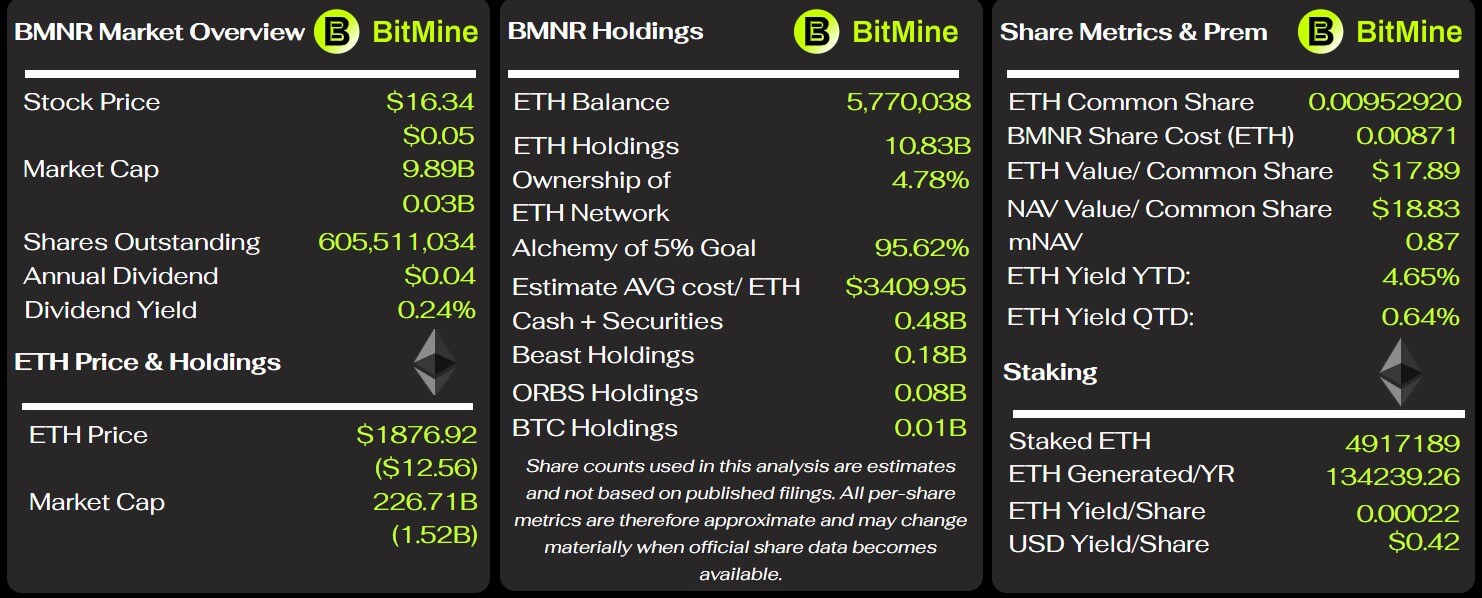

Key Metrics for BitMine, Source: BitMine Tracker


As of the end of May, this Ethereum portfolio was valued at only $10.86 billion, representing an unrealized loss of approximately $8.2 billion, a 43% decline from cost.


This portfolio devaluation was the primary source of the $9.04 billion unrealized loss on digital assets for the first nine months of the fiscal year, during which the company reported a cumulative net loss of $9.1 billion. The massive unrealized loss vividly illustrates that BitMine's share issuances purchased Ethereum at high prices, with all the risk borne by shareholders.


A shareholder meeting in January approved an increase in the company's authorized common shares from 500 million to 50 billion. This authorization does not obligate the company to issue all shares but grants management ample room to continue issuing stock for purchasing digital assets and other investments.


BitMine cautioned that its ability to expand its Ethereum holdings is highly dependent on continuous and unimpeded access to financing. A decline in Ethereum's price, weakness in the company's stock price, or a decrease in investor appetite for its offerings could all increase the cost of future financing or even restrict the company's ability to issue securities on favorable terms.


The viability of this business model depends not only on staking yields and future Ethereum price appreciation but also on shareholders accepting significant equity dilution and the portfolio carrying billions in unrealized losses, while continuously providing capital for the company's coin accumulation.


Long-Term Service Contracts Increase Staking Operating Costs, Compressing Profit Margins


BitMine relies on its staking business to hedge against portfolio price volatility, but accompanying long-term cooperation agreements generate fixed fees and profit-sharing, continuously compressing overall profitability. The company has a ten-year consulting agreement with third-party service provider Ethereum Tower, incurring an expense of $12.8 million this quarter, representing about 28% of the period's total staking revenue. Cumulative fees for the first nine months amounted to $37.5 million; the company estimates annual fees in the range of $40 to $50 million, calculated on a tiered basis against the total value of managed digital assets.


The agreement can only be terminated under a few specific conditions. If BitMine terminates without cause, it must pay Ethereum Tower 85% of all estimated service fees for the remaining contract term.


Furthermore, following its acquisition of node operator Pier Two, BitMine entered into a separate ten-year management services agreement. This agreement grants Ethereum Tower a 2% equity stake in the MAVAN platform, with monthly profit-sharing based on a percentage of the platform's native staking rewards. As of May 31, the company had not accrued any expenses related to this agreement, so the profit-sharing costs are not yet reflected in the staking business's income statement.


BitMine stated that the vast majority of its Ethereum is staked through MAVAN, and over the long term, staking rewards are expected to cover asset custody costs. Looking solely at the operational level this quarter, staking revenue did cover sales and administrative expenses excluding crypto asset valuation changes. However, the combination of a decade-long fixed consulting fee, future profit-sharing, and various other asset management expenses means that relying solely on staking income does not accurately reflect the business's true profitability.


Despite No Debt, BitMine's Dependence on Capital Markets Deepens


As of the end of May, BitMine's balance sheet showed extremely low leverage, with $340.3 million in cash, working capital of $433.1 million, and no traditional debt. Total assets were $11.63 billion, with total liabilities of only $30.1 million, and assets predominantly consisting of Ethereum and other digital assets. On paper, the company faces no immediate debt crisis, but operating activities used $287.6 million in cash during the first nine months. The company attributed the cash burn primarily to legal, consulting, and investment banking fundraising fees associated with expanding its Ethereum holdings.


After the quarter ended, BitMine issued an additional 3.5 million shares of its 9.5% annual perpetual preferred stock, BMNP, raising $273.8 million. While this offering supplemented short-term liquidity, it adds a new, rigid annual dividend expense of approximately $33.25 million for the preferred shares. Although this security is equity, not debt, it has priority over common shares in liquidation, and its high dividend continuously consumes company cash flow.


Management believes existing cash, expected operating cash flow, and the at-the-market offering facility are sufficient to fund operations for at least the next 12 months. This assessment assumes the capital markets remain open: if Ethereum prices remain depressed long-term, the company's stock price weakens, or investor appetite wanes, the company's financing costs will rise, and its operational flexibility will be constrained.


Synthesizing the latest financial report, BitMine presents a set of contradictory realities: On one hand, the company has established a mature staking business generating tens of millions in quarterly revenue, enough to cover core operational expenses. On the other hand, massive options losses completely devour staking profits, long-term contracts persistently increase management costs, and Ethereum accumulation relies entirely on share issuance, with the total share count more than doubling.


Therefore, BitMine's long-term economic viability depends on whether staking income can stably cover various asset management costs and options losses, whether the company can sustainably secure equity financing, and whether Ethereum's price can stage a significant recovery.

Trend Kriptolar

İlgili Sorular

QWhat was the main driver behind BitMine's significant increase in revenue for the fiscal year Q3 2026, and what percentage of total revenue did it constitute?

AThe significant increase in revenue was primarily driven by BitMine's Ethereum staking and node validation business, which generated approximately $45.7 million and constituted 98% of the total quarterly revenue of $46.5 million.

QHow did BitMine's derivatives trading strategy impact its overall financial performance in the reported quarter, and what was the nature of this strategy?

ABitMine's Ethereum derivatives trading strategy resulted in a loss of $92.1 million, completely negating the $45.7 million earned from staking. The strategy involved primarily selling put options to earn premiums and accumulate assets at lower prices, which backfired due to adverse market movements.

QHow did BitMine finance its large-scale accumulation of Ethereum, and what was the impact on existing shareholders?

ABitMine financed its Ethereum purchases almost entirely by issuing new common stock (BMNR) to the public market. Over nine months, it issued 340.7 million shares, raising $11.87 billion. This diluted existing shareholders' equity significantly, increasing the number of common shares outstanding by 149%.

QWhat are the key long-term costs associated with BitMine's staking operations that squeeze its profit margins?

AKey long-term costs include a 10-year consulting agreement with Ethereum Tower, costing $12.8 million in the quarter (28% of staking revenue), and a 10-year management services agreement related to the Pier Two acquisition, which will give Ethereum Tower 2% equity in the MAVAN platform and a share of future staking rewards.

QDespite having no traditional debt, what are the significant risks and dependencies in BitMine's financial model according to the article?

ABitMine's financial model is heavily dependent on continuous access to capital markets through equity financing to fund its Ethereum accumulation and operations. Risks include: high dilution for shareholders, massive unrealized losses on its Ethereum holdings ($8.2 billion), large mandatory costs from long-term service contracts, and vulnerability to declines in Ethereum's price or the company's stock price, which could hinder its ability to raise funds.

İlgili Okumalar

Are Meme Coins a Shortcut or a Trap? Robinhood Chain Faces a Crucial Decision

Robinhood Chain, the blockchain initiative by the brokerage platform, is experiencing a strong initial surge in activity. Key metrics include over 300,000 daily active addresses, daily DEX trading volume surpassing $1 billion (ranking second among public blockchains), and a TVL exceeding $3 billion. However, the article expresses significant concern that this growth is overwhelmingly driven by memecoin trading, as observed on the Robinhood Wallet. The author argues this is a dangerous shortcut. While memecoins can rapidly boost user numbers, trading volume, and liquidity, they often result in substantial investor losses, erode trust in the ecosystem, and risk cementing Robinhood's reputation as a speculative, meme-driven platform—a perception Wall Street already holds. The piece contrasts this path with that of Coinbase's Base chain, which has emphasized fostering applications with real utility and sustainable business models. It urges Robinhood Chain to avoid becoming a "memecoin chain" and instead focus its resources on substantial use cases, particularly the tokenization of real-world assets (RWA). The proposed strategic pivot is toward facilitating global access to tokenized stocks, RWA, and other real financial instruments through its chain. This aligns with crypto's original promise of democratizing finance and represents Robinhood's largest growth opportunity: tapping into over 100 million potential new international users beyond its nearing-saturation U.S. market. Success in this direction could drive significant future revenue and redefine the company's legacy beyond the meme-stock narrative. The core message is a plea to Robinhood's leadership: choose sustainable, value-creating finance over the fleeting and damaging allure of memecoins.

Foresight News14 dk önce

Are Meme Coins a Shortcut or a Trap? Robinhood Chain Faces a Crucial Decision

Foresight News14 dk önce

The Biggest Bull Market in History: Did It Cause 320,000 South Koreans to Go Bankrupt Overnight?

South Korea's stock market experienced extreme volatility in mid-2026, leading to massive losses for retail investors. The KOSPI index, driven heavily by semiconductor giants Samsung Electronics and SK Hynix, plunged about 25% from its June high, entering a technical bear market. On July 13 alone, SK Hynix shares crashed over 15%, its worst single-day drop in two decades, triggering margin calls for over 1.2 million leveraged散户 accounts. Approximately 320,000 of these were forcibly liquidated. The dramatic sell-off followed a historic bull run where the KOSPI had doubled in six months, with SK Hynix soaring 300%. This fueled a national投机 frenzy, with散户 extracting savings and taking on record leverage to chase AI and semiconductor stocks. However, data revealed that even during the rally, about 73% of散户 lost money in the top 50 most-traded stocks. The market's extreme concentration—Samsung and SK Hynix alone comprised half the KOSPI's市值—made it highly volatile. Five全市场熔断 occurred in just five weeks. The downturn sparked widespread distress, including reports of a suicide attempt and a stabbing linked to investment losses. A sharp rebound occurred on July 15, with the KOSPI soaring over 7%, but the episode highlighted the risks of a highly leveraged, sentiment-driven market. Analysts note a recurring pattern in Korea of rapid, narrative-driven booms and busts—from the Han River Miracle to internet stocks and now AI—driven by a "compressed modernity" and a pervasive "get-rich-quick" mentality among investors across all ages.

marsbit23 dk önce

The Biggest Bull Market in History: Did It Cause 320,000 South Koreans to Go Bankrupt Overnight?

marsbit23 dk önce

From Blockchain's First Share to the Edge of Delisting: Canaan Technology Trapped in a 'Fight for Survival'

Canaan Inc., once hailed as the "first global blockchain stock," is now fighting to avoid delisting from Nasdaq. On July 15, the company received a 180-day extension, until January 11, 2027, to regain compliance after its ADS price fell below $1 for 30 consecutive trading days. Its market cap has plummeted over 90% from its peak after its 2019 IPO. The financial picture is grim. Q1 2026 results showed a 24.3% year-over-year revenue decline to $62.7 million and a net loss of $88.7 million. The company recorded a gross loss, including approximately $25 million in non-cash inventory writedowns for its mining machines, signaling collapsing demand. Its Q2 revenue guidance is a weak $35-45 million. A costly strategic misstep contributed to its troubles. In June 2025, Canaan terminated its non-core AI chip business after years of development yielded minimal revenue but significant operating expenses, forcing a full retreat to its core Bitcoin mining hardware and proprietary mining operations. However, the core business faces intense pressure. The mining machine industry is highly cyclical and tied to Bitcoin's price. In the current "post-halving" environment with lower marginal returns, demand has cooled sharply. Canaan's product revenue crashed to $42.9 million in Q1 2026 from $164.9 million in Q4 2024. In response, management is pivoting from a pure hardware seller to a "computing power infrastructure service provider." It is expanding proprietary mining, with total hash rate in joint projects reaching 11 EH/s, and exploring energy integration projects like using mining heat for agriculture. It also secured $72 million in strategic investment in late 2025. Canaan's struggle reflects the broader crypto mining winter, where capital has shifted toward AI and high-performance computing. The company must now prove its viability within the 180-day grace period, with a potential reverse stock split on the table, as the market focuses on cash flow and profitability over mere narrative.

Foresight News45 dk önce

From Blockchain's First Share to the Edge of Delisting: Canaan Technology Trapped in a 'Fight for Survival'

Foresight News45 dk önce

New Fire Research Institute: Rising Middle East Tensions and Capital Outflows Put Short-Term Pressure on the Crypto Market

New Fire Institute Research: Crypto Market Under Short-Term Pressure Amid Rising Middle East Tensions and Capital Outflows **Market Recap:** US military strikes in the Middle East escalated tensions, driving oil prices and US Treasury yields higher while pressuring Asian risk assets. Against a backdrop of weaker gold and a strong US dollar, crypto market risk appetite faced external pressure. The total stablecoin market cap has shrunk by $10 billion since May, with a net outflow of $7.7 billion in June alone. Trading volume on South Korea's top five crypto exchanges hit a near-2.9-year low. Despite broad market pressure, Robinhood's L2 network saw over $70 million in ETH bridged in its first week, boosting optimism for the Ethereum ecosystem. Circle's approval to establish a US national trust bank also injected confidence into long-term compliant funding channels. A correction signal in the AI sector is notable, with US AI stocks pulling back over 30% from recent highs. Macro-geopolitical risks and shrinking on-chain liquidity suggest the crypto market is in a short-term, 'risk-off' defensive phase, with Bitcoin price fluctuating in a 'high-value range'. **Outlook:** The US Senate will review the *CLARITY Act* on July 20th, with its direction potentially reshaping the industry's compliance framework. Key debates center on ethics restrictions for government officials in crypto, developer liability, and stablecoin rewards. Escalating Middle East tensions could reignite inflation concerns, impacting Fed policy expectations. The Bank of Japan's likely rate hold in July may temporarily ease liquidity pressure from yen carry trades. Monitoring oil prices and the strong dollar's impact on risk assets is crucial. Notably, Hyundai Motor became the first major South Korean firm to adopt internal stablecoin transfers, accelerating the trend of traditional giants embracing Web3. **Market View:** The market is currently in a state of 'macro risk-off versus price action博弈'. With momentum limited by Middle East tensions and capital outflows, and with significant regulatory developments pending, sidelined capital is adopting a wait-and-see approach. The market is likely to maintain range-bound, liquidity-seeking consolidation in the near term.

marsbit1 saat önce

New Fire Research Institute: Rising Middle East Tensions and Capital Outflows Put Short-Term Pressure on the Crypto Market

marsbit1 saat önce

İşlemler

Spot

Popüler Makaleler

ETH 2.0 Nedir

ETH 2.0: Ethereum için Yeni Bir Dönem Giriş ETH 2.0, Ethereum 2.0 olarak da bilinir, Ethereum blok zincirinde önemli bir yükseltmeyi işaret eder. Bu geçiş yalnızca bir yüz değiştirme değil; ağın ölçeklenebilirliğini, güvenliğini ve sürdürülebilirliğini temelinden geliştirmeyi hedeflemektedir. Enerji yoğun Proof of Work (PoW) konsensüs mekanizmasından daha verimli olan Proof of Stake (PoS) mekanizmasına geçişle birlikte, ETH 2.0 blok zinciri ekosistemine dönüştürücü bir yaklaşım vaat etmektedir. ETH 2.0 Nedir? ETH 2.0, Ethereum'un yeteneklerini ve performansını optimize etmeye odaklanmış özel, birbirine bağlı güncellemelerin bir derlemesidir. Yenileme, mevcut Ethereum mekanizmasının karşılaştığı kritik zorlukları, özellikle işlem hızı ve ağ tıkanıklığı ile ilgili sorunları ele almak üzere tasarlanmıştır. ETH 2.0'ın Amaçları ETH 2.0'ın ana amaçları, üç temel unsuru geliştirmeye odaklanmaktadır: Ölçeklenebilirlik: Ağın saniye başına işleyebileceği işlem sayısını önemli ölçüde artırmayı hedefleyen ETH 2.0, mevcut yaklaşık 15 işlem/saniye sınırlamasını aşmayı ve potansiyel olarak binlerce işleme ulaşmayı planlamaktadır. Güvenlik: Geliştirilmiş güvenlik önlemleri, özellikle siber saldırılara karşı daha iyi direnç sağlama ve Ethereum'un merkeziyetsiz görünümünü koruma açısından ETH 2.0 için hayati öneme sahiptir. Sürdürülebilirlik: Yeni PoS mekanizması, sadece verimliliği artırmakla kalmayıp aynı zamanda enerji tüketimini de önemli ölçüde azaltma hedefiyle tasarlanmış olup, Ethereum'un operasyonel çerçevesini çevresel kaygılarla uyumlu hale getirmektedir. ETH 2.0'ın Yaratıcısı Kimdir? ETH 2.0'ın yaratılması Ethereum Vakfı'na atfedilebilir. Ethereum'un gelişimini destekleme konusunda kritik bir rol oynayan bu kar amacı gütmeyen kuruluş, dikkat çekici kurucu ortağı Vitalik Buterin tarafından yönetilmektedir. Daha ölçeklenebilir ve sürdürülebilir bir Ethereum vizyonu, bu yükseltmenin arkasındaki itici güç olmuştur ve protokolü geliştirmek için kendini adamış küresel bir geliştici ve meraklı topluluğunun katkılarını içermektedir. ETH 2.0'ın Yatırımcıları Kimlerdir? ETH 2.0 yatırımcıları ile ilgili detaylar kamuoyuna açıklanmamış olsa da, Ethereum Vakfı'nın blok zinciri ve teknoloji alanında çeşitli kuruluşlar ve bireyler tarafından desteklendiği bilinmektedir. Bu ortaklar arasında merkeziyetsiz teknolojilerin ve blok zinciri altyapısının geliştirilmesine karşılıklı ilgi duyan girişim sermayesi şirketleri, teknoloji firmaları ve hayır kurumları yer almaktadır. ETH 2.0 Nasıl Çalışır? ETH 2.0, onu öncüsünden ayıran bir dizi önemli özelliği tanıtmasıyla dikkat çekmektedir. Proof of Stake (PoS) PoS konsensüs mekanizmasına geçiş, ETH 2.0'ın en belirgin değişikliklerinden biridir. İşlem doğrulama için enerji yoğun madenciliğe dayanmak yerine, PoS kullanıcıların ağa yatırdıkları ETH miktarına göre işlemleri doğrulayıp yeni bloklar oluşturmalarına olanak tanır. Bu, enerji verimliliğinin artırılmasına yol açarak tüketimi yaklaşık %99,95 oranında azaltmakta ve Ethereum 2.0'ı önemli ölçüde daha çevre dostu bir alternatif haline getirmektedir. Shard Zincirleri Shard zincirleri, ETH 2.0'ın diğer bir kritik yeniliğidir. Bu daha küçük zincirler, ana Ethereum zinciri ile paralel olarak çalışarak birden fazla işlemin aynı anda işlenmesine olanak tanır. Bu yaklaşım, ağın genel kapasitesini artırarak Ethereum'u rahatsız eden ölçeklenebilirlik sorunlarını ele alır. Beacon Zinciri ETH 2.0'ın temelinde, ağı koordine eden ve PoS protokolünü yöneten Beacon Zinciri yer almaktadır. Bu, bir tür organizatör olarak işlev görür: doğrulayıcıları denetler, shard'ların ağa bağlı kalmasını sağlar ve blok zinciri ekosisteminin genel sağlığını izler. ETH 2.0 Zaman Çizelgesi ETH 2.0'ın yolculuğu, bu önemli yükseltmenin evrimini gösteren birkaç önemli dönüm noktası ile tanımlanmıştır: Aralık 2020: Beacon Zinciri'nin başlatılması, PoS'un tanıtımını işaret etmiş ve ETH 2.0’a geçiş için sahneyi hazırlamıştır. Eylül 2022: "The Merge" tamamlanması, Ethereum ağının başarılı bir şekilde PoW'den PoS çerçevesine geçiş yaptığı kritik bir anı temsil etmekte ve Ethereum için yeni bir dönemi müjdelemektedir. 2023: Shard zincirlerinin beklenen dağıtımı, Ethereum ağının ölçeklenebilirliğini daha da artırmayı hedeflemekte ve ETH 2.0'ı merkeziyetsiz uygulamalar ve hizmetler için sağlam bir platform haline getirmeyi pekiştirmektedir. Ana Özellikler ve Faydalar Geliştirilmiş Ölçeklenebilirlik ETH 2.0'ın en önemli avantajlarından biri, geliştirilmiş ölçeklenebilirliğidir. PoS ve shard zincirlerinin kombinasyonu, ağın kapasitesini artırarak, eski sistemle kıyaslandığında çok daha fazla işlem hacmi karşılayabilmesini sağlamaktadır. Enerji Verimliliği PoS'un uygulanması, blok zinciri teknolojisinde enerji verimliliği yönünde büyük bir adım teşkil etmektedir. Enerji tüketimini ciddi şekilde azaltarak, ETH 2.0 yalnızca işletme maliyetlerini düşürmekle kalmaz, aynı zamanda küresel sürdürülebilirlik hedefleriyle daha yakın bir uyum sağlar. Geliştirilmiş Güvenlik ETH 2.0'ın güncellenmiş mekanizmaları, ağ genelinde güvenliğin artırılmasına katkıda bulunmaktadır. PoS'un uygulanması ve shard zincirleri ile Beacon Zinciri aracılığıyla geliştirilen yenilikçi kontrol önlemleri, potansiyel tehditlere karşı daha yüksek bir koruma sağlar. Kullanıcılar için Düşük Maliyetler Ölçeklenebilirlik geliştikçe, işlem maliyetleri üzerindeki etkiler de belirgin hale gelecektir. Artan kapasite ve azalan tıkanıklığın, kullanıcılar için düşük ücretler anlamına gelmesi beklenmekte ve Ethereum'u günlük işlemler için daha erişilebilir hale getirmektedir. Sonuç ETH 2.0, Ethereum blok zinciri ekosisteminde önemli bir evrimi işaret etmektedir. Ölçeklenebilirlik, enerji tüketimi, işlem verimliliği ve genel güvenlik gibi temel sorunları ele alırken, bu güncellemenin önemi abartılamaz. Proof of Stake'e geçiş, shard zincirlerinin tanıtımı ve Beacon Zinciri'nin altyapı çalışmaları, Ethereum'un merkeziyetsiz piyasalarının artan taleplerini karşılayabileceği bir geleceği göstermektedir. Yenilik ve ilerleme ile şekillenen bir sektörde, ETH 2.0, blok zinciri teknolojisinin daha sürdürülebilir ve verimli bir dijital ekonomi için yol açmadaki yeteneklerinin bir kanıtıdır.

220 Toplam GörüntülenmeYayınlanma 2024.04.04Güncellenme 2024.12.03

ETH 2.0 Nedir

ETH 3.0 Nedir

ETH3.0 ve $eth 3.0: Ethereum'un Geleceği Üzerine Derinlemesine Bir İnceleme Giriş Hızla evrilen kripto para ve blok zinciri teknolojisi ortamında, ETH3.0, sıklıkla $eth 3.0 olarak adlandırılmakta, önemli bir ilgi ve spekülasyon konusu haline gelmiştir. Bu terim, netleştirilmesi gereken iki temel kavramı kapsamaktadır: Ethereum 3.0: Bu, mevcut Ethereum blok zincirinin yeteneklerini artırmayı hedefleyen olası bir gelecekteki güncellemeyi temsil eder, özellikle ölçeklenebilirlik ve performansı iyileştirmeye odaklanmaktadır. ETH3.0 Meme Token: Bu ayrı kripto para projesi, Ethereum blok zincirini kullanarak meme merkezli bir ekosistem oluşturmayı amaçlamakta ve kripto para topluluğu içinde etkileşimi artırmaktadır. ETH3.0'ün bu yönlerini anlamak, yalnızca kripto meraklıları için değil, aynı zamanda dijital alandaki daha geniş teknolojik trendleri gözlemleyenler için de hayati öneme sahiptir. ETH3.0 Nedir? Ethereum 3.0 Ethereum 3.0, zaten kurulmuş olan Ethereum ağına önerilen bir güncelleme olarak duyurulmaktadır; bu ağ, kuruluşundan bu yana birçok merkeziyetsiz uygulamanın (dApp'ler) ve akıllı sözleşmelerin belkemiği olmuştur. Tasarlanan iyileştirmeler, esasen ölçeklenebilirlik üzerine yoğunlaşmakta – shardlama ve sıfır bilgi kanıtları (zk-proofs) gibi ileri teknolojileri entegre etmektedir. Bu teknolojik yenilikler, saniyede eşi benzeri görülmemiş sayıda işlem (TPS) gerçekleştirmeyi kolaylaştırmayı amaçlamakta olup, muhtemelen milyonlara ulaşarak mevcut blok zinciri teknolojisinin karşılaştığı en büyük sınırlamalardan birine çözüm getirmektedir. İyileştirme yalnızca teknik değil, aynı zamanda stratejiktir; Ethereum ağını, merkeziyetsiz çözümlere olan artan talep ile belirginleşen bir geleceğe hazırlamak için tasarlanmıştır. ETH3.0 Meme Token Ethereum 3.0'ın aksine, ETH3.0 Meme Token, internet meme kültürünü kripto para dinamikleriyle birleştirerek daha hafif ve eğlenceli bir alanda hareket etmektedir. Bu proje, kullanıcıların Ethereum blok zincirinde meme alım, satım ve ticaret yapmalarına izin vererek, yaratıcılık ve ortak ilgi alanları aracılığıyla topluluk etkileşimini teşvik eden bir platform sunmaktadır. ETH3.0 Meme Token, blok zinciri teknolojisinin dijital kültürle nasıl kesişebileceğini göstererek, hem eğlenceli hem de finansal olarak sürdürülebilir kullanım senaryoları oluşturmayı hedeflemektedir. ETH3.0'un Yaratıcısı Kimdir? Ethereum 3.0 Ethereum 3.0'a yönelik girişim, esas olarak Ethereum topluluğundaki bir geliştirici ve araştırmacı konsorsiyumu tarafından yönlendirilmektedir ve bunlar arasında Justin Drake de bulunmaktadır. Ethereum'un evrimine yönelik içgörüleri ve katkılarıyla tanınan Drake, Ethereum'u “Beam Chain” olarak adlandırılan yeni bir konsensüs katmanına geçirme konusundaki tartışmalarda öne çıkan bir figür olmuştur. Geliştirmeye yönelik bu iş birliği yaklaşımı, Ethereum 3.0'ın tek bir yaratıcının ürünü olmadığını, aksine blok zinciri teknolojisini ilerletmeye odaklanmış kolektif bir dehanın tezahürü olduğunu göstermektedir. ETH3.0 Meme Token ETH3.0 Meme Token'ın yaratıcısına dair detaylar şu anda izlenemez durumdadır. Meme tokenların doğası, genellikle daha merkeziyetsiz ve topluluk odaklı bir yapıya yol açmakta olup, bu da spesifik bir atıf eksikliğini açıklayabilir. Bu durum, yeniliğin genellikle iş birliği yerine bireysel çabalardan ortaya çıktığı kripto topluluğunun genel felsefesiyle uyumludur. ETH3.0 Yatırımcıları Kimlerdir? Ethereum 3.0 Ethereum 3.0'a olan destek, esasen Ethereum Vakfı ve hevesli bir geliştirici ve yatırımcı topluluğu tarafından sağlanmaktadır. Bu temel birliktelik, yıllar süren ağ operasyonlarıyla inşa edilen güven ve itibarından yararlanarak önemli bir meşruiyet sağlamaktadır. Kripto para dünyasının hızla değişen ikliminde, topluluk desteği, gelişim ve benimsemeyi yönlendirmede kritik bir rol oynamakta ve Ethereum 3.0'ı gelecekteki blok zinciri ilerlemeleri için ciddi bir rakip haline getirmektedir. ETH3.0 Meme Token Mevcut kaynaklar, ETH3.0 Meme Token'ı destekleyen yatırım temelleri veya kuruluşları hakkında net bilgiler sağlamasa da, bu durum meme tokenlar için tipik olan finansman modelini göstermektedir; bu model genellikle tabandan destek ve topluluk katılımına dayanır. Bu tür projelerdeki yatırımcılar genellikle toplum odaklı yenilik potansiyeli ve kripto topluluğunda bulunan iş birliği ruhuyla motive olmuş bireylerden oluşmaktadır. ETH3.0 Nasıl Çalışır? Ethereum 3.0 Ethereum 3.0'ın ayırt edici özellikleri, önerilen shardlama ve zk-proof teknolojisinin uygulanmasında yatmaktadır. Shardlama, blok zincirini daha küçük, yönetilebilir parçalara veya “parçalara” ayırma yöntemidir; bu parçalar işlemleri ardışık değil, eşzamanlı olarak işleyebilir. Bu işlem yükünün merkeziyetsizliği, tıkanıklığı önlemeye yardımcı olur ve ağın yoğun yük altında bile yanıt verebilir olmasını sağlar. Sıfır bilgi kanıtı (zk-proof) teknolojisi, işleme katılan temel verileri ifşa etmeden işlem doğrulaması sağlamasıyla başka bir sofistike katman ekler. Bu yön, sadece gizliliği artırmakla kalmaz, aynı zamanda ağın genel verimliliğini de artırır. Bu güncellemeye, ağın yeteneklerini ve faydasını daha da artırarak sıfır bilgi Ethereum Sanal Makinesi (zkEVM) entegrasyonunun da eklenmesi gündeme gelmektedir. ETH3.0 Meme Token ETH3.0 Meme Token, meme kültürünün popülaritesinden yararlanarak kendini farklılaştırmaktadır. Kullanıcıların sadece eğlence için değil, aynı zamanda potansiyel ekonomik kazançlar için meme ticareti yapmalarına olanak tanıyacak bir pazar yeri oluşturur. Stake etme, likidite sağlama ve yönetim mekanizmaları gibi özelliklerin entegrasyonu sayesinde, proje topluluk etkileşimini ve katılımını teşvik eden bir ortam oluşturur. Eğlence ve ekonomik fırsatların eşsiz bir karışımını sunarak, ETH3.0 Meme Token, kripto tutkunlarından gündelik meme meraklılarına kadar çeşitli bir kitleyi çekmeyi hedeflemektedir. ETH3.0 Zaman Çizelgesi Ethereum 3.0 11 Kasım 2024: Justin Drake, ölçeklenebilirlik iyileştirmeleri etrafında şekillenen yaklaşan ETH 3.0 güncellemesine işaret ediyor. Bu duyuru, Ethereum'un gelecekteki mimarisi hakkında resmi tartışmaların başlangıcını simgeliyor. 12 Kasım 2024: Ethereum 3.0'a yönelik beklenen önerinin, Bangkok'taki Devcon'da açıklanması planlanıyor ve bu, daha geniş topluluk geri bildirimi ve gelişim için olası sonraki adımların zeminini hazırlıyor. ETH3.0 Meme Token 21 Mart 2024: ETH3.0 Meme Token, CoinMarketCap'ta resmi olarak listeleniyor, bu da kamusal kripto alanına adım atarak meme merkezli ekosisteminin görünürlüğünü artırıyor. Ana Noktalar Sonuç olarak, Ethereum 3.0, gelişmiş teknolojiler aracılığıyla ölçeklenebilirlik ve performansla ilgili sınırlamaların üstesinden gelmeye odaklanan Ethereum ağındaki önemli bir evrimi temsil etmektedir. Önerilen güncellemeleri, gelecekteki talepler ve kullanılabilirlik için proaktif bir yaklaşımı yansıtmaktadır. Öte yandan, ETH3.0 Meme Token, kripto para alanındaki topluluk odaklı kültürün özünü kapsamakta, meme kültürünü kullanarak kullanıcı yaratıcılığını ve katılımını teşvik eden etkileşimli platformlar oluşturmayı hedeflemektedir. ETH3.0 ve $eth 3.0'un farklı amaçlarının ve işlevlerinin anlaşılması, kripto alanındaki gelişmeleri takip eden herkes için hayati öneme sahiptir. Her iki girişim de benzersiz yollar çizerek, blok zinciri yeniliğinin dinamik ve çok yönlü doğasını birlikte vurgulamaktadır.

212 Toplam GörüntülenmeYayınlanma 2024.04.04Güncellenme 2024.12.03

ETH 3.0 Nedir

ETH Nasıl Satın Alınır

HTX.com’a hoş geldiniz! Ethereum (ETH) satın alma işlemlerini basit ve kullanışlı bir hâle getirdik. Adım adım açıkladığımız rehberimizi takip ederek kripto yolculuğunuza başlayın. 1. Adım: HTX Hesabınızı OluşturunHTX'te ücretsiz bir hesap açmak için e-posta adresinizi veya telefon numaranızı kullanın. Sorunsuzca kaydolun ve tüm özelliklerin kilidini açın. Hesabımı Aç2. Adım: Kripto Satın Al Bölümüne Gidin ve Ödeme Yönteminizi SeçinKredi/Banka Kartı: Visa veya Mastercard'ınızı kullanarak anında Ethereum (ETH) satın alın.Bakiye: Sorunsuz bir şekilde işlem yapmak için HTX hesap bakiyenizdeki fonları kullanın.Üçüncü Taraflar: Kullanımı kolaylaştırmak için Google Pay ve Apple Pay gibi popüler ödeme yöntemlerini ekledik.P2P: HTX'teki diğer kullanıcılarla doğrudan işlem yapın.Borsa Dışı (OTC): Yatırımcılar için kişiye özel hizmetler ve rekabetçi döviz kurları sunuyoruz.3. Adım: Ethereum (ETH) Varlıklarınızı SaklayınEthereum (ETH) satın aldıktan sonra HTX hesabınızda saklayın. Alternatif olarak, blok zinciri transferi yoluyla başka bir yere gönderebilir veya diğer kripto para birimlerini takas etmek için kullanabilirsiniz.4. Adım: Ethereum (ETH) Varlıklarınızla İşlem YapınHTX'in spot piyasasında Ethereum (ETH) ile kolayca işlemler yapın.Hesabınıza erişin, işlem çiftinizi seçin, işlemlerinizi gerçekleştirin ve gerçek zamanlı olarak izleyin. Hem yeni başlayanlar hem de deneyimli yatırımcılar için kullanıcı dostu bir deneyim sunuyoruz.

3.7k Toplam GörüntülenmeYayınlanma 2024.12.10Güncellenme 2026.06.02

ETH Nasıl Satın Alınır

Tartışmalar

HTX Topluluğuna hoş geldiniz. Burada, en son platform gelişmeleri hakkında bilgi sahibi olabilir ve profesyonel piyasa görüşlerine erişebilirsiniz. Kullanıcıların ETH (ETH) fiyatı hakkındaki görüşleri aşağıda sunulmaktadır.

活动图片