Housing Price "Shorting Tool" Emerges as Polymarket Launches Real Estate Prediction Market

Odaily星球日报2026-01-06 tarihinde yayınlandı2026-01-06 tarihinde güncellendi

Özet

A new real estate prediction market has been launched on Polymarket in collaboration with Parcl, a blockchain-based real estate platform. The partnership integrates Parcl’s daily housing price indices into Polymarket’s prediction markets, enabling users to trade on future price movements of real estate in major U.S. cities such as New York, Miami, San Francisco, and Austin. The markets will allow participants to speculate on whether housing prices will rise or fall over monthly, quarterly, or annual periods, using USDC on the Polygon blockchain. Settlement is based on Parcl’s transparent and independently verifiable data, addressing delays and subjectivity in traditional real estate reporting. This initiative introduces a form of “shorting tool” for real estate, enabling users to hedge against or bet on housing market declines without needing to buy or sell physical property. The move is seen as a significant step in bringing liquidity and real-time price discovery to an otherwise illiquid market, while also incorporating real-world asset (RWA) data into the crypto ecosystem.

Original | Odaily Planet Daily (@OdailyChina)

Author | Asher (@Asher_ 0210)

The credibility of "everything is predictable" continues to rise.

On the evening of January 5th, the on-chain real estate platform Parcl announced a collaboration with the prediction market Polymarket, aiming to introduce Parcl's daily housing price index into Polymarket's new real estate prediction market. Following this news, Parcl's token PRCL surged by over 150% at its peak, though it has since retraced slightly. The current price is $0.042, with a market capitalization of $19 million.
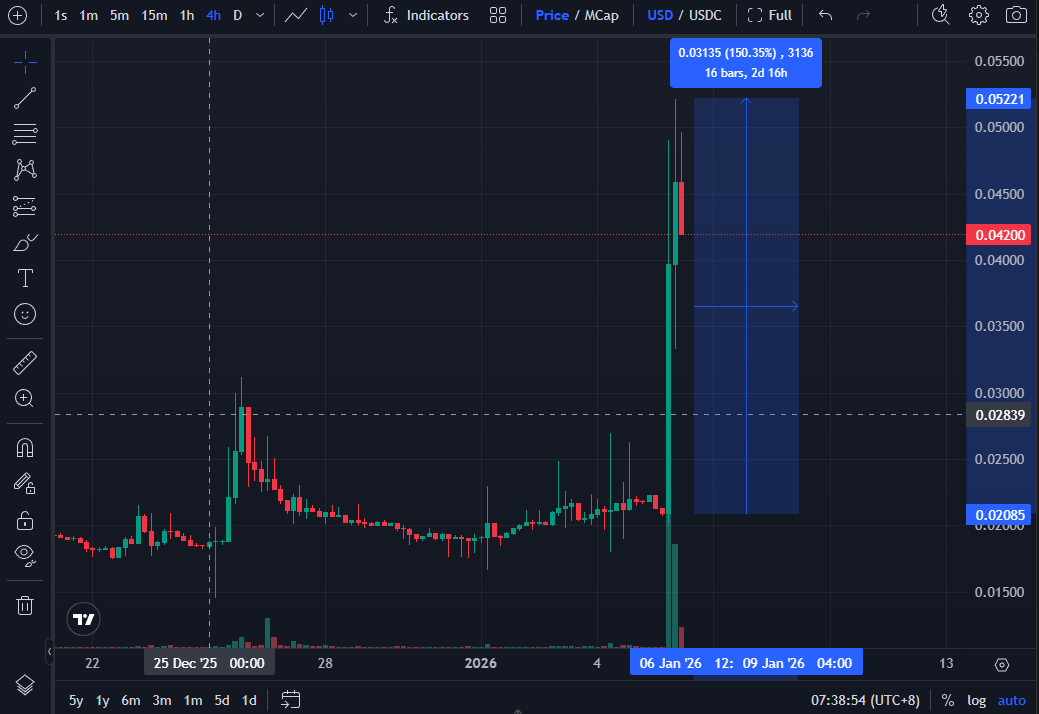
PRCL Price Chart

Operational Details of Polymarket's Real Estate Prediction Market Section

Collaboration Details:

  • Parcl provides a daily housing price index as an independent, transparent reference data for market settlement;
  • Polymarket is responsible for listing and operating the markets, where users can trade using USDC on the Polygon chain;
  • Market settlements are based on Parcl's publicly verifiable index, avoiding the delays (typically monthly) and subjectivity of traditional real estate data.

Market Types:

  • Predicting whether housing prices will rise or fall within a month, quarter, or year;
  • Threshold markets: e.g., whether housing prices exceed a specific level;
  • Each market is linked to a dedicated settlement page on Parcl, displaying the final value, historical data, and index calculation methods.

Coverage:

  • Initially starting with high-liquidity U.S. cities, such as New York, Miami, San Francisco, Austin, etc.;
  • Additional cities and market types will be expanded based on user demand.

Example Display:

Currently, this section has 7 monthly real estate prediction events listed, with relatively low liquidity. The event with the highest trading volume, "U.S. Los Angeles Housing Agent Price on February 1st," has only $3,700 in volume.
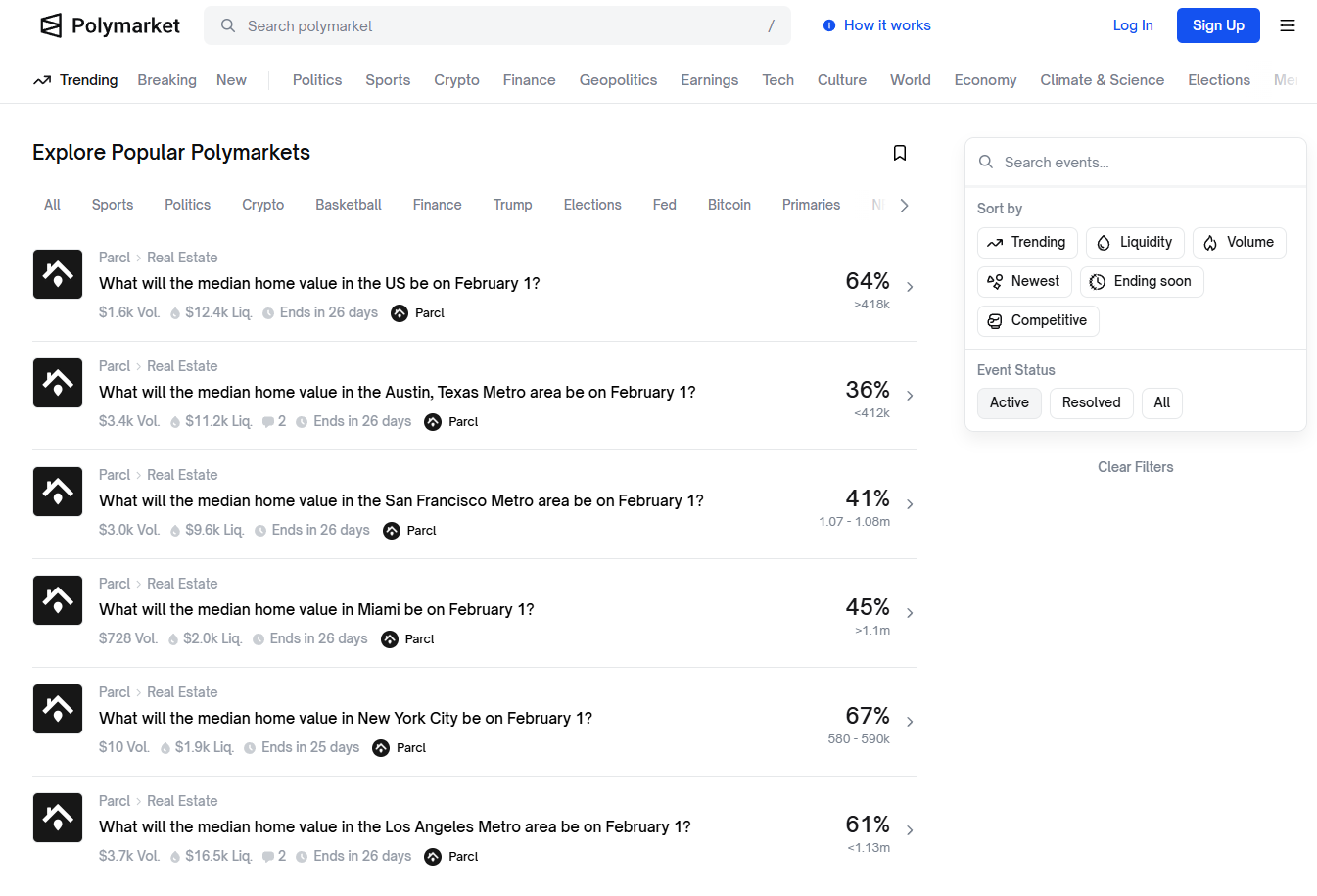
Polymarket's New Real Estate Prediction Market Section

In traditional real estate markets, whether bullish or bearish, such expectations are difficult to express directly, let alone form continuous market signals. Polymarket's introduction essentially separates "judgments on housing prices" from asset transactions. As long as there is a clear settlement standard, expectations themselves can be priced independently.

The Real Estate Market Finally Has a "Shorting Tool"

An easily overlooked fact is that the potential demand for real estate-related markets does not solely originate from native speculators.

In the traditional financial system, "falling housing prices" are almost a risk that cannot be directly hedged. Whether holding property or having asset structures and income sources highly dependent on a particular city's real estate cycle, the practical response is often to continue holding or directly sell physical assets—both of which involve high transaction costs, long cycles, and lack flexible intermediate options. As KOL 0xMarioNawfal (@RoundtableSpace) stated: "This is far more than just betting; it's about bringing liquidity to one of the world's most illiquid markets. Imagine housing prices are at historic highs, and you expect a crash but can't sell your house—now you can hedge and short the market."

The introduction of prediction markets abstracts the decline in housing prices into a tradable risk judgment. When housing prices are high and market expectations begin to weaken, the trend of real estate prices itself can be priced separately without having to dispose of underlying assets for risk management.

Through Polymarket, the downside risk of real estate prices is abstracted into a tradable judgment rather than requiring the disposal of physical assets. From this perspective, Polymarket's real estate prediction market is closer to a simplified macro hedging mechanism than a mere speculative game around price movements. It does not change the liquidity structure of real estate assets themselves but provides a trading layer that can reflect expectations in real time for a traditionally low-liquidity market.

Polymarket CMO Matthew Modabber stated: "Prediction markets are best suited for events with clear, verifiable data. Parcl's daily housing price index provides us with a transparent, consistent settlement foundation. Real estate should become a first-class category in prediction markets."

The collaboration between Polymarket and Parcl also introduces traditional real estate price signals into the crypto system: Originally low-frequency, closed, and high-barrier assets are broken down into index results that are settleable, verifiable, and tradable, resembling stock indices or crypto derivatives. This may represent a more practical and demand-aligned implementation path within the RWA narrative.


İlgili Sorular

QWhat is the significance of the partnership between Parcl and Polymarket in the real estate market?

AThe partnership introduces Parcl's daily housing price indices into Polymarket's prediction markets, enabling users to trade on real estate price movements using USDC on Polygon. This provides a transparent, verifiable, and low-cost way to speculate on or hedge against real estate price changes, effectively creating a 'shorting tool' for the traditionally illiquid real estate market.

QHow does the real estate prediction market on Polymarket work?

AUsers can trade on predictions about whether real estate prices in specific U.S. cities (e.g., New York, Miami) will rise or fall over monthly, quarterly, or annual periods. Markets are settled based on Parcl's publicly verifiable daily price indices, avoiding the delays and subjectivity of traditional real estate data.

QWhat problem does this new prediction market solve for traditional real estate investors?

AIt allows investors to hedge against or speculate on real estate price declines without needing to sell physical assets, which is typically costly and time-consuming. This provides a flexible, intermediate option for managing risk in a historically illiquid market.

QWhich cities are initially covered by Polymarket's real estate prediction markets?

AThe initial coverage includes high-liquidity U.S. cities such as New York, Miami, San Francisco, and Austin, with plans to expand to more cities based on user demand.

QWhat impact did the announcement have on Parcl's native token PRCL?

AFollowing the announcement, Parcl's token PRCL surged by over 150% in the short term, reaching a price of $0.042 and a market capitalization of $19 million, though it later experienced some pullback.

İlgili Okumalar

Bitcoin Mining Farms Are Becoming AI Factories

Bitcoin mines are transforming into AI factories. This shift is driven by the convergence of three key assets from the previous crypto cycle: infrastructure, talent, and capital. Crypto mining companies like Crusoe, CoreWeave, and Bitdeer are repurposing their core competency—securing power, land, and grid connections in remote locations—to build data centers for AI clients. These firms are signing multi-billion dollar, long-term contracts with companies like Anthropic, AWS, and Microsoft, as AI's demand for reliable, high-capacity compute surpasses the profitability of Bitcoin mining. Simultaneously, crypto entrepreneurs and engineers are applying their skills to new AI ventures. Examples include OpenSea's co-founder launching OpenRouter (an AI model aggregator), and former Coinbase engineers building Fal.ai (a generative media infrastructure platform). Their experience in building scalable, global software networks translates effectively to the AI space. Furthermore, capital accumulated during the crypto boom is now fueling AI. Figures like Jed McCaleb (co-founder of Ripple) funded Voltage Park, a large-scale GPU cloud provider. Notably, some crypto investments, like FTX's early bets on Anthropic and Cursor, have generated astronomical paper returns, demonstrating how high-risk crypto capital flowed into AI before it became mainstream. The transition is not just about repurposing hardware, but about redirecting critical resources—power infrastructure, distributed systems expertise, and venture funding—to the next technological frontier: artificial intelligence.

链捕手35 dk önce

Bitcoin Mining Farms Are Becoming AI Factories

链捕手35 dk önce

Morpho Launches Fixed-Rate Product Midnight: Lenders and Borrowers Set Their Own Rates, Ending the Era of Interest Rate Models

Morpho Launches Fixed-Rate Product Midnight: Lenders and Borrowers Set Their Own Rates, Ending the Era of Algorithmic Interest Models On-chain lending has grown to $60 billion but remains minuscule compared to traditional finance's $200 trillion annual credit volume. Morpho identifies the lack of fixed rates and maturity dates as key bottlenecks. Institutions need predictability, not the passive floating rates set by algorithmic models. Midnight allows lenders and borrowers to directly quote rates, set terms, and become price makers, not takers. Fixed-rate lending is now viable due to cheaper, faster blockchains and the entry of institutions demanding control and certainty over returns, costs, and duration. Morpho Blue previously gave users control over risk; Midnight adds control over interest rates. Past attempts at on-chain fixed-rate lending failed primarily because they were built on top of floating-rate pools (creating unpredictability) or lacked sufficient active participants. Midnight avoids these pitfalls as a standalone primitive with fixed rates at its core, built upon Morpho Blue's existing large and active user base. Midnight offers distinct value: institutions gain predictable term structures and full control; fintech companies can offer tailored fixed-rate products; lenders/borrowers achieve predictability and efficiency; and curators can now differentiate by configuring both risk and interest rates. Morpho Midnight is not a replacement for Morpho Blue. The Morpho network will now feature two complementary market structures: floating-rate/open-term (Blue) for flexibility and fixed-rate/fixed-term (Midnight) for predictability. Liquidity can flow between them. The launch will be gradual, prioritizing security. Initially, it will support direct lending on Base network with one trading pair (cbBTC/USDC) and limited maturity dates. Advanced features like auto-rollovers will be introduced later.

marsbit36 dk önce

Morpho Launches Fixed-Rate Product Midnight: Lenders and Borrowers Set Their Own Rates, Ending the Era of Interest Rate Models

marsbit36 dk önce

İşlemler

Spot
活动图片




