HongKongDoll Reveals Conditions of Opinion's $100 Million Valuation KOL Round; Hot Project Mired in 'Rug' Controversy

marsbit2026-03-04 tarihinde yayınlandı2026-03-04 tarihinde güncellendi

Özet

The prediction market project Opinion (OPN), one of the most anticipated TGEs in early 2026, faced significant backlash from the community following its token distribution announcement. Despite strong backing from top VCs including YZi Labs (formerly Binance Labs), Hack VC, and Jump Crypto, and its position as a leading platform in the prediction market niche, the airdrop allocation disappointed many users. Although 23.5% of the total 1 billion OPN supply was designated for airdrops, only 3.5% was unlocked at TGE, with the remainder vested over 7 months. In contrast, insiders—including the team, advisors, and investors—collectively held over 54% of tokens. Many users reported losses, with some estimating that their airdropped tokens were worth far less than their initial investment. High-profile KOLs like HongKongDoll publicly shared their negative returns, further fueling community anger. Additional frustration arose from last-minute Sybil account purges and the perception that Binance received disproportionately favorable treatment, with its Launchpool allocation fully unlocked at TGE. While the project's fundamentals remain strong, the incident has severely damaged community trust, with many labeling the event a "rug" or "scam." Rebuilding user confidence is now Opinion's most pressing challenge.

If we were to vote for the most anticipated TGE in the crypto space in early 2026, the prediction market Opinion (OPN) would likely be a top contender.

This project has almost all the elements to become a market sensation: top-tier VC backing, a hot sector, strong ties to the Binance ecosystem, and the prediction market narrative, which has been one of the hottest trends in recent years, attracting immense attention even before its launch.

The funding lineup is nothing short of stellar. Opinion Labs has raised a total of $25 million across three rounds: an initial angel round in August 2024, a $5 million Seed round led by YZi Labs (formerly Binance Labs) in March 2025, and a $20 million Pre-Series A round in February this year, attracting top-tier institutions like Hack VC, Jump Crypto, and Primitive Ventures.

Hack VC is a well-known fund in the crypto space focused on AI and DeFi, having early investments in Anthropic; Jump Crypto is a key pillar of the Solana ecosystem with assets under management in the tens of billions. The simultaneous backing from these two institutions is itself a strong market signal. Meanwhile, YZi Labs (formerly Binance Labs) participated in both the angel and Seed rounds without missing a beat, directly paving the way for Opinion's listing within the Binance ecosystem.

The timing of the sector choice is impeccable. Continuous funding for Polymarket and Kalshi, partnerships with mainstream media, and soaring trading volumes have made prediction markets one of the hottest crypto narratives since 2025. Opinion, deeply entrenched in the BSC ecosystem, has long ranked among the top three prediction markets by TVL, emerging as an early leader in this wave.

The market's high expectations for prediction markets are also evident in the resource allocation. Binance set up a dedicated Launchpool for OPN, allocating 2% of the supply for BNB/USDC staking mining. Pre-market trading saw prices surge over 30%, hitting a high of $0.57. Binance's endorsement solidified OPN's market position even before its official launch.

With all these positive factors combined, Opinion was listed by many as a must-farm project for Season 1 airdrops, with numerous users investing real money in hopes of a substantial return from this highly anticipated project.

However, when the airdrop query page went live, community expectations turned to disappointment, which quickly escalated into anger.
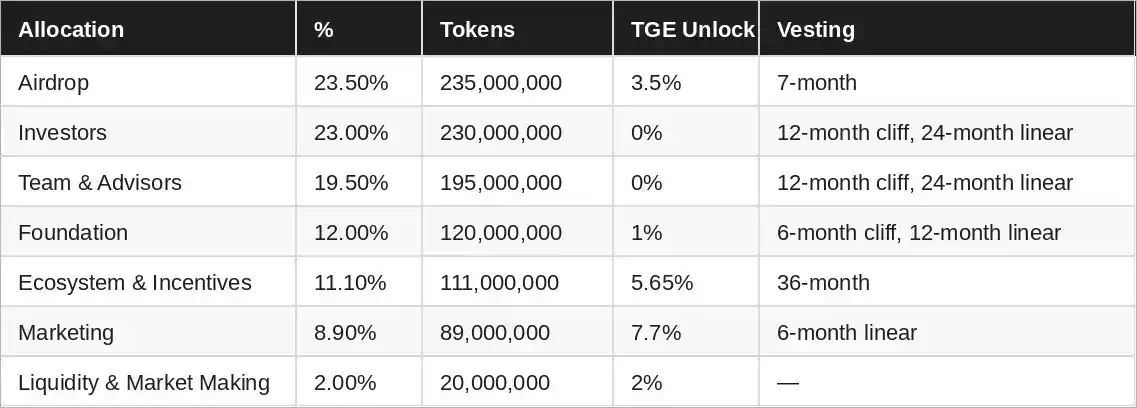
OPN has a total supply of 1 billion tokens. On the surface, the airdrop allocation of 23.5% (235 million tokens) doesn’t seem low. The problem, however, is that only 3.5% (35 million tokens) were unlocked on TGE day, with the remainder to be released over 7 months linearly. For the vast majority of farming users, the immediate rewards were far less than expected.

Meanwhile, another set of data pushed community sentiment over the edge: the team and advisors hold a combined 19.5%, investors hold 23%, and the foundation holds 12%—insiders collectively hold over 54% of the tokens, while all the hardworking community users only get 3.5% on TGE day.

Actual user returns were dismal. Multiple participants publicly shared their scores and earnings. Influencer Suoha (@WEB3_furture) summarized: "Airdrop 3%, one point is about 15 OPN, now worth $8.5 per point. At its peak OTC, it was $45 per point. It looks like everyone got rugged; most people's costs were above $10 per point."
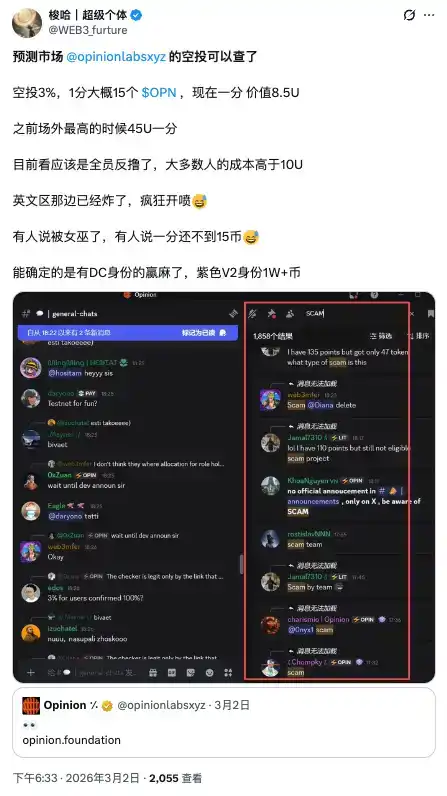
HongKongDoll, who has participated in many crypto projects, complained about her Telegram channel regarding her KOL round cooperation terms and farming data. Although the KOL round cooperation yielded definite returns, she invested $50,000 in farming. Each premium account had about 500 points, and she ultimately received just over 30,000 OPN. Calculated at the TGE price of $0.5, she recouped less than $15,000. Even including the unlocked returns from the investment, she overall lost $15,000. She bluntly stated: "I feel as disgusted as if I’d eaten fly droppings."
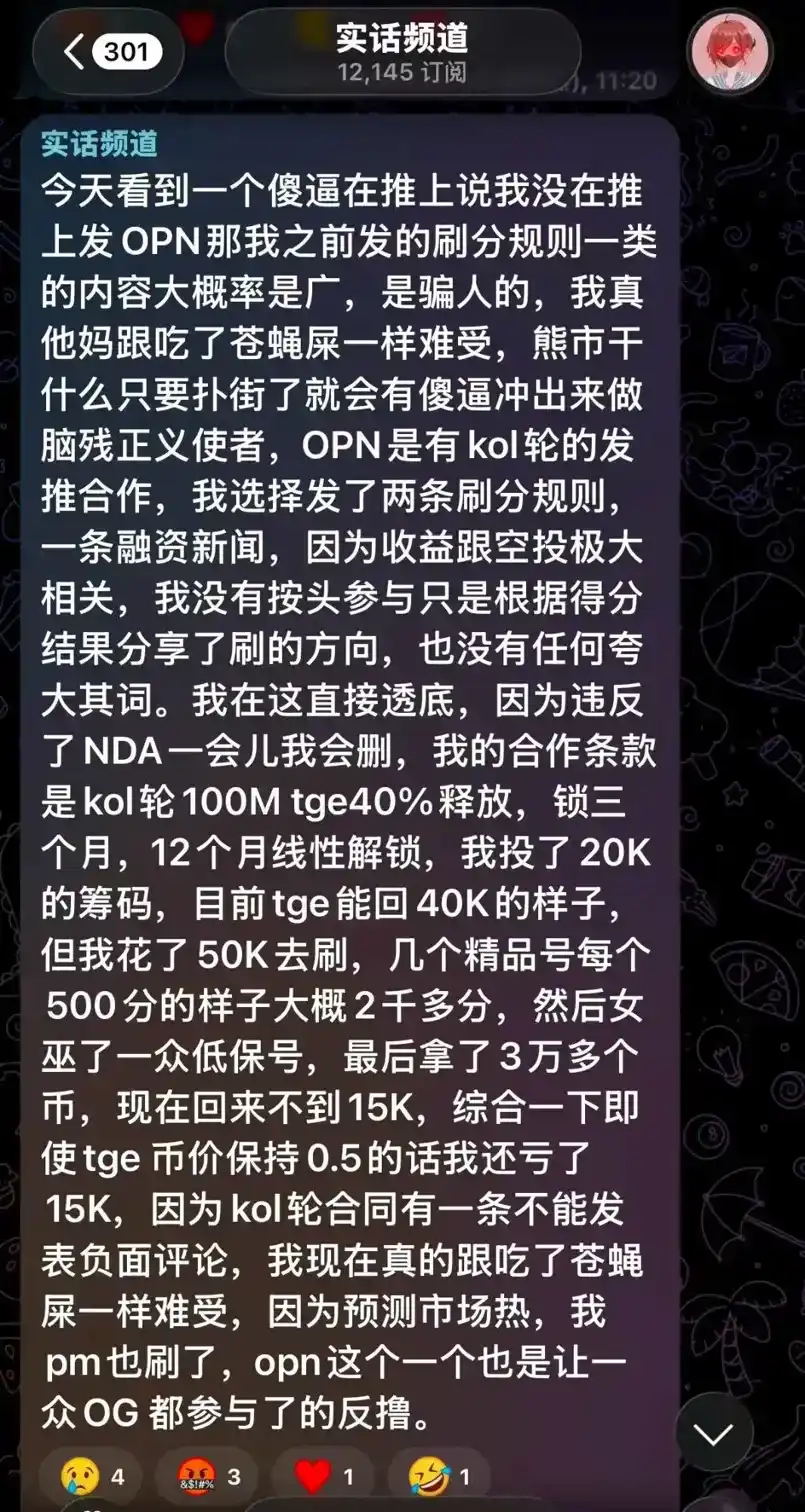
Another KOL, Mati Orange (@bitcoinzhang1), pointed out: "Based on Binance’s pre-listing price, if the airdrop ratio were 5%, one point would be valued at $11; if it were 10%, one point would be $22. And that’s just the static valuation; Binance alpha and booster have even cheaper筹码 to dump...... It seems like a collective rug."
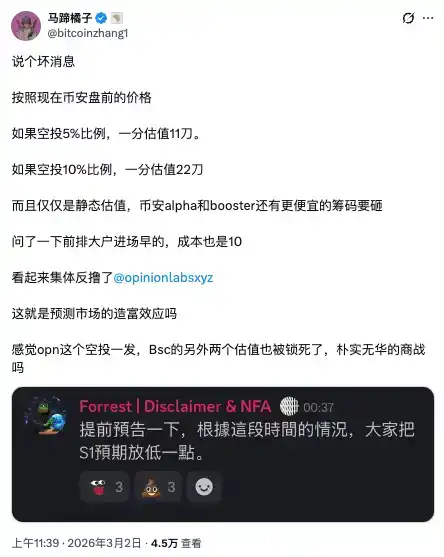
Sybil attacks sparked a new wave of controversy. Beyond the allocation ratio itself, the project team’s large-scale crackdown on Sybil accounts and multi-account operations just before TGE led to many farming users having their points slashed or disqualified. While this move is justified in principle, the execution method and timing left the community feeling dissatisfied: during the farming period, the project team tacitly allowed or even encouraged high-frequency participation, only to start a concentrated crackdown on the eve of TGE. This was interpreted by many as a "use and discard" strategy, further deepening the impression of a "rug pull."

Binance’s allocation became a major point of criticism. Compared to the community’s mere 3.5% unlocked at TGE, the Binance Launchpool directly received 2% of the supply, with the marketing portion having a 7.7% TGE unlock ratio, and the liquidity portion being 100% unlocked. This contrast led many to conclude directly: "Opinion only airdropped 3% to users but gave a huge amount of筹码 to Binance." The community widely perceives this as a typical allocation method that "favors the exchange at the expense of the community."

On Discord and Twitter, discussions about Opinion were quickly filled with intense words like "scam" and "rug." The English-speaking community also erupted. KOLs publicly shared their loss statements, and negative sentiment continued to ferment.

It is worth noting that the project’s fundamentals are not fundamentally problematic—$25 million in funding, backing from Hack VC and Jump Crypto, and a leading position in the BSC prediction market are all objective advantages. However, even the strongest funding lineup can hardly弥补 the damage once community trust collapses.

When "welcoming data farming initially, then pulling the rug after launch" becomes the community consensus, the biggest challenge Opinion faces may no longer be market cap management, but how to rebuild basic trust with its users.


İlgili Sorular

QWhat is the total supply of Opinion (OPN) tokens and what percentage was allocated for the airdrop?

AThe total supply of Opinion (OPN) tokens is 1 billion. The airdrop allocation was 23.5% (235 million tokens).

QWhy did the community become angry about the OPN airdrop distribution?

AThe community was angry because only 3.5% (35 million tokens) of the total airdrop allocation was unlocked at TGE, with the rest vested over 7 months. This was a much lower immediate distribution than expected, especially compared to the 54% of tokens allocated to insiders (team, advisors, and investors) who received a larger share.

QWhich major venture capital firms invested in Opinion Labs?

AMajor venture capital firms that invested in Opinion Labs include YZi Labs (formerly Binance Labs), Hack VC, Jump Crypto, and Primitive Ventures.

QWhat was the financial outcome for the KOL HongKongDoll (玩偶姐姐) from her participation in the OPN airdrop?

AHongKongDoll invested $50,000 to farm points and received just over 30,000 OPN tokens. At the TGE price of $0.50 per token, her return was less than $15,000, resulting in an overall loss of approximately $15,000, even when including returns from her KOL partnership.

QWhat was a major point of controversy regarding Binance's role in the OPN token launch?

AA major controversy was the perceived unfair allocation favoring Binance. The Binance Launchpool received 2% of the total token supply, and the marketing allocation had a 7.7% TGE unlock, while the community airdrop only had a 3.5% unlock at TGE. This led to accusations that the project favored the exchange over its community users.

İlgili Okumalar

Podcast Notes | Conversation with GSR Asset Management Head: To Determine if This Crypto Rally is Real, Just Watch the Lending Rates on Aave

Podcast Summary: Dialogue with GSR's Head of Asset Management: To Determine if This Crypto Rally is Real, Just Check Lending Rates on Aave Andy Baehr, Managing Director of Asset Management at GSR, discusses the current crypto market, characterizing it as stuck in a state of "ambivalence" with short-lived, unsustainable rallies. He outlines a simple framework: the market moves between "ambivalence" and "conviction" (sustained upward momentum). Currently, every rally resembles a single-stage rocket booster that quickly fizzles out. Baehr identifies three key signals to watch: 1) DeFi lending rates, 2) the potential passage of the CLARITY Act, and 3) the market forming a consensus on the "Fed hawkish peak." He emphasizes that the most immediate indicator for the sustainability of the recent CPI-triggered rally is the USDC borrowing rate on Aave, currently around 3.75%—close to U.S. Treasury yields. The absence of a credit spread indicates low leverage demand and a lack of market energy. He explains that a healthy, sustained rally requires layered buying pressure. Last year's rally progressed from an ETH short squeeze to crypto-native trader influx and finally to ETF inflows. Currently, this structure is missing. Other potential structural buyers like Digital Asset Treasury (DAT) companies are absent, and ETF flows have proven transient. Baehr notes that while small-cap crypto tokens outperformed large caps in Q2—a potential sign of capitation in major assets—capital is also flowing to more exciting opportunities like AI stocks and tech IPOs, leaving crypto sidelined. Regarding DeFi, he highlights that platforms like Aave provide a clear, real-time signal of leverage demand through their supply/demand-driven interest rates. A significant, sustained rate increase would signal genuine market conviction. He also observes the quiet emergence of fixed-income-like products and vaults in DeFi. On regulation, the probability of the CLARITY Act passing before the August 7th deadline has dropped linearly from 75% to below 40% on Polymarket. Baehr suggests its passage would be treated as a bullish surprise, a potent driver for price movement. However, political hurdles, including ethical clause debates and disclosures about the First Family's crypto profits, remain significant obstacles. Ultimately, the market awaits clarity on the Fed's terminal rate under Chair Warsh. Until the "Fed Solstice"—the point where the market collectively understands the peak of hawkish policy—sustained conviction will be difficult to achieve.

marsbit16 dk önce

Podcast Notes | Conversation with GSR Asset Management Head: To Determine if This Crypto Rally is Real, Just Watch the Lending Rates on Aave

marsbit16 dk önce

7 Months After the Collapse of Huiwang, Southeast Asia's Escrow Platforms Undergo a Major Reshuffle

Following the collapse of Huione Pay—dubbed the "Alipay of Southeast Asia"—seven months ago, the region's underground financial guarantee platform sector is undergoing a significant reshuffle. This power vacuum has been swiftly filled by emerging platforms such as XinBi, Tiger/Navigator, JinBei (renamed JinBo), Dali/Tiancheng, and FullyLight. These platforms, operating largely via Telegram and offering services like escrow for illicit transactions, have absorbed the vast user base and markets left behind by Huione. While positioning themselves as "trust intermediaries," their primary clientele consists of networks involved in online scams, money laundering, illegal gambling, and even human trafficking. For instance, the Tiger/Navigator platform explicitly provides "escrow" services for kidnapping-for-ransom operations ("强押车交易"). Data underscores the immense scale: Huione alone processed over $103 billion in cryptocurrency payments and facilitated over $31 billion through its escrow market before its downfall, linking it to Cambodia's notorious Prince Group. Since its collapse, competitors have seen explosive growth. For example, the XinBi platform has accumulated over $1.6 billion in total USDT revenue, while platforms like NewPay, OkPay (under Dali), and FullyLight Wallet collectively processed over $4.8 billion in USDT in a single year. This ecosystem thrives in regions like Cambodia and Myanmar, where regulatory gaps allow these platforms to act as critical financial infrastructure for sprawling cybercrime industries, from scam compounds to online casinos. The article concludes that the moniker "Southeast Asian Alipay" is a misnomer, obscuring the platforms' fundamental role in enabling serious criminal enterprises rather than representing legitimate financial innovation.

Odaily星球日报1 saat önce

7 Months After the Collapse of Huiwang, Southeast Asia's Escrow Platforms Undergo a Major Reshuffle

Odaily星球日报1 saat önce

İşlemler

Spot
活动图片




