Hong Kong Unveils New Rules To Allow Crypto Margin Financing And Perpetual Contracts

bitcoinist2026-02-12 tarihinde yayınlandı2026-02-12 tarihinde güncellendi

Özet

Hong Kong's Securities and Futures Commission (SFC) has introduced new rules allowing licensed virtual asset brokers to offer crypto margin financing and perpetual contracts to professional investors. Under the ASPIRe roadmap's Pillar P, eligible clients with strong credit and sufficient collateral can use Bitcoin and Ether as collateral for margin trading. The move aims to enhance market liquidity, provide risk management tools, and strengthen Hong Kong's position as a global virtual asset hub. The SFC emphasized the need for robust risk controls, as these products carry distinct risks. Executive Director Eric Yip stated that these measures are part of a broader strategy to cultivate market depth and investor confidence through regulated innovation.

Hong Kong financial authorities have announced new rules to expand the scope of product offerings, allowing the integration of crypto margin financing and perpetual contracts into the local virtual assets market.

Hong Kong Approves Crypto Margin Financing, Perps

On Wednesday, Hong Kong’s Securities and Futures Commission (SFC) unveiled a framework for licensed corporations that provide virtual asset dealing services (VA brokers) to offer virtual asset financing.

According to the SFC’s circular, the financial watchdog will permit VA brokers to extend credit to margin clients with strong credit profiles and sufficient securities collateral, under Pillar P of its Access, Safeguards, Products, Infrastructure and Relationships (ASPIRe) roadmap.

This will allow eligible margin clients to “increase their participation in VA trading, which can enhance the liquidity of Hong Kong’s VA market. At the same time, this can also facilitate the development of VA financing in a risk-controlled environment.”

Under the new guidance, only the two leading cryptocurrencies, Bitcoin (BTC) and Ether (ETH), will be eligible as VA collateral. The regulator also released a high-level framework for licensed virtual asset trading platforms to offer crypto perpetual contracts to professional investors.

“Under the ASPIRe roadmap, Pillar P reflects the SFC’s commitment to expanding the scope of product offerings, including Perps. This initiative aims to deepen market liquidity, broaden risk management tools for investors, and further strengthen Hong Kong’s position as a leading global virtual asset hub,” the watchdog affirmed.

The SFC emphasized that the introduction of Perps will bring new opportunities to the market, but noted that it also carries “a range of risks that are distinct from those associated with traditional futures or spot trading of virtual assets.”

Therefore, the framework requires platform operators to have robust management measures and transparent processes governing valuation, margining, collateralization, and liquidation management.

Hong Kong Digital Landscape In ‘Defining Stage’

Speaking at Consensus Hong Kong 2026 on Wednesday, Eric Yip, SFC’s Executive Director of Intermediaries, shared his views on the watchdog’s regulatory enhancements for the next phase of Hong Kong’s crypto assets ecosystem.

Yip affirmed that Hong Kong’s crypto asset development has entered a “defining stage, shaped by the SFC’s ASPIRe roadmap that outlines a future-proof regulatory framework aimed at deepening market quality, resilience, and global competitiveness.”

He emphasized this year’s focus on liquidity, “cultivating market depth, strengthening price discovery, and building investor confidence through a strategic blend of expanded access and responsible product innovation.”

As the executive explained, the SFC is expanding the city’s crypto product suite under Pillar P while maintaining regulatory guardrails aligned with traditional financial market standards.

Notably, Yip highlighted the SFC’s greenlight of crypto margin financing, which will be anchored to the existing securities margin financing framework. He noted that it will provide clarification on the use of crypto assets as collateral, “enabling responsible leverage that supports liquidity without undermining financial stability.”

In addition, he also outlined the new high-level framework for leveraged perpetual contracts for professional investors, which sets out a principles-based model.

Discussing how to bridge innovation and regulatory clarity, he pointed to the upcoming Digital Asset Accelerator to be set up under Pillar Re, which will serve as a structured communication channel between the regulatory agency and industry innovators.

He concluded that “liquidity does not emerge organically; it must be cultivated through openness, strong governance, and a purposeful regulatory design. Through targeted access reforms, product expansion, and structured innovation support, Hong Kong is well-positioned to become a leading global digital assets centre where liquidity thrives on a foundation of integrity, resilience, and international cooperation.”
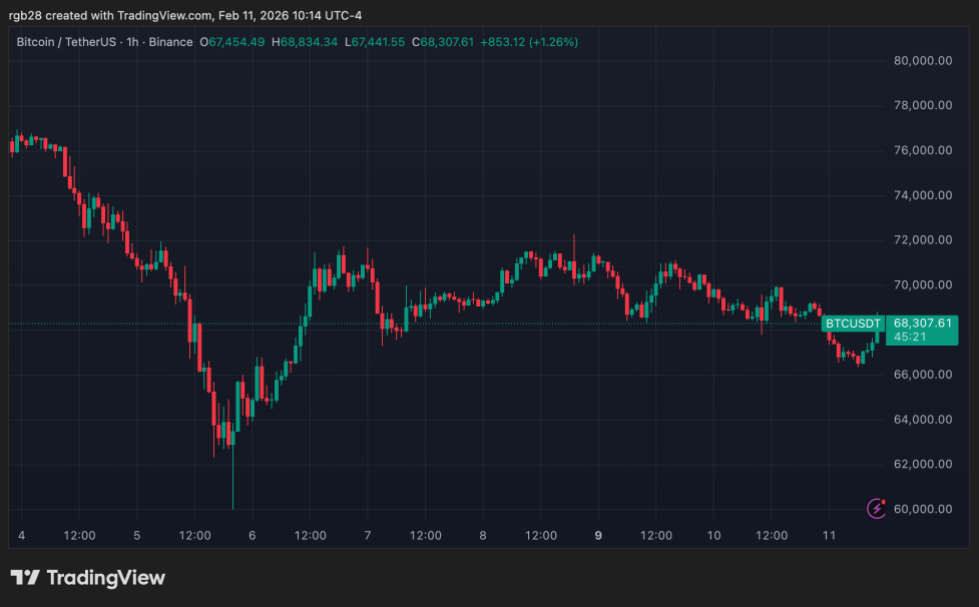
Bitcoin trades at $68,307 in the one-week chart. Source: BTCUSDT on TradingView

İlgili Sorular

QWhat new financial products has Hong Kong's SFC approved for the virtual assets market?

AHong Kong's SFC has approved crypto margin financing and perpetual contracts for professional investors.

QWhich two specific cryptocurrencies are eligible to be used as collateral under the new margin financing rules?

AOnly Bitcoin (BTC) and Ether (ETH) are eligible as virtual asset collateral under the new guidance.

QWhat is the name of the SFC's roadmap that outlines this new regulatory framework?

AThe regulatory framework is part of the SFC's ASPIRe (Access, Safeguards, Products, Infrastructure and Relationships) roadmap.

QAccording to the SFC executive, what stage has Hong Kong's crypto asset development entered?

AAccording to Eric Yip, Hong Kong's crypto asset development has entered a 'defining stage'.

QWhat is the primary goal of introducing these new products like margin financing and perpetual contracts?

AThe primary goals are to enhance market liquidity, broaden risk management tools for investors, and strengthen Hong Kong's position as a leading global virtual asset hub.

İlgili Okumalar

Bank of Japan Signals Interest Rate Hike Despite Keeping Them at 1%

The Bank of Japan (BOJ) kept its benchmark interest rate at 1% on July 31, as widely expected, following a June hike to a 31-year high. The decision passed with an 8-1 vote, with board member Hajime Takata again dissenting in favor of a hike to 1.25%. Despite holding rates steady, the BOJ signaled a hawkish tilt, warning that underlying inflation is likely to accelerate and exceed 2% from the latter half of the fiscal year. While it slightly lowered its core inflation forecast for FY2026, officials expressed stronger confidence that an overshoot will occur later, driven by yen weakness, corporate pricing behavior, and lingering energy shock effects. Markets were focused on the BOJ's forward guidance. Analysts noted the central bank appeared to balance short-term caution with a long-term warning of tighter policy. Governor Kazuo Ueda faces the challenge of reconciling a government reluctant to tighten further with bond markets already pricing in additional hikes, with the timing of the next move debated. Adding complexity, the BOJ reportedly intervened in currency markets hours before the rate decision, buying yen to support the currency which had fallen to 40-year lows against the dollar. Yen weakness stems from the wide U.S.-Japan interest rate gap, high fuel prices, and market skepticism about the pace of BOJ policy normalization. The yield on Japan's 10-year government bonds fell to 2.8%, indicating investor expectations for future monetary tightening.

cryptonews.ru5 dk önce

Bank of Japan Signals Interest Rate Hike Despite Keeping Them at 1%

cryptonews.ru5 dk önce

Why Are Leveraged ETFs like 7709 Inherently Negative EV Products?

This article argues that the SK H力士 2x Leveraged ETF (7709) is fundamentally a negative expected value (EV) product, rather than simply a "double SK H力士" investment. Its core issue stems from its daily rebalancing mechanism to maintain a 2x leverage target. After a price move, the fund must buy more after a rise or sell after a fall to readjust its leverage, creating a systematic pattern of buying high and selling low. This introduces a "delay loss": it always reacts to past price changes, missing potential gains from adjusting earlier during an uptrend and suffering greater losses from adjusting later during a downtrend. While more frequent intraday rebalancing would improve returns in strong, smooth trending markets by reinvesting profits or cutting losses sooner, it also dramatically increases volatility drag (frictional losses) during choppy, oscillating markets due to more frequent high-buy/low-sell trades. The author draws a parallel to an option seller who delta hedges (short gamma), which involves similar "buy high, sell low" dynamic hedging. However, unlike an option seller who receives upfront premium (IV and theta) as compensation for this risk, the leveraged ETF investor receives no such compensation. Instead, they bear all the path-dependent volatility decay, plus additional costs like swap/derivatives financing, management fees, and trading slippage. Thus, the product's return profile can be framed as: 2x directional return minus realized variance drag minus financing costs minus derivatives costs minus management fees minus transaction costs. For the investor to profit, SK H力士's price must not only rise significantly but do so in a strong, sustained, and smooth trend to overcome these inherent structural costs. High volatility and frequent price reversals are particularly damaging. The article also notes that while the ETF has no explicit liquidation line like perpetual futures, avoiding a sudden "blow-up," its net asset value can still decay towards zero over time through this combination of volatility drag and fees. For experienced traders, directly managing leverage via perpetual contracts may offer more control and potentially lower costs than this packaged, mechanistic product.

marsbit12 dk önce

Why Are Leveraged ETFs like 7709 Inherently Negative EV Products?

marsbit12 dk önce

'Backstabbing' or 'Win-Win'? How Likely Is TradeXYZ to Break Away from Hyperliquid and Go Solo?

The article discusses the growing debate over whether TradeXYZ, which dominates Hyperliquid's HIP-3 market with over 90% of its volume, might break away to build its own independent trading platform. This possibility is fueled by TradeXYZ's immense market influence and the common industry trend of successful projects seeking more control and profit capture. Key arguments for a potential split include TradeXYZ's overwhelming contribution to Hyperliquid's metrics and the financial incentive to retain all transaction fees, as it currently splits them 50/50 with Hyperliquid. The piece draws parallels to other cases, like Anthropic's "Claude Code" competing with its former partner Cursor, suggesting "betrayal" can occur when business leverage shifts. However, strong counterarguments suggest a split is unlikely or would be detrimental. TradeXYZ relies on Hyperliquid's high-performance infrastructure and its platform as a primary user acquisition channel. Building a comparable system would be challenging. Furthermore, the founders of both projects share a history of trust and mutual admiration. The analysis concludes that a separation would likely be a lose-lose scenario: Hyperliquid would lose a major growth narrative and trading volume, while TradeXYZ would face technical hurdles, user migration issues, and reputational damage, potentially allowing competitors to seize market share. The most rational path is seen as continued collaboration, with TradeXYZ potentially negotiating better terms while leveraging Hyperliquid's established strengths.

marsbit22 dk önce

'Backstabbing' or 'Win-Win'? How Likely Is TradeXYZ to Break Away from Hyperliquid and Go Solo?

marsbit22 dk önce

İşlemler

Spot
活动图片