Hong Kong Prepares To Grant Limited Batch Of Stablecoin Licenses In March – Report

bitcoinist2026-02-03 tarihinde yayınlandı2026-02-03 tarihinde güncellendi

Özet

Hong Kong's financial authorities, led by the Hong Kong Monetary Authority (HKMA), are preparing to issue the first limited batch of stablecoin issuer licenses in March. Chief Executive Eddie Yue confirmed that a "very small number" of licenses will be granted after the review process for applications nears completion. Over 30 companies, including Ant Group's overseas arm, have applied since the Stablecoins Ordinance was enacted in August, requiring any issuer of fiat-referenced stablecoins in Hong Kong to be licensed. The HKMA is focusing on use cases, risk management, AML measures, and asset backing. This move is part of Hong Kong's broader strategy to become a regulated global crypto hub, despite potential challenges from mainland China's strict stance against stablecoins.

Hong Kong financial authorities have announced that they will soon grant the first, limited batch of stablecoin provider licenses as the review process for applications is almost completed.

HKMA To Grant Limited Stablecoin Licenses Soon

On Monday, the Hong Kong Monetary Authority (HKMA)’s Chief Executive, Eddie Yue, announced that the regulatory agency is preparing to grant the first batch of the highly anticipated stablecoin licenses next month.

At a Legislative Council meeting, Yue affirmed that the financial authority expects to issue a “very small number” of stablecoin issuer licenses in March, according to a Reuters report.

In August, the HKMA enacted the Stablecoins Ordinance, which directs any individual or entity seeking to issue any fiat-referenced stablecoin (FRS) in Hong Kong, or any Hong Kong Dollar (HKD)-denominated token, to obtain a license from the regulator.

Local news outlets have reported that more than 30 companies have applied for the license, including the overseas arm of Chinese mainland financial technology giant Ant Group and logistics technology firm Reitar Logtech.

In December, legal experts suggested that Hong Kong’s ambitions to become a key regulated hub for stablecoins could be clouded by the People’s Bank of China’s explicit crackdown on the sector.

As reported by Bitcoinist, top financial regulators affirmed that stablecoins don’t qualify as legal tender in the mainland, which could delay the original early 2026 schedule and affect the HKMA’s approval of projects involving the yuan or mainland Chinese institutions.

Nonetheless, Hong Kong’s Financial Secretary, Paul Chan Mo-po, recently confirmed the regulators’ plan to grant stablecoin issuers licenses in the first quarter of the year at the World Economic Forum in Davos.

During a Monday media briefing, HKMA’s Chief Executive reportedly noted that their application review process is near its completion. Yue also highlighted that the regulator is focusing on use cases, risk management, anti-money laundering (AML) measures, and asset backing.

Moreover, he asserted that licensed issuers must comply with local regulations for cross-border activities, but added that “mutual recognition arrangements with other jurisdictions could be explored in the future.”

Hong Kong Continues Crypto Regulation Efforts

Hong Kong has been actively developing a comprehensive framework to support the expansion of the digital assets industry as part of its long-term strategy to become a global crypto hub.

Notably, financial authorities have been exploring rules to enable insurance companies to invest in cryptocurrencies and the infrastructure sector. In addition, the jurisdiction is among the 76 markets committed to implementing the Organisation for Economic Co-operation and Development’s (OECD) new global standard for exchanging tax information related to crypto assets.

The upcoming crypto reporting framework, the Crypto Asset Reporting Framework (CARF), is intended to bring crypto users across borders under global tax transparency rules, thereby preventing tax evasion. Hong Kong is set to begin its first cross-border exchanges of crypto reporting data in 2028.

However, the Hong Kong Securities & Futures Professionals Association (HKSFPA) has expressed its concerns about the implementation of the OECD’s CARF and the related amendments made to Hong Kong’s Common Reporting Standard (CRS).

The group noted that it mostly supports the proposals, but urged regulators to ease the record-keeping requirements for dissolved entities and the uncapped per-account penalties for minor technical errors. The Professionals Association warned that these elements of the CARF and CRS amendments could create operational and liability risks for market participants.
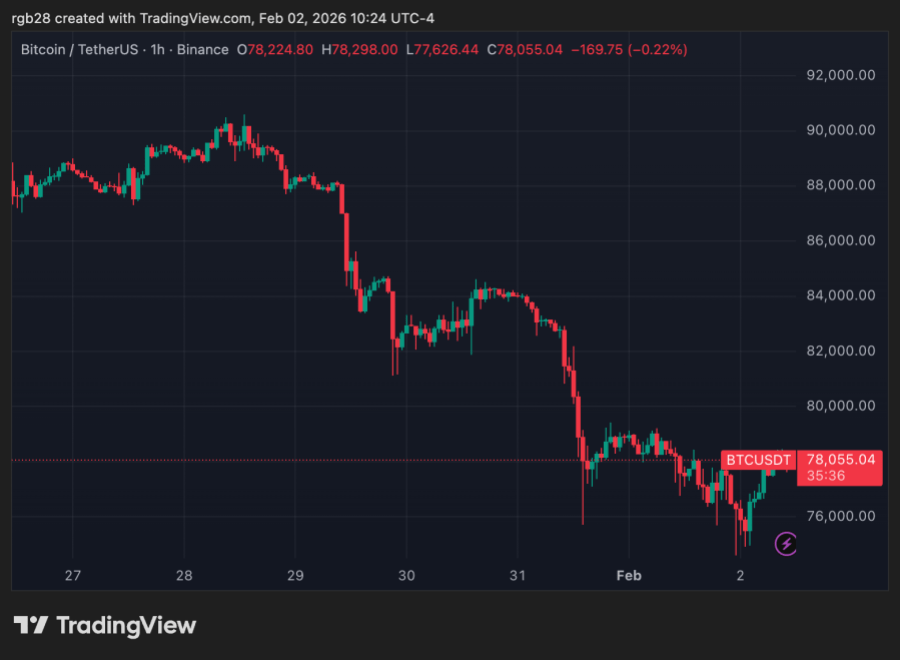
Bitcoin (BTC) trades at $78,055 in the one-week chart. Source: BTCUSDT on TradingView


İlgili Sorular

QWhen is the Hong Kong Monetary Authority (HKMA) preparing to grant the first batch of stablecoin licenses?

AThe HKMA is preparing to grant the first batch of stablecoin licenses in March.

QWhat is the name of the ordinance that requires a license to issue fiat-referenced stablecoins in Hong Kong?

AThe ordinance is called the Stablecoins Ordinance.

QWhich two companies were mentioned as having applied for a stablecoin license in Hong Kong?

AThe overseas arm of Ant Group and the logistics technology firm Reitar Logtech were mentioned as applicants.

QWhat potential challenge to Hong Kong's stablecoin hub ambitions was raised by legal experts in December?

ALegal experts suggested that the People's Bank of China's explicit crackdown on the stablecoin sector could cloud Hong Kong's ambitions.

QWhat new global standard for crypto tax information is Hong Kong committed to implementing?

AHong Kong is committed to implementing the Organisation for Economic Co-operation and Development’s (OECD) Crypto Asset Reporting Framework (CARF).

İlgili Okumalar

Google and Amazon Simultaneously Invest Heavily in a Competitor: The Most Absurd Business Logic of the AI Era Is Becoming Reality

In a span of four days, Amazon announced an additional $25 billion investment, and Google pledged up to $40 billion—both direct competitors pouring over $65 billion into the same AI startup, Anthropic. Rather than a typical venture capital move, this signals the latest escalation in the cloud wars. The core of the deal is not equity but compute pre-orders: Anthropic must spend the majority of these funds on AWS and Google Cloud services and chips, effectively locking in massive future compute consumption. This reflects a shift in cloud market dynamics—enterprises now choose cloud providers based on which hosts the best AI models, not just price or stability. With OpenAI deeply tied to Microsoft, Anthropic’s Claude has become the only viable strategic asset for Google and Amazon to remain competitive. Anthropic’s annualized revenue has surged to $30 billion, and it is expanding into verticals like biotech, positioning itself as a cross-industry AI infrastructure layer. However, this funding comes with constraints: Anthropic’s independence is challenged as it balances two rival investors, its safety-first narrative faces pressure from regulatory scrutiny, and its path to IPO introduces new financial pressures. Globally, this accelerates a "tri-polar" closed-loop structure in AI infrastructure, with Microsoft-OpenAI, Google-Anthropic, and Amazon-Anthropic forming exclusive model-cloud alliances. In contrast, China’s landscape differs—investments like Alibaba and Tencent backing open-source model firm DeepSeek reflect a more decoupled approach, though closed-source models from major cloud providers still dominate. The $65 billion bet is ultimately about securing a seat at the table in an AI-defined future—where missing the model layer means losing the cloud war.

marsbit1 saat önce

Google and Amazon Simultaneously Invest Heavily in a Competitor: The Most Absurd Business Logic of the AI Era Is Becoming Reality

marsbit1 saat önce

Computing Power Constrained, Why Did DeepSeek-V4 Open Source?

DeepSeek-V4 has been released as a preview open-source model, featuring 1 million tokens of context length as a baseline capability—previously a premium feature locked behind enterprise paywalls by major overseas AI firms. The official announcement, however, openly acknowledges computational constraints, particularly limited service throughput for the high-end DeepSeek-V4-Pro version due to restricted high-end computing power. Rather than competing on pure scale, DeepSeek adopts a pragmatic approach that balances algorithmic innovation with hardware realities in China’s AI ecosystem. The V4-Pro model uses a highly sparse architecture with 1.6T total parameters but only activates 49B during inference. It performs strongly in agentic coding, knowledge-intensive tasks, and STEM reasoning, competing closely with top-tier closed models like Gemini Pro 3.1 and Claude Opus 4.6 in certain scenarios. A key strategic product is the Flash edition, with 284B total parameters but only 13B activated—making it cost-effective and accessible for mid- and low-tier hardware, including domestic AI chips from Huawei (Ascend), Cambricon, and Hygon. This design supports broader adoption across developers and SMEs while stimulating China's domestic semiconductor ecosystem. Despite facing talent outflow and intense competition in user traffic—with rivals like Doubao and Qianwen leading in monthly active users—DeepSeek has maintained technical momentum. The release also comes amid reports of a new funding round targeting a valuation exceeding $10 billion, potentially setting a new record in China’s LLM sector. Ultimately, DeepSeek-V4 represents a shift toward open yet realistic infrastructure development in the constrained compute landscape of Chinese AI, emphasizing engineering efficiency and domestic hardware compatibility over pure model scale.

marsbit1 saat önce

Computing Power Constrained, Why Did DeepSeek-V4 Open Source?

marsbit1 saat önce

İşlemler

Spot
Futures
活动图片