Hong Kong Aims to Act as Global Connector Between Crypto and Traditional Finance

TheNewsCrypto2026-02-02 tarihinde yayınlandı2026-02-02 tarihinde güncellendi

Özet

Hong Kong lawmaker Johnny Ng emphasizes that the city is positioning itself as a global connector between cryptocurrency and traditional finance, rather than competing directly with other nations. He argues that crypto is not a zero-sum game and should function as an interconnected global system. Hong Kong’s advantages include its common law system, English-language courts, and free capital flow, which help build a regulated and trusted crypto environment. The city also leverages the Greater Bay Area, collaborating with hubs like Shenzhen and Macau to combine fundraising and regulatory expertise with technological innovation. Recent efforts include inviting global crypto firms, such as Coinbase, to establish operations in Hong Kong and introducing clearer custody and OTC trading rules to better integrate crypto with institutional and corporate finance.

Johnny Ng, a Hong Kong lawmaker and a strong supporter of Web3 and digital assets, says that Hong Kong is not trying to “Beat” other countries in crypto; instead, it can act as a global connector between crypto markets and traditional finance across the U.S., Europe, and China.

Ng says that crypto should not be treated as the Zero sum game, meaning Crypto doesn’t belong to one country and is global, which works best when it is connected. He also stated that Hong Kong’s goal is to link East and West, Crypto startups and traditional banks, and innovation and regulations.

Why Hong Kong has a strong advantage

According to him, Hong Kong already has the strong advantages of a common law system that the global investors could understand and the English language court, trusted by the international businesses, with a free movement of money in and out of the city. This helps Hong Kong to build a crypto market that is regulated, safer, and accepted by the global financial institutions.

A key part of Hong Kong’s strategy involves the Greater Bay Area, which connects cities and Chinese hubs such as Shenzhen and Macau. Ng explained that Hong Kong helps to raise money and handle rules, whereas these main cities turn ideas into real products, which makes the region powerful.

Inviting the global crypto firms
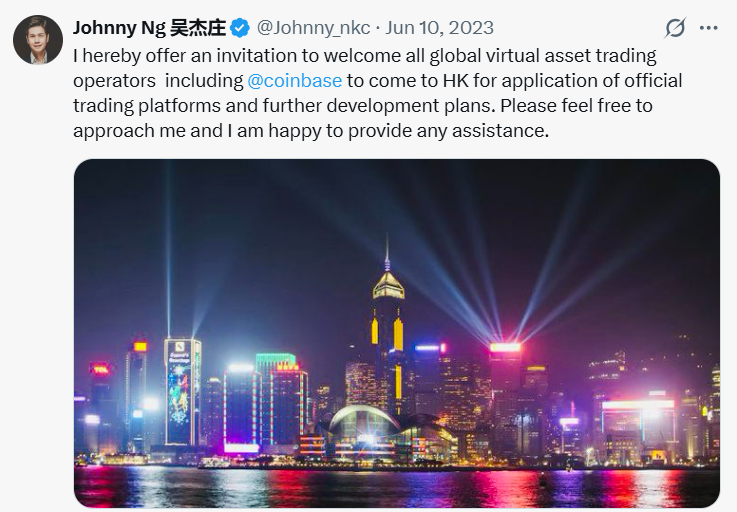
Ng pointed out that Vitalik Buterin spent a lot of time in Hong Kong during Ethereum’s early stages, which shows that the region has long supported blockchain innovations. In 2023, during the period of strict enforcement by the U.S. regulations, he invited the major crypto companies like Coinbase to operate in Hong Kong.

In 2026, Hong Kong plans to introduce clearer custody rules and regulate OTC crypto trading with larger trading limits for professional investors. Ng says that the next phase is about the infrastructure, and these steps aim to make crypto work smoothly with real businesses and large investors.

Highlighted Crypto News:

XRP Slides Below $1.60 Amid Broader Crypto Market Pullback

TagsBlockchainCryptoHongKong

İlgili Sorular

QWhat role does Hong Kong aim to play in the global crypto market according to Johnny Ng?

AHong Kong aims to act as a global connector between crypto markets and traditional finance, linking East and West, crypto startups and traditional banks, and innovation and regulations.

QWhat advantages does Hong Kong have in building a regulated crypto market?

AHong Kong has a common law system, English language courts trusted by international businesses, and free movement of money, which help build a regulated, safer crypto market accepted by global financial institutions.

QHow does the Greater Bay Area contribute to Hong Kong's crypto strategy?

AThe Greater Bay Area connects cities like Shenzhen and Macau, where Hong Kong handles fundraising and regulations while these cities turn ideas into real products, making the region powerful.

QWhat did Johnny Ng do in 2023 regarding global crypto companies?

AIn 2023, during strict U.S. regulations, Johnny Ng invited major crypto companies like Coinbase to operate in Hong Kong.

QWhat regulatory steps is Hong Kong planning for 2026 to support crypto integration?

AIn 2026, Hong Kong plans to introduce clearer custody rules and regulate OTC crypto trading with larger limits for professional investors to make crypto work smoothly with real businesses and large investors.

İlgili Okumalar

From Code to Cognition: A Ten-Thousand-Word Guide to the Evolution of the Robot Brain

"From Code to Cognition: The Evolution of Robot Brains" The journey of robotic intelligence has shifted dramatically from manually coded systems to AI-driven brains. For decades, robots relied on layered software stacks—perception, state estimation, planning, control—each handcrafted. While predictable, they lacked adaptability. The 2010s saw deep learning revolutionize perception (e.g., object detection) and control (via reinforcement learning), but learned skills remained narrow. The arrival of Large Language Models (LLMs) marked a turning point. LLMs acted as high-level planners, interpreting natural language instructions and generating sequences of actions for traditional robotic systems to execute. However, true integration came with Visual-Language-Action (VLA) models, which fused vision, language, and motion prediction into a single network. Pioneered by models like RT-2 and open-source projects like OpenVLA, VLAs enable robots to reason and act directly from visual input and commands. The most advanced humanoid robots now employ a "dual-brain" architecture: a slow-thinking, large VLA (System 2) for reasoning and planning, and a fast-reacting, small network (System 1) for high-frequency motion control, sometimes with an even lower-level System 0 for balance. This split balances cognition with the physics of real-time movement. Computation is split between onboard hardware (e.g., NVIDIA Jetson) for safety-critical control loops and cloud/edge servers for non-critical tasks like learning and interfaces. A crucial driver is the open-source ecosystem—models like GR00T and OpenVLA allow startups to build upon pre-trained brains and fine-tune them with their own data, accelerating development. Despite progress, current systems struggle with recovery from errors, sample inefficiency, and long-horizon tasks. This has spurred the rise of **World Models**—neural networks that predict the consequences of actions. By simulating possible futures before acting (like NVIDIA Cosmos or Meta V-JEPA), robots can plan, recover, and generalize better. This represents the next frontier: shifting intelligence from learned reactions to an internal model of physics and cause-and-effect. The field is rapidly evolving. While not yet at its "ChatGPT moment," the convergence of cheaper hardware, scalable simulation, and world models points toward robots that are increasingly capable, adaptive, and useful. The question is shifting from "what can robots do?" to "what *should* they do?"

marsbit7 dk önce

From Code to Cognition: A Ten-Thousand-Word Guide to the Evolution of the Robot Brain

marsbit7 dk önce

AI Bubble Is Bursting

The AI Bubble is Bursting: A Necessary Purge on the Path to Ubiquitous Intelligence Market volatility has reignited debates about an AI bubble, with figures like Ray Dalio pointing to high valuations. However, this parallels the dot-com bubble, which, despite its crash, laid the physical infrastructure for today's internet era. The current AI investment frenzy, with tech giants planning trillions in infrastructure spending far outstripping current AI application revenues, appears similarly imbalanced. This 'bubble' is seen as an inevitable phase for a disruptive technology, paying the "innovation tax." Critically, AI inference costs have plummeted over 99.7% since 2023, making intelligence nearly free at the margin. This hasn't reduced spending but has instead unlocked massive new demand, as seen in enterprise AI cloud expenditure tripling. This follows the Jevons Paradox: efficiency gains lead to greater total consumption. The market is now entering a cleansing phase, weeding out speculative ventures lacking real moats. The deeper shift is a move from capital expenditure (CapEx) on hardware to value creation in operational expenditure (OpEx) through AI applications that solve real industry problems. While infrastructure valuations are high, rapid earnings growth from widespread AI adoption across sectors—from manufacturing and finance to law and healthcare—may digest these valuations over time. Ultimately, this creative destruction will leave behind robust infrastructure and optimized models, cheaply powering an AI-augmented future for all industries, much as the internet became indispensable after its own bubble burst. The core productive potential remains undiminished.

链捕手17 dk önce

AI Bubble Is Bursting

链捕手17 dk önce

İşlemler

Spot
Futures
活动图片