Honeypot Finance: The New Full-Stack Perp DEX – Can It Challenge Hyperliquid?

marsbit2025-12-23 tarihinde yayınlandı2025-12-23 tarihinde güncellendi

Özet

Honeypot Finance, a new full-stack perpetual DEX, is emerging as a potential challenger to established players like Hyperliquid. With a $35M valuation and backing from investors like Mask Network, it aims to reshape the Perp DEX landscape through a unique hybrid model combining order book efficiency with AMM resilience. Unlike traditional models, Honeypot integrates an order book (via Orderly Network) for low-slip execution during normal conditions and a proprietary AMM that activates during high volatility, ensuring continuous tradability. It also introduces a structured risk management system featuring layered vaults—allowing conservative capital to enter "Priority Vaults" for safer yields, while risk-tolerant users opt for "Secondary Vaults" for higher returns. The platform employs a multi-stage liquidation process to minimize unfair liquidations and avoid automatic deleveraging (ADL) unless absolutely necessary. The ecosystem is supported by a closed-loop tokenomics model. The $HPOT token (500M fixed supply) benefits from protocol fee buybacks and burns, tying its value to real revenue. HoneyGenesis NFTs act as yield-weight amplifiers, rewarding long-term stakers or offering permanent boost options when burned. Having already facilitated over $120M in total trading volume ($20M in perpetuals), Honeypot aims to create a synergistic system—from meme launchpad (Pot2Pump) to derivatives trading—that captures and sustains value through actual usage rather than inflationary ...

Author: momo, ChainCatcher

The decentralized perpetual futures (Perp DEX) market is currently in a new phase of reshuffling. Following Hyperliquid, protocols like Aster and Lighter have successively entered the market, breaking the old landscape. This indicates that competition is far from over before the infrastructure matures.

Against this backdrop, the newcomer Honeypot Finance provides a case study. It recently completed a new funding round at a $35 million valuation, receiving support from well-known institutions like Mask Network.

Unlike mainstream solutions, Honeypot's differentiation lies in its "full-stack" approach, which combines AMM and order book models. It goes beyond optimizing the trading experience, attempting to integrate token issuance, liquidity management, and derivatives trading into a synergistic system. The trading volume of its perpetual contracts has exceeded $20 million since launch.

This article will analyze Honeypot's product and mechanisms, exploring whether its full-stack integration model can build a sustainable, practical advantage in the current competition.

From Meme Launchpad to Full-Stack Perp DEX

Before entering the Perp DEX space, Honeypot's core focus was the Meme Launchpad. Through its star product Pot2Pump, the team directly addressed and attempted to solve the core pain points of the Memecoin economy at the time: how to capture and retain real, long-term value for the protocol during the狂热but short issuance cycles, rather than just one-off traffic.

Pot2Pump revolutionarily transformed early participants into native liquidity providers (LPs) from the token's inception, allowing the liquidity pool and the token to be born simultaneously. This design changed the恶性循环of early "scientist" arbitrage and rapidly depleting liquidity for Memecoins, turning high volatility into sustainable fee income for LPs.

Through Pot2Pump, Honeypot successfully validated an important model: in asset classes like Memecoins, characterized by high volatility and strong博弈, ingenious mechanism design can guide liquidity behavior, converting market hype into a stable stream of收益that can be shared by the protocol and the community.

However, Honeypot also quickly realized that Memecoins were more of an entry point for liquidity experiments, not the final form. The long-term viability of the protocol depends on whether capital can continuously trade, price, and be liquidated within the system.

Based on this judgment, the team expanded its perspective from单一发行to a complete structure encompassing market making, trading, and risk management, with perpetual contracts being the natural choice. Compared to spot trading or one-off发行, a Perp DEX can sustainably carry trading demand, generate stable fees, and transform volatility into manageable risk exposure.

Honeypot Finance's Differentiation and Innovation

When Honeypot Finance entered the perpetual contracts arena, it faced two mainstream paradigms, each with its own flaws.

On one side is the order book model reliant on market makers. It excels in efficiency during calm markets, but once volatility spikes, liquidity can evaporate instantly, leading to price gaps and users being liquidated under adverse conditions.

On the other side is the AMM model, exemplified by GMX. It uses oracle pricing to avoid information lag but makes liquidity providers the direct counterparty to all traders. In trending markets, these fund providers suffer continuous losses, often resulting in capital fleeing the protocol just when it needs support the most.

A deeper issue lies in the imbalance of risk and fairness: To ensure system stability, some protocols employ automatic deleveraging mechanisms (ADL), sacrificing some profitable traders' gains to cover losses in extreme situations, which raises widespread fairness concerns. Simultaneously, pooling all capital together without distinction hinders the entry of capital with different risk appetites, particularly large, conservative funds.

1. Building Full-Stack Liquidity: Order Book and AMM Working in Tandem

Addressing these structural issues, Honeypot did not choose to patch the old paradigms but proposed an integrated approach. Its core is building a "full-stack" perpetual DEX where the order book and AMM work协同, automatically adapting to different market conditions.

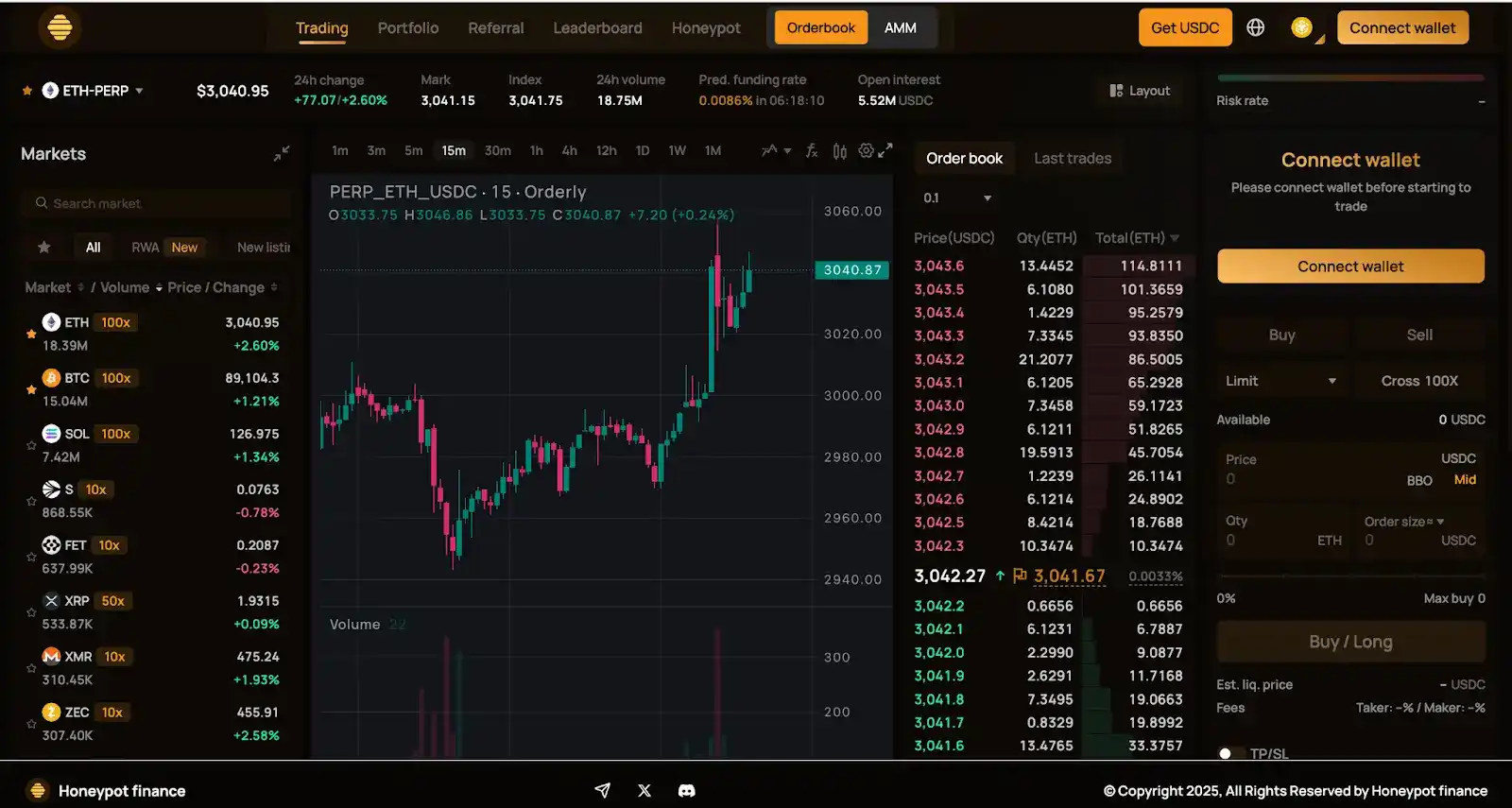
Order Book Handles Efficiency and Depth: By integrating a high-performance on-chain order book through a partnership with Orderly Network, Honeypot provides traders with a near-centralized exchange experience—low slippage, high speed—during stable market conditions, meeting the needs of高频and professional traders.

AMM Provides Resilience and Guarantee: Honeypot's self-developed AMM mechanism centers around a dynamic price band built around the oracle price. When the market experiences剧烈波动or black swan events, and order book liquidity dries up, the AMM acts as the final layer of executable guarantee, ensuring trades can be executed at any time.

The system automatically selects the optimal execution path (order book or AMM) for user trades based on market volatility and order book depth. Users get the best experience without manual intervention. This truly achieves "efficient trading in calm times, predictable execution in storms."
2. Implementing Structured Risk Control: Tiered Vaults and Fair Liquidation Process

In the core area of risk management, Honeypot's thinking is equally profound.

They started with the capital structure, introducing a tiered vault system.

This allows conservative capital seeking stable returns (like potential institutional capital) to enter the "Senior Vault," enjoying priority in fee distribution and being the last to bear losses, achieving risk isolation. Crypto-native players can voluntarily choose to enter the "Junior Vault," becoming the first line of defense to absorb losses in exchange for higher potential returns. This design transforms risk from a "passive, mixed burden" into an "active, clearly priced choice."

On this foundation, they redesigned the liquidation process, creating a "waterfall" sequence with multiple buffers.

When a position approaches liquidation, the system doesn't immediately liquidate it entirely. Instead, it sequentially attempts "Partial Liquidation," markets the position through a "Micro-Auction" for市场化处理, and has the Junior Vault absorb the loss. Following this, the Insurance Fund intervenes as a protocol-level buffer to cover extreme tail-risk events; only if all the above mechanisms are insufficient to stabilize the system is the minimally impactful and fully auditable ADL (Automatic Deleveraging) enabled as a last resort. This transparent design, which pushes punitive measures to the very end, aims to truly fulfill its promise of "procedural fairness."

Market feedback suggests this systemic design, from the foundational liquidity layer to the risk底层, is gaining initial validation. According to industry information, its platform's total trading volume has exceeded $120 million, and the perpetual contracts trading volume has surpassed $20 million since launch.

This data strongly indicates that the appeal of its risk-tiered structure to稳健capital has translated into real capital deposits. Through this series of designs, Honeypot not only attempts to solve existing pain points but also explores building a next-generation on-chain derivatives infrastructure capable of承载more complex capital and placing greater emphasis on fairness.

Token Economics and NFT Mechanism: How is the收益Closed Loop Achieved?

Honeypot Finance doesn't just aim to improve the trading experience; it attempts to build a self-sustaining收益system. Its token and NFT designs revolve around the same core goal: enabling the real revenue generated by the protocol to be continuously recaptured, redistributed, and, in turn, support the ecosystem itself.

1. HPOT: As a Vehicle for收益Bearing and Distribution

In many DeFi protocols, tokens primarily serve激励or governance functions, with limited connection to the protocol's actual revenue. Honeypot's token, $HPOT, with a fixed total supply of 500 million, is designed as a hub connecting trading activity and value distribution.

A portion of the trading fees generated by the protocol's products, like perpetual contracts, flows into the All-in-One Vault. Managed by the treasury and participating in on-chain strategies, these fees are converted into sustainable real yield. This yield is not simply retained; it is explicitly allocated:一部分is used to buy back and burn $HPOT, creating continuous supply contraction; another portion is distributed as claimable yield to users participating in the vaults.

In this structure, $HPOT is not just a speculative asset awaiting price fluctuations but a value carrier linked to the protocol's actual operational results. Its role is closer to a "收益relay" than a one-way incentive tool.

2. NFT: Transforming Long-Term Participation into收益Weight

Honeypot's HoneyGenesis NFT is not merely an identity or membership pass; it is a收益component designed around "long-term participation."

Holders can choose to stake the NFT, accumulating收益weight over time; or they can choose to burn the NFT in exchange for a permanent, higher收益multiplier. This design essentially incentivizes users to exchange time and commitment for higher long-term returns, rather than short-term arbitrage.

Here, the NFT de-emphasizes collectibility and instead functions as a "收益weight amplifier," making the act of participation itself a quantifiable, upgradable capital investment.

In summary, Honeypot attempts to avoid an "incentive consumption" model, instead basing ecosystem growth on real usage and revenue. The最终result is not one-way subsidies but a positive feedback system operating around收益recapture and redistribution.

Conclusion:

With the token即将上线, Honeypot Finance is transitioning from a project driven by early adopters and ecosystem builders to a broader, more complex public market.

Honeypot's current practice already provides a profound case study on structure, risk, and fairness for the on-chain derivatives track. Its core value lies not in the deepening of a single function but in a series of coherent design philosophies:

First, is the compatibility and scalability of the structure. The "full-stack" model is not just a hybrid solution born to cope with market volatility; it also reserves underlying interfaces to carry longer-term, more diverse capital and trading scenarios. The tiered vault design transforms risk from "passive sharing" into "active choice," paving the way for attracting traditional, conservative capital.

Second, is the long-term orientation of the economic mechanisms. Whether it's feeding protocol revenue back to users through token buyback/burns and claimable yield, or designing NFTs as upgradable "收益positions," the goal is to build a value closed loop of "participation equals accumulation." This logic aims to reduce reliance on one-off liquidity mining incentives and explore the possibility of continuing operation based on real use cases and sustainable收益distribution after incentives taper off.

Third, is the synergistic potential of the ecosystem. Honeypot's Perp DEX is not an isolated product but a key link in its full liquidity chain from asset issuance and spot trading to derivatives hedging. This deep integration means different products can potentially form a positive cycle of capital and user behavior, building a deeper moat.

However, after the initial hype subsides, can Honeypot translate its meticulously designed structural advantages into stable capital deposits, sustained real trading demand, and healthy protocol revenue? Can it prove that its advocated "procedural fairness" and risk tiering can truly protect users and maintain system stability in extreme market conditions? This still requires market validation.


İlgili Sorular

QWhat is the core innovation of Honeypot Finance's Perp DEX model compared to mainstream solutions like Hyperliquid?

AHoneypot Finance's core innovation is its 'full-stack' approach that synergistically combines an order book and an AMM model. It integrates with Orderly Network for a high-performance on-chain order book to provide low-slip, high-speed trading during stable conditions, while its proprietary AMM acts as a final execution layer with a price band around the oracle price to ensure trades can be executed during high volatility or black swan events when order book liquidity dries up. This aims to offer efficient trading in calm markets and guaranteed execution during storms.

QHow does Honeypot Finance's risk management system, specifically its 'Tiered Vaults', work to attract different types of capital?

AHoneypot's risk management system features a 'Tiered Vault' structure. It allows conservative capital seeking stable returns (e.g., potential institutional funds) to enter the 'Senior Vault,' which enjoys priority in fee sharing and is the last to absorb losses, achieving risk isolation. Crypto-native players can voluntarily choose the 'Junior Vault' to become the first line of defense against losses in exchange for higher potential returns. This design transforms risk from a passive, shared burden into an active, priced choice.

QWhat role does the HPOT token play in Honeypot's ecosystem, and how is it different from mere incentive tokens in other DeFi protocols?

AThe HPOT token is designed as a central hub connecting trading activity to value distribution, not just for incentives or governance. A portion of the protocol's revenue from trading fees is directed to an 'All-in-One Vault.' The revenue is then used to buy back and burn HPOT tokens (creating constant supply contraction) and is distributed as claimable earnings to users participating in the vaults. This structure makes HPOT a value carrier tied to the protocol's actual operational results, functioning more as a 'profit relay' than a simple incentive tool.

QHow does Honeypot Finance's 'waterfall' liquidation process aim to improve fairness for users?

AHoneypot's 'waterfall' liquidation process is a multi-buffered sequence designed for fairness. When a position nears liquidation, the system doesn't immediately liquidate it. Instead, it first attempts 'partial deleveraging,' then markets the position through a 'micro-auction' for the Junior Vault to absorb losses. The insurance fund acts as a protocol-level buffer for extreme tail risks. Only if all these mechanisms are insufficient does the protocol use Audited Automatic Deleveraging (ADL) as a last resort. This transparent, penalty-last design aims to fulfill its commitment to 'process fairness.'

QWhat was Honeypot's initial product, and how did the experience from it inform the development of their Perp DEX?

AHoneypot's initial core product was a Meme Launchpad called Pot2Pump. It addressed the pain point of capturing long-term value from memecoin launches by directly converting early participants into native liquidity providers (LPs), allowing the liquidity pool and token to be born simultaneously. This experience validated that clever mechanism design could guide liquidity behavior and convert market hype into a stable stream of fees for the protocol and community. It led them to expand into Perp DEX, recognizing that perpetual contracts could sustainably carry trading demand, generate steady fees, and transform volatility into manageable risk exposure, which is crucial for long-term protocol viability.

İlgili Okumalar

He Just Raised 2.7 Billion, and Li Fei-Fei Also Invested

Pete Florence, a former senior research scientist at Google DeepMind and a key contributor to the Vision-Language-Action (VLA) model architecture, is deliberately distancing his startup, Generalist AI, from the trendy "world model" label. He argues that the industry should prioritize concrete goals over buzzwords. His goal is to create robots that can perform a vast range of unseen tasks with high speed and success rates, without needing task-specific training data. Recently, his company raised $400 million (¥2.7 billion) at a $2 billion valuation. Notable investors include NVIDIA's NVentures, Bezos Expeditions, NFDG, as well as Xiaomi co-founder Lin Bin, Zoom founder Eric Yuan, and renowned AI scientist Fei-Fei Li. Florence's approach stems from his academic background at MIT under Professor Russ Tedrake, focusing on understanding the physical world. After joining DeepMind, he developed models like Transporter Network and co-created the VLA framework. He left in 2025 to found Generalist AI. The company has launched two models: GEN-0, which demonstrated that scaling laws apply to physical motion, and GEN-1. GEN-1 was trained on over 500,000 hours of physical interaction data collected via a specialized wearable device. It achieves a 99% success rate on precise mechanical tasks like folding boxes and maintains performance three times faster than its predecessor. Florence believes GEN-1 is reaching a commercial utility threshold similar to the GPT-3 inflection point. The substantial funding round, following GEN-1's release, signifies strong investor confidence in Generalist AI's practical, goal-driven path to creating versatile, useful robots, regardless of the "world model" terminology.

marsbit3 dk önce

He Just Raised 2.7 Billion, and Li Fei-Fei Also Invested

marsbit3 dk önce

Two Legends Lost in Three Days: Is Google's AI Talent Dam Cracking?

In three days, Google lost two AI legends. On June 18, Noam Shazeer, co-author of the seminal "Attention is All You Need" paper and Gemini co-lead, left for OpenAI. Just 48 hours later, John Jumper, 2024 Nobel laureate and AlphaFold lead, departed DeepMind for Anthropic. This follows Andrej Karpathy joining Anthropic in May. These moves highlight a structural trend: top AI talent is concentrating at mission-driven, pre-IPO firms like OpenAI and Anthropic, while Google becomes a primary source. The exodus stems from a core mission mismatch. Google's ad-centric model often subordinates AI research to product and revenue goals, creating friction for pioneers like Shazeer, who returned in 2024 only to leave again. In contrast, OpenAI and Anthropic offer singular focus on pushing AI boundaries, whether towards AGI or safety-aligned models, which deeply appeals to top researchers like Jumper. Financial incentives amplify the pull. With both OpenAI and Anthropic nearing IPO, employees stand to gain immensely from equity, an upside Google's mature stock cannot match. Furthermore, the 2023 merger of Google Brain and DeepMind, intended to consolidate strength, has instead created cultural tension and slowed the path from research to product, as evidenced by Gemini's pace. This talent redistribution is reshaping the AI landscape. While Google retains vast data and compute resources, its true crisis is the quiet, continuous loss of the people who define the field's future. The real moat in AI is not infrastructure, but the concentration of brilliant minds—a battle Google is currently losing.

marsbit2 saat önce

Two Legends Lost in Three Days: Is Google's AI Talent Dam Cracking?

marsbit2 saat önce

Behind the AI Report Card, Lies a Chinese 'Exam Setter'

Beyond the familiar performance charts like MMLU-Pro and MMMU, which major AI models strive to ace, stands a key "examiner": Chinese-Canadian researcher Wenhu Chen. An assistant professor at the University of Waterloo and founder of TIGERLab, Chen addresses the crucial need for more rigorous AI evaluation. As models like GPT-4 began scoring near-perfect results on older benchmarks like MMLU, it became difficult to distinguish their true capabilities. In response, Chen introduced MMLU-Pro in 2024, featuring harder, more reasoning-focused questions with more answer choices, successfully reintroducing meaningful performance gaps. His work extends to multi-modal evaluation with MMMU and its enhanced version, MMMU-Pro. These benchmarks test a model's ability to understand and reason with complex information from images, charts, and text across diverse academic subjects, exposing the significant challenges even top models face in genuine comprehension. Chen's background in complex QA, table reasoning, and his experience at Google DeepMind on projects like Gemini inform his approach. He understands that effective benchmarks must anticipate how models might "cheat" by memorizing data or avoiding visual analysis. His lab also actively researches video understanding and generation models (e.g., UniVideo, Vamba), ensuring his evaluation work is grounded in practical model-building challenges. Now at Meta's Super Intelligence Lab, Chen continues his focus on multi-modal data and evaluation, representing the deep yet often unseen contributions of Chinese talent in shaping the fundamental tools of the AI industry.

marsbit2 saat önce

Behind the AI Report Card, Lies a Chinese 'Exam Setter'

marsbit2 saat önce

Alliance Co-founder's Letter to Entrepreneurs: Written at the Moment Cursor Sold for $600 Billion

Alliance Co-founder's Letter to Entrepreneurs: On Cursor's $60 Billion Sale Many aspiring founders see massive exits like Cursor's $60B sale and wonder why they can't achieve the same, often concluding opportunities are exhausted. But great companies aren't built in obvious, crowded spaces. Cursor, like Stripe, Figma, and Shopify before it, started with a non-consensus belief about the future. Before ChatGPT, they believed AI would transform knowledge work. They focused on a genuinely exciting domain, became their own customer, and obsessed over power users. Their journey involved years of "glass-chewing" effort before the market was ready. The pattern is consistent: identify a long-term technological shift, find a missed entry point, and execute for years before the trend becomes obvious. First-generation products (PayPal, Adobe, Amazon) prove a market exists. Second-generation winners (Stripe, Figma, Shopify) rebuild that market around new insights, technology, or changing customer behaviors. Founders must identify their phase in the cycle. Early entrants like Coinbase or Cursor focus on making new technology usable for power users. Later entrants find the "yin" to the established "yang"—the blind spots incumbents miss as they grow distant from individual users. The key is deep market immersion. Use every product in your space. Talk to users. Build an audience. Stop looking for ideas and start *seeing* them everywhere. Then, choose one. The idea must offer a 10x improvement or solve a "hair-on-fire" pain point—something severe enough that users are already crafting workarounds. When building, avoid feature bloat. Ask: why would someone switch? Great startups rarely force new behaviors; they improve familiar workflows with drastically lower friction (e.g., Cursor forked VS Code instead of creating a new editor). Distribution is the underestimated moat. Before product-market fit, achieve distribution-market fit. How do customers discover new tools? Founders like those at Airbnb, Stripe, and Cursor did unscalable, manual work to recruit early users. The final, unteachable ingredient is resilience. Cursor built for years pre-market, faced rejection, and persisted. So did Airbnb, Nvidia, and Rain (which launched post-FTX collapse). The lesson isn't that these founders were smarter, but that they stayed in the game long enough for their insights to compound. Framework: Spot technological cycles. Cultivate unique insight. Obsess over your market. Talk to customers. Find a hair-on-fire problem. Build the simplest wedge. Win your distribution channel. Above all, don't quit when it gets hard. Most people won't do these things consistently. The few who do build the next generation of great companies. Go build.

marsbit2 saat önce

Alliance Co-founder's Letter to Entrepreneurs: Written at the Moment Cursor Sold for $600 Billion

marsbit2 saat önce

İşlemler

Spot
Futures
活动图片