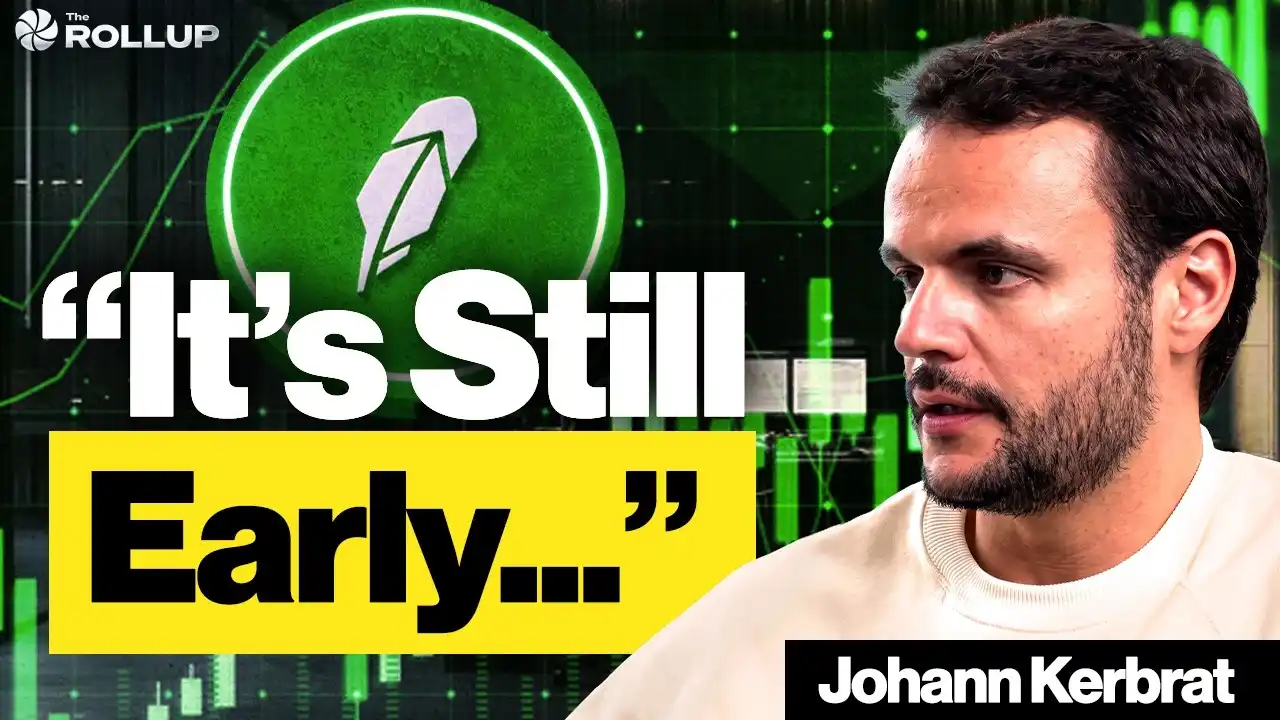
"Anything But Crypto, everything else can make money."
Recently, the crypto circle and other global markets seem to be worlds apart.
Throughout 2025, gold rose over 60%, silver surged 210.9%, and the U.S. stock Russell 2000 index increased by 12.8%. Bitcoin, however, closed the year negative after briefly hitting a new high.
In early 2026, the divergence intensified. On January 20th, gold and silver hit new highs successively, the Russell 2000 index outperformed the S&P 500 for 11 consecutive days, and China's STAR 50 index gained over 15% in a single month.
In contrast, Bitcoin, on January 21st, fell for six consecutive days, dropping from $98,000 back below $90,000 without looking back.
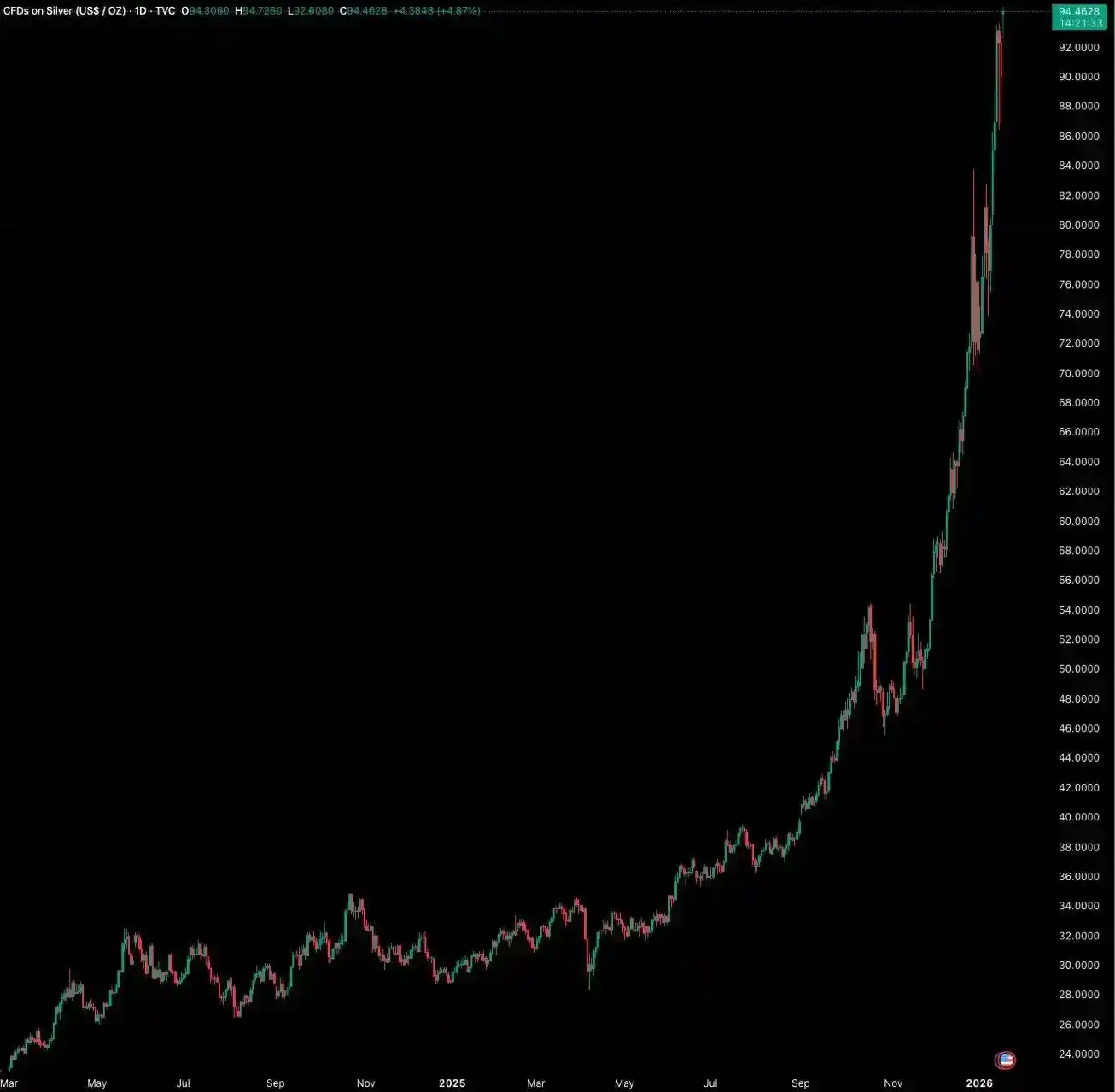
Silver's performance over the past year
Funds seem to have decisively left the crypto space after the events of October 11th (1011). BTC has been oscillating below $100,000 for over three months, and the market has entered a period of "the lowest volatility ever."
Disappointment is spreading among crypto investors. When asked about investors who left Crypto and made money in other markets, they even shared the "ABC" "secret" -- "Anything But Crypto" -- meaning, as long as you don't invest in Crypto, you can make money elsewhere.
The "Mass Adoption" anticipated in the last cycle seems to have arrived, but not in the form of decentralized application普及 everyone hoped for. Instead, it's a complete "assetization" led by Wall Street.
In this cycle, the U.S. establishment and Wall Street have embraced Crypto with an unprecedented attitude. The SEC approved spot ETFs; BlackRock and JPMorgan allocated assets to Ethereum; the U.S. incorporated Bitcoin into its national strategic reserves; pension funds in several states invested in Bitcoin; even the NYSE announced plans to launch a cryptocurrency trading platform.
So the question arises: Why, after gaining so much political and capital backing, has Bitcoin's price performance been so disappointing while precious metals and stock markets are hitting new highs?
When crypto investors have become accustomed to checking pre-market U.S. stock prices to gauge crypto market trends, why is Bitcoin not following the rise?
Why is Bitcoin so weak?
Leading Indicator
Bitcoin is a "leading indicator" for global risk assets, as Real Vision founder Raoul Pal has repeatedly mentioned in his articles. Because Bitcoin's price is purely driven by global liquidity and is not directly affected by national earnings reports or interest rates, its fluctuations often lead those of mainstream risk assets like the Nasdaq index.
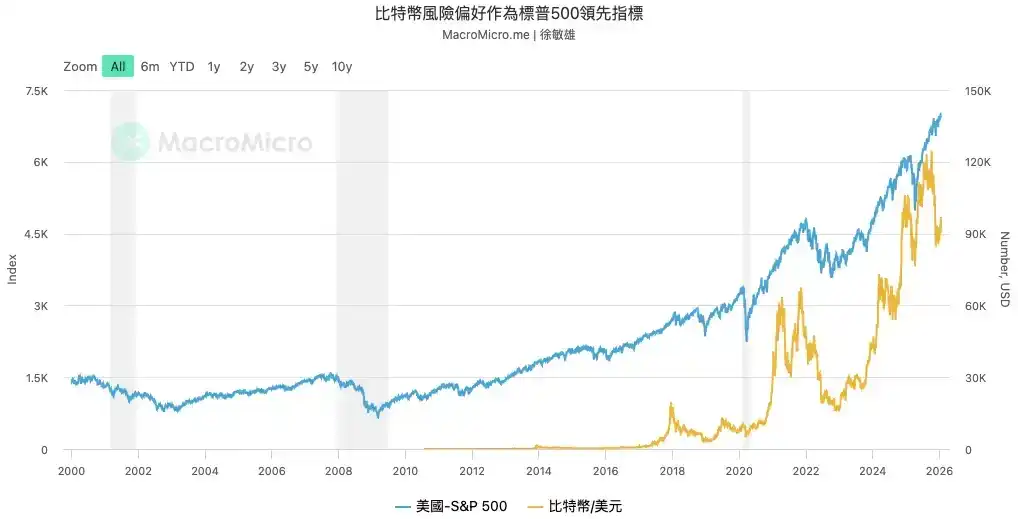
According to MacroMicro data, Bitcoin's price turning points have repeatedly led the S&P 500 index in recent years. Therefore, once the upward momentum of Bitcoin, as a leading indicator, stalls and fails to make new highs, it constitutes a strong warning signal that the upward momentum of other assets may also be nearing exhaustion.
Liquidity Tightening
Secondly, Bitcoin's price, to this day, remains highly correlated with global net dollar liquidity. Although the Fed cut interest rates in 2024 and 2025, the quantitative tightening (QT) that began in 2022 is still continuously sucking liquidity out of the market.
Bitcoin's new high in 2025 was more due to new funds brought by ETF approvals, but this did not change the fundamental landscape of tight global macro liquidity. Bitcoin's sideways movement is a direct reaction to this macro reality. In an environment short of money, it is difficult for it to start a super bull market.
And the world's second-largest source of liquidity—the yen—is also beginning to tighten. The Bank of Japan raised its short-term policy rate to 0.75% in December 2025, the highest level in nearly 30 years. This directly impacts an important source of funding for global risk assets over the past decades: the yen carry trade.
Historical data shows that since 2024, all three rate hikes by the Bank of Japan were accompanied by Bitcoin price drops of over 20%. Synchronized tightening by the Fed and the Bank of Japan has made the global liquidity environment even worse.
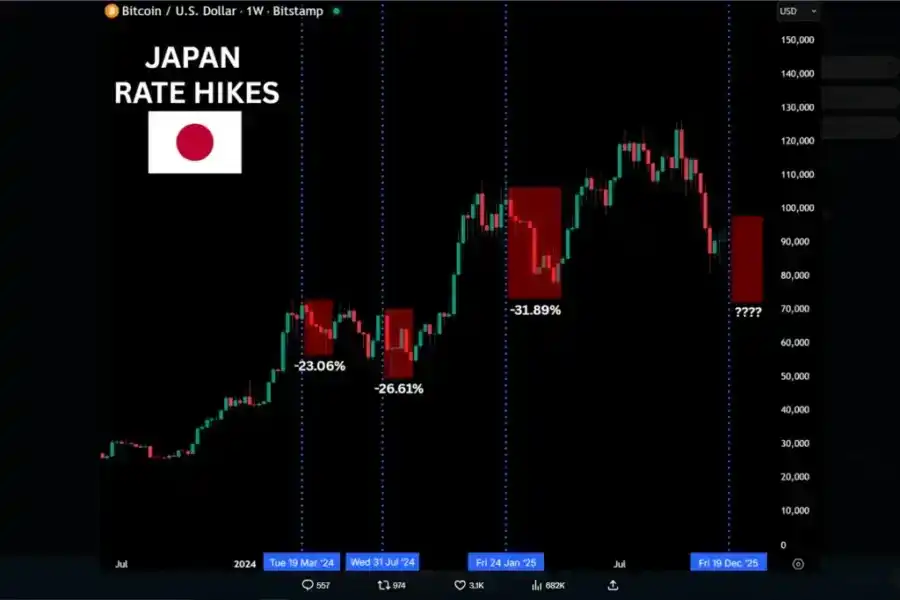
Crypto market decline following each Japanese rate hike
Geopolitical Conflict
Finally, potential geopolitical "black swans" are keeping market nerves on edge, and a series of actions by Trump in early 2026 have pushed this uncertainty to new heights.
Internationally, the actions of the Trump administration are full of unpredictability. From military intervention in Venezuela and the arrest of its president (unprecedented in modern international relations), to war with Iran again being on the brink; from attempting to forcibly purchase Greenland, to issuing new tariff threats against the EU. This series of radical unilateral actions is comprehensively intensifying major power contradictions.
Domestically in the U.S., his moves have sparked deep public concern about a constitutional crisis. He not only proposed renaming the "Department of Defense" to the "Department of War," but has also ordered active-duty troops to prepare for potential domestic deployment.
These actions, combined with his past暗示 (hints) of regretting not using military force and unwillingness to accept midterm election losses, have made public fears increasingly clear: would he refuse to accept a midterm election defeat and use force to stay in power? This speculation and high pressure are already exacerbating internal U.S. contradictions, with protests currently showing signs of expanding.

Trump invoked the Insurrection Act last week and deployed troops to Minnesota to quell protests; the Pentagon has ordered about 1,500 active-duty soldiers stationed in Alaska to be on standby.
The normalization of this conflict is dragging the world into a "gray zone" between localized war and a new Cold War. Traditional full-scale hot war had relatively clear paths, market expectations, and was even accompanied by stimulus "bailouts."
This kind of localized conflict, however, has extreme uncertainty, filled with "unknown unknowns." For risk capital markets that highly rely on stable expectations, this uncertainty is fatal. When large capital cannot judge the future, the most rational choice is to increase cash holdings and wait on the sidelines, rather than allocating funds to high-risk, high-volatility assets.
Why Aren't Other Assets Falling?
In stark contrast to the crypto silence, since 2025, markets like precious metals, U.S. stocks, and A-shares have taken turns rising. But the rise in these markets is not because the macro and liquidity fundamentals have generally improved; rather, it is a structural行情 (market trend) driven by sovereign will and industrial policy against the backdrop of great power games.
The rise in gold is a reaction by sovereign states to the existing international order, rooted in the credit cracks of the dollar system. The 2008 global financial tsunami and the 2022 freezing of Russian foreign exchange reserves completely shattered the "risk-free" myth of the U.S. dollar and U.S. Treasury bonds as the world's ultimate reserve assets. In this context, global central banks have become "price-insensitive buyers." They buy gold not for short-term profit, but to find an ultimate store of value that does not rely on any single sovereign credit.
Data from the World Gold Council shows that in 2022 and 2023, global central banks' net gold purchases exceeded 1,000 tons for two consecutive years, setting historical records. The main driver of this gold rally is official force, not market-based speculative force.
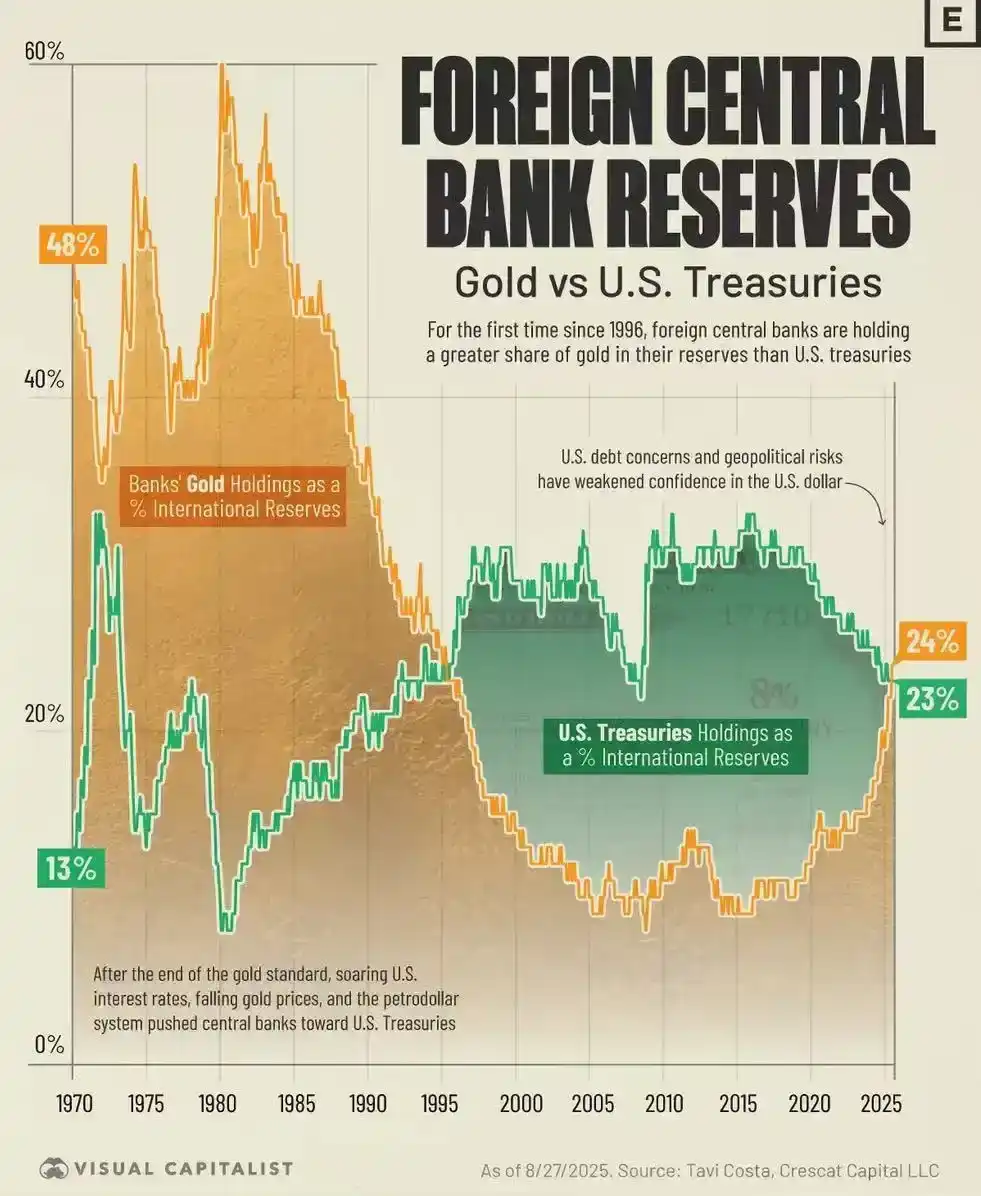
Comparison of the proportion of gold and U.S. Treasury bonds in sovereign national central bank reserves; in 2025, total gold reserves exceeded those of U.S. Treasury bonds.
The rise in the stock market is a reflection of national industrial policies. Whether it is the U.S. "AI Nationalization" strategy or China's "industrial autonomy" policy, state power is deeply介入 (intervening) and directing the flow of capital.
Take the U.S., for example. Through the CHIPS and Science Act, the AI industry has been elevated to a national security priority. Funds are clearly flowing out of large tech stocks and into more growth-oriented small and mid-cap stocks that align with policy directions.
In China's A-share market, funds are also highly concentrated in areas closely related to national security and industrial upgrading, such as "信创" (IT application innovation) and "国防军工" (national defense and military industry). This kind of government-strongly-led行情 (market trend) has a natural difference in pricing logic from Bitcoin, which relies on purely market-driven liquidity.
Will History Repeat Itself?
Historically, it is not the first time Bitcoin's performance has diverged from other assets. And each divergence ultimately ended with a strong rebound in Bitcoin.
Historically, there have been four times when Bitcoin's RSI (Relative Strength Index) against gold fell below 30, indicating extreme oversold conditions: in 2015, 2018, 2022, and 2025.
Each time Bitcoin was extremely undervalued relative to gold, it foreshadowed a rebound in the exchange rate pair or Bitcoin's price.
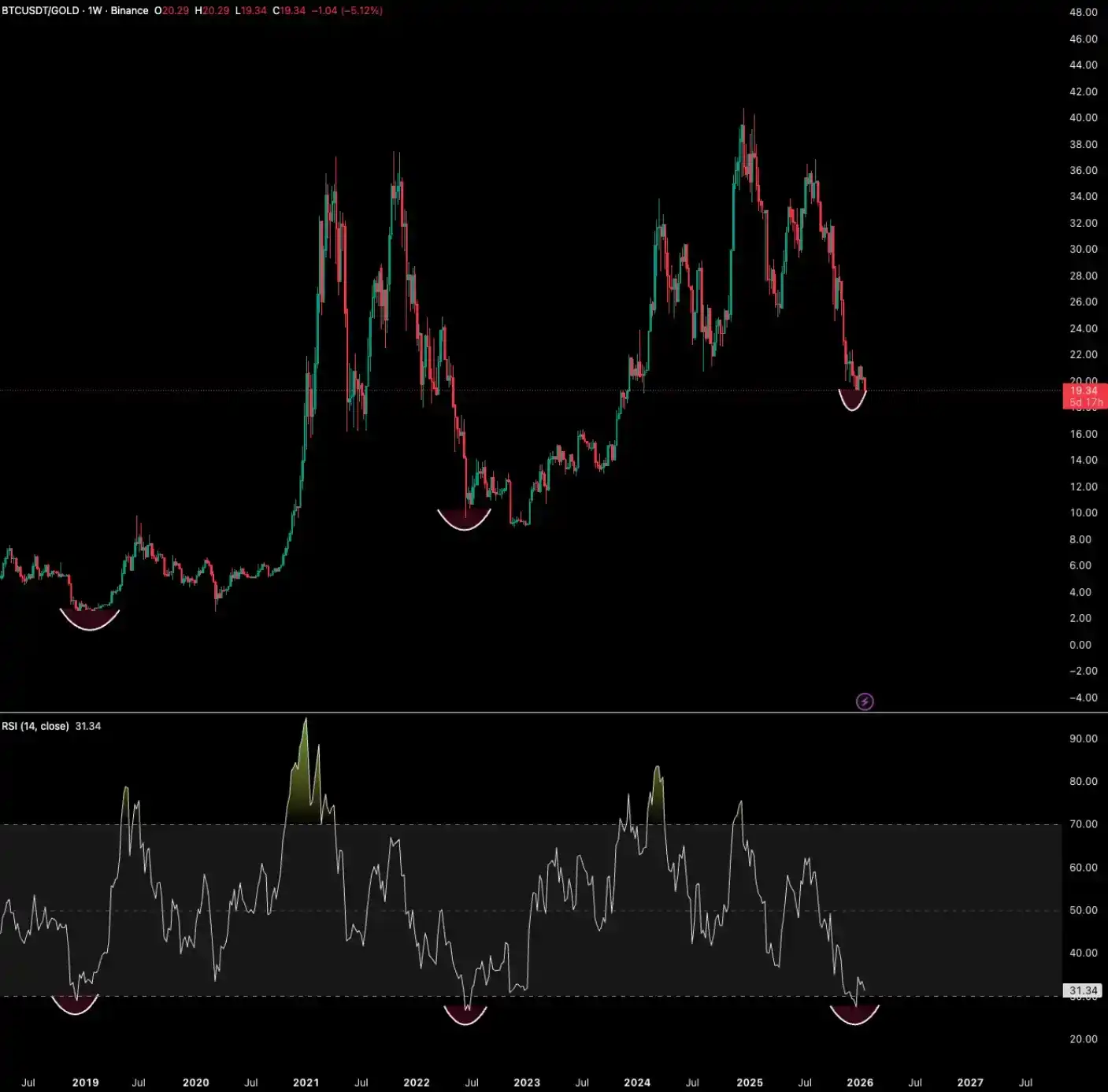
Historical trend of Bitcoin/Gold, with RSI indicator below
In 2015, at the end of the bear market, Bitcoin's RSI against gold fell below 30, subsequently launching the 2016-2017 super bull market.
In 2018, during the bear market, Bitcoin fell over 40%, while gold rose nearly 6%. After the RSI fell below 30, Bitcoin rebounded over 770% from its 2020 low.
In 2022, during the bear market, Bitcoin fell nearly 60%. After the RSI fell below 30, Bitcoin rebounded, again outperforming gold.
From late 2025 to now, we are witnessing this historic oversold signal for the fourth time. Gold surged 64% in 2025, and Bitcoin's RSI against gold has once again fallen into oversold territory.
Is It Still Worth Chasing Other Assets Now?
Amid the "ABC" noise, easily selling crypto assets to chase the rally in other currently seemingly more prosperous markets could be a dangerous decision.
When U.S. small-cap stocks start leading gains, historically it has often been the final狂欢 (carnival) before liquidity dries up at the end of a bull market. The Russell 2000 index has risen over 45% from its 2025 low, but most of its component companies have relatively poor profitability and are very sensitive to interest rate changes. Once the Fed's monetary policy falls short of expectations, the fragility of these companies will be immediately exposed.
Secondly, the frenzy in the AI sector is showing typical bubble characteristics. Whether it's Deutsche Bank's survey or warnings from Bridgewater founder Ray Dalio, the AI bubble is listed as the biggest risk for the 2026 market.
The valuations of star companies like Nvidia and Palantir have reached historical highs, and whether their profit growth can support such high valuations is being questioned more and more. A deeper risk is that the huge energy consumption of AI could trigger a new round of inflationary pressure, forcing central banks to tighten monetary policy and burst the asset bubble.
According to Bank of America's fund manager survey in January, global investor optimism hit a new high since July 2021, and global growth expectations soared. Cash holdings fell to a record low of 3.2%, and protection measures against market corrections are at their lowest level since January 2018.
On one side are sovereign assets疯狂上涨 (rising疯狂ly),普遍乐观 (generally optimistic) investor sentiment; on the other side are intensifying geopolitical conflicts.
Against this macro backdrop, Bitcoin's "stagnation" is not simply "underperforming." It is more like a清醒 (sobering) signal, an early warning of greater risks ahead, and also积蓄力量 (accumulating strength) for a grander narrative shift.
For true long-termists, this is precisely the moment to test convictions, resist temptation, and prepare for the coming crises and opportunities.