Hidden Ads No More: Under X's New Disclosure Rules, KOLs' Easy Money Model Faces Account Suspension Risks

比推2026-02-24 tarihinde yayınlandı2026-02-24 tarihinde güncellendi

Özet

X, formerly known as Twitter, is set to enforce stricter advertising disclosure rules, as announced by product lead Nikita Bier. The new policy will require users to clearly label paid promotions with tags like #ad or #sponsored. This follows a public intervention by Bier, who warned an influential account promoting Kalshi without proper disclosure of its financial ties. The article highlights several high-engagement “stealth ads”—posts disguised as organic content that are actually paid promotions—from accounts like @jota_snchez and @FluentInFinance, which garnered millions of views without disclosure. These posts often promoted prediction markets like Polymarket and Kalshi by leveraging FOMO and misleading narratives. The new rules aim to increase transparency, impacting Web3 projects and influencers who rely on undisclosed soft promotions for user acquisition. KOLs may face higher risks, including post removal and account suspension, while projects could see rising marketing costs. Alternatively, advertisers may shift budgets to X’s official promoted post system, potentially increasing the platform’s ad revenue. The move is expected to reduce deceptive marketing practices and improve user awareness in the long term.

Author: Sanqing, Foresight News

Original Title: X's New Advertising Disclosure Rules to Launch, Potentially Ending the Crypto KOLs' 'Easy Money' Model


On February 21, X platform product lead Nikita Bier (@nikitabier) publicly intervened in a post suspected of undisclosed paid promotion, directly requesting the original poster to add a disclosure statement or face account suspension. User @infodexx posted a list of the "Most Valuable Startups of 2025," with prediction market Kalshi ranking second with a $11 billion valuation, accompanied by Kalshi's green brand image and founder's photo.

The post garnered over 420,000 views, nearly 2000 likes, and hundreds of reposts. While it appeared to be an objective ranking, it was flagged in the reader community notes as "this is a paid post." Furthermore, @infodexx's bio explicitly states "@Kalshi partner," yet the original post lacked any clear disclosure labels like #ad or #sponsored.
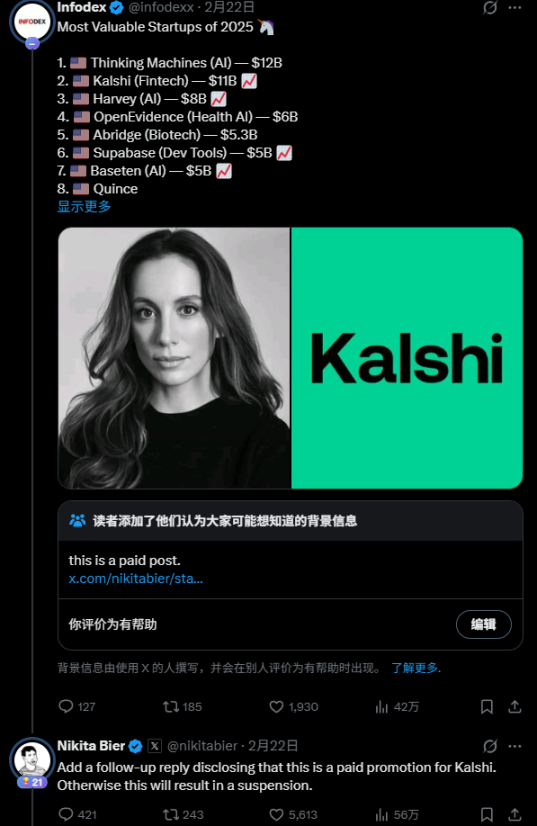
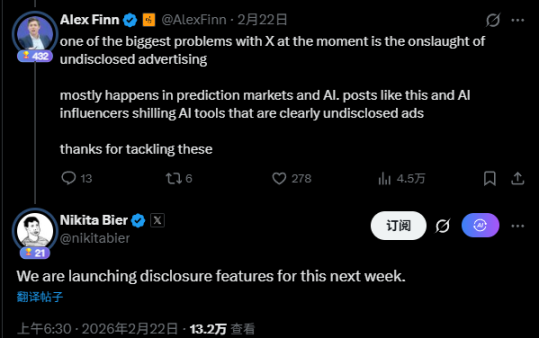
Nikita Bier replied to the post on the same day: "Please add a follow-up reply disclosing this is a paid promotion for Kalshi. Otherwise, this will result in account suspension." Later, when user @AlexFinn complained about the X platform being flooded with undisclosed ads (especially posts related to prediction markets and AI), Nikita Bier further stated: "We are launching a disclosure feature for this type of issue next week."
High-Viewership Hidden Ads Will Be Brought into the Light

Below are several examples of high-viewership "hidden ads" selected by the author. These tweets appear to be natural shares but are suspected promotions lacking any disclosure labels. They attract high views, lure degens to follow the trend, yet evade responsibility.

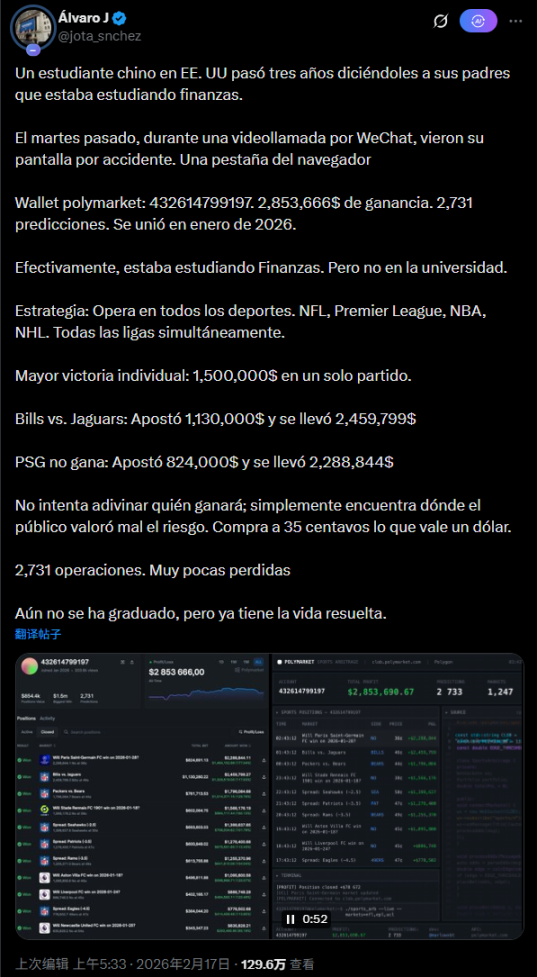
A Spanish-language account @jota_snchez shared a story about a "Chinese student making a fortune on Polymarket," with over 1.29 million views, 7313 likes, and 312 reposts. The content detailed strategies with images and videos, seeming like an inspirational post but actually softly promoting Polymarket's money-making potential. No #ad label, yet indirectly hyping the platform—a classic disguise of experience sharing.
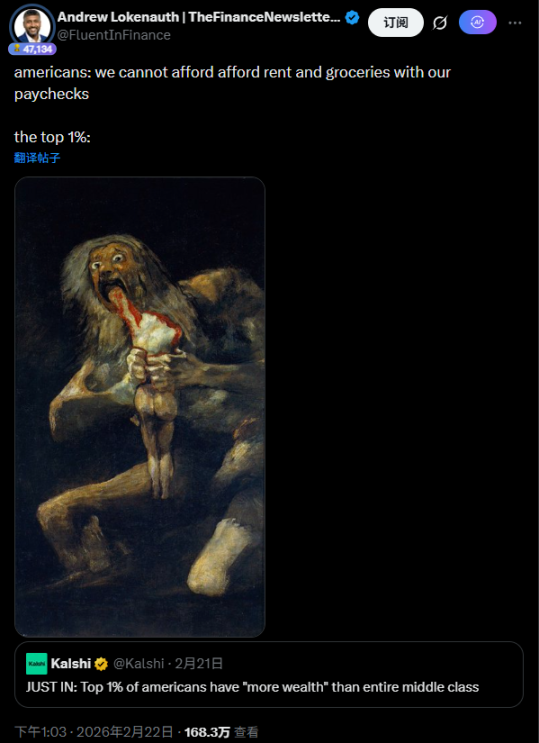
User @FluentInFinance quoted a Kalshi tweet, complaining "US 1% wealthier than middle class," with 1.68 million views, 150k+ likes, and 20k+ reposts. Superficially social commentary, it actually quoted Kalshi's "JUST IN" news, guiding users to bet on related events on the platform. Not labeled #sponsored, yet amplified exposure through high engagement. This is where Web3 degens often get tricked.
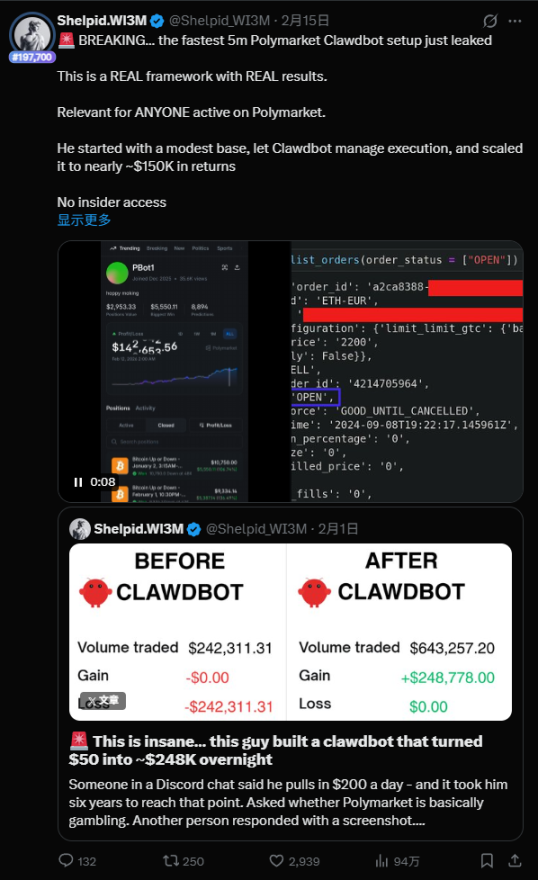
@Shelpid_WI3M "exposed" a 5-minute setup framework for Polymarket Clawdbot, with 940k views, 2940 likes, 6091 bookmarks. Detailed steps + link, seeming like a "free share" but actually promoting a copytrade tool, indirectly pulling new users to Polymarket. No disclosure of any partnership—this type of "developer perspective" hidden ad is the most deceptive for technical degens.
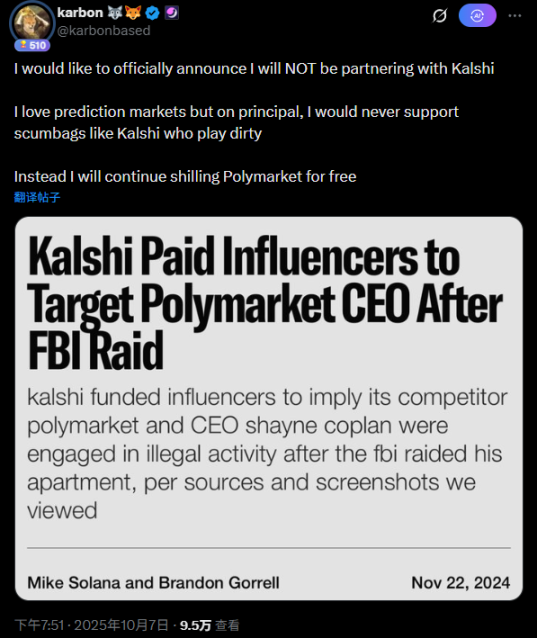
@karbonbased publicly "refused Kalshi collaboration but continues to shill Polymarket for free," with 95k views, 764 likes. Superficially a "principled" refusal, it actually promotes Polymarket indirectly. The word "free" is most suspicious—what's truly free in Web3? No #ad, yet using moral high ground to induce followers.
@pablofindsout uploaded a video discussing the nature of Polymarket and Kalshi, with 300k views, 1657 likes. Citing expert opinions, seemingly neutral but actually amplifying platform exposure—an unlabeled sponsored隐形广告片 (stealth ad video).

These examples show that high viewership does not equal sincerity. They rely on FOMO for viral spread but avoid disclosure, costing wallets dearly. After the new rules, similar tweets will be restricted.

Impact of X's New Rules on Web3 Marketing

For Web3 project teams, this means a significant increase in marketing costs. Many prediction market projects (like Polymarket and Kalshi) rely on KOLs' soft ads to drive user FOMO entry at low cost.

Now, the new rules require any content involving payment, gifts, affiliate links, or material incentives to be prominently labeled with "#ad," "sponsored," or "paid partnership," etc. Otherwise, the tweet will be directly removed, and the account faces suspension or even permanent ban.

In the short term, growth for these platforms will slow down. KOLs will hesitate to share freely, collaboration thresholds will be raised, and budgets will be forced towards more expensive channels.

For KOLs, the most direct impact is the end of the "low-effort easy money" model. In the past, many projects heavily relied on KOLs' "soft ad" strategy: disguising promotions as neutral experience sharing, data-driven complaints, or viral memes to create FOMO and drive user participation at low cost.

Now, forced explicit disclosure means KOLs can no longer hide commercial relationships and dare not casually "share naturally." Once detected by AI or reported, the risk of tweet deletion and account suspension is extremely high.

This will also raise the collaboration threshold between projects and KOLs. As risks increase, KOLs' rates may rise. But in the long run, this is positive for the Web3 ecosystem. Increased transparency will restore user trust in promoted content, reducing rug pulls and short-term speculation.

A common alternative is shifting to X's official Promoted Post system: these ads automatically carry "Promoted" or "Ads" labels, handled uniformly by the platform for disclosure, avoiding manual labeling risks. However, this also means project teams pay directly to X, concentrating more ad revenue into the platform's hands rather than dispersing it to KOLs.

X's move also likely aims to enhance its own advertising monetization capability. By enforcing explicit disclosure and promoting official ad tools, the platform can attract more budgets into its own system, capturing the share of "hidden ads" that originally flowed to KOLs, further strengthening its position as an ad revenue source, especially in competitive fields like prediction markets and AI content.


Twitter:https://twitter.com/BitpushNewsCN

Bitpush TG Discussion Group:https://t.me/BitPushCommunity

Bitpush TG Subscription: https://t.me/bitpush

Original article link:https://www.bitpush.news/articles/7614106

İlgili Sorular

QWhat new policy is X platform introducing regarding paid promotions?

AX platform is introducing a new policy that requires any content involving paid promotions, giveaways, affiliate links, or material incentives to be clearly labeled with disclosures such as '#ad', 'sponsored', or 'paid partnership'. Failure to comply will result in post removal and potential account suspension or permanent ban.

QWho is Nikita Bier and what action did he take on February 21st?

ANikita Bier is the Product Lead at X platform. On February 21st, he publicly intervened on a post by user @infodexx that was suspected of being an undisclosed paid promotion. He instructed the user to add a disclosure statement or face account suspension.

QWhat are some examples of high-engagement 'stealth ads' mentioned in the article?

AExamples include a Spanish account @jota_snchez sharing a story about a Chinese student making money on Polymarket (1.29M views), @FluentInFinance criticizing wealth inequality while referencing Kalshi (1.68M views), and @Shelpid_WI3M sharing a 'setup framework' for a Polymarket tool (940k views). All lacked proper disclosure tags.

QHow will the new disclosure rules impact Web3 projects and KOLs according to the article?

AFor Web3 projects, marketing costs will rise as they can no longer rely on low-cost, undisclosed KOL soft promotions. For KOLs, their 'easy money' model of sharing undisclosed ads will end, forcing them to properly label content. This raises the cooperation threshold and may increase KOL pricing due to higher risks.

QWhat is a potential alternative for advertisers under the new rules, and what is X platform's possible motive?

AA common alternative is to use X's official Promoted Post system, which automatically labels ads as 'Promoted' or 'Ads'. The article suggests X's motive may be to increase its own advertising revenue by redirecting budgets from KOL 'stealth ads' to its official ad platform, especially in competitive areas like prediction markets and AI content.

İlgili Okumalar

Crypto Miners' Big AI Gamble: Valuations Enter Differentiation Stage, Comeback Fight Proves Tough

Crypto Mining Firms' AI Bet: Valuation Divergence and a Challenging Transformation Facing declining profitability in crypto mining, mining companies are pivoting to AI infrastructure, capitalizing on their existing power resources, land, and data center expertise to offer GPU compute power. This transition narrative has boosted their stock prices significantly, with firms like Hut 8 and Bitfarms seeing gains over 100% year-to-date, far outpacing Bitcoin. This has led to a market valuation split, with pioneers like CoreWeave reaching a $62.8B market cap, while others remain below $5B. The market currently prioritizes growth potential over short-term profits, which remain under pressure due to heavy capital expenditures for AI build-outs and crypto asset volatility. However, the transformation is a high-stakes gamble. Bitcoin mining profitability is shrinking, with the average production cost around $63,707 and miner margins contracting. While AI offers a more lucrative long-term path, it requires massive investment—estimated at a $500B near-term funding gap. Success now hinges on execution: delivering on contracted power capacity, securing quality tenants like major cloud providers, and managing the immense financial burden. The valuation focus is shifting from mere power capacity to project delivery, future cash flows, and tenant quality, making this a difficult but critical turnaround attempt.

链捕手3 dk önce

Crypto Miners' Big AI Gamble: Valuations Enter Differentiation Stage, Comeback Fight Proves Tough

链捕手3 dk önce

Analysis of the Latest Portfolio Adjustment by the "Top Player" in the U.S. Stock Market: $9 Billion Short on NVIDIA, Shifting Focus to Power and Memory Sectors

AI investor Leopold Aschenbrenner has made a significant portfolio shift, taking a $9 billion nominal short position against top AI infrastructure stocks like NVIDIA, ASML, and Oracle. Simultaneously, he is redirecting capital towards what he sees as the next critical bottlenecks in the AI boom: power, memory, and data center networking, alongside private investments in AI model companies like Anthropic. This move is interpreted not as a call that the AI bubble has burst, but as a rotation within the infrastructure stack. The analysis highlights NVIDIA's recent $25 billion bond issuance as a potential signal, questioning why a cash-rich company would seek external debt despite high profits and increased dividends/buybacks. The core investment thesis is that the initial, crowded "picks and shovels" trade in semiconductors is maturing. The next wave of capital is expected to flow into the physical and logistical constraints of AI expansion: electricity supply, memory chip capacity, data center construction, and enabling technologies like optical networking (fiber) for high-bandwidth communication, where copper remains crucial for short distances. Aschenbrenner's substantial (approx. 20% of fund) private stake in Anthropic is noted as a key part of his strategy—investing directly in the "mine" (AI models) rather than just the "shovels." The discussion concludes that while certain segments may be overvalued, the overarching AI infrastructure demand driven by real product usage remains robust. The most promising long-term investments are seen in essential, non-sexy infrastructure—particularly energy and power companies—whose demand is viewed as a global constant irrespective of AI's cyclicality.

marsbit24 dk önce

Analysis of the Latest Portfolio Adjustment by the "Top Player" in the U.S. Stock Market: $9 Billion Short on NVIDIA, Shifting Focus to Power and Memory Sectors

marsbit24 dk önce

BIT Research: Liquidity is Disappearing, Will Bitcoin Replay the Bottoming Pattern of 2022?

The crypto market is currently in an adjustment phase driven by policy expectations and liquidity shifts. Despite a brief rebound fueled by geopolitical easing and SpaceX's strong IPO performance, unexpectedly hawkish signals from new Fed Chair Kevin Warsh have removed anticipated easing support. Concurrently, stablecoin liquidity is shrinking, with insufficient new capital inflows, pushing the market into a typically quiet summer period. Pricing lacks catalysts for a sustained rally. Daily trading volume has significantly contracted, stablecoin growth has slowed markedly, and the supportive effect of Strategy's (formerly MicroStrategy) STRC preferred stock-financed Bitcoin purchases is fading. Amid policy uncertainty, seasonal weakness, and liquidity contraction, Bitcoin faces near-term downward pressure. Warsh's hawkish pivot and refusal to provide a clear policy outlook have increased risk premiums, historically unfavorable for Bitcoin. Technically, the trend remains bearish below $73,700, with $62,446 as critical support. A break below could accelerate declines, though a prolonged consolidation phase, similar to 2022's bottoming process, is possible. Liquidity is a core constraint. Current daily volume is around $500 billion, roughly 25% of the peak during the July-Oct 2025 rally. The 12-month growth rates for USDT and USDC have fallen to ~20%, with 6-month growth near zero, indicating weak new inflows. Bitcoin ETF and Strategy-driven inflows have also weakened, with a 30-day rolling net outflow. With inflation at 4.2% above the Fed's target, combined hawkish policy, seasonal factors, and liquidity shortages challenge Bitcoin's ability to hold above $60,000. However, this adjustment phase may be forming a cyclical low this summer, potentially setting the stage for the next bull cycle.

marsbit52 dk önce

BIT Research: Liquidity is Disappearing, Will Bitcoin Replay the Bottoming Pattern of 2022?

marsbit52 dk önce

Who Makes the Best Use of Claude Code? The Answer Might Not Be Programmers

Claude Code Usage Report Summary (Based on ~400k sessions) Core Finding: In agentic programming with Claude Code, a clear division of labor has emerged: humans primarily decide *what* to build (planning decisions), while Claude decides *how* to build it (execution decisions). Key Insights: 1. **Effectiveness is not limited to programmers.** In code-generation tasks, success rates for users in non-technical fields (law, finance, management, research) are nearing those of software engineers. What matters most is the user's domain expertise and understanding of the problem to be solved. 2. **Domain expertise drives success and efficiency.** Sessions where users exhibited "expert" proficiency in the task's domain saw verified success rates double compared to "novice" sessions. Experts also delegated more work per instruction, with Claude executing more actions and producing more output. 3. **AI is amplifying, not replacing, domain knowledge.** Claude Code lowers the *implementation* barrier, not the *judgment* barrier. The value of knowing the "what" and "why" is increasing relative to just knowing the "how" to code. 4. **Usage is evolving.** Over a 7-month period (Oct '25 - Apr '26), the share of sessions for debugging halved, while use for software operations, data analysis, and non-code writing roughly doubled. The estimated economic value of typical tasks increased by ~25%. Conclusion: The data suggests coding agents are making programming background less critical for completing technical tasks. However, they reward and amplify deep domain understanding. The ability to successfully direct an AI agent stems more from mastery of a specific field than from coding skill itself. The primary gains come from being competent in a domain; deep specialization adds only marginal additional advantage. This may signal a shift where software creation becomes integrated into various professions.

marsbit1 saat önce

Who Makes the Best Use of Claude Code? The Answer Might Not Be Programmers

marsbit1 saat önce

İşlemler

Spot
Futures
活动图片