Has the Cryptocurrency Market Hit Bottom? Here's What Institutions Think

Foresight News2026-06-16 tarihinde yayınlandı2026-06-16 tarihinde güncellendi

Özet

"Has the crypto market bottomed out? Major institutions are divided on the outlook, according to a recent analysis by Matt Hougan, Chief Investment Officer of Bitwise. Three prominent research firms published in-depth reports on the topic with differing conclusions. Galaxy Digital argues Bitcoin has not yet found its bottom, pointing to only 4 out of 13 historical bottoming indicators being met. Their analysis suggests a potential bottom range of $30,000 to $54,000. NYDIG adopts a more cautious stance, noting that while metrics are close to historical bear market lows, a classic panic-selling capitulation event is missing. They acknowledge the possibility of a bottom but consider it unlikely, citing structural changes from institutional adoption. In contrast, Standard Chartered Bank asserts the bottom is already in at around $59,000. Their revised bullish view, predicting a year-end target of $100,000, hinges on anticipated reductions in ETF selling pressure linked to events like a potential SpaceX IPO. Despite the surface-level disagreement on the exact price floor, the reports share significant common ground crucial for long-term investors. All three institutions agree that a market bottom will likely form within the current year, that current prices are closer to the bottom than to previous cycle highs, and that Bitcoin is poised for another major bull cycle in the future. The core takeaway is that while the precise bottom level remains debated, the long-term value prop...


Authored by: Matt Hougan, Chief Investment Officer, Bitwise

Compiled by: Chopper, Foresight News


Over the past two weeks, three cryptocurrency research firms I have long followed—other than Bitwise—have published in-depth reports addressing the same issue: Has the cryptocurrency market reached its bottom?


  • Galaxy Digital: Bitcoin has not bottomed yet; data points to a potential bottoming zone.
  • NYDIG: What factors are currently suppressing Bitcoin's price performance?
  • Standard Chartered: The market bottom has already occurred.


The three reports are detailed, containing a wealth of data and complete logical reasoning, and are worth reading in full. However, if you're looking for a simple, unified answer, you might be disappointed: the judgments given by these three authoritative institutions are completely different.


Has the Market Bottomed?


  • Galaxy Digital: No
  • NYDIG: Possibly, but not very likely
  • Standard Chartered: Yes


Below, we break down the core logic of each institution one by one.


Three Institutions, Three Views


Galaxy Digital


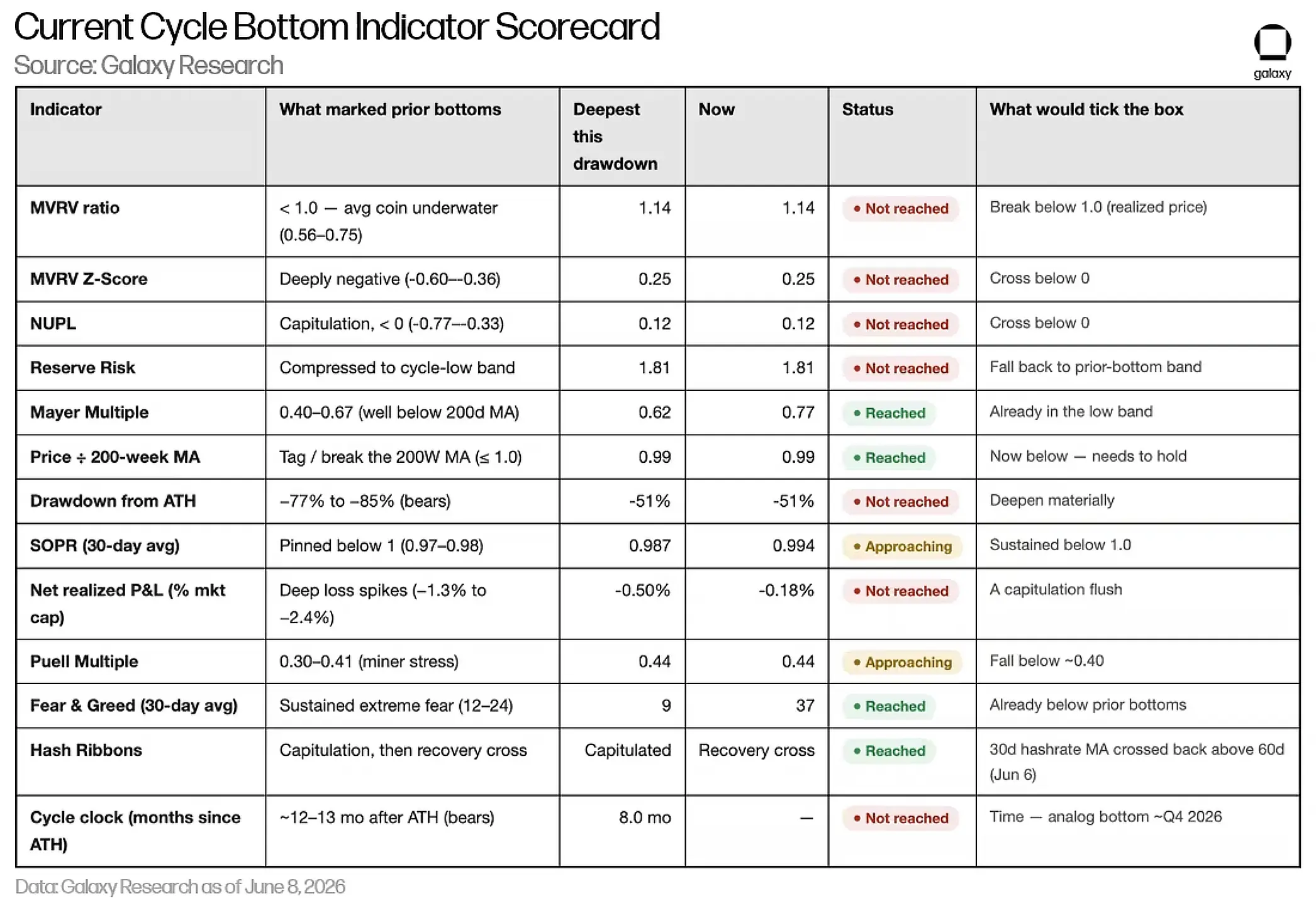
Galaxy Digital reviewed Bitcoin's full 17-year price history and summarized 13 indicators that typically appear simultaneously when the market truly bottoms out. These cover six dimensions: valuation, profit-taking, miner pressure, price trends, bull/bear cycles, and market sentiment. Long-term Bitcoin investors are familiar with these indicators, including the 200-week moving average, Fear & Greed Index, Mayer Multiple, etc.


Galaxy found that currently only 4 indicators fully meet the criteria, 2 are partially met, and the remaining 7 have not triggered a bottom signal. The report concludes that the bottom range for this Bitcoin cycle is between $30,000 and $54,000, with a neutral baseline bottom of $40,000 to $46,000.


NYDIG


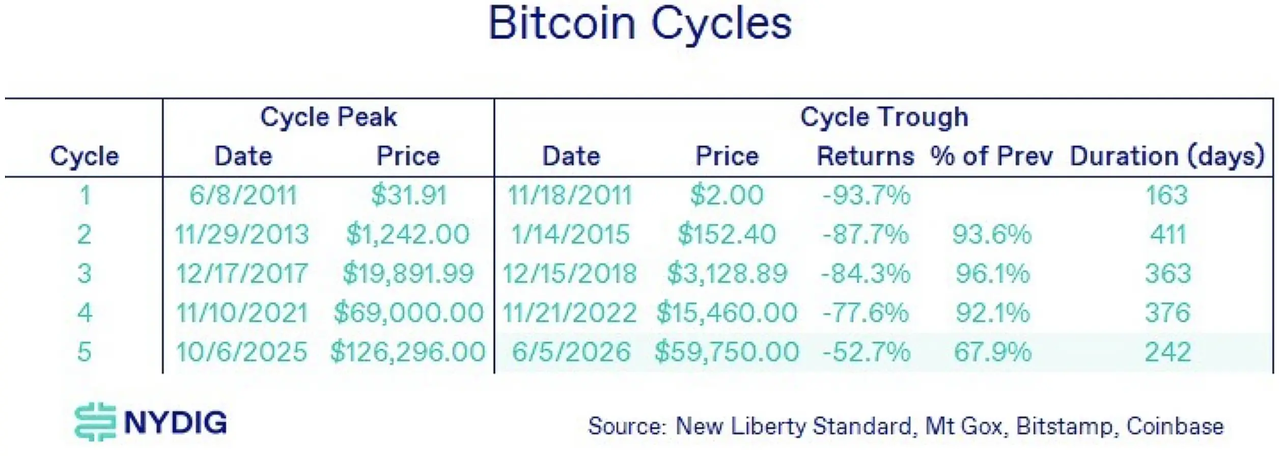
NYDIG also adopts a multi-indicator comprehensive analysis framework, comparing the current market with historical cycles, assessing the market status from dimensions such as the duration of maximum drawdown and holder profit/loss (what Bitcoin users call 'MVRV,' or the market value to realized value ratio).


NYDIG believes that current indicators are very close to the extreme ranges of historical major bottoms, but the hallmark widespread panic selling seen in past major bear markets has not yet occurred. However, the report introduces a variable: the entry of institutional funds has fundamentally changed Bitcoin's cycle logic. The magnitude of this correction might be smaller than in historical bear markets. From this perspective, the bottom might also have already appeared.


Standard Chartered


Standard Chartered is not unwaveringly bullish on Bitcoin. Back in February when Bitcoin was at $67,000, the bank lowered its full-year price forecast, warning that the price could fall to $50,000, citing a weaker macroeconomic environment and sustained selling pressure from Bitcoin ETFs.


But last Friday, Standard Chartered updated its view, identifying $59,000 as the bottom of this cycle. The two main logics supporting this view are: a potential diplomatic agreement between the US and Iran, and the highly anticipated upcoming SpaceX IPO. Standard Chartered believes that the substantial selling by ETF holders was to raise funds for participating in the SpaceX listing, and this selling pressure will gradually subside. Standard Chartered's latest forecast is that Bitcoin will challenge $100,000 within the year.


Consensus Far Outweighs Differences in the Three Reports


You might wonder, what useful information can be extracted from three reports with seemingly opposing views? In fact, the underlying consensus in these three reports far outweighs the surface differences. For long-term investors, the conclusions they agree on are far more valuable than their disagreements:


  • All three judge that the market bottom for this cycle will occur within this year.
  • All three believe the current price is closer to the bottom than to the previous high.
  • All three unanimously remain bullish, expecting Bitcoin to usher in a new bull market in the future.


At the time of writing this article, Bitcoin is trading around $67,000. One report claims the bottom at $59,000 has already occurred, one sees a potential drop to $50,000, and another a neutral baseline bottom of $43,000. But the core conclusion is highly unified: a bottom will definitely be reached within the year.


This is the key point long-term investors should focus on. Whether the bottom is at $40,000, $50,000, or $60,000, the difference is actually limited. What truly matters is whether Bitcoin can subsequently surge to $100,000, $200,000, or even $1 million. As long as it reaches those levels, entering and holding long-term at the current price offers considerable upside potential.


A rather ironic phenomenon in the current market is that everyone is obsessing over whether the market has bottomed, while overlooking a more important question—has the top already appeared? In my view, as long as the peak has not arrived, Bitcoin retains its long-term allocation value.


The core logic supporting Bitcoin's long-term value has not only persisted but continues to strengthen: government debt continues to accumulate worldwide with no effective resolution in sight; inflation constantly erodes the real purchasing power of wealth; public trust in centralized institutions like governments and banks continues to decline; the global digitalization process keeps accelerating; Bitcoin's trading and investment channels are constantly improving; and the early crypto-native demographic is aging, with their assets and industry influence growing simultaneously.


Of course, potential risks remain in the market, including threats from quantum computing and tightening global regulation. However, on balance, the current situation looks better than in any previous crypto winter.


İlgili Sorular

QWhat are the three major research institutions mentioned in the article and their respective views on whether the crypto market has bottomed?

AThe three institutions are Galaxy Digital, NYDIG, and Standard Chartered. Their views are: Galaxy Digital believes the market has not bottomed yet. NYDIG considers it possible but unlikely that the bottom has been reached. Standard Chartered asserts that the bottom has already appeared at $59,000.

QAccording to Galaxy Digital, how many out of its 13 identified bottoming indicators are currently signaling a market bottom?

AAccording to Galaxy Digital's analysis, only 4 of the 13 indicators are fully met, 2 are partially met, and 7 have not yet signaled a bottom.

QWhat is the core consensus shared by the three research reports despite their differing views on the exact bottom price?

AThe core consensus is threefold: 1) The market bottom will occur within this year. 2) The current price is closer to the bottom than to the previous all-time high. 3) All three institutions are optimistic that Bitcoin will experience a new bull market in the future.

QWhat two specific reasons did Standard Chartered give for revising its view and declaring that the market bottomed at $59,000?

AStandard Chartered based its revised view on two primary reasons: 1) A potential diplomatic agreement between the US and Iran. 2) The upcoming, highly anticipated SpaceX IPO, which they believe led to ETF selling pressure as investors raised funds to participate, and this pressure is expected to subside.

QWhat does Matt Hougan, the author and Bitwise CIO, suggest is a more important question for long-term investors than whether the market has bottomed?

AMatt Hougan suggests that a more important question for long-term investors is whether the market top has already appeared. He argues that as long as the peak has not been reached, Bitcoin retains its value as a long-term investment.

İlgili Okumalar

Can Japan Buy Growth with AI? Will the Bond Market Believe It?

Japan's cabinet has introduced the 2026 Basic Policy on Economic and Fiscal Management and Reform, shifting its primary fiscal target. The new framework moves away from the traditional annual primary balance goal and instead prioritizes a stable reduction of the debt-to-GDP ratio. This change is tied to a strategy of increased "responsible proactive fiscal" spending, aiming to boost long-term growth through investments in strategic sectors like AI, semiconductors, energy, and robotics. The government estimates total public and private investment in 62 key technologies could exceed 370 trillion yen by 2040. The market reaction has been mixed and cautious. While equity markets may respond to policy signals, bond markets are focused on fiscal credibility. Concerns center on whether the weakening of the clear primary balance anchor could lead to looser fiscal discipline. If investors doubt that these strategic investments will generate sufficient productivity gains, tax revenue, and nominal growth to outpace rising interest costs, they may demand higher yields on Japanese Government Bonds (JGBs). Recent volatility in the yen and JGB yields, with the 10-year yield briefly reaching 2.9%, reflects this skepticism. The success of this new framework hinges on two factors: whether Japan can achieve a nominal growth rate consistently higher than its long-term interest rates, and whether future budgets demonstrate disciplined control over bond issuance. The government's narrative is that strategic investment is essential to break Japan's cycle of low growth, aging, and labor shortages. However, the bond market will continuously assess the credibility of this plan, pricing the risk that it may represent fiscal expansion rather than a viable growth strategy.

marsbit33 dk önce

Can Japan Buy Growth with AI? Will the Bond Market Believe It?

marsbit33 dk önce

Misjudged A-Shares: Resilience, Expectations, and Confidence

China's A-share market recently faced selling pressure, especially in tech sectors, initially triggered by a global tech sell-off that began in South Korea. However, the article argues this is a case of "mistaken injury" and highlights the market's underlying resilience. This resilience stems from three main pillars: **1) Tech Sector Fundamentals:** Unlike Korea's market dominated by a few memory chip stocks, China's tech sector is diversified across computing, communications, electronics, and semiconductors, supported by dual narratives of global AI supply chains and domestic substitution. Core areas like optical modules and fiber optics continue to show strong earnings growth. **2) "National Team" Support:** State-backed institutions and large corporations have made significant market purchases and announced buybacks, providing liquidity and signaling confidence. This is seen as a stabilizing policy signal, often associated with market bottoms. **3) Broader Market Pillars:** Other major sectors are showing endogenous recovery momentum. Consumer stocks benefit from stabilizing CPI and signs of sector recovery (e.g., liquor price hikes). Cyclical sectors like aluminum have high earnings, potential price increases due to tight supply, and low valuations. The financial sector offers stable dividends and low valuations. The conclusion is that the sell-off was driven by external contagion, not a collapse in fundamentals. With strong policy support and recovering momentum across key sectors, the A-share market possesses the toughness to regain stability.

marsbit1 saat önce

Misjudged A-Shares: Resilience, Expectations, and Confidence

marsbit1 saat önce

İşlemler

Spot
活动图片




