Has the Crypto Talent Market Saturated with an 80% Plunge in Job Openings?

marsbit2026-01-19 tarihinde yayınlandı2026-01-19 tarihinde güncellendi

Özet

Has the crypto job market reached saturation? The data from early 2026 suggests a sharp slowdown. In the first two weeks of January 2026, only 85–90 new unique job postings were recorded across major crypto-focused job boards—an 80% drop compared to the same period in 2025, which saw around 38 postings per day. Despite the decline, certain trends stand out: 60% of roles are technical/engineering positions, while 40% are non-technical or business development roles. About 65% of openings are mid-to-senior level, indicating that companies are prioritizing experienced talent to lead core projects. Most roles require 5+ years of experience, with management positions demanding 7+ years. Hiring remains strongest among growth-stage companies that have completed Series A funding or beyond. Key areas attracting talent include infrastructure, stablecoins, and payment/fintech startups. Prediction markets like Kalshi and Polymarket are also actively competing for talent. A notable shift is the rising influence of the Solana ecosystem. For the first time since 2016, Solana attracted a larger share of new developers (22%) than Ethereum (16%) in 2024. With a 70% year-over-year increase in ecosystem funding in Q3 2025, Solana is challenging Ethereum’s long-standing dominance in developer and hiring markets. Looking ahead, the author suggests that the crypto job market will continue to evolve. Projects with strong fundamentals, real users, and sustainable revenue models are likely to succe...

Written by: willthetrill

Compiled by: Chopper, Foresight News

Has the recruitment market in the cryptocurrency industry become saturated? The answer is both yes and no. Although there were layoffs sporadically in December, overall, the momentum of hiring in the fourth quarter remained strong.

To uncover the truth, I specifically extracted data from major vertical recruitment websites in the crypto industry for the first two weeks of January 2026 (this data does not include official recruitment pages of companies). The results showed that only 85-90 new independent positions were added during this period.

This year's start has been quite quiet. In contrast, the data for January 2025 was quite impressive, with a total of 1,192 positions posted in that month alone, making it the highest month for recruitment in all of 2025.
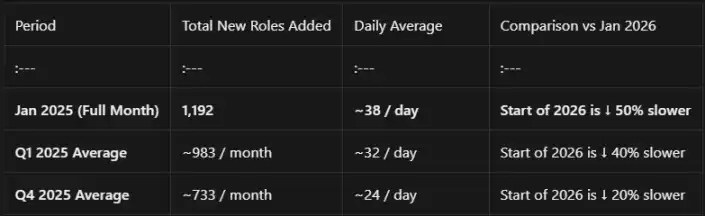
Data as of January 12, 2026

In the first two weeks of January 2025, the average daily number of positions posted was about 38; in the same period of 2026, the average daily number of positions posted was only about 6.5.

Recruitment activity in early January decreased by approximately 80% compared to the same period last year. This data confirms the widespread speculation: the industry's start this year is far less heated than last year.

Analyzing the details of the above job data, the main characteristics of the current recruitment market are as follows:

  • Distribution of job types: Technical/engineering positions account for 60%, while non-technical/business development positions account for 40%.
  • Distribution of job levels: Mid-to-senior positions such as specialists/senior specialists/supervisors/department heads account for about 65%. This signal indicates that companies are prioritizing the recruitment of experienced talent to lead key projects related to core product development and business growth.
  • Experience requirements: Most positions require candidates to have more than 5 years of relevant experience; management positions require more than 7 years of experience.

When conducting screening interviews with candidates, I often ask them: What currently attracts you to the crypto industry? The answers are invariably two: prediction markets and stablecoins. Therefore, it is no surprise that the data shows about 60% of recruitment demand is concentrated in infrastructure teams, stablecoin projects, and payment/fintech infrastructure startups. Additionally, the talent war between Kalshi and Polymarket continues, and this competition is expected to persist.

The most aggressive recruiters at the moment are those growth-stage enterprises (i.e., companies that have completed Series A funding or above). A quick glance at the recruitment pages of several companies and information on the Ashby platform can also confirm this conclusion.

  • Series A companies: Lifi Protocol has 13 open positions, Privy IO (acquired) has 10 open positions, Crossmint has 10 open positions, Coinflow Labs has 14 open positions;
  • Series B companies: TurnkeyHQ has 12 open positions;
  • Series C companies: Raincards has 49 open positions;
  • Series D companies: Anchorage has 66 open positions.

However, perhaps more intriguing is the change in talent flow.

Having worked full-time in crypto recruitment for 5 years, I can't help but reflect: "Has there ever been a public chain ecosystem, like Solana, that challenged Ethereum's dominance in the recruitment and developer growth arena?" The answer is: no, at least not on such a scale.

Looking back, other public chains like Polkadot and Cosmos have all experienced phases of rapid growth in developer numbers, but they have never been able to pose a challenge to Ethereum of the same magnitude in terms of market share and sustained recruitment scale.

Solana is the first ecosystem truly capable of competing with Ethereum. In 2024, it set a historic record: for the first time since 2016, the proportion of new contributing developers exceeded that of Ethereum. Solana attracted over 22% of the new developers in the crypto industry, while Ethereum's proportion was about 16%. This phenomenon is quite rare, especially considering that in the past, Ethereum almost monopolized the vast majority of new talent.
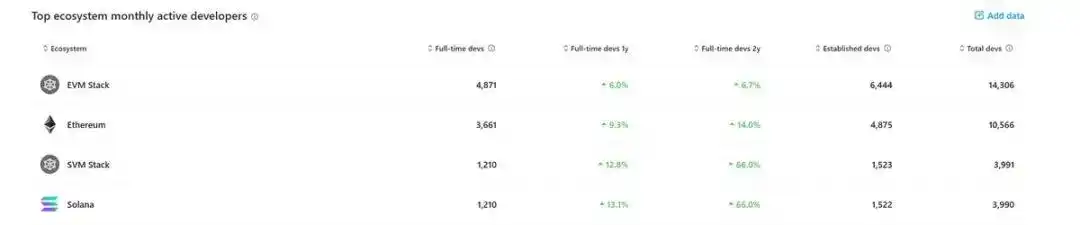
Data source: Electric Capital "Developer Report," as of January 14, 2026

In the third quarter of 2025 alone, 23 Solana ecosystem projects completed financing, raising a total of $211 million, representing a 70% year-on-year growth in ecosystem financing scale.

For example: When a project completes a $13.5 million financing round (such as Raikucom's financing in the third quarter of 2025), its first priority is to recruit 5-10 senior engineers to build the core engineering team and business development team. Such positions often do not appear on public recruitment websites but are instead filled through investor/angel investor networks, hackathon events, and targeted headhunting.

The crypto industry is constantly evolving, and the landscape of the recruitment market will change accordingly. Through token issuance, crypto technology has been able to drive the maximization of development in internet capital markets. However, the reality is that the vast majority of tokens issued in the past two years have seen their prices decline.

I believe that in 2026, the ripple effects of this phenomenon will gradually emerge, impacting companies' risk financing methods, market expansion strategies, and, of course, talent recruitment strategies.

The projects that will stand out this year will undoubtedly be those with solid business fundamentals, a real user base, solving actual needs, and most importantly, those capable of generating revenue.


İlgili Sorular

QAccording to the data, what was the percentage decline in daily job postings in the crypto industry in early January 2026 compared to the same period in 2025?

AThe daily job postings in early January 2026 declined by approximately 80% compared to the same period in 2025.

QWhat are the two main areas that candidates are most attracted to in the crypto industry, as mentioned in the article?

AThe two main areas that attract candidates are prediction markets and stablecoins.

QWhich blockchain ecosystem is highlighted as the first to seriously challenge Ethereum's dominance in terms of developer recruitment and growth?

AThe Solana ecosystem is highlighted as the first to seriously challenge Ethereum's dominance in developer recruitment and growth.

QWhat type of companies are currently the most aggressive in their hiring efforts within the crypto space?

AGrowth-stage companies (those that have completed Series A funding or later) are currently the most aggressive in their hiring efforts.

QWhat key characteristic is mentioned for projects that are expected to stand out in 2026?

AProjects that are expected to stand out in 2026 are those with solid business fundamentals, a real user base, solving actual needs, and, most importantly, the ability to generate revenue.

İlgili Okumalar

In Jinjiang, Fujian, a Storage Super Unicorn Lies Quiet

In Fujian's Jinjiang, a city known for sportswear, lies a quiet semiconductor giant: Fujian Jinhua Integrated Circuit Co. (JHICC). Once a promising domestic DRAM manufacturer alongside Yangtze Memory and ChangXin Memory Technologies (CXMT), its journey was derailed in 2018 when the U.S. placed it on an Entity List and filed criminal charges for alleged trade secret theft. This halted production for years. A turning point came in February 2024 when a U.S. federal court found JHICC not guilty. However, it had lost crucial time. While CXMT soared to become a top-valued A-share company in 2024, JHICC, with an estimated valuation of 80 billion RMB, was just restarting. Its current output is primarily customized DDR4 chips, not the advanced DDR5/HBM demanded for AI, but it still benefits from the broader memory chip upcycle. JHICC's story is tied to Chen Zhengkun, a veteran engineer who left Micron to lead the venture. Founded in 2016 with state-backed funding, JHICC partnered with Taiwan's UMC to develop DRAM technology. Rapid progress was cut short by the U.S. actions, which Micron initiated, partly due to its heavy reliance on the Chinese market. Post-sanctions, Chen's team worked to rebuild the production line with reduced reliance on U.S. technology. According to its records, JHICC achieved small-scale production and revenue growth under immense pressure. It now focuses on the stable "niche" DRAM market (e.g., TVs, routers) with a monthly capacity of ~40,000 wafers, aiming for 60,000 by 2026. It holds over 1,000 patents but remains on the Entity List. For Jinjiang, investing in JHICC was a bold industrial leap. The local government provided unwavering financial and logistical support during the crisis, helping the company survive. JHICC has become the anchor for a growing local semiconductor cluster. Though its scale lags behind domestic peers, JHICC's persistence symbolizes a hard-won foothold in a global market long dominated by Samsung, SK Hynix, and Micron. Having missed one boom, it seeks a place in the new AI-driven memory supercycle.

marsbit16 dk önce

In Jinjiang, Fujian, a Storage Super Unicorn Lies Quiet

marsbit16 dk önce

Must-Watch Events Next Week|CLARITY Act Could Face Senate Vote; SpaceX, Circle to Report Earnings (8.3-8.9)

**Summary: Key Events and Developments to Watch (August 3-9)** The upcoming week is marked by significant financial disclosures, key legislative deadlines, and notable product updates. **Major Financial Events:** Several companies are scheduled to release their Q2 2026 earnings. American Bitcoin (ABTC) will report on August 3, followed by SpaceX and Hut 8 Mining Corp. on August 4, and Circle on August 5. Notably, a significant portion of SpaceX shares (up to 12% of total shares) will be unlocked on August 6 following their earnings release. **Key Legislative Deadline:** The U.S. Senate faces an August 7 deadline to secure 60 votes for the CLARITY Act, a bipartisan bill aiming to establish a federal regulatory framework for cryptocurrencies. The Senate may hold a full vote on the bill during the week. **Economic Data:** The U.S. July Non-Farm Payrolls report will be released on August 7, providing crucial labor market data. **Technology & Product Updates:** * **Shutdowns:** DeFi portfolio tracker Zapper and wallet app Ctrl Wallet will cease operations on August 3. * **Upgrades:** LayerZero will deprecate its v1 relayers on August 3. XRP Ledger's new version 3.3.0, featuring five new functions, is expected next week. * **AI:** Elon Musk announced that the advanced Grok 4.6 AI model is set for release around August 7. * **Bitcoin:** The BIP-110 forced signaling for a potential Bitcoin network change is scheduled to begin around August 8. **Other Notable Events:** Chinese robotics firm Unitree Tech has set its preliminary price inquiry for its IPO for August 5. South Korean exchange Upbit will delist AQT and AERGO tokens on August 3.

marsbit2 saat önce

Must-Watch Events Next Week|CLARITY Act Could Face Senate Vote; SpaceX, Circle to Report Earnings (8.3-8.9)

marsbit2 saat önce

İşlemler

Spot
活动图片




