Hang Seng TECH Index Launches Largest Reform in History

marsbit2026-08-12 tarihinde yayınlandı2026-08-12 tarihinde güncellendi

Özet

The Hang Seng Tech Index is undergoing its most significant reform since its launch in 2020. In a consultation paper, Hang Seng Indexes proposed major changes to enhance the index's market representation, reflecting the evolution of Hong Kong's tech sector. Key proposed revisions include completely removing industry classification restrictions, updating six key technology themes (e.g., Digital Platforms, AI, Advanced Hardware), and implementing a dual-track selection mechanism. This new mechanism will pick 40 constituents based on market capitalization and 10 based on revenue growth, expanding the total number of constituents from 30 to 50. The reform aims to address the index's historical concentration in large internet platforms like Tencent and Alibaba, which has caused it to miss gains from newer, high-growth tech areas such as AI and semiconductors. Many of these newer companies are smaller in market cap but show stronger revenue growth. The proposed changes would significantly increase exposure to themes like Advanced Hardware (from 5 to 15 simulated constituents) and AI (from 3 to 6). Simulated results show the reform would slightly reduce the index's concentration in its top ten holdings, diversify its thematic exposure, and incorporate faster-growing companies. The "revenue growth" subset of new constituents shows a median growth rate of 82%, far exceeding the current index's 13.8%. Final revisions are expected by late September, with changes taking effect in Dec...

The Hang Seng TECH Index is actively embracing hard technology.

On the evening of August 10, Hang Seng Indexes Company issued a consultation paper stating that the composition of Hong Kong's technology sector continues to expand, with faster-growing revenue companies often having smaller market capitalizations. To enhance the market representation of the Hang Seng TECH Index, they are seeking market opinions on the index revision proposal.

The key points of this reform include: fully removing industry restrictions; revising six technology themes; introducing a dual-track stock selection mechanism based on market capitalization and revenue growth; and expanding the number of constituent stocks from 30 to 50.

"The Hang Seng Index has been under significant pressure over the past six months, missing out on the gains brought by the global AI (Artificial Intelligence) surge," a source close to Hang Seng Indexes Company told Caijing. "This is just the first step of the reform, starting with the consultation paper. We will see how the market responds next."

According to simulation calculations by Hang Seng Indexes Company, among the 50 constituent stocks of the revised Hang Seng TECH Index, the number of stocks related to advanced hardware and artificial intelligence would increase from the current 5 and 3 to 15 and 6, respectively.

The results of this revision are expected to be announced by the end of September, with changes to the constituent stocks taking effect on the official index adjustment date in December. If the plan is ultimately approved, this would be the most significant and systematic structural reform of the Hang Seng TECH Index since its launch in 2020.

As of the end of June 2026, the global fund assets tracking this index have reached US$40.4 billion. Any changes to the constituent list and weights will trigger large-scale passive fund rebalancing, and its impact on Hong Kong's technology sector extends far beyond technical adjustments to index compilation.

1

Changes in Hong Kong's Tech Ecosystem

Looking back to July 2020, the Hang Seng TECH Index was officially launched, with the original intention of providing global investors with a tool to track the overall performance of Hong Kong-listed technology companies, selecting the 30 largest technology firms by market capitalization. Today, the Hang Seng TECH Index has grown into one of the most influential flagship indices in the Hong Kong stock market, with tracking assets increasing from an initial US$1.5 billion to US$40.4 billion, a nearly 26-fold increase.

Although the index's market status has grown, its representative capacity has not kept pace with the dramatic changes in Hong Kong's technology ecosystem. In the past, because the Hang Seng TECH Index has been highly concentrated in the Network and E-commerce themes since its inception, the weights of internet platform companies such as Tencent, Meituan, and Alibaba have long dominated. The index's fluctuations were largely tied to the outcomes of food delivery subsidy wars, e-commerce promotional season data, and even the approval rhythm of game licenses.

The scope of technology investment in Hong Kong continues to expand. Over the past few years, Hong Kong has welcomed a batch of companies in artificial intelligence, semiconductors, robotics, and specialized technology, with enterprises listed under the HKEX's new Chapter 18C rules also increasing. However, these companies generally have short listing histories and small market capitalizations, systematically excluded by the market capitalization threshold.

According to Hang Seng Indexes Company data, at the end of 2021, the Network theme had the highest share among Hong Kong tech stocks, accounting for 37.3%. By the first half of 2026, Network's share had dropped to 25.0%, surpassed by Intelligent Transformation at 32.1%.

Furthermore, within Hong Kong's technology sector, companies with stronger revenue growth tend to have smaller market capitalizations. Hang Seng Indexes Company data shows that the median revenue growth of current Hang Seng TECH Index constituents is significantly lower than that of smaller-cap, non-constituent companies.

Currently, the Hang Seng TECH Index has included two major AI listed companies, but this has not impacted the heavyweight stocks. The latest Hang Seng TECH Index changes effective on June 8 included MiniMax and Zhipu AI, with a combined weighting of less than 1%.

2

What Impact Will the Two Major Revision Proposals Have?

The revision proposals for the Hang Seng TECH Index involve structural adjustments around two dimensions.

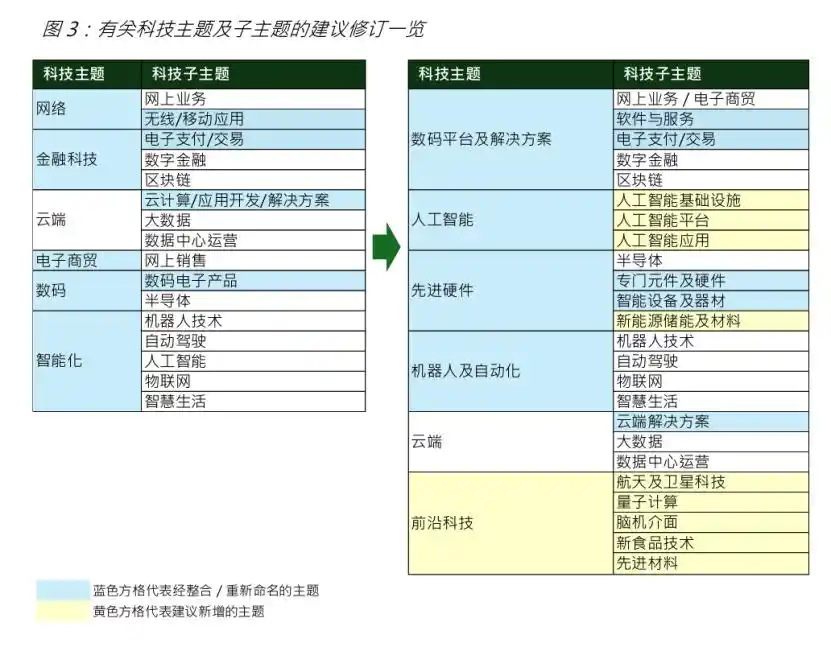
The first is expanding the coverage of technology themes. Specific suggestions include: removing industry requirements, as technological innovation has integrated into all industries and is not limited by traditional sector classifications; revising six major technology themes to cover Digital Platforms & Solutions, Artificial Intelligence, Advanced Hardware, Robotics & Automation, Cloud, and Frontier Technology. Additionally, expanding the number of technology sub-themes under the six major themes from 16 to 24.
Source: Hang Seng Indexes Company website

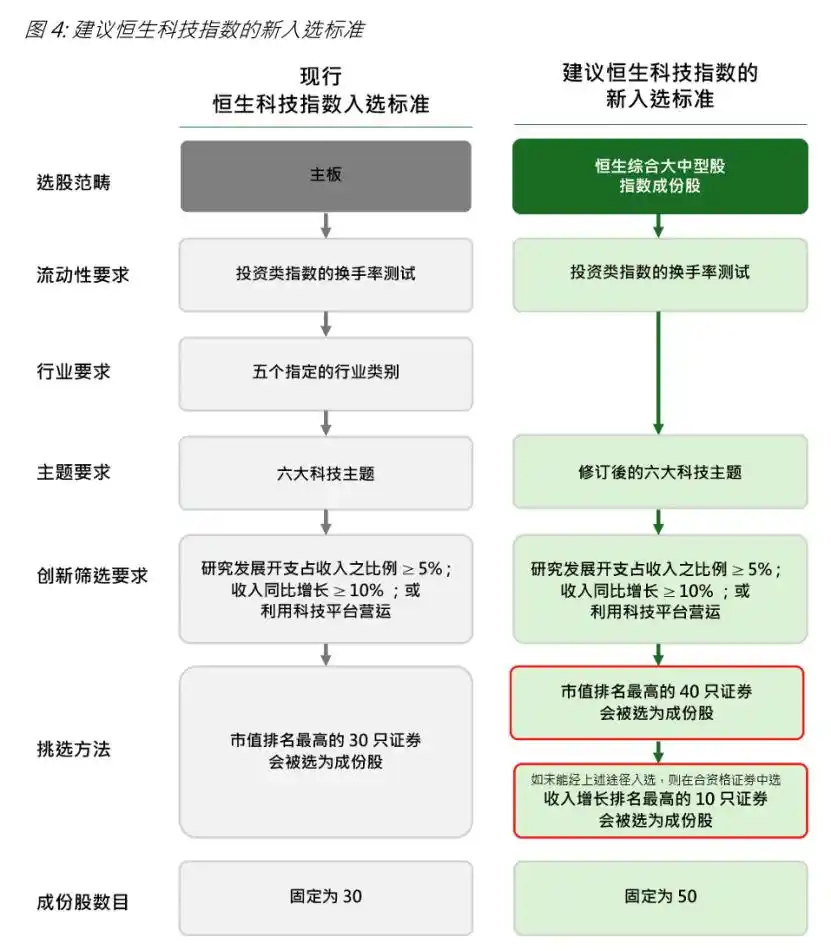
The second is introducing a grouping selection mechanism. Hang Seng Indexes Company proposes that the stock selection scope for the Hang Seng TECH Index be limited to constituents of the Hang Seng Composite LargeCap & MidCap Index, while introducing a grouping selection mechanism. Selection will proceed via a dual-track system based on "Market Capitalization Group" and "Revenue Growth Group," and the number of constituent stocks will increase from 30 to 50. Specifically, the top 40 will be selected by market capitalization ranking, and the top 10 will be selected by revenue growth ranking.
Source: Hang Seng Indexes Company website

According to simulation results released by Hang Seng Indexes Company, the revision will bring three major impacts on index characteristics.

First, index concentration will decrease slightly. Hang Seng Indexes Company simulation results show that the weight of the top ten constituents will drop from the current 70.6% to 66.3%, dispersing the index's exposure to leading companies somewhat.

Second, the distribution of technology themes will become more diverse. Under the new thematic framework, the number of constituents related to "Advanced Hardware" will increase from 5 to 15, and those related to "Artificial Intelligence" will increase from 3 to 6. Newly added themes like "Frontier Technology" will also gain inclusion space, significantly broadening the index's coverage of technology attributes.

Finally, the Revenue Growth Group will introduce high-growth targets. Simulation results show that the 10 new constituent stocks added via the "Revenue Growth Group" have a median revenue growth rate as high as 82%, higher than the 23.4% for those added via the "Market Capitalization Group," and far exceeding the 13.8% revenue growth rate of existing constituents.

This article is from the WeChat public account "Read One Insight" (ID: dushuyizhi007), author: Cheng Mengqi, editor: Guo Nan.


Trend Kriptolar

İlgili Sorular

QWhat are the main objectives of the proposed reforms to the Hang Seng TECH Index?

AThe main objectives are to enhance the index's market representation by adapting to the evolving Hong Kong tech ecosystem. Key changes include removing industry restrictions, revising the six tech themes, introducing a dual-track selection mechanism based on market cap and revenue growth, and expanding the number of constituent stocks from 30 to 50.

QHow does the proposed dual-track selection mechanism for the Hang Seng TECH Index work?

AThe dual-track selection mechanism involves selecting constituents based on two criteria: market capitalization and revenue growth. The top 40 stocks will be chosen by market cap ranking, and the top 10 stocks will be chosen by revenue growth ranking, resulting in a total of 50 constituent companies.

QWhat changes are expected in the thematic composition of the Hang Seng TECH Index based on the reform proposal?

AThe thematic composition will become more diversified. The number of constituents related to 'Advanced Hardware' is projected to increase from 5 to 15, and those related to 'Artificial Intelligence' from 3 to 6. New themes like 'Frontier Technology' will also gain representation.

QAccording to the article, how has the focus of Hong Kong's listed tech stocks shifted between 2021 and 2026?

AThe focus has shifted from internet-centric to intelligence-centric. In 2021, the 'Network' theme comprised 37.3% of listed tech stocks. By H1 2026, its share had fallen to 25.0%, while the 'Intelligent Implementation' theme had become the largest, accounting for 32.1%.

QWhat is the significance of the Hang Seng TECH Index's asset under management (AUM) growth mentioned in the article?

AThe article highlights that the global assets tracking the Hang Seng TECH Index have grown from $1.5 billion at launch to $40.4 billion as of June 2026. This 26-fold increase signifies the index's status as a major flagship index. Consequently, any changes to its constituents or weights will trigger significant passive fund reallocations, impacting the broader Hong Kong tech sector.

İlgili Okumalar

AI Boosting Efficiency and Cutting Costs Makes VC Increasingly Expensive

"AI for Cost Reduction Makes VC Funding More Expensive" Despite the "cost-reduction and efficiency" narrative of AI, venture capital (VC) investment in the AI sector is becoming increasingly costly. While AI tools lower the initial costs for many startups—with team sizes shrinking across funding stages—the market is polarizing. For top-tier AI teams, especially those from leading companies like Google and OpenAI, funding rounds are now larger and valuations are higher than ever at the seed and early stages. For example, new ventures by prominent researchers are securing billions in funding with valuations reaching tens of billions before having a mature product. This creates a "barbell" market: lightweight startups need less capital, while elite AI firms attract massive investments early on. This dynamic raises the cost for VCs to acquire and maintain meaningful ownership stakes. As valuations soar early, securing the same equity percentage requires significantly larger capital commitments. VCs must now invest more upfront and reserve substantial funds for follow-on rounds to avoid dilution, prompting large firms like Accel and a16z to raise massive new funds. Consequently, capital is concentrating intensely in a few perceived winners like OpenAI and Anthropic, widening the gap between large and small VC funds. While high valuations bake in future growth expectations, they also compress potential returns, demanding that portfolio companies achieve unprecedented scale. For major VCs, the core strategy is clear: secure early positions in potential winners and maintain the capital to keep investing as valuations rapidly escalate.

marsbit19 dk önce

AI Boosting Efficiency and Cutting Costs Makes VC Increasingly Expensive

marsbit19 dk önce

An Eight-Year Investment Takes a Sharp Turn: Why Did Ethereum Suddenly Abandon Poseidon?

On August 13, Ethereum researcher Justin Drake announced a significant shift in Ethereum's Layer-1 cryptographic roadmap: abandoning the SNARK-friendly hash function Poseidon in favor of traditional functions like SHA2 or BLAKE2. This decision ends eight years of research and investment, marking a major revision to the post-quantum security strategy. Poseidon, introduced in 2019, was highly efficient for zkRollups and zkVMs within SNARK circuits. However, its need for prolonged cryptanalysis and the pressing timeline for quantum resistance revealed limitations. Recent breakthroughs in SNARK design, specifically using binary fields, now enable traditional, battle-tested hash functions to perform as efficiently as Poseidon within SNARKs. Benchmarks show modern laptops can now verify over a million traditional hash calls per second. This change is partly driven by accelerated concerns over quantum computing threats. Reports warn that "Cryptographically Relevant Quantum Computers" could break current blockchain signatures like ECDSA by the early 2030s, risking trillions in assets. Ethereum's response focuses on hash-based post-quantum signature schemes, deemed more quantum-resistant than some lattice-based alternatives under pressure from AI cryptanalysis. Ethereum's updated post-quantum roadmap targets a production-ready "leanVM" for signature aggregation by 2027, with full deployment across consensus, execution, and data layers by 2028. The shift to mature hash functions like SHA2 reduces reliance on newer algorithms and aligns with the goal of using widely analyzed cryptographic primitives. Other major blockchains are also preparing. Solana's core teams have independently chosen the NIST-standardized Falcon signature scheme for its compact size. Starknet plans a phased migration, starting with replacing its Pedersen hash with BLAKE2. Ethereum's move signifies a strategic pivot towards proven security foundations for the quantum era.

marsbit1 saat önce

An Eight-Year Investment Takes a Sharp Turn: Why Did Ethereum Suddenly Abandon Poseidon?

marsbit1 saat önce

Programmers Worldwide Are Wasting Money on Anthropic! The Company Can't Stand It Anymore

Anthropic recently published guidelines to help developers using Claude Code reduce unnecessary token costs. The key recommendations include: 1) Clear (/clear) conversations after completing a task to avoid carrying irrelevant file reads and command outputs into the next task. 2) Set the model and reasoning effort level at the start of a session, as switching mid-session invalidates the prompt cache, requiring a full-price recalculation of the entire dialog history. 3) Attach files using @ references instead of typing paths manually to avoid extra tool calls and searches that bloat the context. 4) Add quiet flags to verbose commands (e.g., in CLAUDE.md) to minimize lengthy output in the dialog history. 5) Use /compact while the session cache is still warm (before breaks) to compress the dialog at one-tenth the cost. 6) Offload large-output tasks to a sub-agent, which runs in an isolated context and only returns conclusions, preventing intermediate outputs from polluting the main dialog. The article explains token pricing: input tokens (prefill) are processed in parallel, while output tokens (decode) are generated serially, making output tokens five times more expensive. Caching is crucial for savings—if a request's prefix (system prompt, CLAUDE.md, dialog history) matches the previous one byte-for-byte, reading it costs only 10% of the standard input price. However, cache invalidation occurs when changing models, effort levels, fast mode, compressing dialogs, after cache expiration, or when resuming old sessions. Dialog history also grows quadratically (O(n²)) as file contents and command outputs accumulate, increasing costs per round. Proactive context management—like isolating noisy tasks, using /rewind to trim unproductive turns, and task-based session clearing—is becoming an essential skill for cost-effective AI-assisted development.

marsbit3 saat önce

Programmers Worldwide Are Wasting Money on Anthropic! The Company Can't Stand It Anymore

marsbit3 saat önce

Pax Silica vs. WAICO: The US Wants to Prohibit Europe from Using Chinese Artificial Intelligence

The United States is preparing to demand that European and other partners abandon Chinese artificial intelligence initiatives, threatening exclusion from the American-led "Pax Silica" coalition, according to a leaked U.S. State Department document. This ultimatum forces signatories of the "AI Opportunity Statement" to choose between the Western technological ecosystem and alternative frameworks, with China not explicitly named but clearly targeted. Pax Silica is a U.S. strategy for AI and semiconductor hegemony, launched in late 2025. Its European presence expanded significantly in mid-2026. Concurrently, China, Russia, and 27 other nations established the World AI Cooperation Organization (WAICO) in July 2026 as an independent intergovernmental platform promoting AI governance based on UN principles. This situation creates a difficult choice, especially for European nations balancing strategic autonomy with dependence on U.S. tech and security. It also pressures Global South countries with pragmatic ties to both Washington and Beijing. The formation of competing blocks risks fragmenting the global tech landscape, forcing companies to split supply chains, increasing costs, and potentially leading to incompatible standards and protocols. The era of open globalization in AI may be ending, replaced by geopolitical confrontation where technological sovereignty trumps economic efficiency. The decisions made will shape the global digital economy for decades.

cryptonews.ru5 saat önce

Pax Silica vs. WAICO: The US Wants to Prohibit Europe from Using Chinese Artificial Intelligence

cryptonews.ru5 saat önce

İşlemler

Spot

Popüler Makaleler

₿O₿ Nedir

Bitcoin Bob ($₿o₿): Hibrid Katman-2 İnovasyonu ile Bitcoin Merkezli DeFi'yi Öncü Hale Getiriyor Dijital ekonominin hızla evrildiği bir dönemde, Bitcoin Bob ($₿o₿), merkeziyetsiz finans (DeFi) sektöründe Bitcoin'in faydasını artırmayı amaçlayan devrim niteliğinde bir proje olarak ortaya çıkıyor. Mayıs 2024'te resmi olarak başlatılan Bitcoin Bob, aynı zamanda Build on Bitcoin (BOB) olarak da bilinir, Bitcoin’in tanınmış güvenliği ve değişmezliğini Ethereum'un programlanabilirliği ile birleştiren hibrid bir Katman-2 blok zinciri çözümünü temsil ediyor. Bu girişim, akıllı sözleşmelerin ve merkeziyetsiz uygulamaların entegrasyonunu kolaylaştırarak Bitcoin ekosisteminde önemli bir boşluğu doldurmayı hedefliyor ve Bitcoin'in özünde bulunan güven ve güvenlik ilkelerini koruyor. Önde gelen girişim sermayedarlarından önemli destek alarak, Bitcoin Bob, DeFi alanında Bitcoin'in rolünü yeniden tanımlamak için konumlanmış durumda ve onu küresel merkeziyetsiz finansal operasyonların temel taşı haline getiriyor. Bitcoin Bob, $₿o₿ Nedir? Bitcoin Bob'un özü, Bitcoin'in işlevselliğini artırmak için tasarlanmış bir hibrid blok zinciri çözümüdür. Projenin ana hedefi, Bitcoin üzerinde merkeziyetsiz finansı mümkün kılmak, hızlı ve sorunsuz işlemler sağlarken yüksek güvenlik seviyelerini garanti etmektir. Bitcoin Bob, Bitcoin'in güvenlik özelliklerini Ethereum Sanal Makinesi (EVM) ile birleştiren hibrid bir katman-2 mimarisi gibi ileri teknoloji kullanmaktadır. Bu pragmatik yaklaşım, projenin Bitcoin'in temel değerlerini tehlikeye atmadan etkili bir şekilde çalışmasını sağlar ve geleneksel Bitcoin sahipleri ile yeni ortaya çıkan DeFi ekosistemi arasında köprü kurmak için önemli bir adım oluşturur. Bitcoin Bob'un öne çıkan özelliklerinden biri, yenilikçi mekanizmalar aracılığıyla güveni minimize edilmiş bir ortam sağlama rolüdür; bu mekanizmalar arasında başlangıçta Ethereum'a dayanan iyimser rolluplar yer almakta ve nihayetinde tam Bitcoin entegrasyonuna geçiş yapılmaktadır. Bu hibrid sistem, Bitcoin'deki geniş likiditenin yalnızca korunmasını değil, aynı zamanda çeşitli DeFi protokollerinde etkili bir şekilde kullanılmasını sağlamayı amaçlamaktadır. Bitcoin Bob'un Yaratıcısı Kimdir, $₿o₿? Bitcoin Bob'un yaratıcı gücü, geniş kripto para alanındaki deneyim ve bilgisiyle Alexei Zamyatin'dir. Zamyatin, Bilgisayar Bilimleri alanında doktora sahibidir ve 2015 yılından bu yana Bitcoin geliştirme sürecinde aktif olarak yer almaktadır. Bitcoin ve Ethereum ekosistemlerine dair derin anlayışı, Bitcoin Bob'un vizyonunu ve teknolojik temellerini şekillendirmede kritik bir rol oynamaktadır. Zamyatin'in yanında, Dominik Harz adlı ortak kurucu, Baş Teknoloji Sorumlusu (CTO) olarak görev yapmaktadır. İkili, blockchain teknolojisinin sınırlarını zorlamaya yönelik ortak bir tutkusu olan yetenekli bireylerden oluşan bir ekip oluşturmuştur ve bu, Bitcoin Bob'un pazardaki yenilikçi konumunu güvence altına almaktadır. Bitcoin Bob'un Yatırımcıları Kimlerdir, $₿o₿? Bitcoin Bob, Bitcoin manzarasını dönüştürme potansiyelini tanıyan bir dizi önde gelen yatırımcı ve girişim sermayesi firması tarafından destek toplamayı başarmıştır. Mart 2024'te proje, Castle Island Ventures liderliğinde 10 milyon dolarlık bir tohum fonlama turunu başarıyla tamamlamış, Coinbase Ventures ve Bankless Ventures gibi firmalardan önemli katılımlar olmuştur. Kısa bir süre sonra, Temmuz 2024'te Bitcoin Bob, ek bir 1.6 milyon dolarlık stratejik fonlama sağlamıştır. Bu tur, Ledger Ventures tarafından ortaklaşa yönetilmiş ve BlackRock, Aave ve Curve gibi çeşitli önde gelen firmalardan melek yatırımcılar yer almıştır. Güçlü finansal destek, Bitcoin Bob'un DeFi alanındaki potansiyelini açığa çıkarmadaki yenilikçi yaklaşımının sektördeki genel kabulünü yansıtmaktadır. Bu fonlama, projenin devam eden gelişimi için kritik öneme sahip olmasının yanı sıra, büyüyen bir kullanıcı tabanının ihtiyaçlarını karşılamaya yönelik Bitcoin yerel merkeziyetsiz uygulamaları (dApps) geliştirmek için bir kuluçka merkezi kurmayı da hedeflemektedir. Bitcoin Bob, $₿o₿ Nasıl Çalışır? Bitcoin Bob'un operasyonel mekanikleri, Bitcoin'in güvenliğinin avantajlarını Ethereum'un EVM'sinin çok yönlülüğü ile birleştirmek üzere tasarlanmış hibrid rollup mimarisi üzerine kuruludur. Proje, kullanıcılar ve geliştiricilerle etkileşimini aşağıdaki şekilde tanımlayan aşamalı bir güvenlik modeli kullanmaktadır: Aşama 1 – İlk aşama, Ethereum üzerinde iyimser bir rollup olarak çalışır; burada işlemler, geçerlilik beklentisi ile işlenir ve Bitcoin üzerindeki gelecekteki gelişmelere zemin hazırlar. Aşama 2 – Proje geçiş yaptıkça, Bitcoin Staking aracılığıyla Bitcoin nihaiyetini entegre edecektir ve güvenliği artırmak için Babylon Ağı'nı kullanacaktır. Bu mekanizma, doğrulayıcıların Bitcoin'i kilitlemesini gerektirir; böylece BOB işlemlerini doğrular, bu da yalnızca güvenliği artırmakla kalmaz, aynı zamanda katılımcılar için getiri fırsatları yaratır. Aşama 3 – Bitcoin Bob'un ileriye dönük vizyonu, BitVM ve sıfır bilgi kanıtları gibi yenilikçi teknolojileri kullanarak Bitcoin ile tam entegrasyon sağlamaktır; bu, off-chain hesaplamayı kolaylaştırırken Bitcoin'in güvenlik bütünlüğünü korumaktadır. Zamyatin tarafından ortaklaşa yazılan BitVM2 gibi temel yenilikler, projenin işlevselliği için kritik öneme sahiptir; bu, geniş ağ bağımlılığı olmaksızın Bitcoin yatırımları ve çekimleri yapılmasına olanak tanır. Bu, ekosistemin Ethereum ve diğer uyumlu zincirlerle etkili bir şekilde bağlantı kurmasını sağlayarak kullanıcılar ve geliştiriciler için akıcı ve etkili bir etkileşim modeli oluşturur. Bitcoin Bob'un Zaman Çizelgesi, $₿o₿ Bitcoin Bob'un evrimini anlamak, önemli kilometre taşlarını takip etmeyi gerektirir: 2019: Alexei Zamyatin ve Dominik Harz, gelecekteki projelerin temelini atan blockchain çözümlerine odaklanan bir araştırma firması kurar. Mart 2024: Bitcoin Bob, 10 milyon dolar tohum fonlama turunu başarıyla tamamlayarak rekabetçi blockchain manzarasına giriş yapar. 1 Mayıs 2024: Resmi ana ağ lansmanı gerçekleşir ve projenin yetenekleri önemli kullanıcı benimsemesi ve toplam değer kilidi (TVL) ile sergilenir. Temmuz 2024: Proje, Bitcoin odaklı yenilikleri teşvik etmek amacıyla kuluçka merkezi kurmak için ek bir 1.6 milyon dolar stratejik fonlama çeker. Ekim 2024: Bitcoin Bob, hibrid katman-2 tasarımını ve ileriye dönük stratejilerini detaylandıran bir “Vizyon Belgesi” yayınlar. 2025: Genel işlevselliği artırmayı amaçlayan Bitcoin nihaiyeti ve BitVM köprülerine odaklanan Aşama 2 özelliklerinin beklenen dağıtımı. Sonuç: Bitcoin'in Merkeziyetsiz Finansındaki Rolünü Yeniden Tanımlamak Bitcoin Bob ($₿o₿), sadece başka bir blok zinciri projesi değil; Bitcoin'in daha geniş finansal uygulamalarla nasıl etkileşimde bulunabileceğine dair bir paradigma değişikliğini temsil ediyor. Bitcoin'in güvenliğini Ethereum'un esnekliği ile titizlikle birleştirerek, Bitcoin Bob, DeFi manzarasını yeniden şekillendirmeyi ve dijital para ile merkeziyetsiz uygulamalar arasındaki boşluğu kapatmayı hedefliyor. Güçlü bir teknolojik çerçeve, sağlam liderlik ve stratejik fonlama ile Bitcoin Bob, kripto para ekosisteminde kendini temel bir oyuncu olarak konumlandırmak için iyi bir konumda ve Bitcoin için yeni likidite ve fayda boyutlarını açma potansiyeline sahip. Proje gelişmeye ve genişlemeye devam ederken, Bitcoin'in yalnızca bir değer saklama aracı olmanın ötesinde, gelecekteki finansal manzaranın temel taşı olarak potansiyelinin çok daha ötesine geçtiğini kanıtlayacak bir yenilik çağına öncülük etme vaadinde bulunuyor. Proje, beklenen aşamaları boyunca ilerledikçe, tüm gözler Bitcoin Bob'un üzerine olacak; özellikle merkeziyetsiz ilkeleri entegre etme taahhüdü ve kullanıcıların Bitcoin ile desteklenen DeFi'nin tüm avantajlarından yararlanmasını sağlama konusundaki kararlılığı açısından.

115 Toplam GörüntülenmeYayınlanma 2025.06.30Güncellenme 2025.06.30

₿O₿ Nedir

O Nasıl Satın Alınır

HTX.com’a hoş geldiniz! O1 exchange (O) satın alma işlemlerini basit ve kullanışlı bir hâle getirdik. Adım adım açıkladığımız rehberimizi takip ederek kripto yolculuğunuza başlayın. 1. Adım: HTX Hesabınızı OluşturunHTX'te ücretsiz bir hesap açmak için e-posta adresinizi veya telefon numaranızı kullanın. Sorunsuzca kaydolun ve tüm özelliklerin kilidini açın. Hesabımı Aç2. Adım: Kripto Satın Al Bölümüne Gidin ve Ödeme Yönteminizi SeçinKredi/Banka Kartı: Visa veya Mastercard'ınızı kullanarak anında O1 exchange (O) satın alın.Bakiye: Sorunsuz bir şekilde işlem yapmak için HTX hesap bakiyenizdeki fonları kullanın.Üçüncü Taraflar: Kullanımı kolaylaştırmak için Google Pay ve Apple Pay gibi popüler ödeme yöntemlerini ekledik.P2P: HTX'teki diğer kullanıcılarla doğrudan işlem yapın.Borsa Dışı (OTC): Yatırımcılar için kişiye özel hizmetler ve rekabetçi döviz kurları sunuyoruz.3. Adım: O1 exchange (O) Varlıklarınızı SaklayınO1 exchange (O) satın aldıktan sonra HTX hesabınızda saklayın. Alternatif olarak, blok zinciri transferi yoluyla başka bir yere gönderebilir veya diğer kripto para birimlerini takas etmek için kullanabilirsiniz.4. Adım: O1 exchange (O) Varlıklarınızla İşlem YapınHTX'in spot piyasasında O1 exchange (O) ile kolayca işlemler yapın.Hesabınıza erişin, işlem çiftinizi seçin, işlemlerinizi gerçekleştirin ve gerçek zamanlı olarak izleyin. Hem yeni başlayanlar hem de deneyimli yatırımcılar için kullanıcı dostu bir deneyim sunuyoruz.

596 Toplam GörüntülenmeYayınlanma 2026.06.19Güncellenme 2026.06.29

O Nasıl Satın Alınır

Tartışmalar

HTX Topluluğuna hoş geldiniz. Burada, en son platform gelişmeleri hakkında bilgi sahibi olabilir ve profesyonel piyasa görüşlerine erişebilirsiniz. Kullanıcıların O (O) fiyatı hakkındaki görüşleri aşağıda sunulmaktadır.

活动图片