Hackers use SpaceXAI, Starlink X accounts to pump SCATMAN: Token crashes 98%

ambcrypto2026-07-13 tarihinde yayınlandı2026-07-13 tarihinde güncellendi

Özet

On July 13th, hackers compromised the verified X accounts of SpaceXAI and Starlink to fraudulently promote the SCATMAN memecoin. The tweets, one gaining over 72,000 views quickly, misled users into believing the token was legitimate, generating significant buying pressure. Prior to the campaign, the attacker had minted 10 trillion SCATMAN tokens. After the price briefly approached a $2 million market cap, the attacker dumped their holdings for 73.7 ETH (approximately $135,000), causing liquidity to vanish and the token's value to crash by 98%. This incident highlights how compromised high-profile accounts can exploit online trust to create exit liquidity for crypto scams.

Attackers are increasingly using trusted social media accounts to fraudulently sell tokens to users. This pattern resurfaced on the 13th of July, when hackers compromised verified SpaceXAI and Starlink X accounts to promote the SCATMAN memecoin.

These tweets garnered large amounts of attention, with one post receiving over 72k views in a matter of minutes.

Many people who viewed the tweets believed that the token had an increased level of legitimacy, thus creating additional buying pressure on the token.
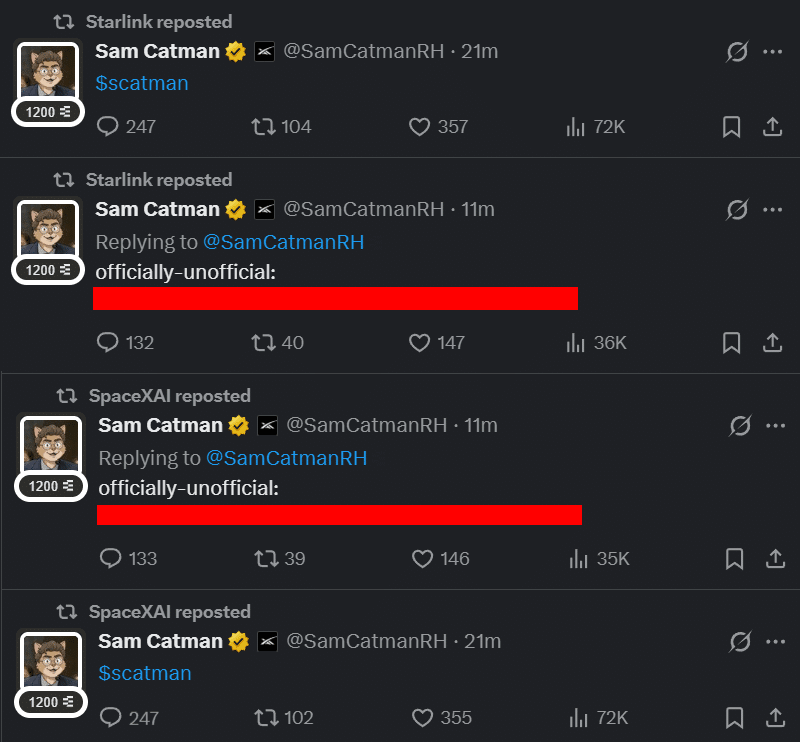
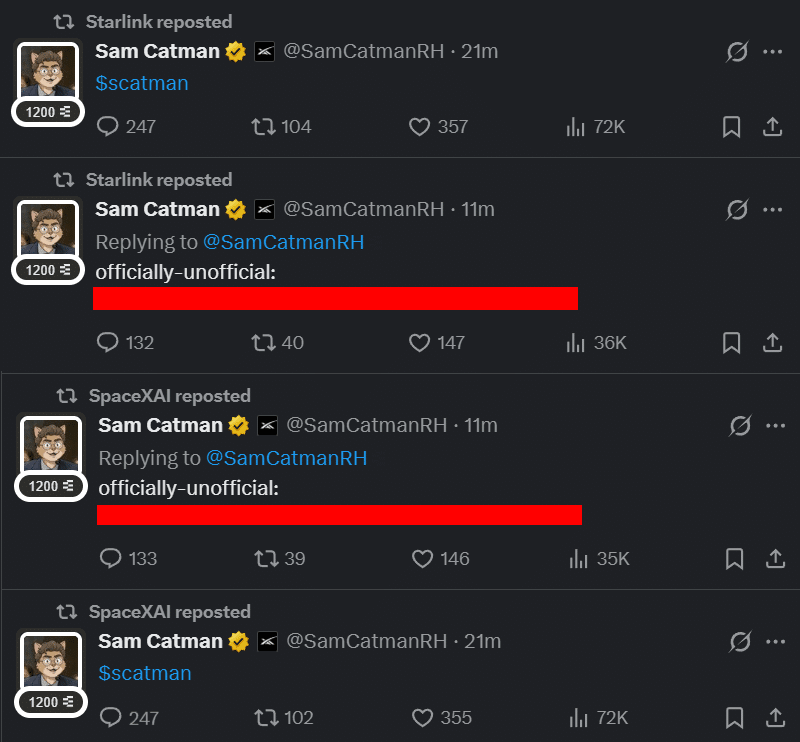
Source: X

Meanwhile, the attacker had already minted 10 trillion SCATMAN before the campaign began. The wallets then dumped holdings for 73.7 ETH, worth roughly $135,000. The token briefly approached a $2 million market capitalization before liquidity disappeared, losing 98% of its value.

This incident again showed how compromised high-profile accounts can rapidly transform online trust into exit liquidity for coordinated crypto scams.


Liquidity failed to sustain the rally

İlgili Sorular

QWhat cryptocurrency was fraudulently promoted by hackers using compromised SpaceXAI and Starlink X accounts?

AThe SCATMAN memecoin was fraudulently promoted by the hackers.

QHow much value did the SCATMAN token lose after the scam?

AThe SCATMAN token lost 98% of its value after the scam.

QWhat did the attackers do before starting the promotion campaign on social media?

ABefore the campaign, the attacker had already minted 10 trillion SCATMAN tokens.

QHow much money did the attacker make by selling the tokens during the scam?

AThe attacker made 73.7 ETH, worth roughly $135,000, by selling the tokens.

QAccording to the article, what does this incident demonstrate about compromised high-profile accounts?

AThe incident shows how compromised high-profile accounts can rapidly transform online trust into exit liquidity for coordinated crypto scams.

İlgili Okumalar

FBI Agent Steals from Within: Millions in Cryptocurrency Stolen by Memorizing Recovery Phrases

A criminal complaint filed in the U.S. District Court for the Eastern District of Virginia details the case of Patrick Steven Yaroch, a former FBI supervisory special agent. Yaroch is accused of using his position to steal nearly $1 million in cryptocurrency from accounts associated with a "foreign adversary" (reportedly Russia) that were under FBI monitoring. He allegedly accessed the accounts' seed phrases from an FBI system, memorized them, and transferred the funds to personal wallets over 10-12 transactions in late 2024 or early 2025. Some stolen assets were held on the Kraken exchange and others were deposited into the Suilend DeFi protocol to earn yield. Despite his senior GS-14 position and high security clearance, Yaroch claimed his actions stemmed from frustration with the FBI's perceived inaction against the monitored accounts. However, evidence from his phone, including ChatGPT conversations from May and June 2026, revealed plans to move to Europe (specifically Portugal) with $1 million and retire early. He booked flights for his family and initiated steps for Portuguese residency. Tormented by guilt, Yaroch voluntarily confessed to the Justice Department and FBI in late July 2026, surrendering the seed phrase and a hardware wallet. He was immediately fired and arrested. He faces charges of interstate transportation of stolen property and receipt of stolen goods. The case highlights vulnerabilities within law enforcement, including excessive access to sensitive data like seed phrases, inadequate internal oversight, and the difficulty of detecting such insider theft on-chain. It echoes past corruption cases, such as those involving agents Carl Force and Shaun Bridges during the Silk Road investigation, where officials misappropriated Bitcoin. The incident underscores that human fallibility remains a critical risk in managing digital assets, even within heavily monitored agencies.

marsbit3 saat önce

FBI Agent Steals from Within: Millions in Cryptocurrency Stolen by Memorizing Recovery Phrases

marsbit3 saat önce

Inside a Fake Ledger: How a 4G Modem is Secretly Embedded in a Hardware Wallet

In a presentation at Hardwear.io 2026, hardware security expert Joe Grand detailed a sophisticated spy chip discovered inside counterfeit Ledger Nano X hardware wallets. Initially reported in 2021, these tampered devices reached victims through data leaked from Ledger in 2020 and subsequent phishing campaigns. The implanted board connects to the internal SPI bus, passively intercepting data between the Secure Element and the OLED display. Using pattern recognition, it "reads" the seed phrase words displayed during wallet setup or recovery, stores them in its flash memory, and then exfiltrates the data via a built-in 4G modem and eSIM, independent of the victim's computer. To fit the extra hardware, the attackers reduced the battery size and replaced a thermal sensor with a fixed resistor to fake a 100% charge reading. Grand noted this is not an isolated incident, with similar supply-chain attacks previously targeting Trezor devices where compromised firmware generated predictable seed phrases. The researcher plans to intercept and decrypt the chip's cellular traffic to learn more about the attackers. Ledger advises users to purchase devices directly from the manufacturer or authorized resellers, not third-party marketplaces, and to compare devices against official photos. The company is also considering enhanced physical security for future products. The article questions whether Ledger Live's Secure Element authentication would detect such a passive hardware implant and highlights that the core risk lies in the physical supply chain, not just software.

cryptonews.ru3 saat önce

Inside a Fake Ledger: How a 4G Modem is Secretly Embedded in a Hardware Wallet

cryptonews.ru3 saat önce

İşlemler

Spot
活动图片