Hackers and Scammers Stole $4 Billion in Cryptocurrencies in 2025

RBK-crypto2026-01-13 tarihinde yayınlandı2026-01-13 tarihinde güncellendi

Özet

In 2025, hackers and fraudsters stole over $4 billion in cryptocurrencies, a 34.2% increase compared to the $3.01 billion stolen in 2024, according to analytics firm PeckShieldAlert. The total damage exceeded $4.04 billion, with $2.67 billion (a 24.2% annual increase) attributed to hacks and $1.37 billion (a 64.2% increase) to fraud cases. A strategic shift was noted towards a rise in scams utilizing social engineering methods, such as psychological manipulation to trick victims into revealing confidential information, which accounted for 12% of the losses. The most significant single incident was the $1.4 billion hack of the Bybit exchange in February of the previous year. An additional 22% of losses came from scams, including 'rug pulls' and pseudo-crypto investment schemes. Another key change was the increasing share of centralized services among the affected platforms. Their share of losses grew from just over 35% in 2023 to around 45% in 2024, and exceeded 70% in 2025. Only about $334.9 million of the stolen funds were frozen or returned during the year, a decrease from the $488.5 million recovered in 2024.

Damage to crypto industry participants increased by 34% compared to 2024

Due to hacks and fraud with cryptocurrencies in 2025, more than $4 billion was lost, according to analysts at PeckShieldAlert. According to their data, this is 34.2% more than in 2024, when $3.01 billion worth of cryptocurrency was stolen.
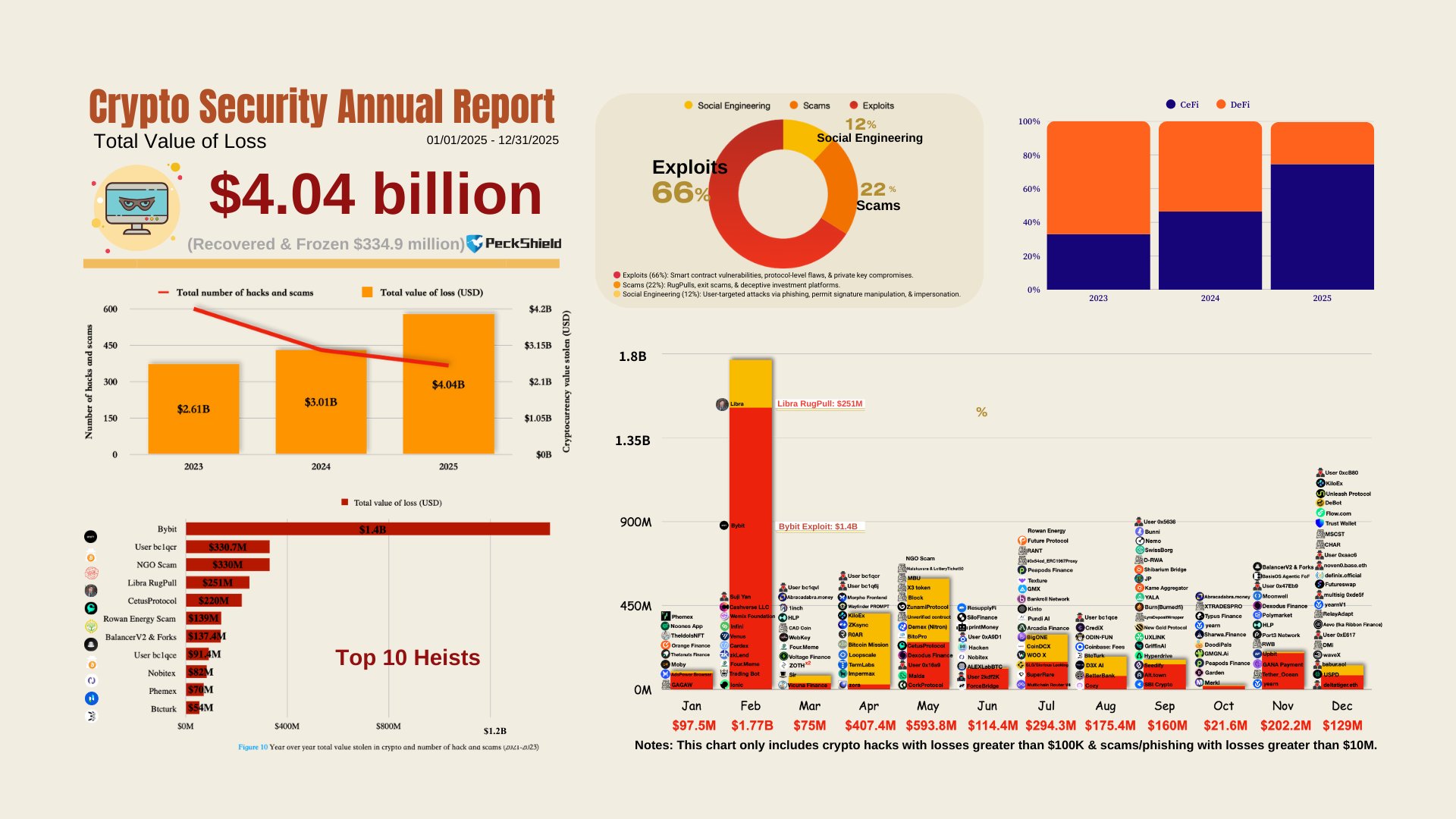
Damage from hacks and fraud with cryptocurrencies in 2025. Source: PeckShield

The total damage in 2025 exceeded $4.04 billion. Of this, $2.67 billion came from losses due to hacks (a 24.2% year-on-year increase) and $1.37 billion was attributed to cases of fraud (a 64.2% increase).

RBC-Crypto Telegram Channel — subscribe and stay up to date with the most important and relevant news about cryptocurrencies.

Join the RBC-Crypto forum on Telegram to discuss news and trends in the crypto world.

The report emphasizes that a strategic shift is occurring — the number of thefts using social engineering methods (psychological techniques and manipulations that force the victim to disclose confidential information that the attacker could use to steal funds) is growing. Analysts attributed 12% of the losses in 2025 to incidents where such methods were used.

66% of the total damage came from hacks, the most serious being the theft of $1.4 billion from the Bybit exchange in February of last year. Another 22% of losses came from scams, including "rug pulls" (when developers withdraw liquidity at the price peak) and pseudo-cryptoinvestments.

Another important change was the increase in the share of centralized services among the affected platforms. If in 2023 they accounted for just over 35%, in 2024 it was already around 45%, and in 2025 — over 70%.

Over the year, only about $334.9 million of the stolen funds was frozen or returned. PeckShield noted a decrease compared to 2024, when $488.5 million was recovered.

Cardano Founder: Trump's Policy Pushed Suburbs Away from Cryptocurrency

Former New York 'Bitcoin Mayor' Faces Charges in Crypto Fraud

The First Bitcoin Transaction Was Executed 17 Years Ago. Who Received These Coins

Trend Kriptolar

İlgili Sorular

QHow much was stolen in cryptocurrencies due to hacks and fraud in 2025 according to PeckShieldAlert?

A$4 billion was stolen in cryptocurrencies in 2025.

QWhat was the percentage increase in losses from crypto hacks and fraud in 2025 compared to 2024?

ALosses increased by 34.2% in 2025 compared to 2024.

QWhat was the largest single crypto theft incident mentioned in the report for 2025?

AThe largest single theft was the $1.4 billion hack of the Bybit exchange in February of the previous year.

QWhat significant shift in attack methods did the PeckShield report highlight for 2025?

AThe report highlighted a strategic shift towards an increase in the number of scams using social engineering methods, which accounted for 12% of the losses.

QWhat percentage of the total losses in 2025 were attributed to centralized services?

AOver 70% of the total losses in 2025 were attributed to centralized services.

İlgili Okumalar

Misjudged A-Shares: Resilience, Expectations, and Confidence

China's A-share market recently faced selling pressure, especially in tech sectors, initially triggered by a global tech sell-off that began in South Korea. However, the article argues this is a case of "mistaken injury" and highlights the market's underlying resilience. This resilience stems from three main pillars: **1) Tech Sector Fundamentals:** Unlike Korea's market dominated by a few memory chip stocks, China's tech sector is diversified across computing, communications, electronics, and semiconductors, supported by dual narratives of global AI supply chains and domestic substitution. Core areas like optical modules and fiber optics continue to show strong earnings growth. **2) "National Team" Support:** State-backed institutions and large corporations have made significant market purchases and announced buybacks, providing liquidity and signaling confidence. This is seen as a stabilizing policy signal, often associated with market bottoms. **3) Broader Market Pillars:** Other major sectors are showing endogenous recovery momentum. Consumer stocks benefit from stabilizing CPI and signs of sector recovery (e.g., liquor price hikes). Cyclical sectors like aluminum have high earnings, potential price increases due to tight supply, and low valuations. The financial sector offers stable dividends and low valuations. The conclusion is that the sell-off was driven by external contagion, not a collapse in fundamentals. With strong policy support and recovering momentum across key sectors, the A-share market possesses the toughness to regain stability.

marsbit31 dk önce

Misjudged A-Shares: Resilience, Expectations, and Confidence

marsbit31 dk önce

The Clarity Act's Journey Through Congress: The Thorny Path of Bipartisan Compromise in the U.S.

The U.S. Congress is struggling to advance the crypto market structure bill known as the Clarity Act, with bipartisan compromise proving difficult. Key hurdles include unresolved disputes over "yield" products and, more critically, the inclusion of strong ethics provisions for elected officials—a non-negotiable demand for many Democrats. While a compromise on yield was reached in May, securing only limited Democratic support in committee, the separate Senate Agriculture Committee version later passed with no Democratic votes due to the ethics impasse. As Republicans push for a full Senate vote in July, demands for ethics rules have expanded, and other contentious issues like developer protections and concerns from law enforcement and large banks further complicate negotiations. Despite consensus on the need for legislation, the path forward is unclear. Recent discussions between senators and White House officials aim to find acceptable ethics language. Some lawmakers question whether a compromise text can garner enough bipartisan support, with one Democrat stating the current proposal lacks the strong ethics provisions required for their vote. Potential short-term goals for the crypto community include symbolic Senate action before the August recess, a longer-term aim for passage by 2026, or establishing a detailed framework that addresses ethics and other compromises. The process remains arduous, relying on the traditional, vote-by-vote effort to build bipartisan support.

marsbit50 dk önce

The Clarity Act's Journey Through Congress: The Thorny Path of Bipartisan Compromise in the U.S.

marsbit50 dk önce

Are Kalshi and Polymarket Founders at Odds? This Business Rivalry Is More Brutal Than You Think

"The Rivalry Between Kalshi and Polymarket Founders Turns Bitter and Litigious" The intense feud between Tarek Mansour, CEO of Kalshi, and Shayne Coplan, founder of Polymarket, has escalated far beyond typical business competition into personal animosity and regulatory battles. Both lead billion-dollar prediction market platforms, but their approaches differ sharply. Kalshi positions itself as the compliant operator, securing U.S. regulatory approval before launching. In contrast, Polymarket initially operated offshore, allowing U.S. users to access its platform via VPN, which drew regulatory scrutiny. The conflict reached a peak in November 2024 when FBI agents raided Coplan's New York apartment. While Coplan publicly blamed political motives, his team privately suspected Kalshi was involved. According to sources, Kalshi's lawyers had previously reported Polymarket's operations to federal prosecutors, highlighting its accessibility to U.S. users despite a ban. This incident fueled mutual accusations and underhanded tactics, including social media smear campaigns and attempts to sabotage each other's major business deals. Their rivalry also played out in Washington, influencing regulatory debates. Kalshi actively lobbied against Polymarket's practices, framing them as illegal and unethical. Polymarket, after facing a CFTC fine and investigation, later acquired a licensed U.S. firm to launch a domestic app, regaining a foothold. Despite the hostility, both companies have seen massive growth, with combined trading volumes soaring. However, increased regulatory scrutiny, particularly around insider trading on Polymarket's platform, continues to pose challenges. The founders' deep-seated mutual disdain ensures their battle for market dominance remains as much a personal vendetta as a commercial one.

marsbit59 dk önce

Are Kalshi and Polymarket Founders at Odds? This Business Rivalry Is More Brutal Than You Think

marsbit59 dk önce

İşlemler

Spot

Popüler Makaleler

4 Nasıl Satın Alınır

HTX.com’a hoş geldiniz! 4 (4) satın alma işlemlerini basit ve kullanışlı bir hâle getirdik. Adım adım açıkladığımız rehberimizi takip ederek kripto yolculuğunuza başlayın. 1. Adım: HTX Hesabınızı OluşturunHTX'te ücretsiz bir hesap açmak için e-posta adresinizi veya telefon numaranızı kullanın. Sorunsuzca kaydolun ve tüm özelliklerin kilidini açın. Hesabımı Aç2. Adım: Kripto Satın Al Bölümüne Gidin ve Ödeme Yönteminizi SeçinKredi/Banka Kartı: Visa veya Mastercard'ınızı kullanarak anında 4 (4) satın alın.Bakiye: Sorunsuz bir şekilde işlem yapmak için HTX hesap bakiyenizdeki fonları kullanın.Üçüncü Taraflar: Kullanımı kolaylaştırmak için Google Pay ve Apple Pay gibi popüler ödeme yöntemlerini ekledik.P2P: HTX'teki diğer kullanıcılarla doğrudan işlem yapın.Borsa Dışı (OTC): Yatırımcılar için kişiye özel hizmetler ve rekabetçi döviz kurları sunuyoruz.3. Adım: 4 (4) Varlıklarınızı Saklayın4 (4) satın aldıktan sonra HTX hesabınızda saklayın. Alternatif olarak, blok zinciri transferi yoluyla başka bir yere gönderebilir veya diğer kripto para birimlerini takas etmek için kullanabilirsiniz.4. Adım: 4 (4) Varlıklarınızla İşlem YapınHTX'in spot piyasasında 4 (4) ile kolayca işlemler yapın.Hesabınıza erişin, işlem çiftinizi seçin, işlemlerinizi gerçekleştirin ve gerçek zamanlı olarak izleyin. Hem yeni başlayanlar hem de deneyimli yatırımcılar için kullanıcı dostu bir deneyim sunuyoruz.

453 Toplam GörüntülenmeYayınlanma 2025.10.20Güncellenme 2026.06.02

4 Nasıl Satın Alınır

Tartışmalar

HTX Topluluğuna hoş geldiniz. Burada, en son platform gelişmeleri hakkında bilgi sahibi olabilir ve profesyonel piyasa görüşlerine erişebilirsiniz. Kullanıcıların 4 (4) fiyatı hakkındaki görüşleri aşağıda sunulmaktadır.

活动图片