Grayscale Discloses Potential Investment Candidates: Which Crypto Assets Are Under Consideration?

marsbit2026-01-15 tarihinde yayınlandı2026-01-15 tarihinde güncellendi

Özet

Grayscale, a leading crypto asset manager, has disclosed its list of potential digital assets under consideration for future investment products, alongside an updated list of assets currently held in its existing products. These lists are organized using Grayscale's proprietary crypto sector classification framework. The "Asset Candidate List" features digital assets not currently held but identified as potential candidates. The "Existing Grayscale Product Assets" list details holdings as of January 12, 2026. The firm plans to update these lists quarterly. Grayscale emphasizes that the inclusion of an asset on the candidate list does not guarantee a product will be launched, as the process is complex and depends on internal controls, custody arrangements, and regulatory considerations. Assets may also be added to products without first appearing on the candidate list. The announcement includes a reminder that new products may not receive approval for secondary market trading. This information is for informational purposes only and not an offer to sell or buy securities.

Author: Grayscale

Compiled by: Deep Tide TechFlow
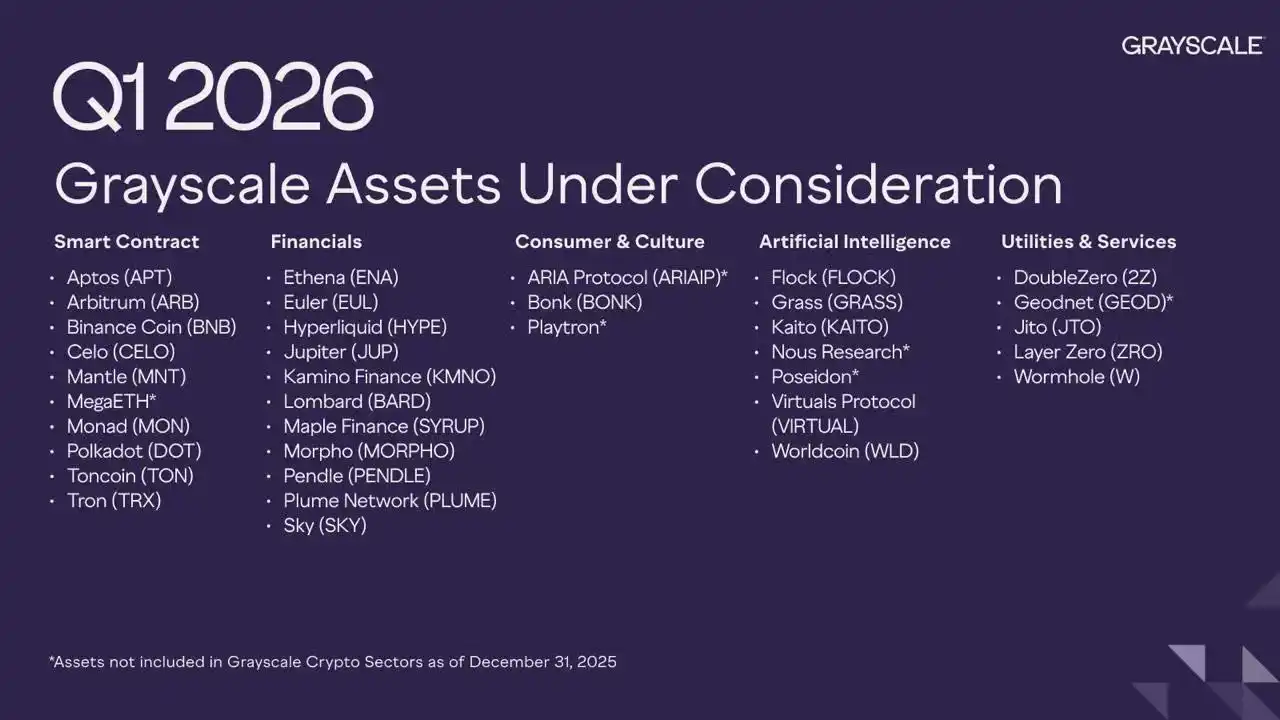
As a leading crypto asset management company, introducing a diverse range of investable digital assets to investors is a crucial part of our mission.

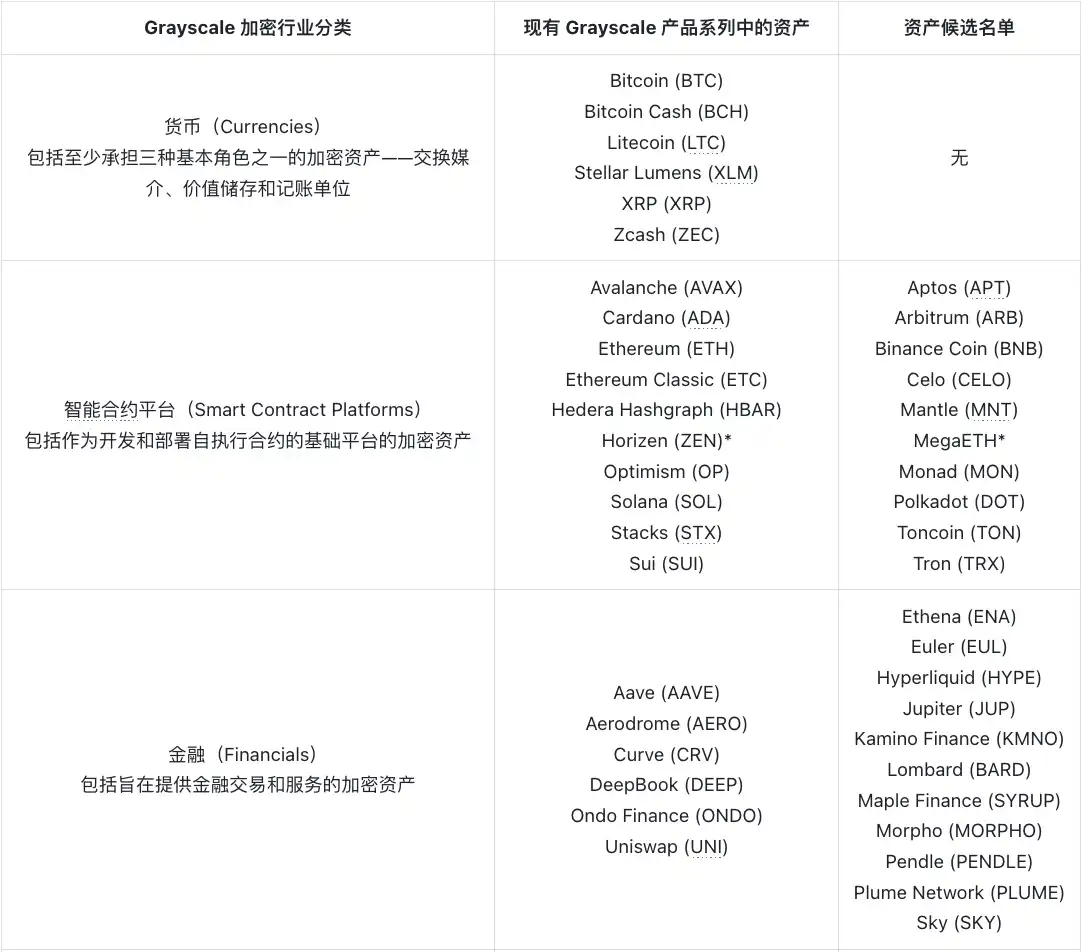
Therefore, we are pleased to share this candidate list of assets that may potentially be included in Grayscale investment products in the future, along with an updated list of assets currently in our existing product lineup. Both lists are categorized according to the Grayscale Crypto Sector Classification Framework we designed, which aims to set the standard for organizing crypto asset categories.

The "Asset Candidate List" includes digital assets that are not currently part of Grayscale investment products but have been identified by our team as potential candidates for future products.

The "Assets in Existing Grayscale Product Lineup" lists the digital assets held by Grayscale products as of January 12, 2026, which may be part of either single-asset products or multi-asset products.

As the crypto ecosystem expands and the Grayscale team reviews or re-evaluates additional assets, we plan to update this list as frequently as possible within 15 days after the end of each quarter. The following lists are as of January 12, 2026, and may change during the quarter as some multi-asset funds rebalance their compositions and we launch new single-asset products.
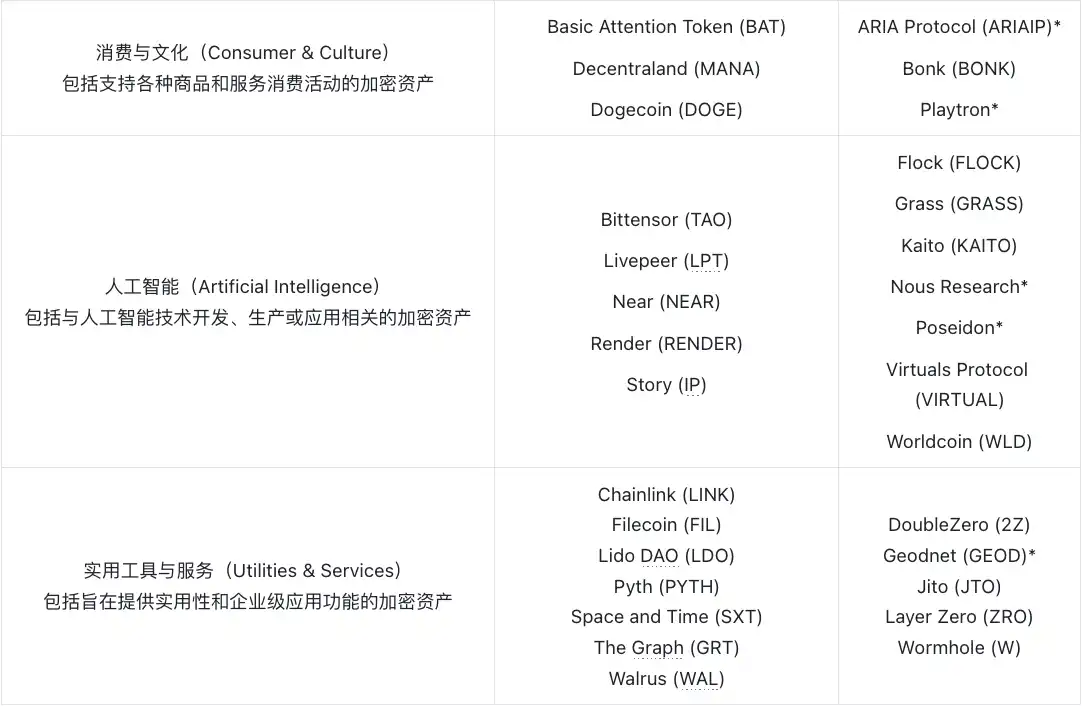
*As of December 31, 2025, assets not included in the Grayscale Crypto Sector Classification.

1 Assets may be directly included in the Grayscale product lineup without first being listed in this table, for example, if a decision is made to include an asset in a Grayscale product during the quarter.

The process of creating investment products similar to our existing ones is complex and multifaceted. It requires in-depth review and consideration and is influenced by various factors such as internal controls, custody arrangements, and regulatory requirements. It is important to note that this table is for informational purposes only, and not all candidate assets will be converted into our investment products. Grayscale may also explore other assets not listed in the table for inclusion in its product lineup. Similarly, assets may be directly included in the Grayscale product lineup without first being listed in this table.

Grayscale may attempt to have shares of new products quoted on secondary markets. Although shares of certain Grayscale products are approved for trading on secondary markets (such as OTCQX), for investors in new products, it cannot be assumed that such shares will receive similar approval due to potential concerns from the U.S. Securities and Exchange Commission (SEC) and/or the Financial Industry Regulatory Authority (FINRA) regarding the status of the underlying digital assets under federal securities laws.

This article does not constitute an offer to sell or a solicitation to buy any securities in any jurisdiction, nor should it be considered as legal to make such an offer, solicitation, or sale without registration or qualification under the securities laws of that jurisdiction. Grayscale, its affiliates, and clients may hold positions in the digital assets or securities discussed herein.


İlgili Sorular

QWhat is the purpose of Grayscale's 'asset candidate list'?

AThe 'asset candidate list' identifies digital assets not currently included in Grayscale investment products but have been identified by their team as potential candidates for future products.

QHow often does Grayscale plan to update its list of potential investment assets?

AGrayscale plans to update the list as frequently as possible, aiming for within 15 days after the end of each quarter.

QAs of the article's date, what framework does Grayscale use to categorize crypto assets for its products?

AGrayscale uses its own designed 'Grayscale Crypto Sector Classification Framework' to categorize crypto assets for its products.

QDoes inclusion on the candidate list guarantee an asset will be turned into a Grayscale investment product?

ANo, inclusion on the candidate list does not guarantee an asset will be turned into a product. It is for informational purposes only, and not all candidate assets will be converted.

QWhat is a significant regulatory consideration mentioned for new Grayscale products seeking secondary market trading?

AA significant consideration is that the SEC and/or FINRA may have concerns about the status of the product's underlying digital asset under federal securities laws, so approval for secondary market trading cannot be assumed.

İlgili Okumalar

TechFlow Intelligence Bureau: Anthropic IPO Odds Exceed 80%, Iran Closes Strait of Hormuz Again, Triggering Oil Price Volatility

**Market Digest** **AI & Tech:** Anthropic is widely expected to announce an IPO before November 2026, raising questions about balancing its trillion-dollar valuation ambitions with its core "AI safety" mission. Brands are increasingly adopting AI-generated virtual influencers for marketing. Cloudflare introduced temporary accounts for AI agents to ease automation workflows. **Infrastructure & Hardware:** Google's IPv6 traffic surpassed 50%, marking a major internet milestone. Goldman Sachs warned that massive projected AI capital expenditure ($5.3T) is approaching credit saturation limits, potentially curbing the "AI arms race." **Space & Robotics:** SpaceX's IPO saw a historic $370M retail buying frenzy in three days. Hyundai Motor Group plans to acquire full ownership of Boston Dynamics. Elon Musk speculated about future "septillion-dollar" investments in antimatter for interstellar travel. **Energy & Geopolitics:** Iran's military announced another closure of the strategic Strait of Hormuz, accusing Israel of violating a ceasefire, causing oil market volatility. However, ship-tracking data indicated some traffic continued. Concurrently, Iran resumed crude loadings at Kharg Island, potentially releasing up to 20 million barrels to the market. **Finance & Macro:** A European CLO (collateralized loan obligation) experienced its first post-2008-crisis-era equity tranche default, raising alarms in credit markets. Nomura warned that new Federal Reserve Chair Wash's perceived hawkish debut speech could signal a significant policy shift. **The Undercurrent:** Seemingly disparate events—the Strait of Hormuz tension, the European CLO default, and warnings on AI spending—point to a tightening of global liquidity and rising marginal costs across energy, credit, and tech investment. Meanwhile, capital continues chasing grand narratives like space exploration and advanced AI, highlighting a divergence where old-world leverage frays as new-world stories grow more ambitious.

marsbit30 dk önce

TechFlow Intelligence Bureau: Anthropic IPO Odds Exceed 80%, Iran Closes Strait of Hormuz Again, Triggering Oil Price Volatility

marsbit30 dk önce

The Hunter Becomes the Hunted: The Most Profitable MEV Bot Gets Hacked

A well-known and highly profitable Ethereum MEV Bot, Jaredfromsubway.eth, suffered a sophisticated on-chain attack this Saturday, losing over $7.5 million. Analysis by Blockaid and others reveals this was not a conventional phishing or smart contract exploit, but a targeted "counter-MEV honeypot attack." The attacker meticulously laid a trap over several weeks, deploying 66 fake token contracts and liquidity pools disguised as major assets like WETH and USDC. These pools created the illusion of arbitrage opportunities. The MEV Bot's automated system detected these signals, executed trades, and in the process, granted approval permissions to attacker-controlled contracts. These approvals were not revoked, creating a persistent vulnerability. The attacker then exploited this in a single transaction, draining the bot's ETH, USDC, and USDT holdings. Jaredfromsubway.eth is notorious as one of Ethereum's most active and profitable MEV Bots, primarily known for executing "sandwich attacks" to profit from transaction slippage. Estimates suggest it has earned tens of millions in MEV revenue. The incident highlights escalating crypto security threats, demonstrating that even top-tier automated "predators" are vulnerable to novel, logic-based attacks designed to exploit their own operational rules. Following the hack, an unverified X account impersonating Jaredfromsubway.eth emerged, falsely offering a bounty for the return of funds, prompting developer warnings for users to stay vigilant.

marsbit1 saat önce

The Hunter Becomes the Hunted: The Most Profitable MEV Bot Gets Hacked

marsbit1 saat önce

The Reality of Payments in Latin America Is Not What You Think

The payment landscape in Latin America is undergoing a fundamental shift, driven by on-the-ground realities that challenge common perceptions. Based on over 500 hours of field research across the region, key insights emerge. Firstly, QR code payments, like Brazil's Pix, are becoming the dominant payment method in most emerging markets, overtaking cards. However, these domestic instant payment systems lack international interoperability, creating a significant gap for cross-border users. Secondly, the narrative around crypto cards is often misunderstood; their primary volume comes from high-net-worth professionals using them for salary conversions (e.g., USDT to local currency via Pix), not retail micro-payments. Competition in payments is shifting from customer acquisition to controlling the settlement layer, leading fintechs to acquire banking licenses for efficiency. Thirdly, treating "Latin America" as a single market is a mistake. Countries like Argentina, Brazil, and Mexico have distinct economic realities, user segments, and regulatory approaches. Brazil alone has at least five distinct user segments with different financial flows. Overlooked markets like Guatemala, Honduras, and El Salvador (the "forgotten five") offer high remittance volumes with lower competitive density. Finally, regulation in Latin America is often ahead of the US, with clearer frameworks for digital assets and a pragmatic approach from regulators focused on safety rather than obstruction. The margin on stablecoin forex is rapidly compressing toward zero, meaning future winners will be those building value-added services on top of the infrastructure, not just the cheapest exchange.

marsbit2 saat önce

The Reality of Payments in Latin America Is Not What You Think

marsbit2 saat önce

İşlemler

Spot
Futures
活动图片