Grayscale Discloses Potential Investment Candidates: Which Crypto Assets Are Under Consideration?

marsbit2026-01-15 tarihinde yayınlandı2026-01-15 tarihinde güncellendi

Özet

Grayscale, a leading crypto asset manager, has disclosed its list of potential digital assets under consideration for future investment products, alongside an updated list of assets currently held in its existing products. These lists are organized using Grayscale's proprietary crypto sector classification framework. The "Asset Candidate List" features digital assets not currently held but identified as potential candidates. The "Existing Grayscale Product Assets" list details holdings as of January 12, 2026. The firm plans to update these lists quarterly. Grayscale emphasizes that the inclusion of an asset on the candidate list does not guarantee a product will be launched, as the process is complex and depends on internal controls, custody arrangements, and regulatory considerations. Assets may also be added to products without first appearing on the candidate list. The announcement includes a reminder that new products may not receive approval for secondary market trading. This information is for informational purposes only and not an offer to sell or buy securities.

Author: Grayscale

Compiled by: Deep Tide TechFlow
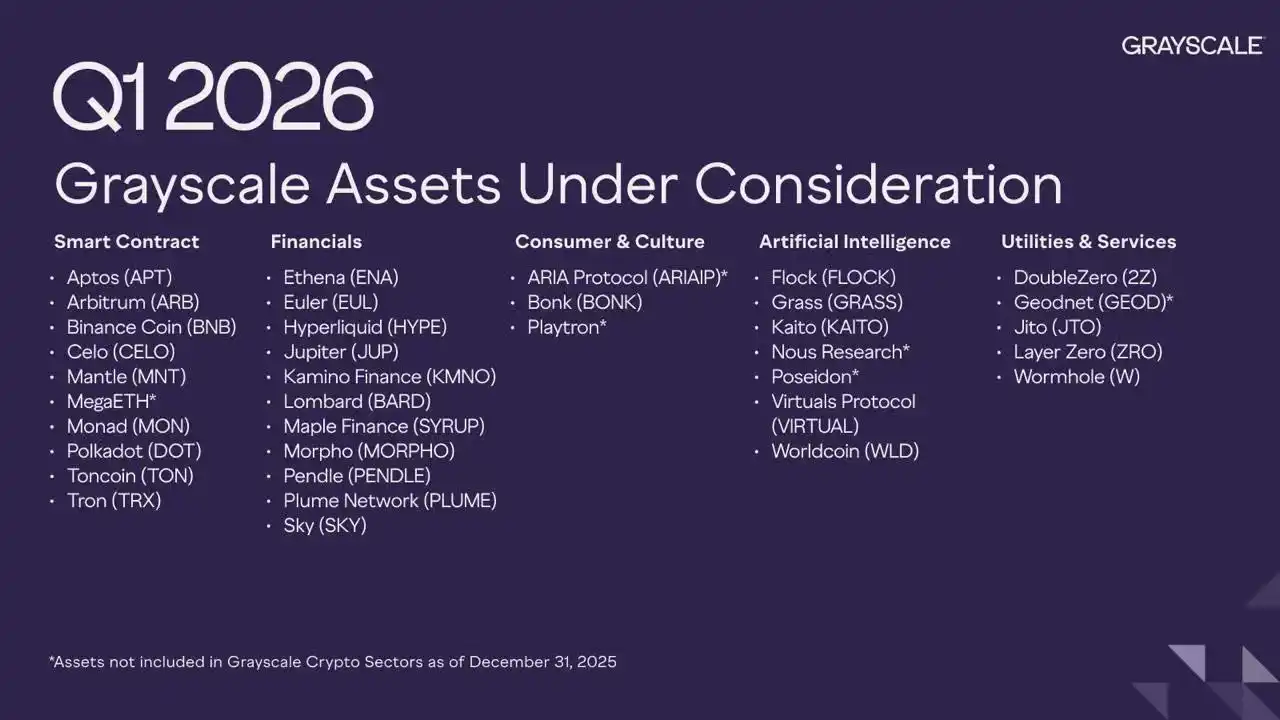
As a leading crypto asset management company, introducing a diverse range of investable digital assets to investors is a crucial part of our mission.

Therefore, we are pleased to share this candidate list of assets that may potentially be included in Grayscale investment products in the future, along with an updated list of assets currently in our existing product lineup. Both lists are categorized according to the Grayscale Crypto Sector Classification Framework we designed, which aims to set the standard for organizing crypto asset categories.

The "Asset Candidate List" includes digital assets that are not currently part of Grayscale investment products but have been identified by our team as potential candidates for future products.

The "Assets in Existing Grayscale Product Lineup" lists the digital assets held by Grayscale products as of January 12, 2026, which may be part of either single-asset products or multi-asset products.

As the crypto ecosystem expands and the Grayscale team reviews or re-evaluates additional assets, we plan to update this list as frequently as possible within 15 days after the end of each quarter. The following lists are as of January 12, 2026, and may change during the quarter as some multi-asset funds rebalance their compositions and we launch new single-asset products.
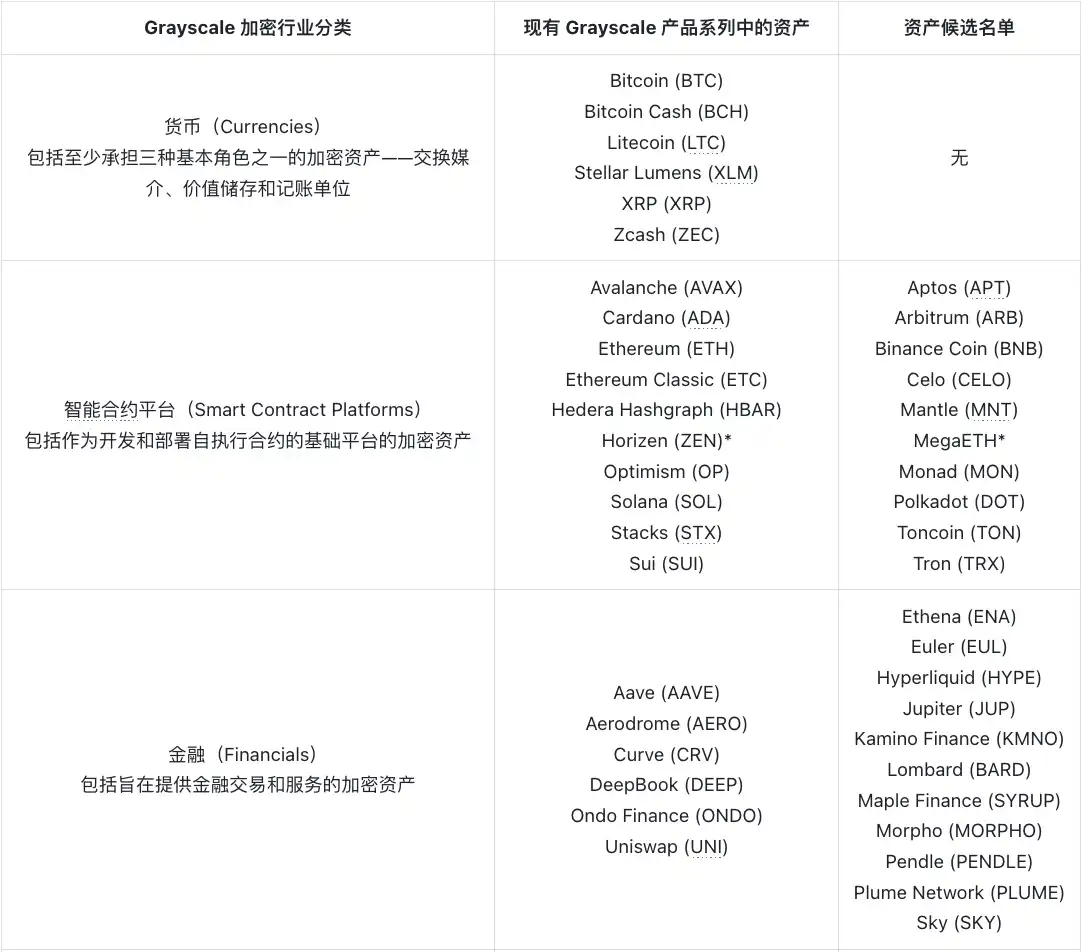
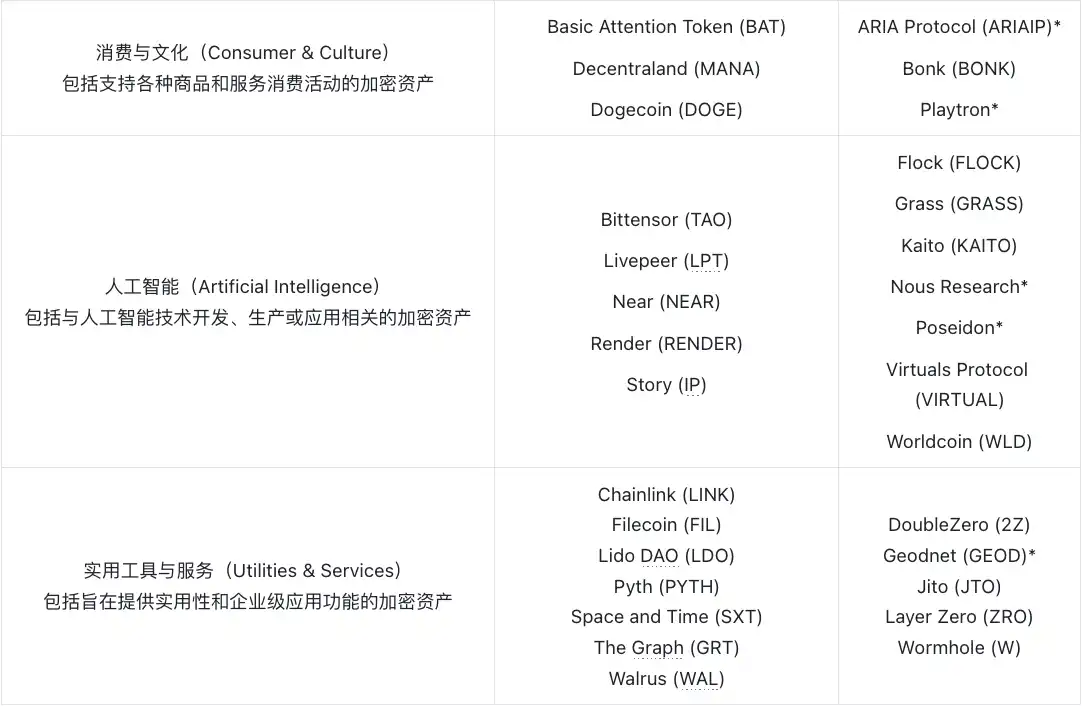
*As of December 31, 2025, assets not included in the Grayscale Crypto Sector Classification.

1 Assets may be directly included in the Grayscale product lineup without first being listed in this table, for example, if a decision is made to include an asset in a Grayscale product during the quarter.

The process of creating investment products similar to our existing ones is complex and multifaceted. It requires in-depth review and consideration and is influenced by various factors such as internal controls, custody arrangements, and regulatory requirements. It is important to note that this table is for informational purposes only, and not all candidate assets will be converted into our investment products. Grayscale may also explore other assets not listed in the table for inclusion in its product lineup. Similarly, assets may be directly included in the Grayscale product lineup without first being listed in this table.

Grayscale may attempt to have shares of new products quoted on secondary markets. Although shares of certain Grayscale products are approved for trading on secondary markets (such as OTCQX), for investors in new products, it cannot be assumed that such shares will receive similar approval due to potential concerns from the U.S. Securities and Exchange Commission (SEC) and/or the Financial Industry Regulatory Authority (FINRA) regarding the status of the underlying digital assets under federal securities laws.

This article does not constitute an offer to sell or a solicitation to buy any securities in any jurisdiction, nor should it be considered as legal to make such an offer, solicitation, or sale without registration or qualification under the securities laws of that jurisdiction. Grayscale, its affiliates, and clients may hold positions in the digital assets or securities discussed herein.


İlgili Sorular

QWhat is the purpose of Grayscale's 'asset candidate list'?

AThe 'asset candidate list' identifies digital assets not currently included in Grayscale investment products but have been identified by their team as potential candidates for future products.

QHow often does Grayscale plan to update its list of potential investment assets?

AGrayscale plans to update the list as frequently as possible, aiming for within 15 days after the end of each quarter.

QAs of the article's date, what framework does Grayscale use to categorize crypto assets for its products?

AGrayscale uses its own designed 'Grayscale Crypto Sector Classification Framework' to categorize crypto assets for its products.

QDoes inclusion on the candidate list guarantee an asset will be turned into a Grayscale investment product?

ANo, inclusion on the candidate list does not guarantee an asset will be turned into a product. It is for informational purposes only, and not all candidate assets will be converted.

QWhat is a significant regulatory consideration mentioned for new Grayscale products seeking secondary market trading?

AA significant consideration is that the SEC and/or FINRA may have concerns about the status of the product's underlying digital asset under federal securities laws, so approval for secondary market trading cannot be assumed.

İlgili Okumalar

Bitcoin Withdrawals Continue: 8 Years of Storage in a Coldcard Cold Wallet Ended in Zero

Coldcard Hardware Wallet Hacked: Losses Mount Due to Vulnerable Seed Generation A critical vulnerability in Coldcard hardware wallets has led to a continued wave of fund thefts. According to Galaxy Research, the total stolen has reached 1,367.05 BTC (approx. $88.6 million) from 4,585 addresses, a significant increase from the initial 594.5 BTC reported on July 30, 2026. Most of the stolen funds remain on the attackers' addresses. The issue is not with the current firmware, which Coinkite has updated, but with seed phrases generated on vulnerable devices between March 2021 and the release of fixed firmware versions. Due to a programmer error, devices switched from using a hardware random number generator to the software-based Yasmarang generator, which was initialized with publicly accessible data like the chip's serial number. This made the seed phrases predictable through offline brute-force attacks, meaning wallets remain at risk until funds are moved to a new wallet generated with the patched firmware. Affected devices include Mk2/Mk3 with firmware 4.0.1–4.1.9 (and up to 5.0.3), Mk4/Mk5 up to version 5.6.0, and Q models up to 1.5.0Q. The only exceptions are seeds created with a high-entropy method like at least 50 independent dice rolls or a strong unique BIP-39 passphrase. All other owners must generate a new seed on the fixed firmware and transfer their assets. A case highlighting the human impact involves a 39-year-old long-term investor who lost 2 BTC (approx. $130,000) in minutes. He had accumulated the Bitcoin over eight years through physical labor, viewing it as a financial lifeline and a retirement plan in a country suffering from hyperinflation. His story underscores that even conservative "buy and hold in cold storage" strategies can be compromised by such underlying technical flaws. From a technical perspective, this incident echoes historical failures where weak random number generators undermined cryptographic security, challenging the assumption that offline storage is automatically foolproof.

cryptonews.ru2 saat önce

Bitcoin Withdrawals Continue: 8 Years of Storage in a Coldcard Cold Wallet Ended in Zero

cryptonews.ru2 saat önce

İşlemler

Spot
活动图片




