Grayscale Discloses Potential Investment Candidates: Which Crypto Assets Are Under Consideration?

marsbit2026-01-15 tarihinde yayınlandı2026-01-15 tarihinde güncellendi

Özet

Grayscale, a leading crypto asset manager, has disclosed its list of potential digital assets under consideration for future investment products, alongside an updated list of assets currently held in its existing products. These lists are organized using Grayscale's proprietary crypto sector classification framework. The "Asset Candidate List" features digital assets not currently held but identified as potential candidates. The "Existing Grayscale Product Assets" list details holdings as of January 12, 2026. The firm plans to update these lists quarterly. Grayscale emphasizes that the inclusion of an asset on the candidate list does not guarantee a product will be launched, as the process is complex and depends on internal controls, custody arrangements, and regulatory considerations. Assets may also be added to products without first appearing on the candidate list. The announcement includes a reminder that new products may not receive approval for secondary market trading. This information is for informational purposes only and not an offer to sell or buy securities.

Author: Grayscale

Compiled by: Deep Tide TechFlow
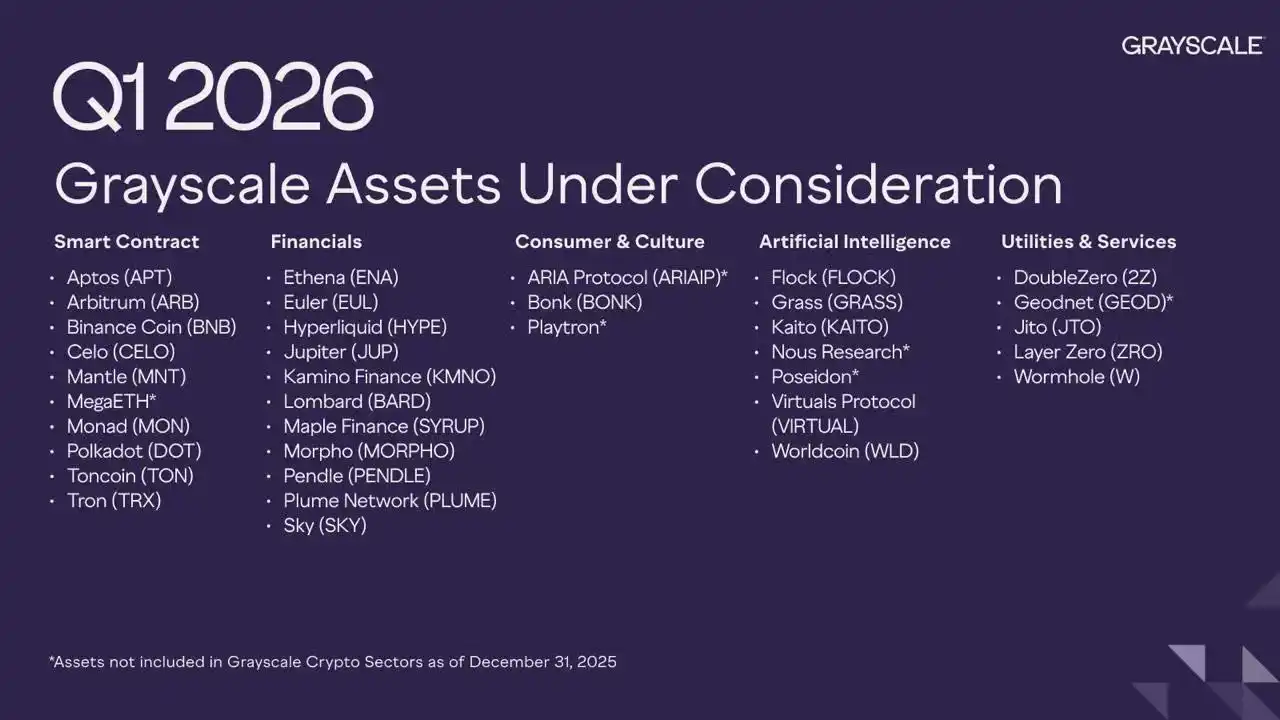
As a leading crypto asset management company, introducing a diverse range of investable digital assets to investors is a crucial part of our mission.

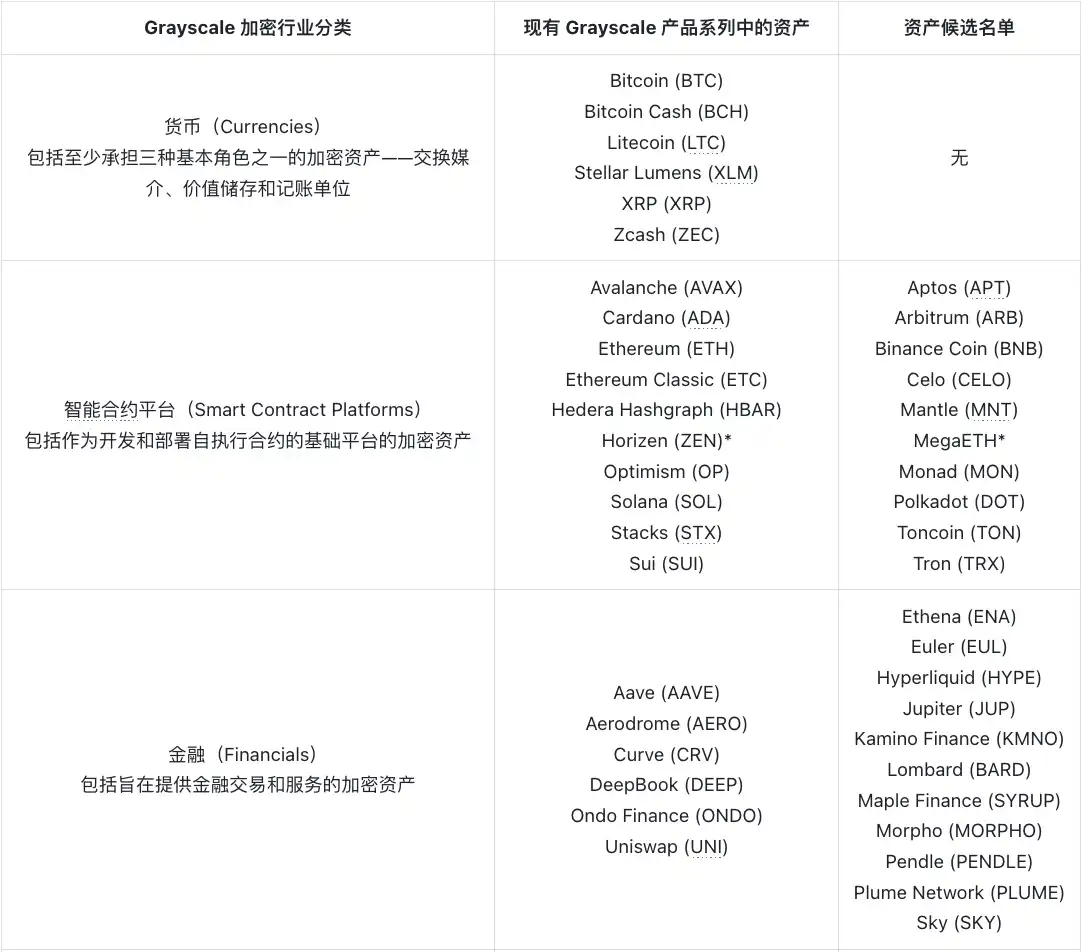
Therefore, we are pleased to share this candidate list of assets that may potentially be included in Grayscale investment products in the future, along with an updated list of assets currently in our existing product lineup. Both lists are categorized according to the Grayscale Crypto Sector Classification Framework we designed, which aims to set the standard for organizing crypto asset categories.

The "Asset Candidate List" includes digital assets that are not currently part of Grayscale investment products but have been identified by our team as potential candidates for future products.

The "Assets in Existing Grayscale Product Lineup" lists the digital assets held by Grayscale products as of January 12, 2026, which may be part of either single-asset products or multi-asset products.

As the crypto ecosystem expands and the Grayscale team reviews or re-evaluates additional assets, we plan to update this list as frequently as possible within 15 days after the end of each quarter. The following lists are as of January 12, 2026, and may change during the quarter as some multi-asset funds rebalance their compositions and we launch new single-asset products.
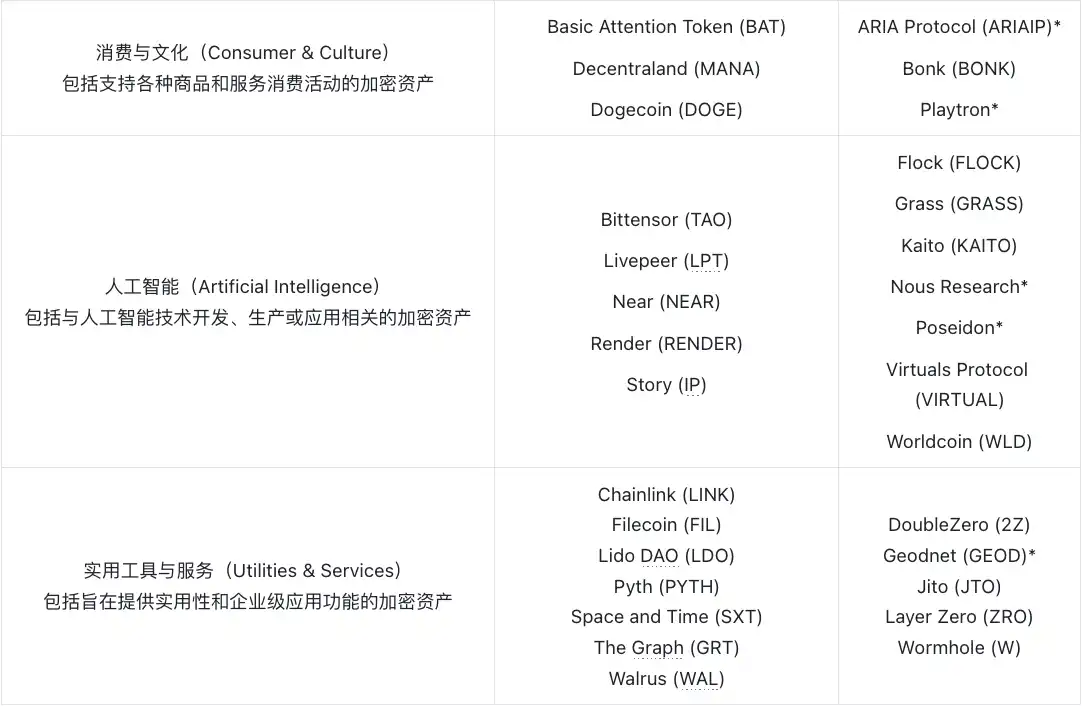
*As of December 31, 2025, assets not included in the Grayscale Crypto Sector Classification.

1 Assets may be directly included in the Grayscale product lineup without first being listed in this table, for example, if a decision is made to include an asset in a Grayscale product during the quarter.

The process of creating investment products similar to our existing ones is complex and multifaceted. It requires in-depth review and consideration and is influenced by various factors such as internal controls, custody arrangements, and regulatory requirements. It is important to note that this table is for informational purposes only, and not all candidate assets will be converted into our investment products. Grayscale may also explore other assets not listed in the table for inclusion in its product lineup. Similarly, assets may be directly included in the Grayscale product lineup without first being listed in this table.

Grayscale may attempt to have shares of new products quoted on secondary markets. Although shares of certain Grayscale products are approved for trading on secondary markets (such as OTCQX), for investors in new products, it cannot be assumed that such shares will receive similar approval due to potential concerns from the U.S. Securities and Exchange Commission (SEC) and/or the Financial Industry Regulatory Authority (FINRA) regarding the status of the underlying digital assets under federal securities laws.

This article does not constitute an offer to sell or a solicitation to buy any securities in any jurisdiction, nor should it be considered as legal to make such an offer, solicitation, or sale without registration or qualification under the securities laws of that jurisdiction. Grayscale, its affiliates, and clients may hold positions in the digital assets or securities discussed herein.


İlgili Sorular

QWhat is the purpose of Grayscale's 'asset candidate list'?

AThe 'asset candidate list' identifies digital assets not currently included in Grayscale investment products but have been identified by their team as potential candidates for future products.

QHow often does Grayscale plan to update its list of potential investment assets?

AGrayscale plans to update the list as frequently as possible, aiming for within 15 days after the end of each quarter.

QAs of the article's date, what framework does Grayscale use to categorize crypto assets for its products?

AGrayscale uses its own designed 'Grayscale Crypto Sector Classification Framework' to categorize crypto assets for its products.

QDoes inclusion on the candidate list guarantee an asset will be turned into a Grayscale investment product?

ANo, inclusion on the candidate list does not guarantee an asset will be turned into a product. It is for informational purposes only, and not all candidate assets will be converted.

QWhat is a significant regulatory consideration mentioned for new Grayscale products seeking secondary market trading?

AA significant consideration is that the SEC and/or FINRA may have concerns about the status of the product's underlying digital asset under federal securities laws, so approval for secondary market trading cannot be assumed.

İlgili Okumalar

With Two Consecutive Quarters of Losses, Coinbase Must Rely on Paths Beyond Trading

Coinbase posted its second consecutive quarterly net loss of $359 million on $1.22 billion in revenue for Q2, highlighting its vulnerability to crypto market cycles where weaker prices and lower volatility reduce user trading. However, the report also reveals a strategic shift in its business model. Despite a 25% quarter-over-quarter decline in global spot trading volume, Coinbase increased its market share to a company-record 10.3%. This suggests its position as a compliant U.S. on-ramp is strengthening even in a cooler market. A key development is the diversification of revenue streams. Transaction revenue fell to $599 million, nearly equaling subscription and services revenue of $555 million. Stablecoin services, generating $292 million, are becoming a crucial revenue "floor." This income, derived from interest on the $20 billion average USDC balance held on its platform, is less tied to daily trading activity. Furthermore, while spot trading volume dropped significantly, derivatives volume held steady at $1.03 trillion. Coinbase is pushing to integrate spot, stablecoin, and derivatives liquidity to create a more interconnected and sticky ecosystem for users. The GAAP net loss includes non-cash expenses like stock-based compensation and crypto asset valuation changes. Its adjusted EBITDA remained positive at $208 million for the 14th straight quarter, indicating core operations can cover ongoing costs. The company is also reducing expenses to manage the downturn. The central question moving forward is whether Coinbase's growing market share, stablecoin revenues, and expanding product integration can sufficiently offset the inherent cyclicality of its core trading business during future market contractions.

marsbit9 dk önce

With Two Consecutive Quarters of Losses, Coinbase Must Rely on Paths Beyond Trading

marsbit9 dk önce

In the Age of Artificial Intelligence, We Need 'Magicians,' Not 'Managers'

In the AI era, leadership must shift from management to magic. As knowledge rapidly expires, value shifts from what leaders know to what they can facilitate. Traditional "inside-out" management, driven by internal experience, is giving way to "outside-in" thinking focused on external opportunities, customer needs, and disruptive change. The core challenge is fostering new ideas that may invalidate existing knowledge. While technologies like steam, electricity, and AI provide the "skeleton" for innovation, it is human vision—connecting technology to customer dreams—that creates magic. Historical figures like Richard Arkwright and Eldridge R. Johnson succeeded not by inventing core technologies, but by reimagining work and business models from the outside in. Leaders must transition from controllers to "architects of flourishing." Their role is to design environments where empowerment, creativity, and adaptive learning thrive. This involves granting autonomy, fostering partnerships, and building resilient systems that scale innovation. Critical leadership qualities now include judgment, creativity, and the ability to learn continuously rather than relying on static expertise. Therefore, cultivating future leaders requires a focus on timeless fundamentals, humanities for broader perspective, and social acuity, rather than over-specialization in quickly outdated technical skills. The future rewards those who respond to the unseen and create conditions for better answers to emerge. Leadership in the AI age is less about having all the answers and more about enabling others to discover them—creating organizations where people explore, imagine, and thrive.

marsbit44 dk önce

In the Age of Artificial Intelligence, We Need 'Magicians,' Not 'Managers'

marsbit44 dk önce

İşlemler

Spot
活动图片