GOP hardliners vexed as defense bill advances without CBDC ban

cointelegraph2025-12-11 tarihinde yayınlandı2025-12-11 tarihinde güncellendi

Özet

A group of Republican hardliners are angered after the U.S. House passed a $900 billion defense spending bill without including a promised ban on central bank digital currencies (CBDCs). GOP Representative Keith Self stated that conservatives were explicitly assured that strong anti-CBDC language would be part of the National Defense Authorization Act (NDAA), but the promise was broken. An amendment to reinstate the ban failed to advance. The provision would have prohibited the Federal Reserve from testing, developing, or issuing a digital currency and from offering financial services directly to individuals. Some Republicans, including Marjorie Taylor Greene, criticized House leadership for not upholding the commitment, citing concerns over government control of money. The House had previously passed a separate CBDC ban in July, but it has stalled in the Senate. Self vowed to continue fighting against CBDCs in future must-pass legislation.

A group of Republicans has called foul after the US House passed a massive defense spending bill on Wednesday, which omitted a ban on central bank digital currencies (CBDC) despite promises it would be included.

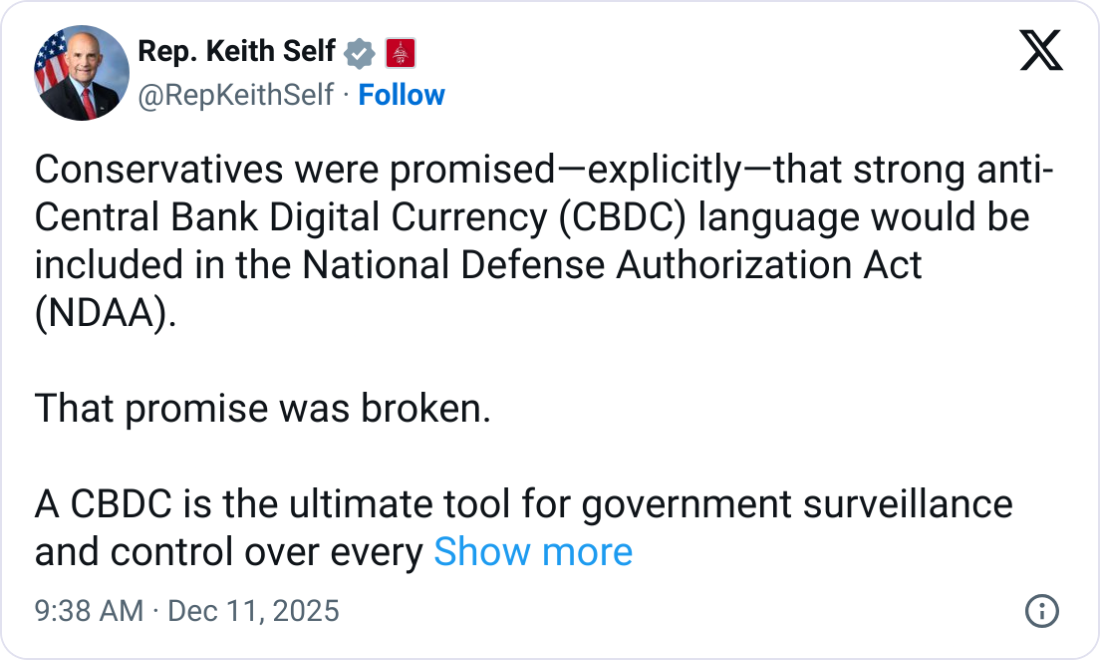
“Conservatives were promised — explicitly — that strong anti-Central Bank Digital Currency (CBDC) language would be included in the National Defense Authorization Act (NDAA). That promise was broken,” GOP Representative Keith Self wrote to X on Wednesday.

The House voted 312-112 to pass the NDAA on Wednesday, sending the $900 billion annual military funding bill to the Senate in a bid to have it passed before the end of the year.

Self had filed an amendment on Tuesday to include a CBDC ban, which had been removed from the bill, but it failed to advance and did not see a vote on the House floor.

Self said a group of Republicans was “assured that anti-CBDC language would be included. Instead, we have been forced into a take-it-or-leave-it bill that breaks that promise. Without that language, I’m inclined to leave it.”
Source: Keith Self

The more than 3,000-page bill is considered must-pass legislation and typically sees non-defense-related amendments that could otherwise be stalled or heavily revised if passed as standalone bills.

In July, House Republican leaders cut a deal with a group of party hardliners to put a CBDC ban in the defense spending bill after the group refused to move forward with three crypto bills unless a CBDC ban was guaranteed.

The bills had been held up in a record-long nine-hour procedural vote and included the stablecoin-regulating GENIUS Act, which President Donald Trump had pressured the GOP to quickly pass.

Related: Does GENIUS turn stablecoin issuers into stealth buyers of US debt?

GOP Representative Marjorie Taylor Greene slammed Speaker Mike Johnson on Monday for not keeping his promise of a CBDC ban, adding she supports crypto but “will never support giving the government the ability to turn off your ability to have full control of your money and to buy and sell.”

An early House version of the bill shared in August had included a CBDC ban, before it was subjected to amendments via multiple markups and committees.

The language of the provision banned the Federal Reserve from testing, studying, developing or issuing any digital currency or asset. It would have also stopped the central bank from offering financial products or services directly to individuals.

In July, the House passed a bill banning CBDCs, the Anti-CBDC Surveillance State Act, with a slim vote of 219-210, which has stalled in the Senate.

Self said he would “fight on in the next must-pass bill to ensure a CBDC never sees the light of day. Financial freedom isn’t negotiable.”

Legal Panel: Crypto wanted to overthrow banks, now it’s becoming them in stablecoin fight

İlgili Okumalar

Weekly Review and Outlook | Circle Issues 500 Million USDC on Solana; Japan Plans to Include Crypto Assets in Securities Regulatory Framework; Gemini Approved by CFTC to Establish Prediction Market; Fed Cuts Benchmark Rate by 25 Basis Points

This week in crypto and financial markets was marked by significant developments and regulatory shifts. Circle issued an additional 500 million USDC on the Solana network, reflecting strong demand for the stablecoin, with trading volume exceeding $11.9 billion within 24 hours. Dubai Customs partnered with Binance to explore crypto payments for trade and logistics, aiming to enhance efficiency and reduce costs. Twenty One Capital, backed by Tether and Bitfinex, began trading on the NYSE, though its stock fell 20% on the first day. Strive launched a $500 million ATM financing plan, partly to acquire more BTC, while American Bitcoin increased its holdings to 4,783 BTC. Japan's FSA proposed bringing crypto assets and IEOs under securities regulations, requiring stricter disclosures and cracking down on insider trading. Jupiter announced its own stablecoin, JUP USD, and acquired RainFi to offer peer-to-peer lending services. Gemini received CFTC approval to launch a blockchain-based prediction market, potentially expanding into crypto derivatives. The Federal Reserve cut interest rates by 25 basis points to 3.50%-3.75%, responding to slowing economic growth. Looking ahead, HashKey Group plans to raise up to HK$1.67 billion in its Hong Kong IPO on December 17. Several tokens, including Starknet, Arbitrum, and LayerZero, are scheduled for unlocks next week, which may influence market liquidity.

cointelegraph_中文2 dk önce

Weekly Review and Outlook | Circle Issues 500 Million USDC on Solana; Japan Plans to Include Crypto Assets in Securities Regulatory Framework; Gemini Approved by CFTC to Establish Prediction Market; Fed Cuts Benchmark Rate by 25 Basis Points

cointelegraph_中文2 dk önce

İşlemler

Spot
Futures
活动图片