Google Shaken, Market Cap Evaporates Hundreds of Billions. Can Gemini Spark Save the Day?

marsbit2026-07-01 tarihinde yayınlandı2026-07-01 tarihinde güncellendi

Özet

Google is facing a turbulent period marked by a significant brain drain of top AI talent. Key figures like Noam Shazeer, John Jumper, Jonas Adler, and Alexander Pritzel have recently left for competitors OpenAI and Anthropic, causing investor concern and a sharp stock decline wiping hundreds of billions from Alphabet's market cap. Amidst this talent exodus and the delayed launch of the anticipated Gemini 3.5 Pro model, Google has unveiled its major new offering: Gemini Spark. This is not a standard chatbot but a persistent, cloud-based AI agent designed to automate multi-step workflows across Google's ecosystem (Gmail, Calendar, Docs, Drive, etc.) and some third-party apps. Powered by the Antigravity framework with Tasks, Skills, and Schedules, it aims to function as a continuous digital assistant. However, its high price point—exclusive to the $100/month AI Ultra tier—has drawn criticism. The article positions Spark as Google's critical, albeit late, move into the AI agent arena, where AI transitions from a tool to an autonomous workforce. While competitors and startups are already advancing in this space, Google's vast integration with Workspace gives it a potential edge, though its historical caution due to scale and risk may have cost it the lead. Ultimately, Spark represents a necessary shift for Google, but the question remains whether this "digital employee" can compensate for the loss of foundational talent and restore investor confidence in the company's future.

Recently, morale is low at Google, with the company seemingly on shaky ground.

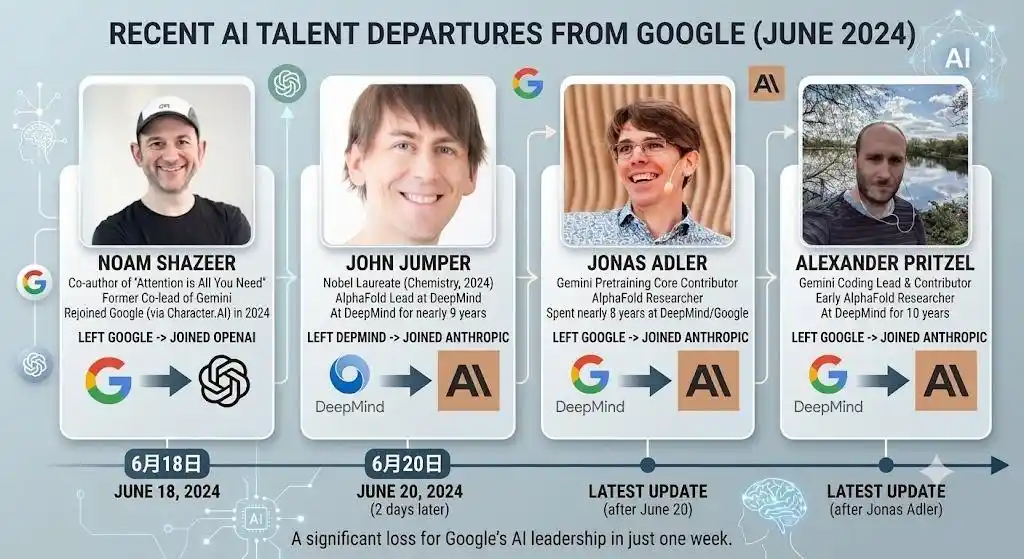
On June 18th, Noam Shazeer, one of the original eight authors of the 'Attention Is All You Need' paper, announced his departure from Google for OpenAI. In 2024, Google spent approximately $2.7 billion to bring him back, placing him in the role of co-lead for Gemini. In less than two years, he's gone again.

Two days later, John Jumper also left, heading to Anthropic. He is a 2024 Nobel Laureate in Chemistry, the lead developer of AlphaFold, and had been at DeepMind for nearly nine years.

Then came Jonas Adler and Alexander Pritzel, core contributors to Gemini's pre-training and programming directions, who also worked on AlphaFold. The latest news: these two are also preparing to join Anthropic.
If these were just ordinary resignations, Google could certainly withstand them.

The problem is, these four individuals each represent crucial nerve centers in the field of large models: architecture, science, programming, and pre-training.

The capital market's reaction was swift and direct, voting with its feet. On June 22nd, Alphabet's stock price fell 5% to 6% over two days, wiping hundreds of billions of dollars from its market capitalization.
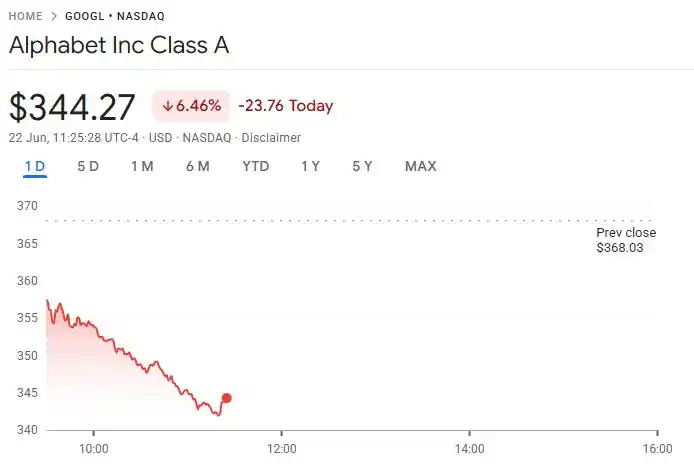
What investors fear isn't a specific product; it's something more fundamental: can Google still retain the people who built its most important creations?

Making things more awkward, during the very same month this brain drain occurred, Google served up its long-brewed new card: Gemini Spark.
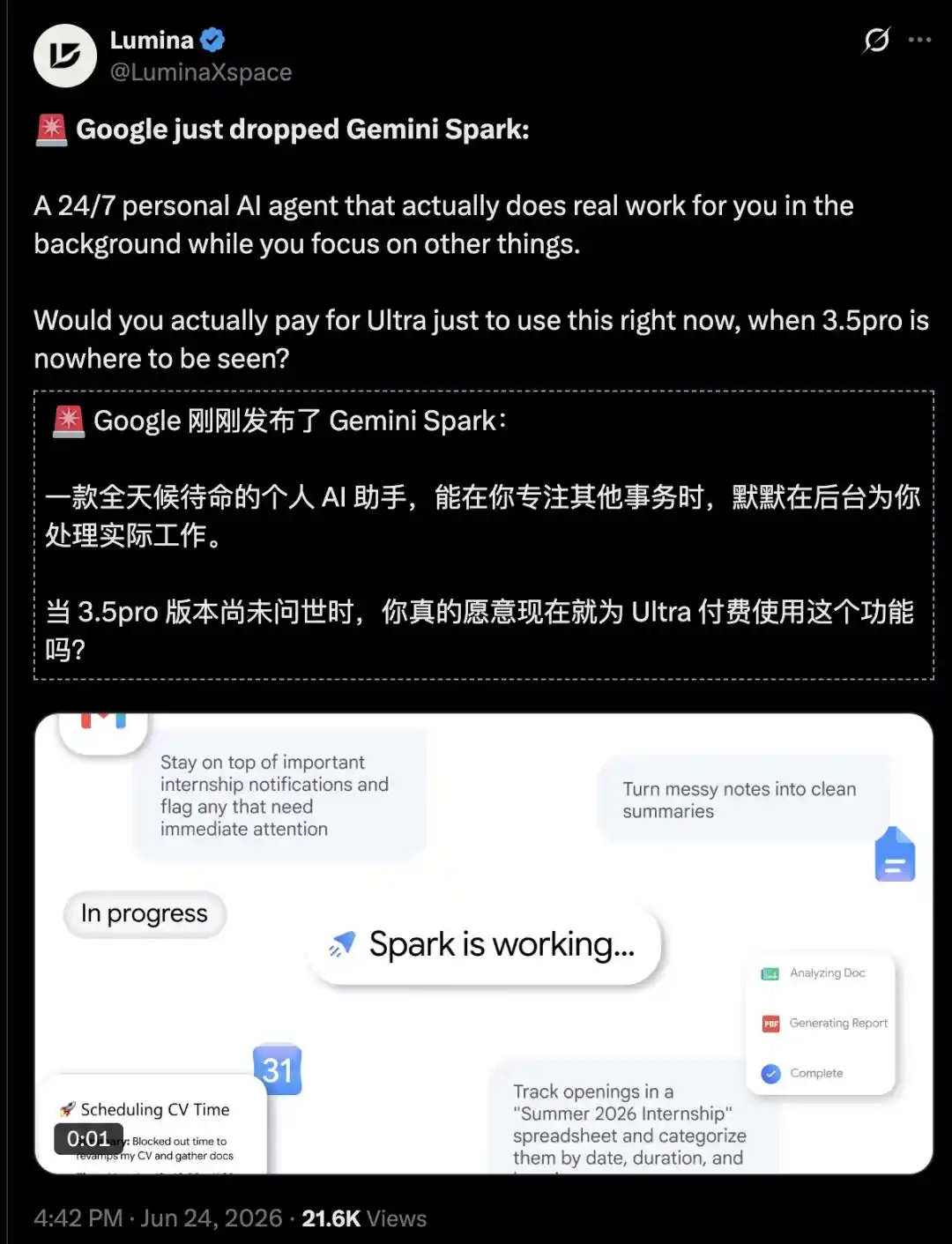
On one side, a brain drain; on the other, a massive push for breakthroughs.

The most authentic portrait of Google in 2026 is hidden within this schism.

Gemini 3.5 Pro Possibly Delayed. Is Google's Breakthrough Tied to Spark?

The talent exodus isn't the only issue; Google's product cadence looks even worse.

At I/O 2026, everyone was waiting for Gemini 3.5 Pro.

Google's CEO stood on stage and said, "Give us another month," reportedly eliciting a collective sigh from the audience.
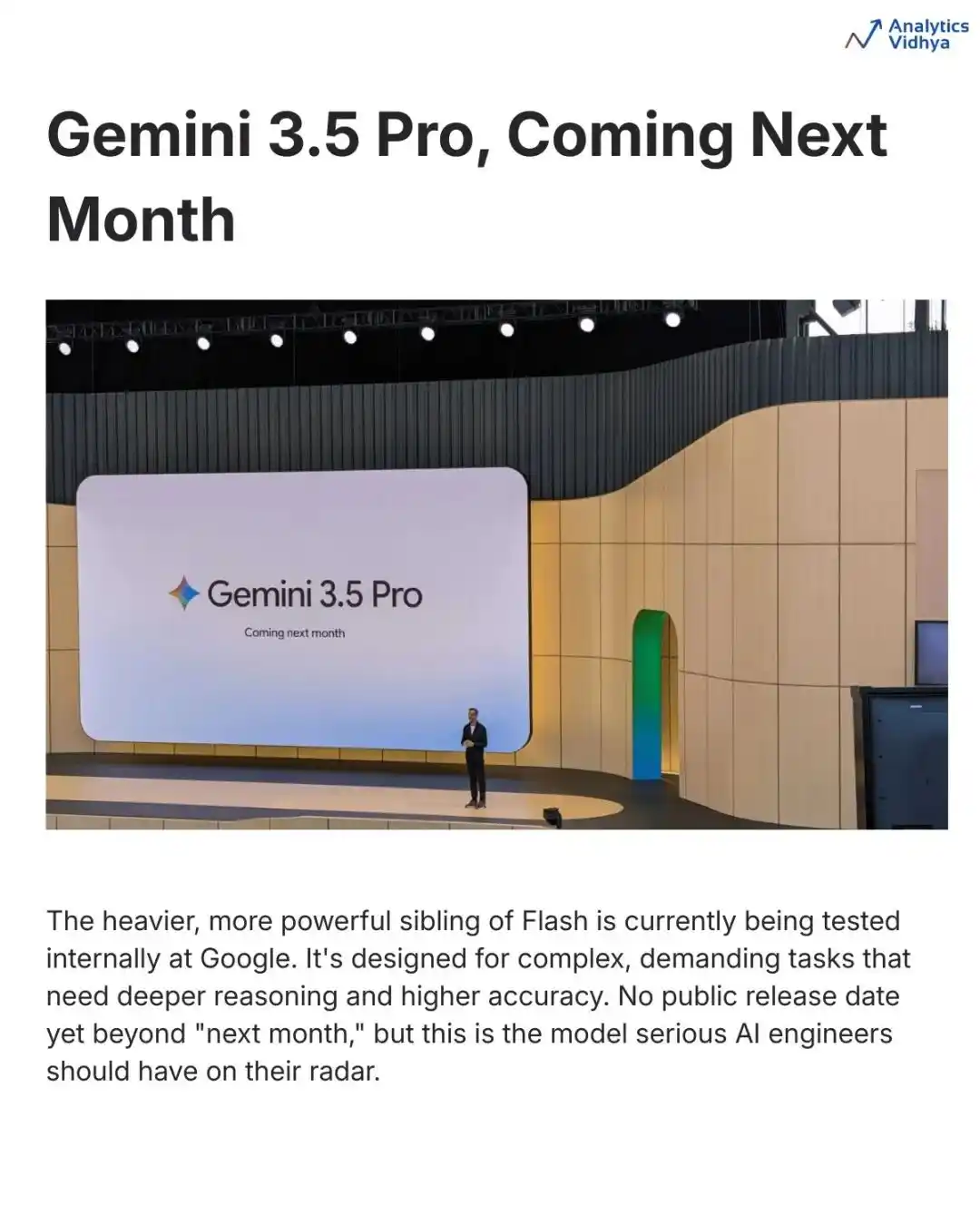
A month passed, and the latest news: Gemini 3.5 Pro has been pushed back from June to July.
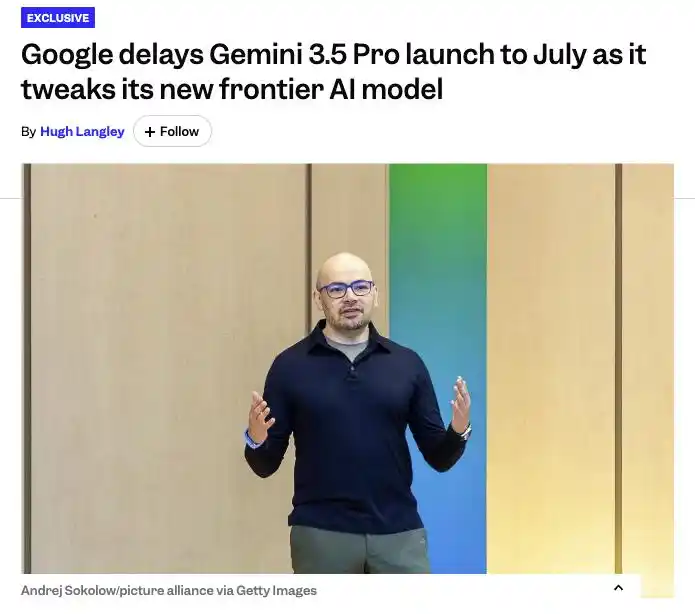
Two million token context, Deep Think reasoning—on paper, it's powerful. It just can't seem to reach your hands.

It was into this twilight that Google played its heaviest card of the year: Gemini Spark.

First, let's clarify how it differs from the Gemini app on your phone.
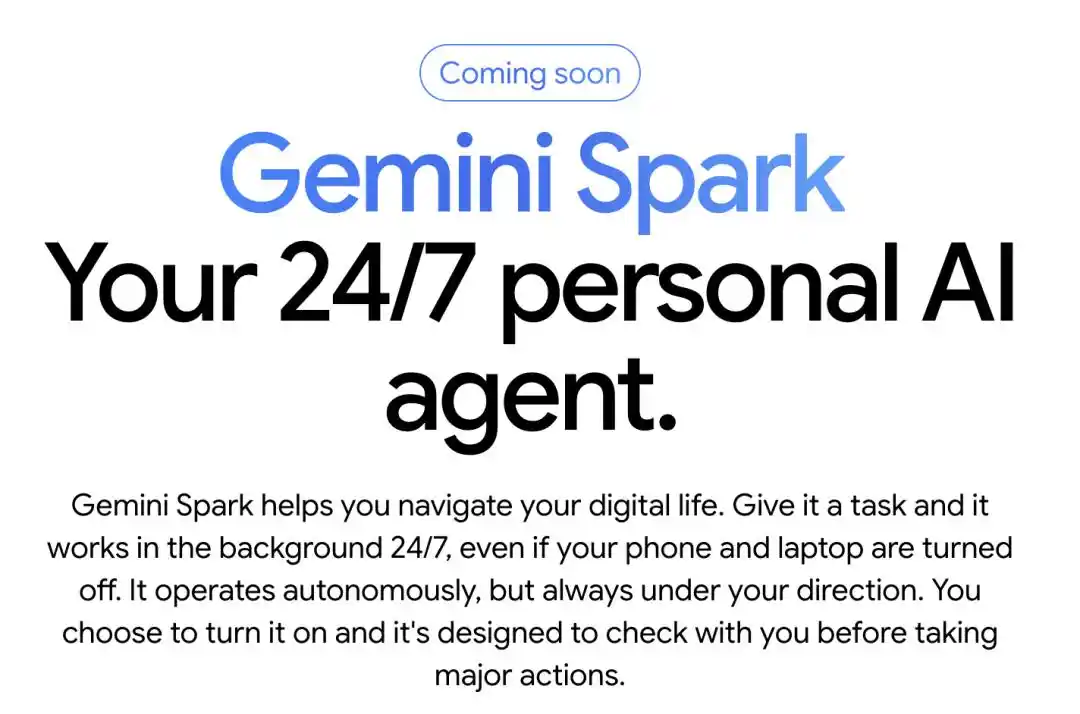
A regular chatbot: you ask, it answers. You close the app, it ceases to exist.

Spark is not like that. It runs on dedicated virtual machines in Google Cloud. You close your laptop, lock your phone, fall asleep—it remains awake in the cloud, continuing to work for you.

You don't need to keep your computer on for it to operate.

It connects most deeply to the Google tools you use every day: Gmail, Calendar, Docs, Sheets, Slides, Drive, plus Maps and YouTube.
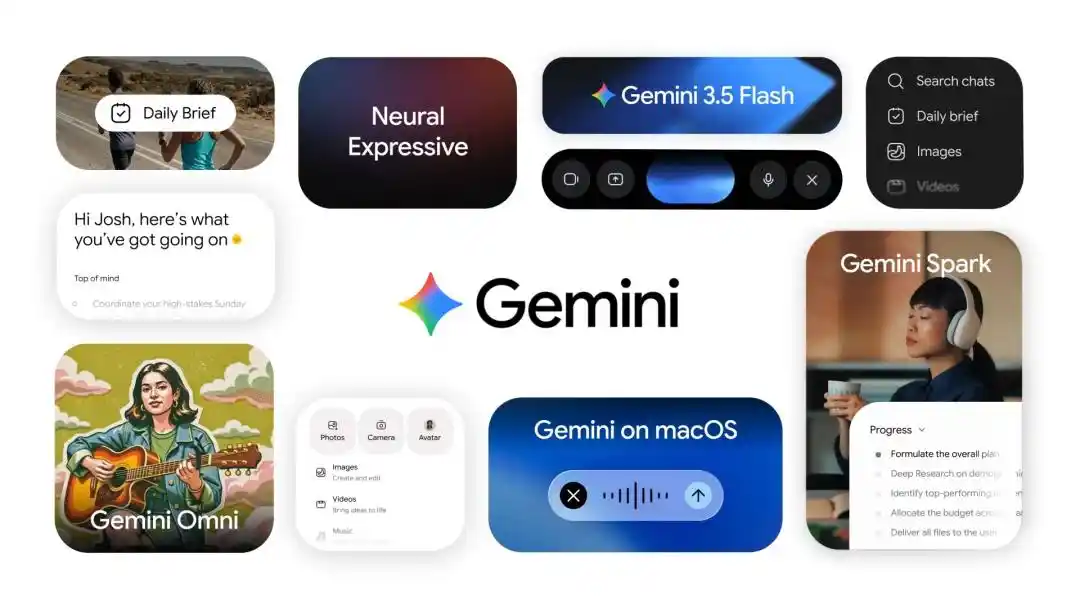
Words aren't enough; let's see what it can actually do.

You're a photographer. An inquiry email comes in. Spark automatically extracts the client's name and requested date, logs it into your "Client Tracker" spreadsheet, and creates a new Drive folder named after that client.

You have kids. Have it monitor your inbox for notifications from the school, extract key deadlines, and send you and your partner a daily summary.

Do you see the pattern?

These aren't one-off "help me write an email" prompts. You give it a goal, and it breaks it down into several steps, running across multiple apps to complete it.

Google equipped it with a framework called Antigravity, divided into Tasks, Skills, and Schedules. It can run on a schedule or wait for a specific trigger condition.

Tasks: You can set AI agents to work, connecting them to your Google Workspace ecosystem, including Gmail, Calendar, Docs, Sheets, and Slides.

Skills: By building skills, you can precisely define how Spark handles your frequently recurring tasks, customizing your experience and freeing you from repetitive prompting.

Schedules: By setting time-based or condition-based trigger rules, you can execute tasks exactly when you need them, automating your workload on your own terms.

It can also reach outward.

Through the MCP protocol, it connects to Canva, OpenTable, Instacart. Theoretically, you could have it book a restaurant or order groceries. For high-risk actions involving spending money or sending emails, it will pause and ask for your confirmation first.

Imagine an unpaid intern who doesn't drink coffee and is permanently online in the cloud. That's roughly the illusion Spark aims to create.

The cost? It's currently only available to Google AI Ultra users, the $100 per month tier.

Pro users get access to something else called Daily Brief, a morning briefing, not the Spark core.

Netizens are calling the pricing a joke.
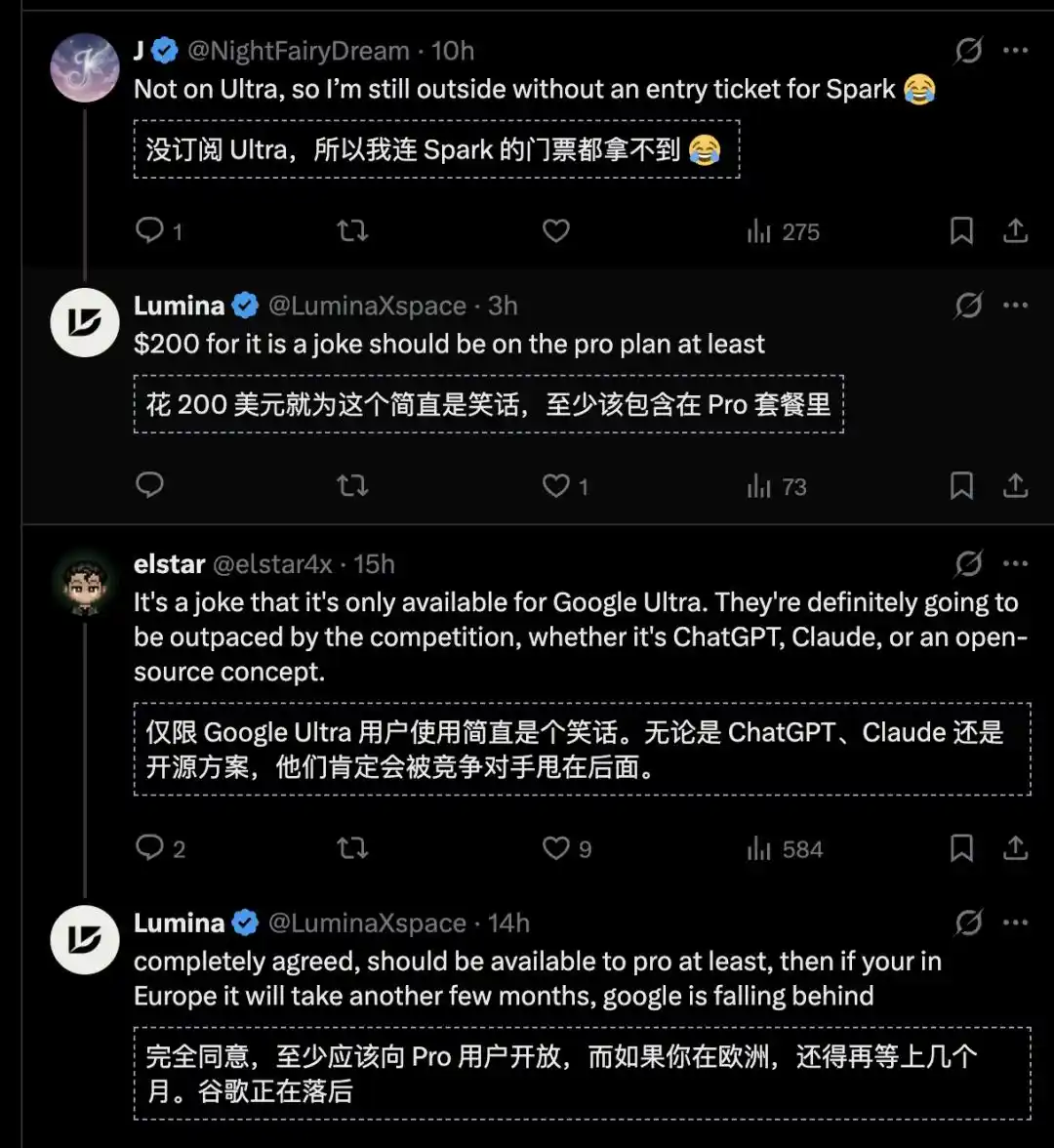
An invisible gate keeps the "digital employee" confined to the most expensive tier.

Google Started Early but Arrived Late to the Party

Placing Spark back into the broader Agent landscape makes its significance even more complex.

OpenAI has its own Agent product roadmap.

Anthropic, from Computer Use to Claude Code, is also delving deeper into "having AI do things for you."

Then there's a plethora of vertical Agent startups cutting into niches like legal, sales, recruitment, customer service, data analysis, and programming.
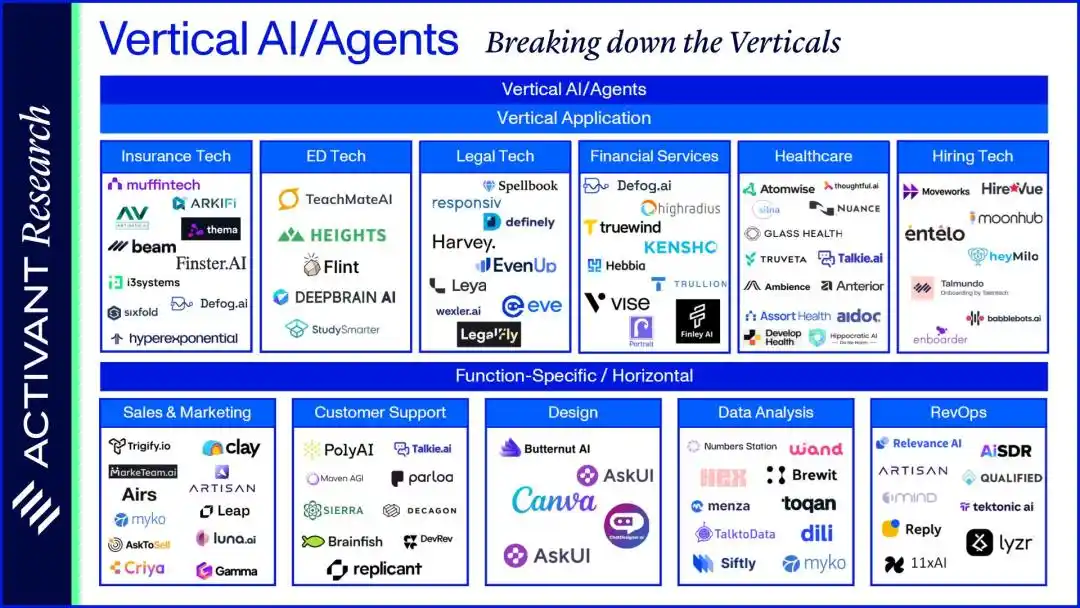
The industry has reached a high degree of consensus: AI is transitioning from being a tool to becoming labor.

Past AI was a co-pilot. You drive, it reminds you. Present AI is the driver. You state the destination, it plans the route.

And here lies Google's most awkward position: it should have won this race.

No company is better suited than Google to build a productivity Agent.

Gmail, Calendar, Docs, Sheets, Drive—these aren't isolated apps; they are the capillaries of modern work life.

A true digital employee, if it could natively access these systems, would possess a terrifying efficiency advantage.

The problem is, Google held the best cards but didn't play them first.

The reason isn't hard to understand. The bigger Google is, the more it fears mishaps.

What if the AI misreads an email? Deletes a file by mistake? Sends out content it shouldn't? Accesses user privacy, triggering a PR disaster?

These are risks for startups, but minefields for Google.

Thus, it was cautious, hesitant, scrutinizing, waiting.

And while Google hesitated, open-source projects like OpenClaw have been redefining "browser agents."

They operate like parasites, directly taking over web browser actions with impressive efficiency.

Google's setback is, at its core, a story of "giant's arrogance and fear."

The emergence of Spark marks the turning point where Google finally decided to loosen the reins, allowing AI to truly enter the background and "do the work."

This is Google's most painful paradox: it started early but arrived late to the party.

Can Google stem the bleeding with Spark? Unlikely.

But Spark at least points the way: AI must step out of the "dialog box" and enter the capillaries of productivity.

And for those investors who watched the market cap evaporate by $200 billion, the question they most want answered is: The creators have left. Can this remaining "work machine" truly support Google's next decade?

References:

https://x.com/LuminaXspace/status/2069702715999998139

https://www.datacamp.com/blog/gemini-spark

This article is from the WeChat public account "New Zhiyuan," author: ASI Apocalypse

Trend Kriptolar

İlgili Sorular

QAccording to the article, what is the primary reason for the recent sharp decline in Alphabet's stock price?

AThe primary reason for Alphabet's recent sharp stock decline is a loss of investor confidence triggered by the departure of key AI talent. The article cites the high-profile exits of core contributors from projects like Gemini and AlphaFold to competitors like OpenAI and Anthropic, making investors question Google's ability to retain the people who build its most important technologies.

QHow does the functionality of Gemini Spark differ fundamentally from a standard chatbot like the Gemini app?

AGemini Spark differs fundamentally from a standard chatbot by being a persistent, autonomous agent. Instead of a simple question-and-answer interface, Spark runs on a dedicated cloud virtual machine, continues working even when the user's device is off, and can execute multi-step tasks across multiple Google Workspace apps (Gmail, Calendar, Docs, etc.) and external services based on user-defined goals, schedules, or triggers.

QWhat are the three core components of the Antigravity agent framework that powers Gemini Spark, as described in the article?

AThe three core components of the Antigravity agent framework powering Gemini Spark are Tasks, Skills, and Schedules. Tasks connect the agent to the Google Workspace ecosystem. Skills allow users to customize how Spark handles repetitive actions. Schedules enable task execution based on time or conditional triggers.

QWhat is the main paradox or contradiction highlighted in the article regarding Google's position in the AI agent race?

AThe main paradox is that Google, which possesses the most suitable ecosystem for productivity agents (its deeply integrated Google Workspace apps), has been slow to launch a full-fledged agent product like Gemini Spark. The article attributes this delay to a combination of 'giant's arrogance and fear'—caution over potential risks and PR disasters—which allowed smaller, more agile players to move first, meaning Google 'woke up early but arrived late to the game.'

QWhat critical question does the article pose to investors at the end, regarding Google's future?

AThe article concludes by posing a critical question to investors: With the key innovators and 'god-makers' leaving the company, can the remaining 'work machine' (referring to products like the task-automating Gemini Spark) truly support Google's next decade?

İlgili Okumalar

Xing Bo Strikes Again: Last Time 'Critiquing' World Models, This Time It's Agents' Turn

Xing Bo, President of MBZUAI and professor at Carnegie Mellon University, along with co-authors Mingkai Deng and Jinyu Hou, has released a new paper, "Critique of Agent Model," critiquing the current state of artificial intelligence agents. The paper draws a crucial distinction between "agentic" systems, which rely on external toolchains, prompts, and workflows, and truly "agentive" systems capable of genuine autonomy driven by internal decision-making structures. To illustrate this, it references a real-world incident where an AI programming assistant, following an external prompt but lacking internalized judgment, caused a catastrophic data deletion. The authors propose a detailed analysis and a new framework, "Goal-Identity-Configurator" (GIC), for building truly autonomous agents. This framework systematically addresses five key dimensions where current "Agent" designs fall short: 1. **Goal:** Moving from step-by-step human instruction to a system capable of autonomously decomposing a single long-term goal and adapting sub-goals based on new information. 2. **Identity:** Evolving self-assessment updated by experience, rather than a static description in a system prompt. 3. **Decision Making:** Replacing textual Chain-of-Thought reasoning with "simulative reasoning" that uses a dedicated world model to predict real-world consequences before selecting actions. 4. **Cognitive Control:** Introducing a separate "System III" metacognitive module that dynamically decides when to deliberate, stick to a plan, or act quickly. 5. **Learning:** Enabling "continual autonomous learning," where the agent itself decides when to act, practice in simulation, or update its world model and self-perception. The GIC architecture integrates six components—a belief encoder, goal decomposer, identity evolver, configurator (System III), simulation-based planner (System II), and executor (System I)—to embody these principles. The paper argues that a growth path akin to pilot training (ground theory, simulator practice, real deployment) should be underpinned by a unified cognitive architecture, not separate workflows. On safety, the authors contend that the GIC framework's modular, explicit design enhances inspectability, allowing problematic behavior to be traced to specific components (e.g., flawed goal or poorly trained module) rather than emerging opaquely. However, they acknowledge that ultimate safety depends on correctly training these modules in the first place. In conclusion, the paper challenges the loose application of the term "Agent," asserting that task completion alone does not equal true autonomy. True autonomy requires goals, identity, and judgment to be genuinely internalized within the agent's architecture, not merely enforced by external scripts.

marsbit12 dk önce

Xing Bo Strikes Again: Last Time 'Critiquing' World Models, This Time It's Agents' Turn

marsbit12 dk önce

How Collector Crypt Uses 'Recirculating Buybacks' to Create an Illusion of Growth

Title: How Collector Crypt Creates a Growth Illusion with "Buyback Loops" Key Findings: Collector Crypt's (CC) net take rate has halved from 11.2% in Q3 2025 to 5.6% in Q2 2026, while GMV grew 4.7x. This growth is driven by higher-tier card packs ($250, $1,000, $2,500) which have lower platform dollar retention rates. The newly launched $2,500 Mythic tier captured 36.7% of June GMV within 13 days. Growth is fueled by a small cohort of high-spending, high-frequency wallets rather than broad user base expansion. The economic model faces pressure from three key areas: 1) **Shifting GMV Mix**: Pushing users towards larger, lower-retention card packs increases GMV but reduces overall profitability. 2) **Physical Redemptions**: Card redemptions for physical items remove reusable inventory from the system, creating costly replenishment needs. In May, redemptions consumed 41.6% of pre-redemption net income. Only 75 wallets drove redemptions in June. 3) **B2B/API Strategy**: Partner revenue remains negligible (cumulatively $1.83M) and dependent on CC for inventory, vaulting, and buyback services, failing to create a scalable, asset-light recurring revenue stream. The core product is a repetitive pack-buyback loop with limited secondary market activity and token value accrual. Sensitive modeling shows CC's economics turn negative when any two of the following pressures coincide: replenishment costs near market price, redemption rates exceeding 9%, or high-tier buyback rates around 93%. While CC operates in a large and growing collectibles market, its current growth levers—bigger packs, high buyback rates, and capital recycling by a few wallets—create a volume illusion without demonstrating sustainable collector engagement, deep secondary markets, or a viable path to improved margins. Future proof points include broadening collector participation, deepening secondary trading, and developing true asset-light B2B revenue channels.

Foresight News35 dk önce

How Collector Crypt Uses 'Recirculating Buybacks' to Create an Illusion of Growth

Foresight News35 dk önce

Grayscale's Latest Research: What is Solana's Next Growth Engine?

Grayscale's latest report, "Solana: Crypto's Financial Bazaar," signals a shift in how the market views Solana, moving beyond its high-performance and meme-centric reputation. The report frames Solana as an evolving application platform for large-scale economic activity, akin to a bustling digital marketplace. The analysis highlights that public chain competition has moved past raw throughput (TPS) to focus on genuine economic activity—daily users, transaction volume, and real revenue. Solana's metrics, such as over 1,000 dApps, 100M+ daily transactions, and ~4.3M daily active users, showcase this shift toward application-layer prosperity. The report identifies three key growth drivers: 1. **Jupiter**: Evolving from a DEX aggregator to a core liquidity hub and comprehensive financial platform for Solana's DeFi. 2. **Pump.fun**: Demonstrates Solana's capacity for consumer-scale applications, attracting millions of users and generating significant, sustainable revenue, validating network stability under high load. 3. **Helium & DePIN**: Represents expansion into real-world infrastructure, connecting blockchain to physical resources like wireless networks and positioning services, opening new long-term use cases. Solana Foundation's recent focus aligns with this broader vision, emphasizing AI Agents (for machine-to-machine transactions), payments, stablecoins, and Real-World Assets (RWA) to build a sustainable growth model beyond cyclical trends. While challenges remain—such as value capture for SOL and maintaining ecosystem sustainability beyond hot trends—institutional interest is growing due to Solana's maturing application business models, expanding payment/stablecoin ecosystem, and persistent developer activity. The competition is no longer about speed alone, but about which network can foster the most vibrant and valuable digital economy.

marsbit56 dk önce

Grayscale's Latest Research: What is Solana's Next Growth Engine?

marsbit56 dk önce

İşlemler

Spot

Popüler Makaleler

CAP Nasıl Satın Alınır

HTX.com’a hoş geldiniz! Cap (CAP) satın alma işlemlerini basit ve kullanışlı bir hâle getirdik. Adım adım açıkladığımız rehberimizi takip ederek kripto yolculuğunuza başlayın. 1. Adım: HTX Hesabınızı OluşturunHTX'te ücretsiz bir hesap açmak için e-posta adresinizi veya telefon numaranızı kullanın. Sorunsuzca kaydolun ve tüm özelliklerin kilidini açın. Hesabımı Aç2. Adım: Kripto Satın Al Bölümüne Gidin ve Ödeme Yönteminizi SeçinKredi/Banka Kartı: Visa veya Mastercard'ınızı kullanarak anında Cap (CAP) satın alın.Bakiye: Sorunsuz bir şekilde işlem yapmak için HTX hesap bakiyenizdeki fonları kullanın.Üçüncü Taraflar: Kullanımı kolaylaştırmak için Google Pay ve Apple Pay gibi popüler ödeme yöntemlerini ekledik.P2P: HTX'teki diğer kullanıcılarla doğrudan işlem yapın.Borsa Dışı (OTC): Yatırımcılar için kişiye özel hizmetler ve rekabetçi döviz kurları sunuyoruz.3. Adım: Cap (CAP) Varlıklarınızı SaklayınCap (CAP) satın aldıktan sonra HTX hesabınızda saklayın. Alternatif olarak, blok zinciri transferi yoluyla başka bir yere gönderebilir veya diğer kripto para birimlerini takas etmek için kullanabilirsiniz.4. Adım: Cap (CAP) Varlıklarınızla İşlem YapınHTX'in spot piyasasında Cap (CAP) ile kolayca işlemler yapın.Hesabınıza erişin, işlem çiftinizi seçin, işlemlerinizi gerçekleştirin ve gerçek zamanlı olarak izleyin. Hem yeni başlayanlar hem de deneyimli yatırımcılar için kullanıcı dostu bir deneyim sunuyoruz.

21 Toplam GörüntülenmeYayınlanma 2026.06.26Güncellenme 2026.06.26

CAP Nasıl Satın Alınır

Tartışmalar

HTX Topluluğuna hoş geldiniz. Burada, en son platform gelişmeleri hakkında bilgi sahibi olabilir ve profesyonel piyasa görüşlerine erişebilirsiniz. Kullanıcıların CAP (CAP) fiyatı hakkındaki görüşleri aşağıda sunulmaktadır.

活动图片