Google Is Really Anxious, Launches Deep Research Agent Late at Night with MCP Support and Native Charts

marsbit2026-04-22 tarihinde yayınlandı2026-04-22 tarihinde güncellendi

Özet

Google has launched two new AI research agents, Deep Research and Deep Research Max, built on the Gemini 3.1 Pro model. These agents are designed for enterprise and developer use, accessible via API, and support integration of open web data with private enterprise information through a single API call. They also feature native chart and infographic generation within reports and support the Model Context Protocol (MCP) to connect with third-party data sources securely. Deep Research is optimized for speed and lower latency, while Deep Research Max prioritizes depth and extended reasoning, making it suitable for asynchronous workflows like overnight analysis tasks. The agents are not available to general Gemini app users, including Pro subscribers, and are currently offered as a paid preview through the Interactions API. The update aims to position Google competitively against rivals like OpenAI and Anthropic in the AI research and analysis tool space, particularly targeting high-value sectors such as finance and consulting. Enhanced capabilities include multi-modal input support, collaborative planning features, and improved performance on benchmarks, though comparative data with competitors should be interpreted cautiously due to potential methodological differences.

By | Alphabet AI

Google is really anxious.

Just earlier, news broke that Google co-founder Sergey Brin has restarted "founder mode," personally overseeing the battle and forming an elite "strike team" to fully enhance Gemini's key capabilities in AI programming and autonomous agents to catch up with competitors like Anthropic.

Then, late at night, Google announced a major update, launching a new generation of autonomous research agents built on the Gemini 3.1 Pro model: Deep Research and Deep Research Max.

Not only has the reasoning capability at the model's foundation been strengthened, but there is also a strong push to evolve autonomous research agents towards enterprise-grade and developer platforms. Through API openness, support for private data, background asynchronous tasks, and other methods, Google is attempting to seize the initiative in the high-value scenario of "AI research/analysis tools," responding to competition from opponents like OpenAI (Hermes) and Perplexity.
These two agents, for the first time, allow developers to fuse open web data with enterprise proprietary information through a single API call, natively generate charts and infographics in research reports, and also connect to any third-party data source via the Model Context Protocol (MCP).

The two agents are now available as a public preview through paid plans of the Gemini API and can be accessed via the Interactions API first launched by Google in December 2025.

That's right, these new agents are currently only available via API; regular users cannot access them in the Gemini App, even if they have a paid subscription. Seeing the update news but finding they can't use it, some users lamented: "Google, for some reason, continues to punish us Pro subscribers of the Gemini App..."

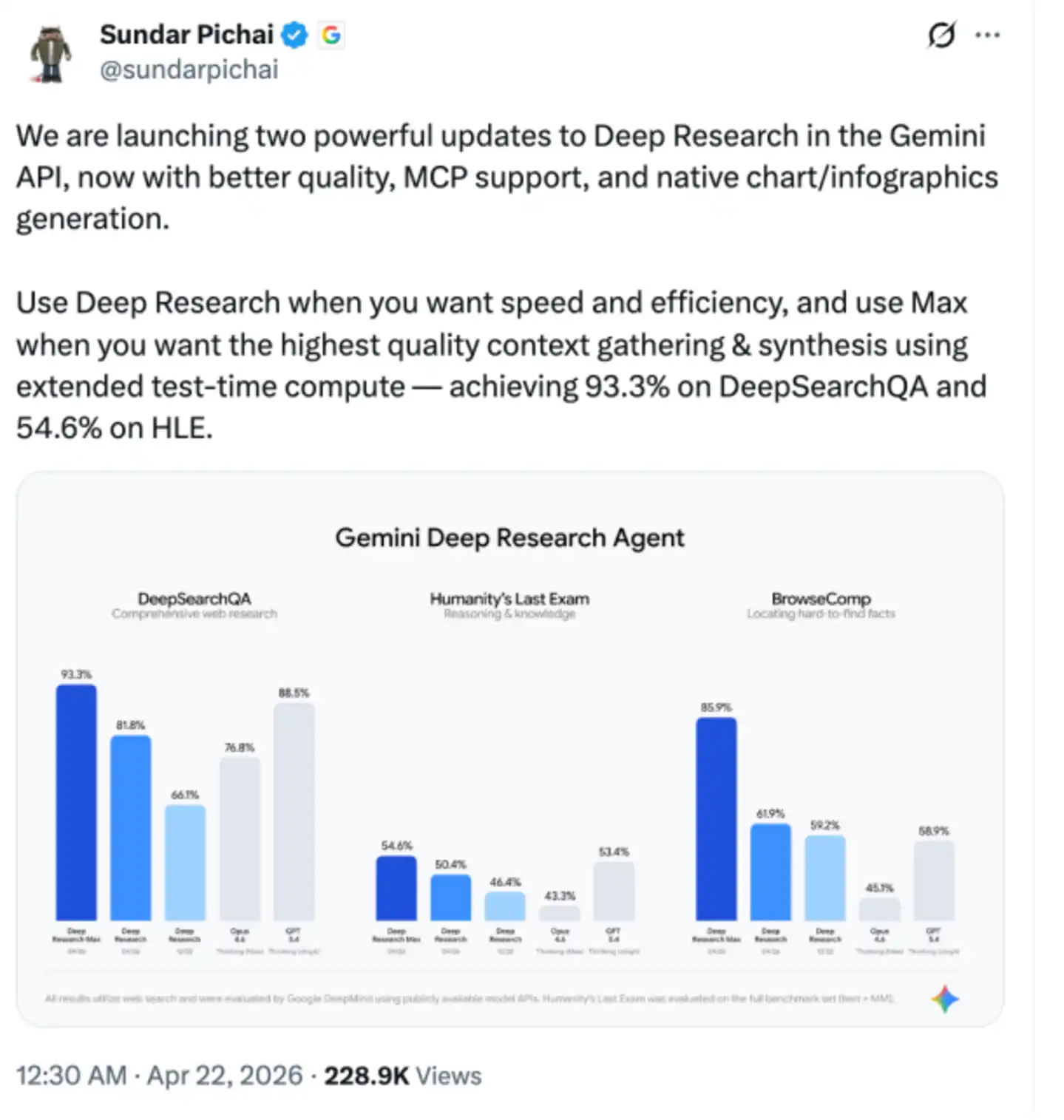
Google CEO Sundar Pichai also personally took to X to promote it: "When you need speed and efficiency, use Deep Research; when you pursue the highest quality context collection and synthesis, use the Max version—it achieves scores of 93.3% on DeepSearchQA and 54.6% on HLE through extended test-time computation."
Eighteen months ago, the goal of Google Deep Research was to help graduate students avoid being overwhelmed by a sea of browser tabs. Today, Google hopes it can replace the basic research work of investment banking junior analysts.

The gap between these two goals—and whether this technology can truly bridge it—will determine whether autonomous research agents become a transformative product in the enterprise software field or just another AI demo that looks impressive in benchmarks but disappoints in meetings.

Two Versions, Adapted to Different Workloads

The standard Deep Research has lower latency and lower cost, suitable for scenarios prioritizing speed.

Deep Research Max prioritizes depth over speed. This agent uses extended test-time computation for deep reasoning, searching, and iteration, ultimately generating a report.

Google points out that asynchronous background workflows are its ideal use case, such as running via a cron job at night and delivering a complete due diligence report to the analyst team the next morning.

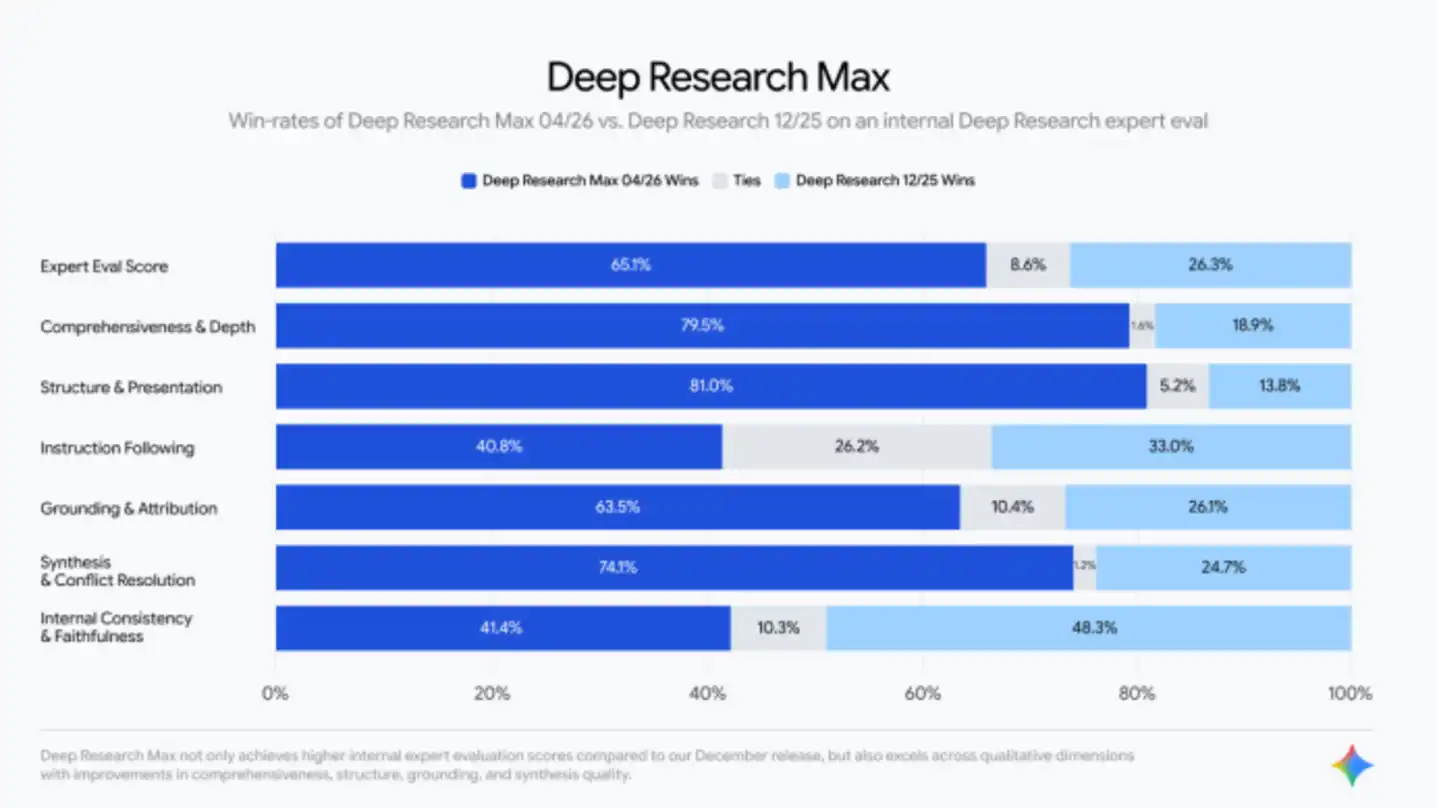
In Google's own benchmarks, Deep Research Max showed significant improvements in retrieval and reasoning tasks. The agent can gather information from more sources than previous versions and capture nuances that older models easily missed.
Google also provided a comparison with competitors.

However, comparing with OpenAI's GPT-5.4 and Anthropic's Opus 4.6 is not entirely fair. GPT-5.4 excels in autonomous web search but is not specifically optimized for deep research. For this, OpenAI provides its own DR agent, which switched to GPT-5.2, not GPT-5.4, after the February update. OpenAI's strongest search model is actually GPT-5.4 Pro, but Google clearly did not include it in the comparison.
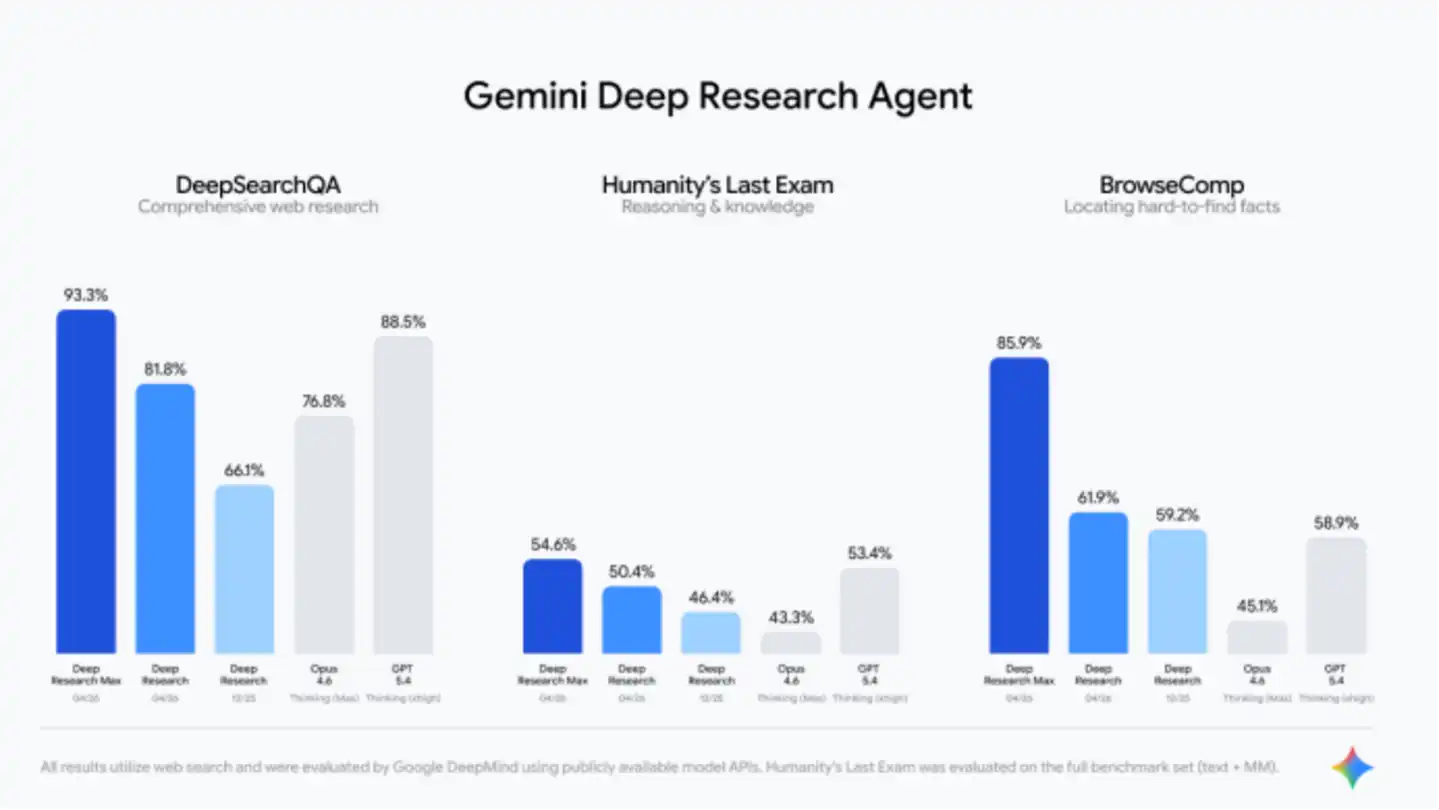
According to OpenAI's data, GPT-5.4 Pro can score up to 89.3% on the agent search benchmark BrowseComp, while GPT-5.4 scores 82.7%.

Based on Anthropic's own reports, Opus 4.6 scores higher on BrowseComp than the value shown, specifically 84%. This score was achieved with reasoning turned off, and the model performed better than the high-intensity reasoning settings used by Google in the API benchmark tests.

These discrepancies likely stem from differences in testing methods—whether the models were evaluated via the raw API or encapsulated within each lab's own toolchain. Google's data is not necessarily wrong, but it deserves cautious interpretation. In any case, the presentation lacks sufficient transparency.

MCP Support

Perhaps the most impactful feature of this release is the newly added support for the Model Context Protocol (MCP). This feature transforms Deep Research from a powerful web research tool into something closer to a "universal data analyst."

MCP is an emerging open standard for connecting AI models to external data sources. It allows Deep Research to securely query private databases, internal document repositories, and specialized third-party data services—all without sensitive information ever leaving its original environment.

In practice, this means a hedge fund could simultaneously point Deep Research to its internal trading flow database and a financial data terminal, then ask the agent to combine both with public information from the web to synthesize insights.

Google revealed that it is actively working with companies like FactSet, S&P, and PitchBook to design their MCP servers, clearly indicating that Google is seeking deep integration with data providers that Wall Street and the broader financial services industry rely on daily.

According to a blog post written by Google DeepMind product managers Lukas Haas and Srinivas Tadepalli, the goal is to "enable joint customers to integrate financial data products into workflows powered by Deep Research, and by leveraging its massive data universe, gather context at lightning speed, thereby leaping forward in productivity."

This feature directly addresses one of the most stubborn pain points in enterprise AI adoption: the huge gap between the information models can find on the open internet and the information organizations actually need for decision-making. Previously, bridging this gap required significant custom engineering work.

MCP support, combined with Deep Research's autonomous browsing and reasoning capabilities, simplifies most of this complexity to a one-time configuration. Developers can now have Deep Research use Google Search, remote MCP servers, URL Context, code execution, and file search simultaneously—or completely turn off web access and search only on custom data.

The system also supports multimodal input, including PDFs, CSVs, images, audio, and video, for use as grounding context.

Native Charts

The second major feature is native chart and infographic generation.

Previous versions of Deep Research could only generate plain text reports. If users needed visualizations, they had to export the data and create charts themselves. This shortcoming significantly weakened the "end-to-end automation" positioning.

Now, the new generation of agents can natively embed high-quality charts and infographics within reports, dynamically rendering complex datasets in HTML or Google's Nano Banana format, making them a direct part of the analytical narrative.

For enterprise users—especially those in the financial and consulting industries who need to produce deliverables ready for stakeholders—this feature transforms Deep Research from a tool that "accelerates the research phase" into one that can generate something close to a final analytical product.
Furthermore, combined with the new collaborative planning feature (which allows users to review, guide, and optimize the agent's research plan before execution) and real-time streaming of intermediate reasoning steps, the new system gives developers fine-grained control over the investigation scope while maintaining the high level of transparency required in regulated industries.

Deep Research Is Becoming Part of the "Infrastructure" Google Provides to Enterprises

Google's official blog post clearly states that when developers build using the Deep Research agent, they are calling "the same autonomous research infrastructure that powers multiple popular Google products (such as the Gemini App, NotebookLM, Google Search, and Google Finance)." This indicates that the agents provided via the API are not simplified versions of Google's internal build, but the same system, offered as a service at platform scale.

This evolution has progressed extremely rapidly.

Google first launched Deep Research in the Gemini App in December 2024 as a consumer-facing feature, then powered by Gemini 1.5 Pro. Google described it as a personal AI research assistant that could synthesize web information in minutes, saving users hours of work.

In March 2025, Google upgraded Deep Research using Gemini 2.0 Flash Thinking Experimental and opened trials to everyone. It was then upgraded to Gemini 2.5 Pro Experimental, with Google reporting that evaluators preferred its reports over competitors' by a 2-to-1 ratio.

December 2025 was a key turning point, as Google launched the Interactions API, providing Deep Research programmatically for the first time, powered by Gemini 3 Pro, and simultaneously released the open-source DeepSearchQA benchmark.

The underlying model driving these improvements is Gemini 3.1 Pro, released on February 19, 2026. It achieved a major leap in core reasoning capability: on the ARC-AGI-2 benchmark, which evaluates a model's ability to solve novel logic patterns, 3.1 Pro scored 77.1%, more than double that of Gemini 3 Pro.


İlgili Sorular

QWhat are the two new autonomous research agents announced by Google, and what are their key differences?

AGoogle announced two new autonomous research agents: Deep Research and Deep Research Max. The standard Deep Research has lower latency and lower cost, making it suitable for speed-critical scenarios. Deep Research Max prioritizes depth over speed, using extended test-time compute for in-depth reasoning, search, and iteration to generate reports, and is ideal for asynchronous background workflows.

QWhat is the Model Context Protocol (MCP) support in the new Deep Research agents, and why is it significant?

AThe Model Context Protocol (MCP) is an emerging open standard for connecting AI models to external data sources. Its support allows Deep Research to securely query private databases, internal document repositories, and third-party data services without sensitive information leaving its original environment. This transforms the agent from a powerful web research tool into a 'universal data analyst' and addresses a key enterprise adoption pain point by bridging the gap between public web information and proprietary organizational data.

QWhat new capability do the Deep Research agents have regarding data visualization, and why is it important for enterprise users?

AThe new Deep Research agents can natively generate high-quality charts and infographics within their reports, dynamically rendering complex datasets in HTML or Google's Nano Banana format. This is important for enterprise users, particularly in finance and consulting, as it transforms the tool from one that only accelerates the research phase into one that can produce analysis products that are nearly ready for delivery to stakeholders.

QHow are these new Deep Research agents made available to users, and is there any limitation for regular Gemini app subscribers?

AThe new Deep Research agents are available as a public preview exclusively through the paid tiers of the Gemini API, accessible via the Interactions API first introduced in December 2025. They are not available to regular users within the Gemini app, even for those who have a paid Pro subscription.

QWhat underlying model powers the latest Deep Research agents, and what major improvement does it offer?

AThe latest Deep Research agents are powered by the Gemini 3.1 Pro model. This model represents a major leap in core reasoning capabilities, achieving a score of 77.1% on the ARC-AGI-2 benchmark, which is more than double the score of its predecessor, Gemini 3 Pro. This benchmark evaluates a model's ability to solve novel logic patterns.

İlgili Okumalar

Stuck Polymarket: The Real Test After Riding the Traffic Boom Has Arrived

Polymarket, a leading prediction market platform, is facing significant technical challenges as its growth outpaces its current infrastructure on Polygon. Users are experiencing laggy transactions, unresponsive orders, and delayed confirmations, severely impacting the trading experience. In response, DeFi Engineering VP Josh Stevens outlined a comprehensive engineering overhaul. The plan includes reducing on-chain data delays, fixing order cancellation issues, rebuilding the central limit order book (CLOB), improving website performance, and developing a unified SDK and API. A major revelation was the ongoing "chain migration," indicating a potential move away from Polygon. The core issue is that Polymarket has evolved from a simple prediction market into a high-frequency trading platform, making Polygon's limitations—such as block space, gas fees, and block time—a ceiling for further growth. The migration is not just a simple chain switch but a fundamental rebuild of its trading system to support more complex products like perpetual contracts (Perps). This announcement has sparked competition among chains like Solana, Sui, and Algorand, all vying to host Polymarket. For Polygon, losing this key application, which contributes significantly to its gas fee revenue, would be a major setback. The real test for Polymarket is no longer attracting users but proving it can provide a stable, reliable trading environment that retains them.

Odaily星球日报52 dk önce

Stuck Polymarket: The Real Test After Riding the Traffic Boom Has Arrived

Odaily星球日报52 dk önce

Lowering Expectations for BTC's Next Bull Market

The author, Alex Xu, explains his decision to significantly reduce his Bitcoin holdings (from full to ~30% of his portfolio) during the current bull cycle, citing a lowered long-term outlook for BTC's price appreciation in the next cycle. He outlines six key reasons for this reduced expectation: 1. **Diminished Growth Drivers:** The narrative of exponential user adoption has largely played out with institutional ETF adoption. The next major growth phase—adoption by sovereign national reserves or central banks—seems unlikely in the near future. 2. **Personal Opportunity Cost:** More attractive investment opportunities have emerged in other assets, such as undervalued companies. 3. **Industry-Wide Contraction:** The broader crypto industry is struggling, with most Web3 business models (SocialFi, GameFi, DePIN) failing. This overall萧条 (depression) reduces the fundamental demand and consensus for Bitcoin. 4. **Strain on Major Buyer:** MicroStrategy, a major corporate buyer of BTC, faces rising financing expenses for its debt, which could slow its purchasing rate and create significant marginal pressure on the market. 5. **Increased Competition from Gold:** The emergence of "tokenized gold" has closed the functional gap (portability, divisibility) between physical gold and Bitcoin, offering a strong competitor in the non-sovereign store-of-value space. 6. **Security Budget Concerns:** The block reward halving continues to exacerbate the long-standing issue of funding Bitcoin's network security, with new fee source explorations like Ordinals and L2s largely failing. The author's decision to hold a significant (though reduced) position reflects a cautious, not bearish, outlook. He remains open to increasing his exposure if the fundamental reasons for his skepticism change or if new positive catalysts emerge.

marsbit1 saat önce

Lowering Expectations for BTC's Next Bull Market

marsbit1 saat önce

Can Iran 'Control' the Strait of Hormuz?

Iran has announced a comprehensive plan to assert control over the strategic Strait of Hormuz, a critical global oil shipping chokepoint. The proposed measures include requiring all vessels to obtain Iranian permission for passage, imposing fees for security, environmental protection, and navigation management—preferably paid in Iranian rials—and absolutely banning Israeli ships. Vessels from countries deemed hostile by Iran’s top security bodies may also be barred. Analysts suggest Iran’s motives are multifaceted: increasing pressure on the U.S. and Israel by leveraging control over oil transit to influence global prices and inflation; creating a new revenue stream, potentially exceeding $7.7 billion annually, to counter Western sanctions and support postwar reconstruction; and using transit permissions as bargaining chips in future negotiations, notably with the U.S. However, the plan faces significant practical and diplomatic challenges. Enforcing comprehensive interception and fee collection in the busy waterway, patrolled by international military forces, would be difficult. The U.S. has already countering with a blockade of Iranian ports and threats to intercept any ship paying fees, potentially strangling Iran’s oil exports and fee revenue. Broad international opposition, led by European and Gulf states, and legal controversies further complicate implementation. The proposal may ultimately serve more as a negotiating tactic than a feasible policy, with its execution remaining highly uncertain.

marsbit2 saat önce

Can Iran 'Control' the Strait of Hormuz?

marsbit2 saat önce

İşlemler

Spot
Futures

Popüler Makaleler

NIGHT Nasıl Satın Alınır

HTX.com’a hoş geldiniz! Midnight (NIGHT) satın alma işlemlerini basit ve kullanışlı bir hâle getirdik. Adım adım açıkladığımız rehberimizi takip ederek kripto yolculuğunuza başlayın. 1. Adım: HTX Hesabınızı OluşturunHTX'te ücretsiz bir hesap açmak için e-posta adresinizi veya telefon numaranızı kullanın. Sorunsuzca kaydolun ve tüm özelliklerin kilidini açın. Hesabımı Aç2. Adım: Kripto Satın Al Bölümüne Gidin ve Ödeme Yönteminizi SeçinKredi/Banka Kartı: Visa veya Mastercard'ınızı kullanarak anında Midnight (NIGHT) satın alın.Bakiye: Sorunsuz bir şekilde işlem yapmak için HTX hesap bakiyenizdeki fonları kullanın.Üçüncü Taraflar: Kullanımı kolaylaştırmak için Google Pay ve Apple Pay gibi popüler ödeme yöntemlerini ekledik.P2P: HTX'teki diğer kullanıcılarla doğrudan işlem yapın.Borsa Dışı (OTC): Yatırımcılar için kişiye özel hizmetler ve rekabetçi döviz kurları sunuyoruz.3. Adım: Midnight (NIGHT) Varlıklarınızı SaklayınMidnight (NIGHT) satın aldıktan sonra HTX hesabınızda saklayın. Alternatif olarak, blok zinciri transferi yoluyla başka bir yere gönderebilir veya diğer kripto para birimlerini takas etmek için kullanabilirsiniz.4. Adım: Midnight (NIGHT) Varlıklarınızla İşlem YapınHTX'in spot piyasasında Midnight (NIGHT) ile kolayca işlemler yapın.Hesabınıza erişin, işlem çiftinizi seçin, işlemlerinizi gerçekleştirin ve gerçek zamanlı olarak izleyin. Hem yeni başlayanlar hem de deneyimli yatırımcılar için kullanıcı dostu bir deneyim sunuyoruz.

259 Toplam GörüntülenmeYayınlanma 2025.12.08Güncellenme 2025.12.08

NIGHT Nasıl Satın Alınır

Tartışmalar

HTX Topluluğuna hoş geldiniz. Burada, en son platform gelişmeleri hakkında bilgi sahibi olabilir ve profesyonel piyasa görüşlerine erişebilirsiniz. Kullanıcıların NIGHT (NIGHT) fiyatı hakkındaki görüşleri aşağıda sunulmaktadır.

活动图片