Google Engineer Arrested For Using Company’s Own Search Data To Win $1.2 Million On Polymarket

bitcoinist2026-05-28 tarihinde yayınlandı2026-05-28 tarihinde güncellendi

Özet

A Google information security engineer, Michele Spagnuolo, has been arrested and charged with commodities fraud, wire fraud, and money laundering. Prosecutors allege he used confidential internal Google search data to place bets on the crypto-based prediction market Polymarket, winning approximately $1.2 million by knowing outcomes before the public. Using an internal tool showing real-time search trends, he reportedly placed successful wagers on contracts tied to Google's "Year in Search" rankings for 2025. This is the second federal criminal case involving Polymarket insider trading in just over a month, following an April arrest of a U.S. Army sergeant accused of using classified military information. The cases highlight increasing legal scrutiny of prediction markets, with blockchain transparency aiding prosecutors. Google placed Spagnuolo on leave and is cooperating with authorities.

A Google information security engineer has been arrested and charged with commodities fraud, wire fraud, and money laundering after allegedly using confidential internal company data to place a series of bets on Polymarket — the crypto-based prediction market platform — winning approximately $1.2 million by knowing the outcomes of his wagers before the trading public did.

The US Attorney’s Office for the Southern District of New York unsealed the complaint against Michele Spagnuolo, 36 — also known by his Polymarket account alias “AlphaRaccoon” — on May 27, 2026. Spagnuolo, an Italian citizen residing in Switzerland, was arrested in New York and appeared before US Magistrate Judge Sarah Netburn, where he was released on a $2.25 million bond secured by $1 million in cash, per the DOJ’s official statement. He did not enter a plea.
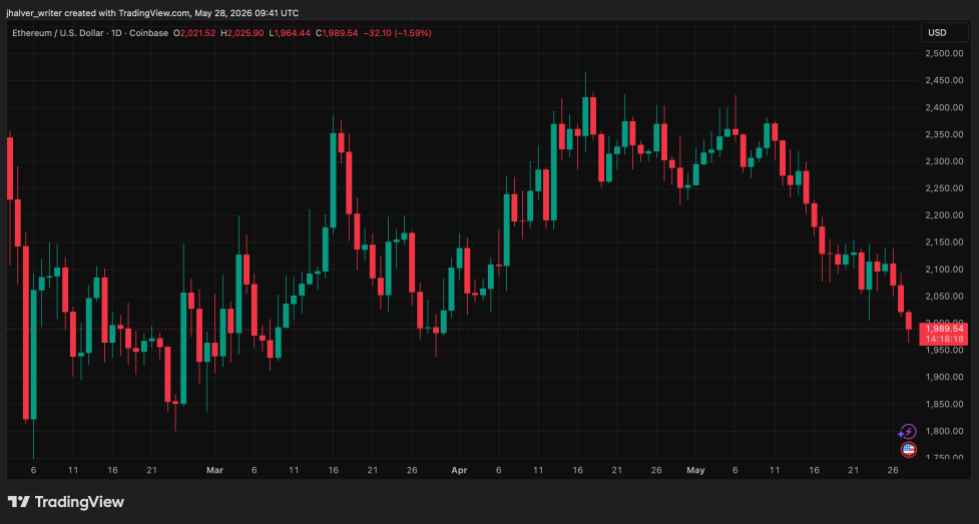
ETH's price trends to the downside on the daily chart. Source: ETHUSD on Tradingview

How The Scheme Worked

According to the unsealed complaint, Spagnuolo had access to an internal Google software tool — bearing a banner marked “Google Confidential” in red text — that provided real-time visibility into what users were searching across Google’s platform, including data that fed directly into Google’s annual “Year in Search” rankings, per the DOJ filing.

Beginning in May 2024, Spagnuolo created a Polymarket account and began placing bets on contracts tied to which individuals would rank on Google’s most-searched list for 2025 — markets Polymarket launched last fall, per the complaint.

Prosecutors allege Spagnuolo transferred approximately $3.8 million in USDC to his Polymarket address and placed bets including a $381.12 “yes” wager that the artist d4vd would rank in Google’s most-searched list and correctly predicted contracts such as “Will Zohran Mamdani rank in the Top 5 most searched” and “Will Squid Game be the number one searched TV show,” per CNBC’s reporting of the complaint. His success rate across these markets was, according to the complaint, no accident. He knew the answers before the markets settled.

The CFTC filed a simultaneous civil case against Spagnuolo seeking monetary disgorgement, restitution, and additional penalties, per the complaint. Google confirmed it had placed Spagnuolo on leave and was cooperating with law enforcement — noting that the tool he used was technically available to all employees, but that using confidential information to place bets represented a serious breach of company policy, per a statement reported by ABC News.

The Second Case In Thirty Days

The Spagnuolo arrest is the second federal criminal case tied to Polymarket insider trading in just over a month. In April 2026, US Army Special Forces Master Sergeant Gannon Ken Van Dyke was arrested for allegedly using classified military knowledge of the planned capture of Venezuelan President Nicolás Maduro to place bets on Polymarket, reportedly netting more than $400,000. Van Dyke has pleaded not guilty, per CNN’s reporting.

Polymarket’s chief legal officer Olivia Chalos said in a statement that the company worked closely with the US Attorney’s Office and the CFTC on the Spagnuolo case — noting that Polymarket is the only prediction platform to date whose cooperation has led to insider trading charges in the United States, and that the blockchain-based nature of the platform means bad actors leave footprints.

This development marks a critical and accelerating moment for the nascent prediction market sector. Two federal insider trading arrests in thirty days — one involving military classified information, the other corporate search data — arriving simultaneously with an active congressional investigation into Polymarket and Kalshi, confirms that the legal perimeter around prediction markets is closing fast. The transparency of blockchain trading, once seen primarily as a feature for users, is now functioning as a forensic trail for federal prosecutors.

Cover image from Grok, ETHUSD chart from Tradingview

İlgili Sorular

QWhat was the Google engineer accused of doing, and how much did he allegedly win?

AThe Google engineer, Michele Spagnuolo, was accused of using confidential internal search data to place bets on Polymarket's prediction markets, specifically those tied to Google's 'Year in Search' rankings. He allegedly won approximately $1.2 million by knowing the outcomes before the trading public.

QWhat specific internal tool did the Google engineer allegedly misuse, and what kind of data did it provide?

AHe allegedly misused an internal Google software tool that displayed a 'Google Confidential' banner. This tool provided real-time visibility into what users were searching across Google's platform, including data that fed directly into Google's annual 'Year in Search' rankings.

QWhat were the federal criminal charges brought against Michele Spagnuolo?

AMichele Spagnuolo was charged with commodities fraud, wire fraud, and money laundering.

QAccording to the article, what was the other recent insider trading case involving Polymarket?

AIn April 2026, US Army Special Forces Master Sergeant Gannon Ken Van Dyke was arrested. He was accused of using classified military knowledge about the planned capture of Venezuelan President Nicolás Maduro to place bets on Polymarket, allegedly netting more than $400,000.

QHow did Polymarket's chief legal officer characterize the platform's role in the Spagnuolo case?

APolymarket's chief legal officer, Olivia Chalos, stated that the company worked closely with authorities, that Polymarket is the only prediction platform whose cooperation has led to U.S. insider trading charges, and that the blockchain-based nature of the platform means bad actors leave forensic footprints.

İlgili Okumalar

Anthropic's IPO Launch: Commercial Miracle or Valuation Bubble?

Anthropic has confidentially filed for an IPO, led by Morgan Stanley and Goldman Sachs, potentially going public by October. Following its latest $650 billion funding round, its pre-IPO valuation stands at $965 billion, with projections reaching up to $2 trillion at listing, which would make it the highest-valued private company ever. The article, written by Fu Sheng, addresses skepticism that this represents an AI bubble akin to the 2000 dot-com crash. It argues the current situation differs fundamentally. Unlike the internet bubble era, which relied on speculative narratives with little revenue, Anthropic's valuation is backed by unprecedented, measurable financial performance. Key data points include: * **Revenue Growth:** ARR skyrocketed from $10 billion in early 2025 to $470 billion by May 2026, targeting $100 billion by year-end—a growth curve unmatched in business history. * **Profitability:** It achieved operating profitability in Q2 2026 with an estimated $5.6 billion profit. * **Efficiency:** With ~3,000 employees and ~$470 billion ARR, its revenue per employee exceeds $10 million. Products like Claude Code, launched less than a year ago, already generate $25 billion in annualized revenue. * **Enterprise Adoption:** It boasts a strong enterprise client base, with 8 of the Fortune 10 and over 1,000 large firms spending over $1 million annually on Claude. The valuation is framed using a traditional SaaS model (e.g., a 10x Price-to-Sales multiple on $100 billion revenue). The author contends the core question for analysts has shifted from "How big could this be?" to "How much is it earning and will earn next quarter?" The discussion extends beyond Anthropic to a broader paradigm shift: the transition from a "carbon-based" to a "silicon-based" economy. Companies are increasingly prioritizing investment in compute and AI capabilities over human resources, as these directly scale productivity and competitive advantage. Anthropic's IPO is thus positioned not just as a corporate milestone, but as a price anchor for this new economic era.

链捕手2 saat önce

Anthropic's IPO Launch: Commercial Miracle or Valuation Bubble?

链捕手2 saat önce

Near Returns to the AI Stage: Transformation into a Public Chain Due to 'Payroll Difficulties,' Agent and Privacy Emerge as New Growth Narratives

NEAR Returns to AI Origins: From Payroll Struggles to Blockchain, Now Focusing on AI Agents and Privacy NEAR Protocol's journey began not with grand blockchain ambitions, but from a practical hurdle: its AI startup founders, including Transformer paper co-author Illia Polosukhin, couldn't efficiently pay international developers in 2017. This led them to pivot and build a high-performance, scalable blockchain. After years navigating various crypto narratives like sharding and cross-chain interoperability, NEAR is now leveraging its AI roots to re-enter the AI arena. A key driver is its "NEAR Intents" layer, which abstracts complex cross-chain transactions. Users simply state their goal (e.g., swap BTC for ETH), and a solver network finds the optimal route. This system has processed over $20B in cross-chain volume, generating significant fee revenue. A major growth area is private transactions via "Confidential Intents/Swaps," which hide trade details until settlement to protect against MEV and front-running. Remarkably, private swaps recently accounted for over 40% of NEAR's transaction volume, highlighting strong demand but also potential regulatory scrutiny. With its AI-founder pedigree, NEAR is positioning itself at the intersection of blockchain, AI agents, and privacy, aiming to become infrastructure for the emerging agent economy while navigating the challenges of its rapid adoption.

marsbit4 saat önce

Near Returns to the AI Stage: Transformation into a Public Chain Due to 'Payroll Difficulties,' Agent and Privacy Emerge as New Growth Narratives

marsbit4 saat önce

İşlemler

Spot
Futures
活动图片





