Goldman Sachs Research Report Analysis: Circle and USDC Are Moving Beyond the Crypto World, Cross-Border Payments and AI Agents Become New Battlegrounds

marsbit2026-07-07 tarihinde yayınlandı2026-07-07 tarihinde güncellendi

Özet

Goldman Sachs published a summary of its meeting with Circle Internet Group (issuer of USDC) on July 5th. The core takeaway is that stablecoins, led by USDC, are evolving from a crypto-native tool into foundational infrastructure for traditional finance and the AI economy. USDC's use cases are rapidly expanding beyond crypto trading into cross-border payments, e-commerce, capital market settlements, and notably, payments for AI agents. Circle's management emphasized that stablecoin growth is now decoupled from crypto market cycles, driven by this diversification. They outlined five key application layers and highlighted USDC's network effects, global liquidity depth, and regulatory compliance as competitive moats. Circle distinguishes USDC from bank-issued tokenized deposits, arguing the former is an open, internet-native system without bank credit risk. Strategically, Circle is building a broader fintech platform with its Arc Layer 1 blockchain, the Circle Payments Network for cross-border transfers, and an "Agentic Stack" to serve AI agent economies, where USDC already dominates. Regarding regulation, Circle views potential U.S. legislation like the CLARITY Act as a catalyst for growth rather than a constraint, expecting it to encourage broader institutional adoption and active usage. Goldman Sachs maintains a Neutral rating on Circle with a $96 price target, noting the company's shift from a pure stablecoin issuer to a financial infrastructure provider. Key risks inclu...

Written by: Rita

Tidal Guide Introduction

Goldman Sachs released the management meeting notes for Circle Internet Group (CRCL.US) on July 5th. Circle is the issuer of USDC. The core message of this meeting is: Stablecoins are transitioning from being peripheral tools in the crypto world to becoming infrastructure for traditional finance and the AI economy. USDC's use cases are rapidly expanding, extending from crypto trading to cross-border payments, consumer e-commerce, capital market settlements, and even AI agent payments. Goldman Sachs rates Circle as Neutral with a target price of $96. The current stock price is $64.62, implying an upside potential of approximately 48.6%.

Stablecoin Growth Has Decoupled from the Crypto Market Cycle

Circle management repeatedly emphasized a key judgment during the meeting: stablecoin growth has decoupled from the fluctuations of the crypto market. Over the past few quarters, while crypto market trading volume and prices have trended downwards, the market capitalization and transaction volume of stablecoins have continued to rise.

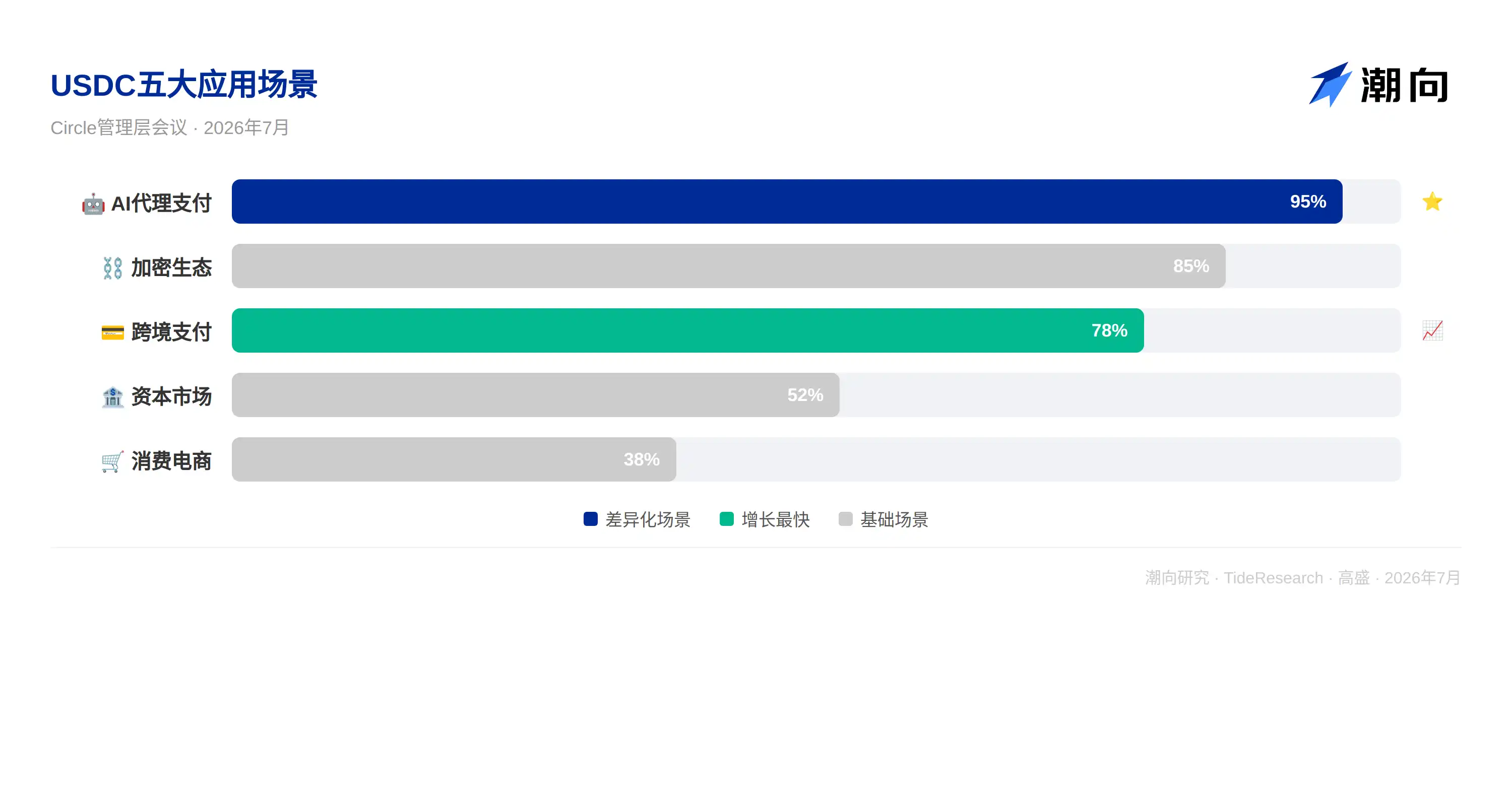
The reason lies in the diversification of use cases. Circle categorizes USDC's application scenarios into five tiers, covering the full spectrum from the crypto ecosystem to AI agent payments.

The crypto ecosystem is USDC's foundation, with continuous expansion of liquidity through partnerships with rapidly growing platforms like Hyperliquid.

Cross-border payments and treasury management are currently the fastest-growing segments. USDC's instant settlement and extremely low transaction costs are transforming traditional bilateral cross-border payment processes. Circle noted that demand for USD stablecoins is particularly strong in emerging markets, representing a trend of "digital dollarization," where people use USDC as a substitute for local currency or unreliable banking systems.

Consumer and e-commerce use cases are also taking shape. Major e-commerce platforms like Stripe and Shopify have begun supporting USDC payments, allowing users to directly choose USDC at checkout. Stablecoin-linked credit cards are also emerging, enabling users to hold and spend stablecoins.

Breakthroughs in capital markets are even more critical. Circle sees the potential for USDC as collateral for derivatives and a settlement currency. The recent CFTC approval allowing Futures Commission Merchants to treat specific stablecoins as readily marketable collateral is a significant institutional catalyst. The tokenization of real-world assets is also expanding USDC's application scenarios, as stablecoins are the natural cash settlement tool for on-chain transactions.

The most emphasized differentiated scenario by Circle is AI agent payments. AI agents are autonomously executing economic activities. x402 is currently a leading agent payment protocol, with USDC accounting for approximately 99% of all transactions on that protocol. AI agents require atomic settlement and extremely low transaction costs, making stablecoins the most suitable payment tool.
USDC's Competitive Moat is Network Effects

Management believes that stablecoins are a classic network effects business. The USDC network is a public, internet-native financial infrastructure that anyone can access—individuals, businesses, and developers alike.

Circle outlined three major competitive advantages for USDC.
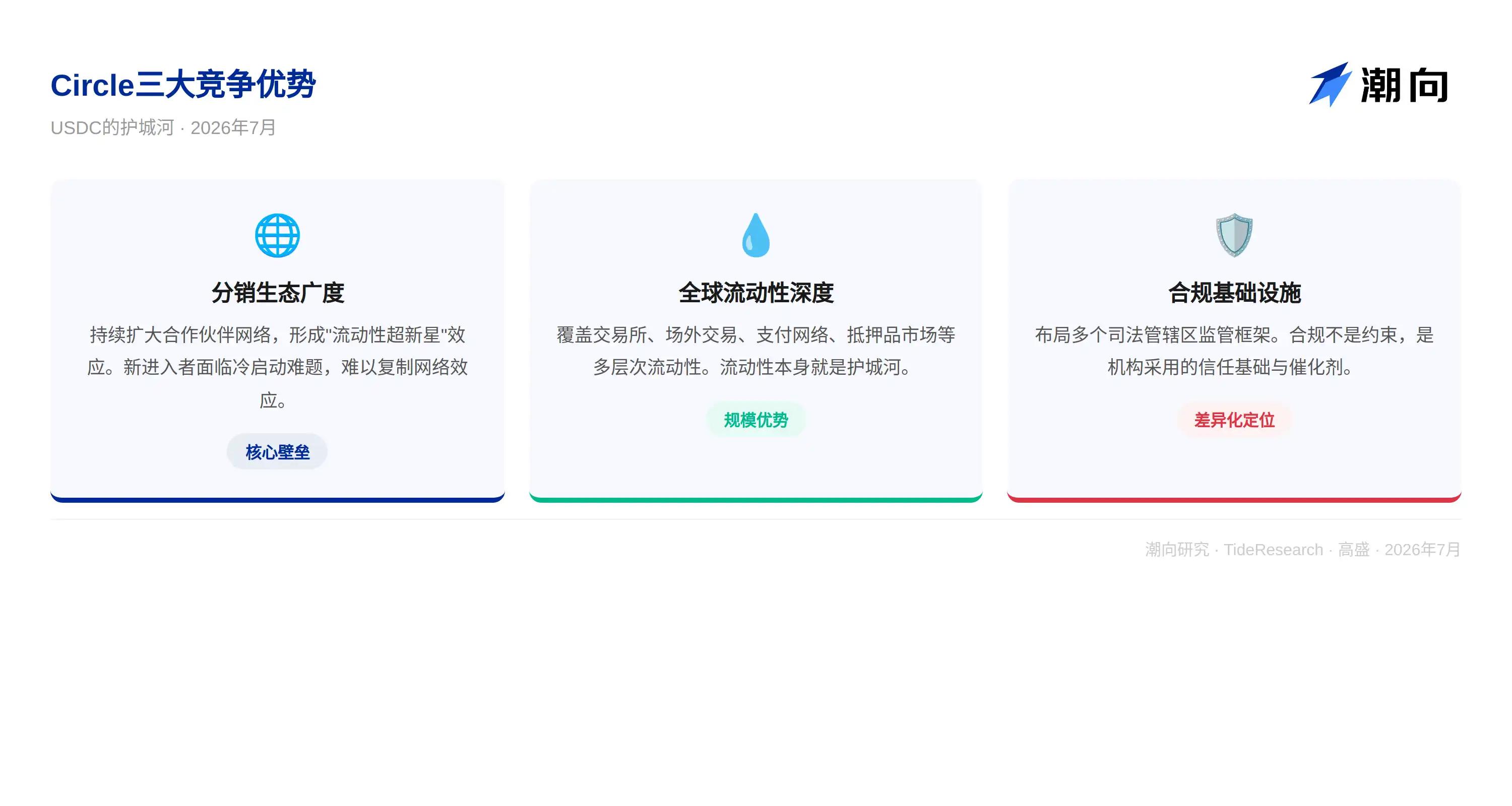
First, the breadth of distribution and platform ecosystems. USDC strengthens liquidity by continuously adding partners, creating a "liquidity supernova" effect. New stablecoin entrants find it difficult to replicate this network effect due to the cold start problem: no liquidity without users, and no users without liquidity.

Second, global liquidity depth. USDC has deep liquidity across exchanges, over-the-counter markets, payment networks, and collateral markets. This depth itself is a moat.

Third, compliance infrastructure. USDC has regulatory arrangements across multiple jurisdictions. Management views this as a key driver for institutional adoption, not a constraint.

Regarding competition, Circle distinguishes between two types of opponents. One is tokenized deposits, which are digital deposit certificates issued by banks. Circle argues that stablecoins have advantages over tokenized deposits because they are open, interoperable, carry no bank credit risk, and are fully reserved. The other is new stablecoin competitors. Circle expects more new stablecoins to emerge, but they lack the network effects Circle has accumulated over more than a decade.

The Difference Between Tokenized Deposits and Stablecoins is Structural

Circle believes the difference between stablecoins and tokenized deposits is structural, not merely a matter of who arrived first.

Stablecoins constitute an open, public, internet-native financial system accessible to anyone, with liquidity flowing freely across platforms. Tokenized deposits are more like an extension of the banking system, likely confined within a single bank or consortium ecosystem. These are two completely different architectures: stablecoins are internet-native, while tokenized deposits represent a digital upgrade of the banking system.

Another key difference is credit risk. Stablecoins are fully reserved, digital cash with no credit risk. Tokenized deposits are essentially liabilities of a bank, carrying bank credit risk. In Circle's view, this difference is fundamental.

Circle's Three Strategic Products Aim to Turn Stablecoins into an Operating System

Circle is not just a stablecoin issuer; it is positioning itself as an internet-native financial platform. Management emphasized three strategic products during the meeting.

Arc is Circle's in-house developed Layer 1 public blockchain, positioned as a comprehensive financial operating system aimed at enhancing liquidity and interoperability, particularly for attracting traditional financial institutions.

Circle Payments Network (CPN) is the cross-border payment product, enabling faster and more efficient cross-border payments through blockchain settlement. Institutional adoption is growing.

Agentic Stack is the product line for AI agents, with the goal of maintaining USDC's dominant share in AI-related economic activities. Given that USDC already accounts for roughly 99% of transaction volume on the x402 protocol, the first-mover advantage in this space is evident.

Regulation is a Catalyst, Not a Constraint

The market has long been concerned that stablecoin regulation might constrain Circle's business model, but Circle management offered a completely opposite interpretation. They believe that if market structure legislation like the CLARITY Act passes, it will serve as a catalyst for USDC growth, not a business constraint. The reasons are threefold: The bill allows issuers to continue incentivizing distribution through revenue sharing, enabling Circle to keep expanding its partner network; The bill could unlock institution-grade crypto adoption, leading to greater stablecoin usage; The bill encourages usage-based reward mechanisms over passive holding, which would promote active use of USDC and reduce idle accumulation.

Tidal Guide Perspective

Goldman Sachs rates Circle as Neutral, but the notes themselves reveal a lot. Circle is successfully expanding USDC from a crypto trading tool into internet-native financial infrastructure, which is the right direction.

It's worth questioning how deep Circle's moat really is. Network effects do exist, but USDC's biggest competitor, USDT, still leads in stablecoin market capitalization. The compliance advantage Circle relies on is seen as a weakness by crypto purists: transparency means being subject to regulation, and regulation means the potential for freezing assets. Circle's institutional positioning is a double-edged sword.

Another point worth noting is Goldman Sachs' valuation framework. The $96 target price corresponds to a 35x P/E ratio, but Circle's current profitability heavily depends on interest income from reserve assets. If interest rates decline, Circle's profits would be directly pressured. This risk is only briefly mentioned in the notes, but its actual impact on valuation could be greater than that of regulation.
Disclaimer

This article is Tidal Guide Research's compilation and interpretation of a third-party securities firm research report. The ratings, target prices, profit forecasts, and related judgments cited herein are the views of that firm's analysts, representing only the stance of their affiliated institution. They do not represent the views of Tidal Guide Research and do not constitute any investment advice.

The market carries risks, and decisions should be made independently. This article should not serve as the basis for buying or selling any securities.


Trend Kriptolar

İlgili Sorular

QAccording to Goldman Sachs' research note, what is the core message from the Circle management meeting?

AThe core message is that stablecoins, specifically USDC, are transitioning from a peripheral tool in the crypto world to becoming infrastructure for traditional finance and the AI economy. Its use cases are rapidly expanding beyond crypto trading into areas like cross-border payments, e-commerce, capital market settlements, and AI agent payments.

QWhat are the five key application layers or use cases for USDC as outlined by Circle's management?

AThe five layers are: 1) The crypto ecosystem (as its fundamental base), 2) Cross-border payments and treasury management, 3) Consumer e-commerce payments, 4) Capital markets (as collateral and settlement currency), and 5) AI agent payments, which is emphasized as a key differentiating scenario.

QWhat does Circle identify as the primary competitive moat for USDC in the stablecoin market?

ACircle identifies network effects as the primary competitive moat. This is built upon the breadth of its distribution and platform ecosystem (liquidity), the depth of its global liquidity, and its established compliance infrastructure across multiple jurisdictions.

QHow does Circle's view of regulation, such as the potential CLARITY Act, differ from typical market concerns?

ACircle views regulation as a potential catalyst for growth, not a constraint. They argue that legislation like the CLARITY Act would allow them to continue incentivizing distribution partners, could unlock institutional crypto adoption (increasing stablecoin usage), and would encourage reward mechanisms based on active use rather than passive holding.

QWhat is the 'tidal direction perspective' or key risk flagged in the article regarding Circle's business model and valuation?

AA key risk noted is that Circle's current profitability is highly dependent on interest income from its reserve assets. If interest rates decline, the company's profits could be directly pressured, which poses a significant risk to its valuation that may be larger than regulatory concerns.

İlgili Okumalar

The Robinhood Stock Tokens You Bought Are Just Debts from Jersey Island

The Robinhood stock tokens you buy are essentially debt securities issued by a shell company in Jersey, not real equity. These tokens merely track stock prices like NVIDIA or Apple but grant no shareholder rights like voting or dividends. If the underlying company fails, you have no claim on its assets. Instead, you hold a debt instrument from Robinhood Assets (Jersey) Limited, which promises returns based on stock performance. If this Jersey entity goes bankrupt, you become an unsecured creditor. This complex structure stems from Robinhood's past crisis during the 2021 GameStop short squeeze, where T+2 settlement caused liquidity issues. The blockchain-based tokens enable instant settlement, theoretically preventing such trading halts. The product is classified by the SEC as a "linked security" or structured note, carrying counterparty risk not borne by actual shareholders. It is available globally but excluded from the US, UK, and other major markets, while Robinhood offers a fully compliant, asset-backed token model in Europe under MiFID II. The system relies on oracles for pricing, which poses risks like manipulation and faulty liquidations seen in DeFi exploits. Robinhood profits from spreads and aims to become a full-chain settlement layer. Meanwhile, competitors like Ondo have launched SEC-registered, fully compliant equity tokens in the US with actual voting rights and dividends. Robinhood’s Jersey debt model appears as a transitional, regulatory-arbitrage product, aiming to capture market share ahead of future regulatory clarity.

Foresight News1 saat önce

The Robinhood Stock Tokens You Bought Are Just Debts from Jersey Island

Foresight News1 saat önce

İşlemler

Spot

Popüler Makaleler

$USDC Nedir

Klasik USDC: Kapsamlı Bir Genel Bakış Klasik USDC'ye Giriş Kripto para piyasasının hızla değişen manzarasında, stabilcoinler kritik bileşenler olarak ortaya çıktı; özellikle dijital varlıkları karakterize eden dalgalanmalara karşı stabilite sağlamada. Bu projelerden biri Klasik USDC’dir; bu dijital para birimi girişimi, stabil ve güvenilir bir değişim aracı sunmayı amaçlamaktadır. ABD doları ile 1:1 oranında bir bağ kurarak, Klasik USDC kullanıcılarına, web3 ve kripto para ekosistemlerinde çeşitli uygulamalar için donatılmış güvenilir bir dijital varlık sunmayı hedeflemektedir. Klasik USDC Nedir? Klasik USDC, temel olarak fiyat dalgalanmasını en aza indirmek üzere tasarlanmış bir kripto para türü olan stabilcoin'dir. Özellikle, Klasik USDC ABD dolarının değerini yakından temsil etmeyi amaçlayarak, kullanıcıların bu dijital para birimini işlemler, tasarruflar ve diğer finansal faaliyetler için kullanabilmelerini sağlamakta; böylece birçok kripto paranın karşılaştığı aniden meydana gelen fiyat dalgalanmalarından dolayı duyacakları korkuyu ortadan kaldırmaktadır. Klasik USDC'nin ana hedefi, ABD dolarının güvenilir ve güvenilir bir dijital eşdeğerini sağlamak; böylece geniş bir yelpazede web3 uygulamalarına, merkeziyetsiz finans (DeFi) platformlarına ve diğer kripto ile ilgili finansal sistemlere sorunsuz bir entegrasyon sağlamaktır. Stabil bir dijital para sunarak, Klasik USDC günlük ticareti kolaylaştırmayı, blok zinciri teknolojisini daha kullanıcı dostu hale getirmeyi ve kripto paraların ana akım kullanıma kabulünü teşvik etmeyi amaçlamaktadır. Klasik USDC'nin Yaratıcısı Klasik USDC'nin yaratıcısının veya geliştirme ekibinin kimliği büyük ölçüde bilinmemektedir ve şeffaflık eksikliği, projenin kökenleri hakkında bir belirsizlik yaratmıştır. Birçok kripto para girişimi kurucularını ve geliştirme ekiplerini öne çıkartırken, Klasik USDC, yaratıcısıyla ilgili kesin bilgi sunmamaktadır; bu durum, potansiyel kullanıcıların veya yatırımcıların projenin güvenilirliğini ve dayanıklılığını değerlendirirken zorluklar yaşamasına neden olmaktadır. Klasik USDC Yatırımcıları Yaratıcılarıyla ilgili belirsizliğin yanı sıra, Klasik USDC’nin yatırımcıları konusunda da spesifiklikten yoksundur. Bir projenin finansal desteği, sıklıkla ona güvenilirlik kazandırabilir ve operasyonlarını stabilize edebilir; ancak Klasik USDC'yi destekleyen belgeye dayalı yatırım fonlarının veya kuruluşlarının yokluğu, fonlama yapısına dair sorular doğurmaktadır. Bu belirsizlik, paydaşların projeye olan güvenini potansiyel olarak baltalayabilir. Klasik USDC Nasıl Çalışır? Klasik USDC'nin operasyonel mekanikleri, bir stabilcoin'in temelini oluşturan rezerv sistemi üzerine yoğunlaşmaktadır. Klasik USDC, dolaşımdaki dijital para biriminin değerine doğrudan karşılık gelen bir varlık rezervi tutmayı taahhüt etmektedir. Özellikle, her bir Klasik USDC token’i için, nakit veya nakit benzeri varlıklar şeklinde, karşılık gelen bir miktar destekleyici varlık rezervde tutulmaktadır. Bu strateji, kullanıcıların token’larını ABD doları karşılığında ne zaman olursa olsun geri alabilecekleri güvenini sunarak Klasik USDC'nin değerini koruyabilmesi için tasarlanmıştır. Bu rezerv yapısı, Klasik USDC’nin stabilitesini ve güvenilirliğini artırmayı amaçlamakta ve onu kripto para piyasasında güvenli bir alternatif haline getirmektedir. Klasik USDC'nin değerinin sürekli olarak ABD doları ile ilişkili olmasını sağlayarak, proje, geniş pazar dinamiklerinden endişe duyan kullanıcılar arasında güven inşa etmeyi hedeflemektedir. Klasik USDC'nin Zaman Çizelgesi Klasik USDC'nin tarihi, kripto para ekosistemindeki yolculuğunu ve evrimini yansıtan birkaç önemli kilometre taşları ile işaretlenmiştir: 2021: Klasik USDC'nin başlangıcı, stabilite için tasarlanmış yeni bir dijital para seçeneği sunmasıyla kaydedilmiştir. Bu yıl, token’in etkinliğine dair ilk kayıtlar ortaya çıkmış ve başlangıç fiyat seviyeleri belirlenmiştir. 2024: Klasik USDC, kripto pazarının genel olarak çeşitli trendlerle ve kullanıcı duyarlılığıyla mücadele etmesiyle dikkat çeken fiyat dalgalanmaları yaşamaya başlamıştır. Gelecek potansiyeline dair tahminler ortaya çıkmakta, pazar gözlemcileri ve analistlerin büyüme fırsatlarına duyduğu güçlü ilgiyi işaret etmektedir. Gelecek Tahminleri Uzmanlar, Klasik USDC'nin önümüzdeki yıllarda daha yüksek kabul ve stabilite seviyelerine ulaşabileceğini, potansiyel olarak 2025 ve 2026 civarında daha fazla gelişme beklenebileceğini speküle etmektedir. Ancak, bu tahminlere temkinli bir iyimserlikle yaklaşılmalıdır; çünkü kripto para piyasası doğası gereği öngörülemezdir ve çeşitli dış faktörler Klasik USDC'nin seyri üzerinde etkili olabilir. Klasik USDC Hakkında Önemli Noktalar Stabilite: Klasik USDC'nin temel tezi, ABD dolarının değeri ile paralel bir dijital para sunmak etrafında döner; böylece sık sık dalgalanan bir pazarda stabilite sağlar. Rezerv Sistemi: Projenin değerini desteklemek için bir varlık rezervi tutma taahhüdü, güvenilirliğini ve operasyonel sağlamlığını vurgulamaktadır. Web3 ve Kripto Entegrasyonu: Klasik USDC, çeşitli uygulamalar içinde kolay entegrasyonu sağlamak üzere tasarlanmış ve kullanıcı deneyimini artırmanın yanı sıra günlük işlemlerde kripto paraların kabulünü genişletmeyi hedeflemektedir. Gelecek Büyüme Potansiyeli: Hala gelişmekte olan Klasik USDC, stabilcoinlerin web3 ve kripto bağlamında kullanımının artmasıyla potansiyel büyüme yolları sunmaktadır. Sonuç Klasik USDC, kripto para alanında dikkate değer bir stabilcoin girişimi olarak kendini göstermekte; kullanıcılarına ABD dolarının stabilitesini temsil eden güvenilir bir dijital para sunmayı hedeflemektedir. Yaratıcıları ve finansal destekle ilgili belirsizliklere rağmen, Klasik USDC'nin arkasındaki ilkeler – rezerv destekli güvenceler etrafında şekillenen – onu dijital ekonomi içinde bireyler ve işletmeler için güvenilir bir seçenek olarak konumlandırma çabasındadır. Geleceğe yönelik bir bakışla, piyasa analistleri Klasik USDC'nin kripto para manzarasındaki değişen dinamiklere nasıl yanıt verdiğini gözlemlemek konusunda heveslidir; bu durum, onu stabilcoinler alanında önemli bir oyuncu haline getirebilir.

55 Toplam GörüntülenmeYayınlanma 2024.05.01Güncellenme 2024.12.03

$USDC Nedir

USDC Nasıl Satın Alınır

HTX.com’a hoş geldiniz! USD Coin (USDC) satın alma işlemlerini basit ve kullanışlı bir hâle getirdik. Adım adım açıkladığımız rehberimizi takip ederek kripto yolculuğunuza başlayın. 1. Adım: HTX Hesabınızı OluşturunHTX'te ücretsiz bir hesap açmak için e-posta adresinizi veya telefon numaranızı kullanın. Sorunsuzca kaydolun ve tüm özelliklerin kilidini açın. Hesabımı Aç2. Adım: Kripto Satın Al Bölümüne Gidin ve Ödeme Yönteminizi SeçinKredi/Banka Kartı: Visa veya Mastercard'ınızı kullanarak anında USD Coin (USDC) satın alın.Bakiye: Sorunsuz bir şekilde işlem yapmak için HTX hesap bakiyenizdeki fonları kullanın.Üçüncü Taraflar: Kullanımı kolaylaştırmak için Google Pay ve Apple Pay gibi popüler ödeme yöntemlerini ekledik.P2P: HTX'teki diğer kullanıcılarla doğrudan işlem yapın.Borsa Dışı (OTC): Yatırımcılar için kişiye özel hizmetler ve rekabetçi döviz kurları sunuyoruz.3. Adım: USD Coin (USDC) Varlıklarınızı SaklayınUSD Coin (USDC) satın aldıktan sonra HTX hesabınızda saklayın. Alternatif olarak, blok zinciri transferi yoluyla başka bir yere gönderebilir veya diğer kripto para birimlerini takas etmek için kullanabilirsiniz.4. Adım: USD Coin (USDC) Varlıklarınızla İşlem YapınHTX'in spot piyasasında USD Coin (USDC) ile kolayca işlemler yapın.Hesabınıza erişin, işlem çiftinizi seçin, işlemlerinizi gerçekleştirin ve gerçek zamanlı olarak izleyin. Hem yeni başlayanlar hem de deneyimli yatırımcılar için kullanıcı dostu bir deneyim sunuyoruz.

388 Toplam GörüntülenmeYayınlanma 2024.12.11Güncellenme 2026.06.02

USDC Nasıl Satın Alınır

Tartışmalar

HTX Topluluğuna hoş geldiniz. Burada, en son platform gelişmeleri hakkında bilgi sahibi olabilir ve profesyonel piyasa görüşlerine erişebilirsiniz. Kullanıcıların USDC (USDC) fiyatı hakkındaki görüşleri aşağıda sunulmaktadır.

活动图片