Goldman Sachs Predicts: Global Stock Markets Expected to Deliver 11% Return Over Next 12 Months

marsbit2026-01-14 tarihinde yayınlandı2026-01-14 tarihinde güncellendi

Özet

Goldman Sachs Research forecasts an 11% total return (including dividends, in USD) for global equities over the next 12 months, anticipating the bull market to continue into 2026. This growth is expected to be primarily driven by corporate earnings and economic expansion, rather than further valuation increases, as current valuations are already at historical highs across major markets. The report, led by Chief Global Equity Strategist Peter Oppenheimer, highlights that diversification was a key theme in 2025 and will remain crucial in 2026. Last year, investors benefited from geographic diversification, with non-US markets outperforming. This trend is expected to continue, extending to style (growth vs. value) and sector diversification. While the market is in an "optimism" phase of the cycle, the AI-driven tech rally is not considered a bubble, as valuations for the largest companies remain below extreme historical levels. The analysts also suggest that investors look for alpha opportunities in non-tech sectors and companies benefiting from tech capital expenditure and the broader adoption of AI.

Author: Goldman Sachs

Compiled by: Deep Tide TechFlow

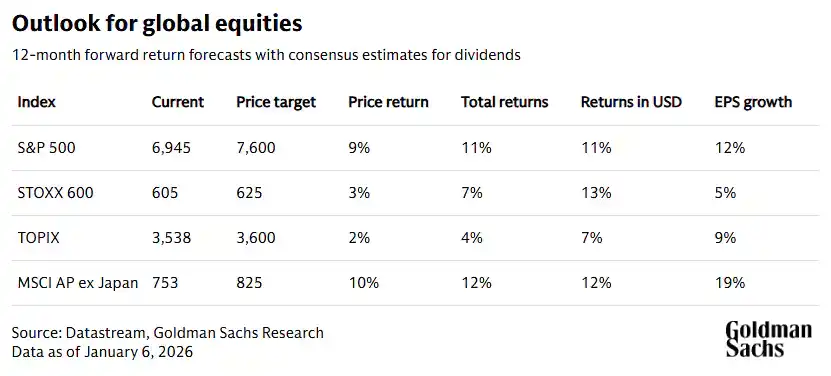
  • Following last year's strong growth, Goldman Sachs Research predicts that global stock markets are poised to continue climbing in 2026, with an expected return of 11% over the next 12 months (including dividends, in USD terms).
  • Although last year's stock market rally has left valuations at historically high levels, corporate earnings and economic growth worldwide are expected to continue supporting the markets.
  • Last year, investors benefited significantly from cross-regional diversification, a trend that is likely to continue. Additionally, diversifying across investment styles and sectors is expected to further enhance returns.

According to Goldman Sachs Research, the global bull market is likely to persist this year, driven by growth in corporate earnings and continued economic expansion. However, the gains in the stock market are expected to be more modest than the significant rally seen in 2025. In 2026, the global economy is anticipated to maintain its expansion across regions, with the US Federal Reserve expected to continue with moderate easing policies.

"In the current macroeconomic context, even with high valuations, a significant stock market correction or bear market in the absence of a recession would be unusual," wrote Peter Oppenheimer, Chief Global Equity Strategist at Goldman Sachs Research, in his report titled "Global Equity Strategy 2026 Outlook: Tech Tonic—a Broadening Bull Market".
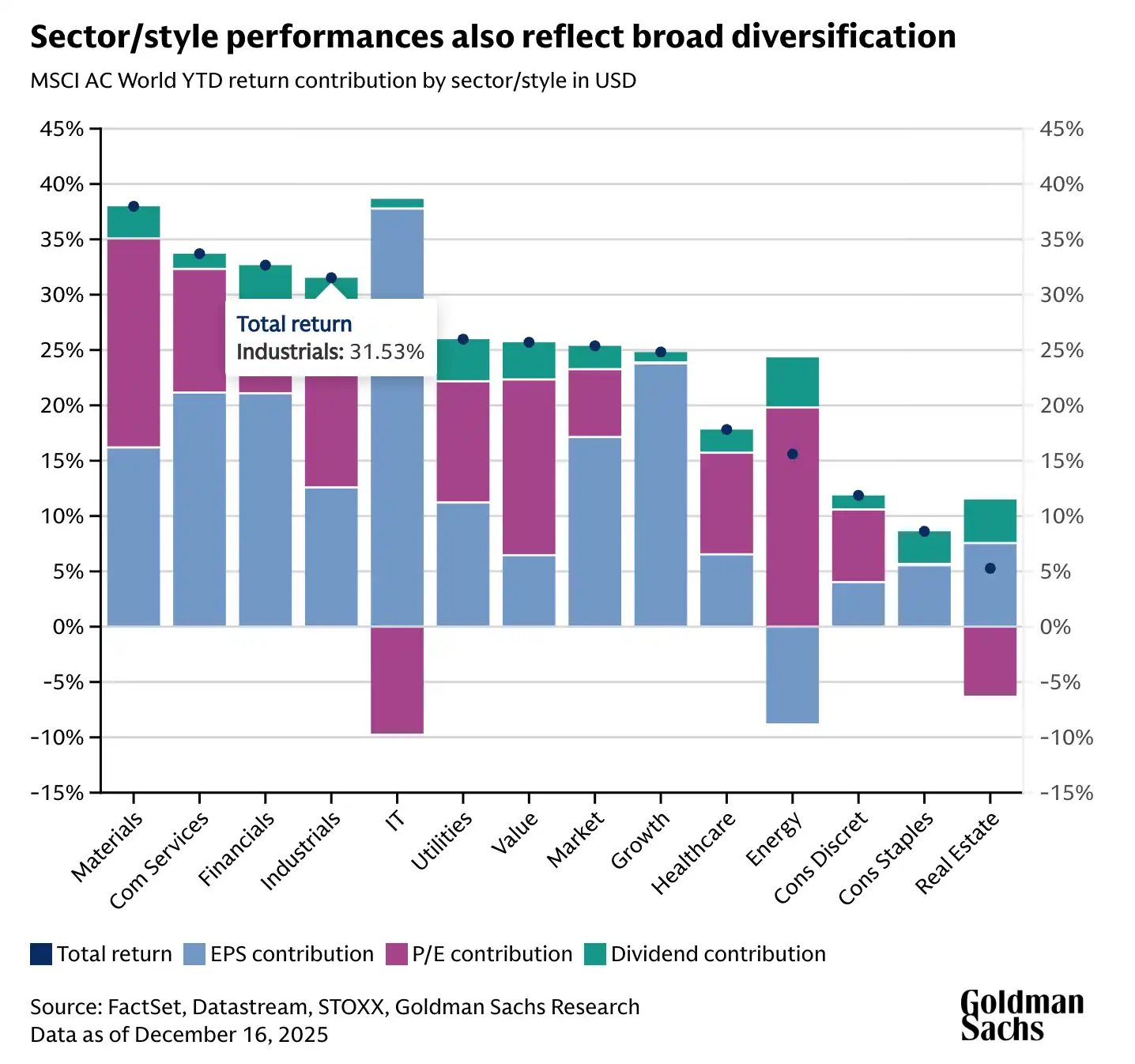
Diversification was a core theme emphasized by Goldman Sachs Research last year. In 2025, for the first time in many years, investors who diversified across regions were rewarded. Goldman Sachs analysts expect this trend to continue in 2026 and expand to include diversification across investment factors such as growth and value, as well as across various sectors. (Investment factors refer to asset characteristics such as size, value, or momentum that typically influence risk and return.)

What is the Outlook for Global Stock Markets in 2026?

Despite the strong performance of stock markets in 2025, outperforming commodities and bonds, the rally was not without its challenges. At the beginning of the year, stocks performed poorly, with the S&P 500 experiencing a nearly 20% correction from mid-February to April before rebounding.

Peter Oppenheimer, Chief Global Equity Strategist at Goldman Sachs Research, noted that the robust rally in global equities has left valuations at historically high levels across all regions, including the US, Japan, Europe, and emerging markets.
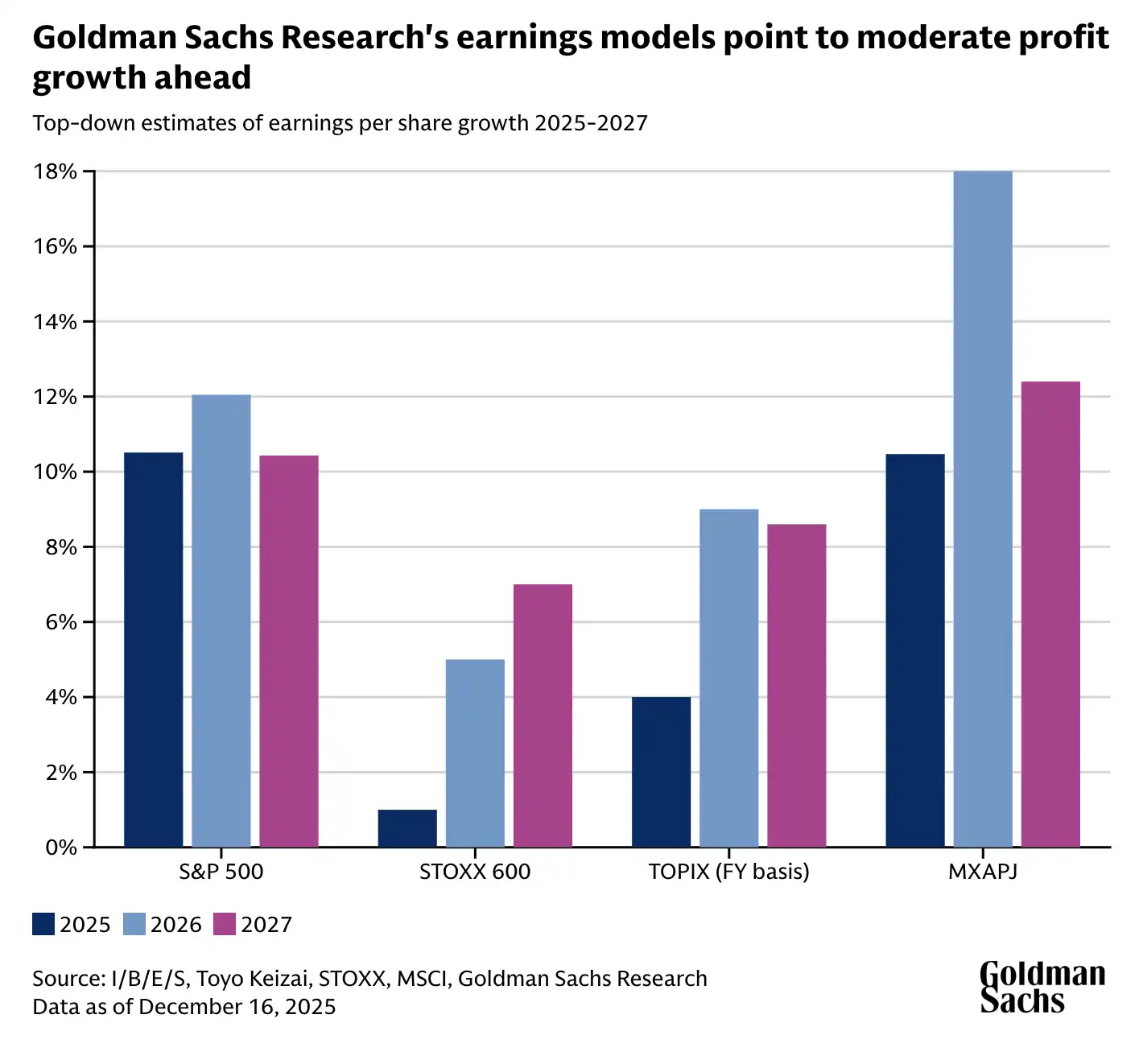
"Therefore, we believe returns in 2026 are more likely to be driven by fundamental earnings growth rather than further multiple expansion," Oppenheimer said. According to Goldman Sachs analysts' forecasts as of January 6, 2026, global share prices (weighted by regional market capitalization) are expected to rise 9% over the next 12 months, delivering an 11% return in USD terms (including dividends). He added, "The majority of the return comes from earnings."

Furthermore, according to another Goldman Sachs forecast, commodity indices are also expected to rise this year, with gains in precious metals once again offsetting declines in energy prices, a trend similar to 2025.

Oppenheimer's team also examined the typical progression of market cycles: the despair phase during bear markets; the short-lived hope phase during market rebounds; the longer growth phase where returns are driven by earnings growth; and finally, the optimistic phase where investor confidence increases and even becomes complacent.

Their analysis suggests that stocks are currently in the optimistic phase of a cycle that began with the bear market during the COVID-19 pandemic in 2020. "This late-cycle optimistic phase is often accompanied by rising valuations, suggesting there may be some upside risk to our core forecast," Oppenheimer's team wrote.

Should Investors Diversify Their Stock Portfolios in 2026?

In 2025, geographical diversification provided significant benefits to investors, which is not common. US stock market performance lagged behind other major markets for the first time in nearly 15 years. Due to a weaker US dollar, returns from European, Chinese, and Asian stock markets were nearly double the total return of the S&P 500.

Returns in the US market were primarily driven by earnings growth, especially from large technology companies. However, outside the US, the balance between earnings improvement and valuation expansion was more even. Last year, the growth-adjusted valuation gap between US stocks and the rest of the world narrowed.

"Even though absolute valuations in the US remain high, we expect these growth-adjusted valuation ratios to continue converging in 2026," Oppenheimer's team wrote.

Oppenheimer noted that diversification is still expected to provide better risk-adjusted returns in 2026. He advises investors to seek broad geographical opportunities, including increased focus on emerging markets. Simultaneously, investors should balance between growth and value stocks and pay attention to different sectors. Furthermore, there is potential for lower correlation between stocks, providing good opportunities for stock selection.
"As stock correlations decline and potentially remain low, we are also paying more attention to enhancing alpha," wrote Peter Oppenheimer, Chief Global Equity Strategist at Goldman Sachs Research. Alpha measures an asset's performance relative to a broader market index.

Oppenheimer added that non-tech sectors might perform strongly this year, and investors could profit from stocks benefiting from tech companies' capital expenditures. Moreover, as new AI capabilities are gradually realized, market attention may increasingly focus on companies outside the tech sector that benefit from AI development.

Are AI Stocks in a Bubble?

Overall, market focus on artificial intelligence "remains fervent," Goldman Sachs analysts noted. However, this does not mean a bubble exists in the AI field. "The dominance of the tech sector in the market was not triggered by the rise of AI," Oppenheimer wrote. "This trend began after the financial crisis and has been supported by its exceptional earnings growth."

Despite the soaring stock prices of large tech companies, current valuation levels have not reached the extremes seen in previous bubble periods. For example, comparing the valuation gap between the five largest companies by market cap in the S&P 500 and the other 495 stocks shows this gap is much smaller than in previous cycles, such as the peak of the tech bubble in 2000.

İlgili Sorular

QWhat is Goldman Sachs' predicted 12-month total return for global equities (in USD terms)?

AGoldman Sachs predicts a 12-month total return of 11% for global equities, including dividends, in USD terms.

QAccording to the report, what is the primary driver expected to fuel equity returns in 2026, rather than further valuation expansion?

AThe primary driver for equity returns in 2026 is expected to be fundamental earnings growth, rather than further expansion of valuations.

QWhat was a core theme for investors that Goldman Sachs highlighted for 2025 and expects to continue into 2026?

AA core theme was diversification, specifically cross-regional diversification, which Goldman Sachs expects to continue into 2026 and expand to include diversification across investment factors and sectors.

QDoes Goldman Sachs believe the AI sector is in a bubble? What evidence is provided?

ANo, Goldman Sachs does not believe the AI sector is in a bubble. They provide evidence that the valuation gap between the top 5 companies in the S&P 500 and the rest of the index is much smaller than it was at the peak of the tech bubble in 2000.

QWhat stage of the market cycle does Goldman Sachs analysis suggest equities are currently in?

ATheir analysis suggests that equities are in the 'optimism' phase of the market cycle, which is a later phase that began with the bear market during the COVID-19 pandemic in 2020.

İlgili Okumalar

Will the Next Crypto Bull Run Start with On-Chain Trading of SpaceX?

This article presents a scenario-based forecast for the crypto industry from 2026 to 2029, arguing that the next major cycle will be driven not by technological narratives but by legal access to real-world assets. The author predicts that by mid-2026, pre-IPO perpetual contracts for top private companies like SpaceX, OpenAI, and Anthropic on platforms like Hyperliquid will become the primary gateway for accessing quality assets, as most crypto-native tokens fail to capture real value. The much-hyped AI x Crypto intersection largely fails except for prediction markets, which thrive on betting on AI model supremacy. By 2027, public blockchain foundations are forced to choose between catering to retail speculation or building compliant infrastructure for institutions, with many opting for the latter. Growth in stablecoins and tokenized private credit/equity hits a "triple ceiling" due to regulatory and political uncertainty rather than market demand. The pivotal shift is forecast for 2028. A major liquidation event in pre-IPO perpetuals exposes the structural flaw of synthetic markets lacking a real underlying asset anchor. In response, regulatory changes finally allow the public solicitation of private securities resales to verified accredited investors. This creates a legitimate secondary market for real company equity, which then becomes the core asset class of the new bull market, relegating synthetic perps to a niche role. By 2029, the industry becomes "boring" but foundational. Tokens without claims on real cash flows or assets cease trading. Stablecoin growth is steady but politically capped. Crypto infrastructure fades from view as it gets absorbed into traditional finance backends. The article's central thesis is that the key bottleneck for crypto's next phase is legal and regulatory channels for real asset ownership, not technology.

marsbit1 saat önce

Will the Next Crypto Bull Run Start with On-Chain Trading of SpaceX?

marsbit1 saat önce

The Value Distribution of Stablecoins

**Summary: The Value Distribution of Stablecoins** The article argues that stablecoins are evolving from mere trading tools into broader channels for dollar access. It divides the stablecoin ecosystem into four layers to analyze how value is distributed: 1. **Issuance Layer:** Mints stablecoins, holds reserve assets, and captures the spread between reserve yield and user costs (e.g., Tether, Circle). This layer currently earns the largest profit margin. 2. **Infrastructure Layer:** Connects stablecoins to the traditional financial system, handling fiat on/off-ramps, banking integration, compliance (KYC/AML), and asset management (e.g., Bridge, BVNK). This is the "unglamorous" but critical work, building the essential bridges between crypto and real-world finance. 3. **Acquiring/Distribution Layer:** Integrates stablecoins into merchant systems, manages payment flows, and provides enterprise financial software (e.g., Stripe, Coinbase). They act as the access point for businesses. 4. **Application Layer:** The end-users and businesses that ultimately use stablecoins for payments, settlements, or as a store of value. They benefit from convenience but have little pricing power. The core thesis is that while the issuance layer currently dominates profits, the often-overlooked **infrastructure layer holds significant long-term potential**. The real challenge and barrier to mass adoption is not the on-chain transfer of stablecoins (which is simple), but the complex "last mile" integration into existing business workflows, banking systems, and regulatory frameworks across different countries. Companies in this layer are currently in a "land grab" phase, investing heavily to build networks, secure bank partnerships, and establish compliance pathways. While their position is currently pressured by the profitable issuers above and distribution platforms below, the article suggests that if stablecoins become a default financial rail for businesses, the infrastructure providers who have done the hard work of integration will ultimately gain strong pricing power and become entrenched, essential players.

marsbit7 saat önce

The Value Distribution of Stablecoins

marsbit7 saat önce

The Value Distribution of Stablecoins

The Value Distribution of Stablecoins The article argues that stablecoins are evolving from a mere trading tool into a broad "dollar channel." It analyzes the industry's value chain through four layers: 1. **Issuance Layer (e.g., Tether, Circle):** The top layer that mints stablecoins, holds reserve assets, and captures the thickest interest rate spread. 2. **Infrastructure Layer (e.g., Bridge, BVNK):** Connects stablecoins to the traditional financial system, handling critical but complex "dirty work" like fiat on/off-ramps, banking integration, compliance (KYC/AML), and cross-border settlement. 3. **Acquiring/Distribution Layer (e.g., Stripe, Coinbase):** Embeds stablecoins into merchant systems, manages payment flows, and integrates with enterprise software. 4. **Application Layer:** End-users and businesses that ultimately use stablecoins for payments, settlement, or storing value. The author posits that while the issuance layer currently captures the most profit, the most overlooked and potentially critical layer is infrastructure. The core challenge for stablecoin adoption isn't the on-chain transfer (which is simple), but bridging the gap between blockchain and the real-world financial system. This involves solving practical problems for businesses: fiat conversion, reconciliation, tax handling, and user onboarding. Infrastructure companies are currently in a difficult "land-grab" phase—building networks, securing banking relationships, and achieving compliance country-by-country. They face pressure from both the profitable issuance layer above and distribution platforms below. However, the author suggests this layer is building a crucial moat. Once stablecoins become a default business rail, the infrastructure players who have done the hard work of integration may gain significant, durable value and pricing power.

链捕手7 saat önce

The Value Distribution of Stablecoins

链捕手7 saat önce

İşlemler

Spot
Futures
活动图片



