Less than a month after its IPO, China's DRAM leader Changxin Technology has received its first coverage from Goldman Sachs.
In a report titled "CHIPS IV: Accelerating China's Semiconductor Self-Sufficiency" released on August 23, Goldman Sachs initiated coverage on Changxin with a "Buy" rating and a 12-month target price of 129 RMB. At the time of the report's release, Changxin was trading at around 10 times its forecasted 2027 P/E; Goldman's target price implies approximately 24 times the forecasted 2027 P/E.
Behind this valuation is a growth model extending to 2030: wafer capacity doubling, traditional DRAM shipments continuing to expand, HBM revenue growing rapidly, coupled with China's AI computing infrastructure construction and customer supply chain diversification jointly driving up local memory demand.
However, this model is also built on a series of relatively optimistic assumptions. Besides capacity expansion and yield improvement, Goldman Sachs also expects DRAM prices to remain high in a tight supply environment, with Changxin's gross margin rising from 41% in 2025 to 82% in 2030. Therefore, the 129 RMB target price is betting not only on import substitution, but on capacity, prices, and product structure all moving in a favorable direction simultaneously.
Changxin Technology landed on the STAR Market on July 27, with stock code 688825. At the time of listing, its total A-share capital was approximately 66.881 billion shares, with about 4.503 billion shares beginning trading initially. According to the prospectus, the raised funds will mainly be used for upgrading wafer fabrication mass production lines, DRAM technology upgrades, and forward-looking technology R&D.
Goldman's new report further projects these investments into a capacity leap lasting until 2030.
Capacity to Double in Four Years, Potentially Covering Half of China's DRAM Demand by 2028
Goldman Sachs expects Changxin's monthly wafer capacity to increase from 270,000 wafers in 2026 to 447,000 wafers in 2028, reaching 665,000 wafers by 2030, more than double the 2026 level.
Sustaining this expansion is continuous capital investment. Goldman expects Changxin's average annual capital expenditure from 2026 to 2030 to reach 84 billion RMB, higher than the approximately 50 billion RMB from 2022 to 2025; compared solely to 2024-2025, the previous two years' average annual capex was about 60 billion RMB.
Driven by capacity expansion, yield improvement, and product specification upgrades, Goldman expects Changxin's total DRAM supply to grow at a 34% CAGR from 2026 to 2030, reaching 9.837 billion GB by 2030.
By 2028, Changxin's traditional DRAM supply is projected to reach 41% and 50% of Samsung and SK Hynix's supply respectively, higher than 28% and 35% in 2025.
A more impactful judgment is this: Goldman expects Changxin's supply to cover approximately 50% of China's DRAM demand by 2028. This is a forecast of future supply capability and does not represent that Changxin currently holds half of the Chinese market share.
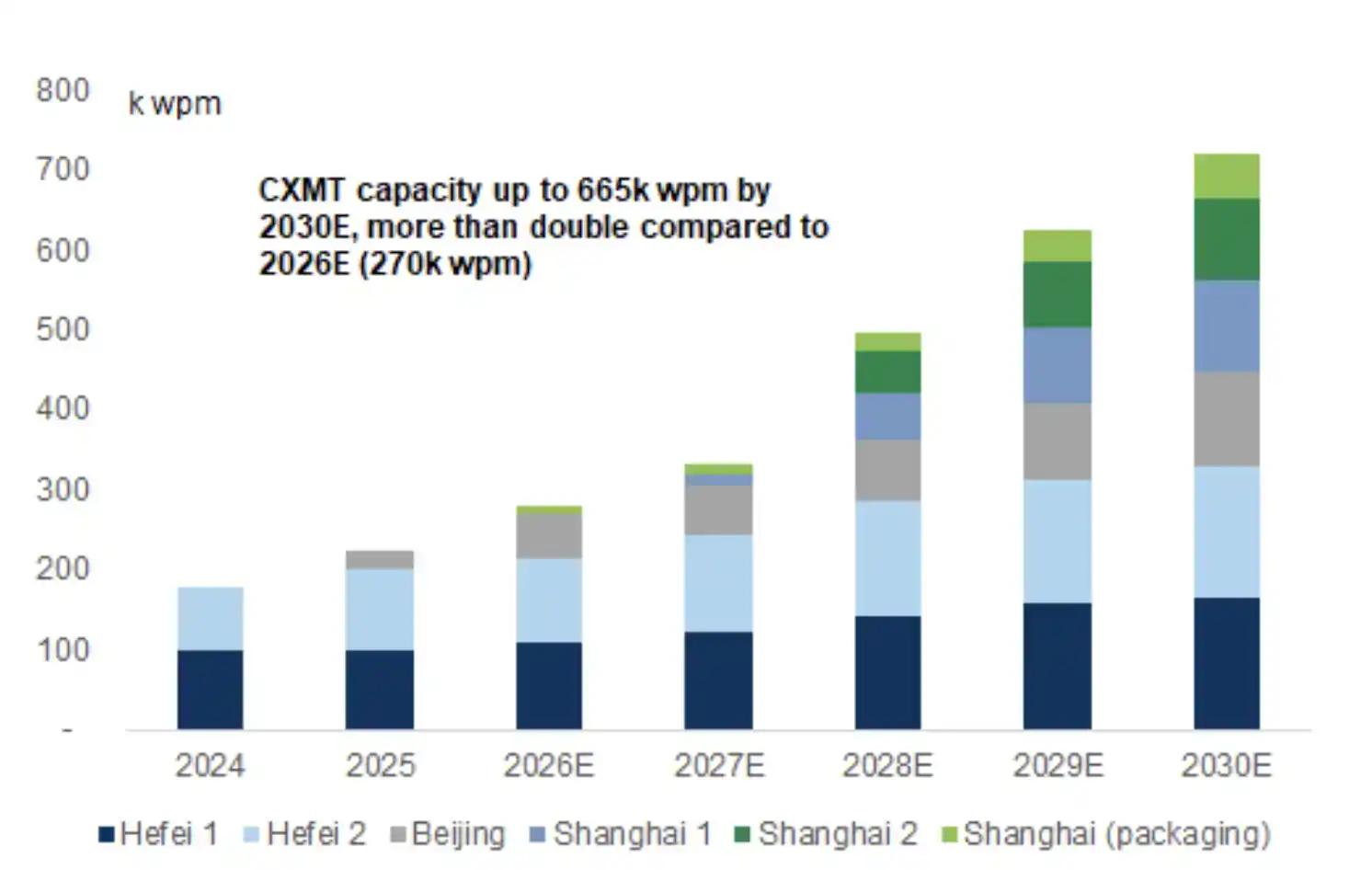
Changxin's monthly capacity expansion trend from 2026 to 2030, with core forecast increasing from 270,000 to 665,000 wafers.
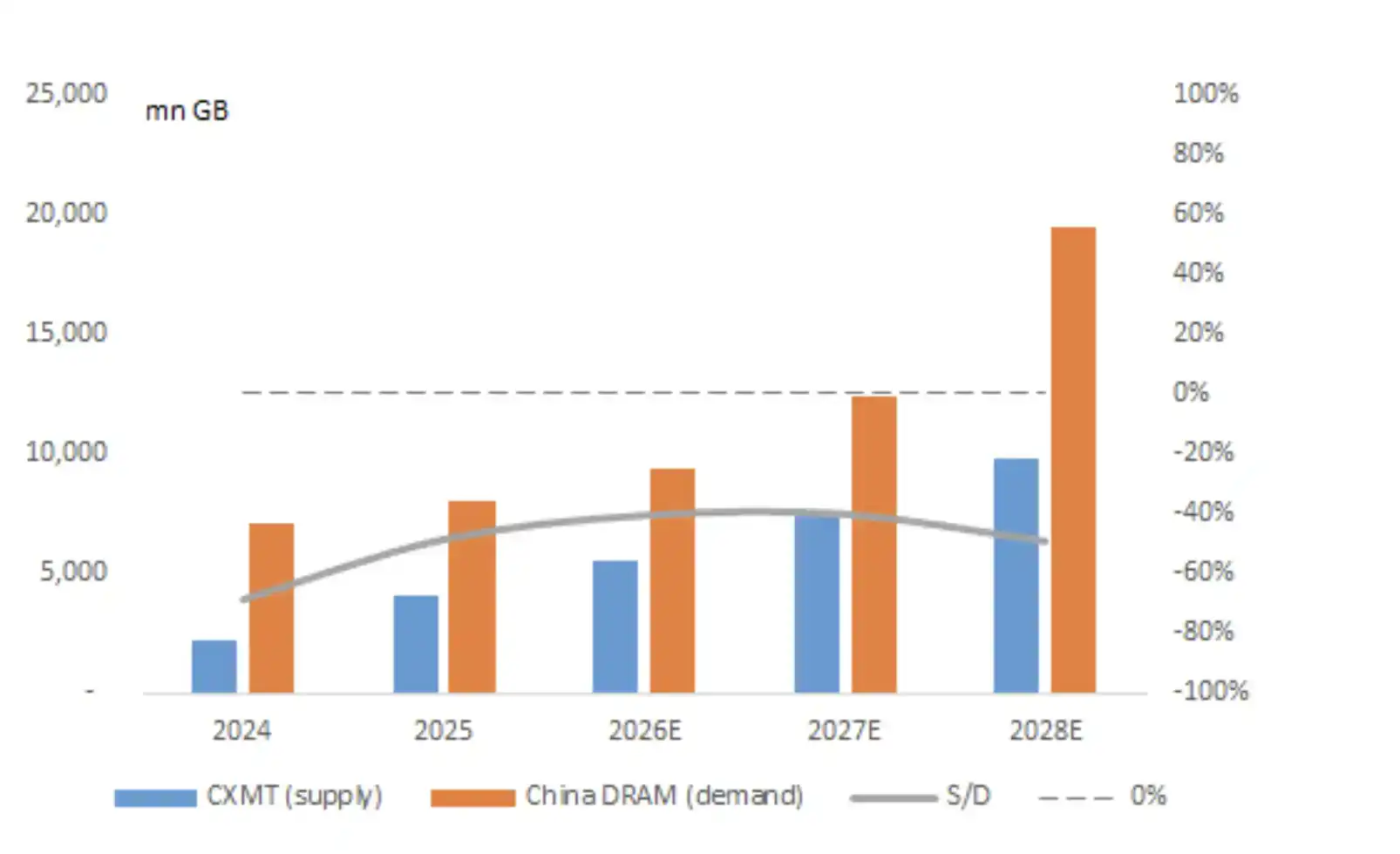
China's DRAM supply and demand comparison. Goldman expects Changxin to cover about 50% of domestic DRAM demand by 2028.
AI Drives China's Memory Demand, Also Leaves Expansion Room for Changxin
Goldman expects China's DRAM market size to grow at a 50% CAGR from 2026 to 2028, reaching $257 billion by 2028. Growth is primarily driven by AI server shipments, server DRAM, and HBM demand, with mobile phones, PCs, networking equipment, and vehicles constituting foundational demand.
Changes are also occurring on the supply side. As global memory manufacturers like Samsung, SK Hynix, and Micron shift more resources towards AI-related products like HBM, traditional DRAM supply is being squeezed. In an environment of high prices and limited supply, consumer electronics manufacturers also have greater incentive to introduce new suppliers to reduce single-source risk.
Goldman believes that even if Changxin's technology nodes still lag global leaders by several generations, US and other overseas customers may still validate its mobile DRAM and traditional DRAM products, especially in smartphones and PCs.
This forms the two main lines of Changxin's expansion: on one hand, meeting China's domestic DRAM demand and import substitution; on the other, filling the traditional DRAM gap left as global manufacturers shift capacity to HBM.
However, whether overseas customers can form large-scale procurement is still influenced by geopolitics and trade restrictions. Willingness for product validation does not equate to confirmed orders, which is also one of the major risks listed by Goldman.
HBM Determines Whether Changxin Can Move from Scale Expansion to Profit Upgrading
Traditional DRAM provides the scale foundation, while HBM determines whether Changxin can truly capture the high-value incremental market of AI memory.
HBM provides higher bandwidth, capacity, and energy efficiency for AI accelerators by vertically stacking multiple layers of DRAM. However, compared to ordinary memory, HBM manufacturing involves multiple steps including front-end DRAM chips, high-precision Through-Silicon Vias (TSV), advanced-node logic wafers, thermal management, and reliability, presenting significantly higher technology and supply chain barriers.
Goldman expects Changxin's HBM products to start contributing revenue from Q4 2026, with HBM revenue share rising from 2% in 2026 to 27% in 2030. Its HBM supply is projected to grow at a 207% CAGR from 2026 to 2028, reaching 1.179 billion GB by 2028.
But this is also the part with the greatest uncertainty in the entire model.
Goldman explicitly states that Changxin's HBM technology maturity is still in early stages, and it is expected to face challenges entering US customer supply chains in the short to medium term. In contrast, overseas customers show stronger willingness to validate mobile DRAM and traditional DRAM.
In other words, Changxin can relatively quickly increase traditional DRAM supply capacity through expansion, but entering the high-value HBM market still requires solving issues related to manufacturing processes, local packaging ecosystem, advanced logic wafers, thermal reliability, and customer qualification.
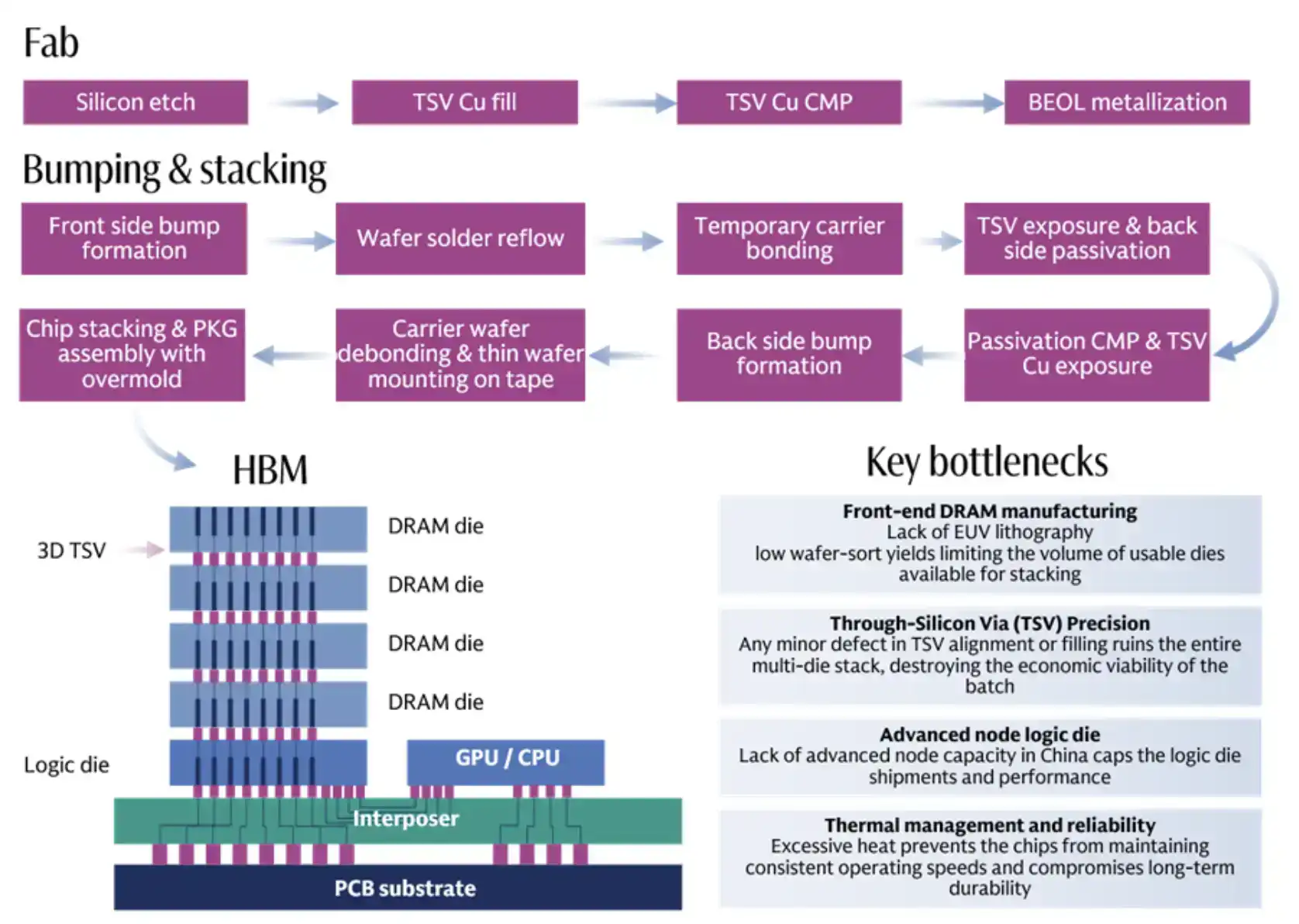
HBM manufacturing flow and key bottlenecks, including front-end DRAM fabrication, high-precision TSV, advanced-node logic wafers, thermal management, and reliability.
The 129 RMB Target Price Bets on More Than Just Shipment Growth
Goldman expects Changxin's net profit to grow at a 47% CAGR from 2026 to 2030, with traditional DRAM revenue CAGR at 34% and HBM revenue CAGR reaching 166% over the same period.
The 129 RMB target price is not directly derived by multiplying 2027 earnings by a 24x P/E ratio. Goldman first assigned Changxin a target P/E ratio of 16.6x for 2030 based on the relationship between peer valuations and earnings growth, then discounted it to 2027 using a 12.7% cost of equity, finally arriving at the 129 RMB target price. This price implies approximately 24 times the forecasted 2027 P/E.
Factors supporting the valuation upgrade are primarily threefold.
First, China's AI infrastructure expansion drives server DRAM and HBM demand. Second, global traditional DRAM supply is squeezed by HBM capacity expansion, prompting consumer electronics customers to accelerate supplier diversification. Third, Changxin's scarcity as a scaled-up Chinese DRAM manufacturer allows it to command a certain valuation premium for domestic semiconductors.
But the truly aggressive part of this valuation lies in the profit margin assumptions.
Goldman expects that with DRAM prices staying high, shipment scale expanding, and product structure upgrading towards DDR5, LPDDR6, and HBM, Changxin's gross margin will rise from 41% in 2025 to 82% in 2030, while its operating expense ratio drops from 27.4% to 7.9% over the same period.
This means the 129 RMB target price not only requires the wafer fabs to come online as planned, but also demands that the new capacity smoothly translates into shipments, the DRAM boom continues, HBM share persistently increases, and ultimately materializes into a significant improvement in profit margins.
From Building Fabs to Realizing Profits, Multiple Hurdles Remain
Memory remains a typical cyclical industry. When demand is strong, capacity expansion can boost both revenue and profits; but when new capacity is released intensively, a reversal in supply-demand dynamics can rapidly depress prices and profitability.
For Changxin, risks mainly come from three aspects.
First, global manufacturers like Samsung, SK Hynix, and Micron are still expanding DRAM capacity and developing next-generation products. Competition stronger than expected could suppress Changxin's shipments and profits. Second, Goldman's margin model is built on the premise that DRAM demand and prices remain strong. Once AI or consumer electronics demand falls short of expectations, both shipment volume and gross margin could face pressure. Finally, the geopolitical environment may restrict Changxin's access to global customer supply chains, weakening overseas growth potential.
Changxin has already completed the leap from "zero to one" in domestic DRAM production to listing on the public market. The harder part that follows is turning the wafer fabs under construction into stable output, and then extending the scale advantage of traditional DRAM to the performance, yield, and customer qualification of HBM.
Therefore, the 129 RMB target price does not present an already realized outcome, but rather a concentrated bet that capacity expansion, strong memory market conditions, import substitution, and HBM upgrade can all materialize simultaneously.