Gold Surpasses $5,000 First, When Will the Crypto Market Reverse?

marsbit2026-01-26 tarihinde yayınlandı2026-01-26 tarihinde güncellendi

Özet

The article discusses the outcome of a popular prediction on Polymarket from October last year: "First to $5,000: Gold or ETH?". While Ethereum had once approached $4,800 with high market confidence, gold ultimately surged past $5,100 per ounce on January 26, whereas Ethereum remained stagnant between $2,800 and $3,000. The rise in gold is attributed to macro factors including concerns over U.S. fiscal health, geopolitical tensions, and inflation-driven capital flight toward safe-haven assets. Institutional sentiment has turned strongly bullish, with banks like OCBC and Goldman Sachs raising their gold price targets. Meanwhile, tokenized gold products have seen record investment inflows. In contrast, the crypto market has faced significant outflows, with Bitcoin and Ethereum ETFs recording substantial withdrawals. Bitcoin has fallen 30% from its peak, and Ethereum is down around 40%. Analysts like Peter Brandt have turned bearish, citing completed bear channels. However, the article suggests that crypto’s downturn may be temporary—a phase in capital rotation toward safety. Once gold’s momentum slows or macro risks ease, capital may return to deeply oversold crypto assets. Bitcoin shows classic bottoming signals, including peak realized losses, while Ethereum’s high staking ratio reflects long-term confidence. The potential appointment of a crypto-friendly Fed chair could also boost the market. The piece concludes that gold’s rally may have further to go, and crypt...

Author:zhou, ChainCatcher

Remember that hot prediction event on Polymarket last October?

"First to $5,000: Gold or ETH?"
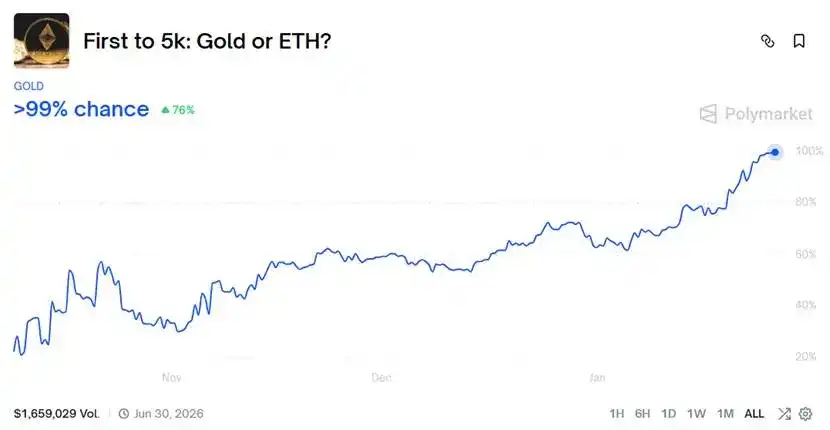
At that time, Ethereum's price surged to around $4,800, with the market giving it an 80% probability of breaking through $5,000. Many believed the era of digital gold had arrived.

Three months later, the market has given its answer.

On January 26, spot gold broke through $5,100 per ounce, while Ethereum is still oscillating between $2,800 and $3,000, with the overall crypto market remaining sluggish.

Amid extreme macroeconomic uncertainty, capital has collectively turned to the most traditional safe-haven assets, while cryptocurrencies, as high-volatility risk assets, were sold off first.

Gold Soars, Crypto Market Capital Votes with Its Feet

Gold's upward momentum stems from multiple macro factors.

First, signals of hedging against US dollar credit risk are becoming increasingly evident. The Danish academic pension fund AkademikerPension announced it would liquidate approximately $100 million in US Treasuries by the end of the month,直言 citing serious concerns about the US fiscal situation. Sweden's largest private pension fund, Alecta, also disclosed that since early 2025, it has significantly reduced its holdings of US Treasuries, amounting to approximately $7.7 to $8.8 billion. Institutions cite US policy uncertainty and持续 debt expansion as core reasons.

Second, geopolitical risks are intensifying. Less than a month into 2026, the world has already witnessed several major events, including the US proposing to "force-buy" Greenland, raiding and capturing the Venezuelan president, imposing 25% tariffs on countries trading with Iran, and further chaos within Iran. Coupled with the prolonged stalemate in the Russia-Ukraine conflict, geopolitical issues have not eased in the new year but have shown signs of恶化.

Additionally, inflation and currency depreciation pressures persist. Against the backdrop of massive central bank liquidity injections and fiscal deficit monetization, the purchasing power of fiat currency is constantly being diluted. Gold and silver, as hard assets, naturally become the首选 for capital seeking shelter.

In this context, institutional views on gold are rapidly turning optimistic. OCBC Bank has raised its year-end gold price target for 2026 to $5,600 per ounce; Goldman Sachs has also significantly adjusted its expectations, raising its year-end target from $4,900 to $5,400.

They emphasize that持续 buying by private investors and emerging market central banks is squeezing limited gold supply. Data shows that in 2025, global central banks net purchased over 1,100 tons of gold, and in 2026, it is expected to maintain a pace of over 60 tons per month. Against the backdrop of the Fed potentially restarting rate cuts, gold ETF holdings have also begun to回升.

On the crypto market side, on-chain gold investment enthusiasm has also reached new heights. According to Coingecko data, the total market capitalization of tokenized gold has now exceeded $525 million, and tokenized silver has also hit a historical record. According to Lookonchain monitoring, a whale lost $18.8 million on ETH in a short period and is now doubling down on gold. It spent $36.04 million to buy 7,536 XAUT at an average price of $4,786, with an unrealized profit of $2.3 million.

In contrast, the cryptocurrency market presents a截然不同的 picture. Bitcoin has fallen about 30% from last year's high, and Ethereum has dropped about 40%. Last week, both Bitcoin and Ethereum spot ETFs recorded massive net outflows: Bitcoin ETF net outflows were $1.33 billion (the second-highest weekly规模 in history), and Ethereum ETF net outflows were $611 million.

As of January 20, the performance of the two largest crypto treasury companies varied. Bitcoin treasury company MicroStrategy (MSTR) holds a total of 709,715 BTC with an average cost of $75,979, resulting in a floating profit of $10.813 billion. Ethereum treasury company Bitmine (BMNR) holds a total of 4,203,036 ETH with an average cost of $3,857, resulting in a floating loss of $3.232 billion.

Market sentiment is clearly偏向 bearish. The famous trader and chart analyst Peter Brandt, who successfully predicted Bitcoin's crash in 2018, stated that the Bitcoin bear market channel is complete and issued a sell signal again. He pointed out that Bitcoin's price needs to recover to $93,000 to negate the sell signal. Bloomberg analysts even believe that the possibility of Ethereum falling below $2,000 in the short term is higher than returning to $4,000.

Capital Rotation: The Day Gold Stops Rising is the Day Crypto Reverses?

However, the crypto market's sluggishness is more of a阶段性表现 of capital rotation. During periods of extreme risk aversion, capital flow typically first rushes into zero-credit-risk assets like US Treasuries and gold. Only after the peak of risk passes does it gradually flow back into stocks and crypto markets.

The current collective rise of gold, silver, and some大宗商品 is precisely the most concentrated stage of defensive allocation. Once gold's momentum weakens as it approaches institutional target prices, or a major macro risk shows signs of easing, profit-takers will likely begin searching for the next high-return opportunity. At that time, deeply回调ed crypto assets, with leverage fully washed out, will become the most natural承接 object.

Specifically for Bitcoin and Ethereum, their respective bottoming signals are becoming increasingly clear.

For Bitcoin, massive on-chain realized losses are often a classic bottom特征. CryptoQuant data shows that Bitcoin's realized loss (Realized Loss) has reached $4.5 billion, the highest level in three years. The last time this happened, Bitcoin's price was around $28,000 after about a year of brief adjustment.

On the institutional side, Bitcoin treasury companies continue to increase their BTC holdings through financing plans, especially after MSCI decided not to remove MSTR from its indices for now, prompting passive funds like Vanguard to follow up and buy MSTR stock. Arthur Hayes publicly stated that the core trading strategy this quarter is to go long on MSTR and Metaplanet.

The situation with Ethereum is similar. On one hand, over 36 million ETH has been staked, accounting for nearly 30% of the circulating supply, with the exit queue接近 zero. Validators are expressing long-term confidence in the network with their actions. On the other hand, BitMine recently obtained shareholder approval to increase the上限 of shares the company can issue to enhance future financing flexibility, and it will most likely continue to increase its Ethereum holdings.

It is worth mentioning that on Polymarket currently, the probability of BlackRock executive Rieder succeeding the Fed chair is close to 50%, significantly领先 competitors. Market analysis suggests that if this event materializes, his friendly stance towards RWA and the crypto ecosystem could provide a major boost to the crypto market.

However, history has proven countless times that when precious metal行情 go crazy, they are completely unreasonable.

How high can gold go next? No one knows. What needs to be done now is not to guess where the top is, let alone short it. In an era of inflation cycles and credit revaluation叠加, it is difficult to call a top for gold.

Loyal crypto investors may only need to patiently wait for the rotation signal to appear. Hopefully, that day will come sooner than we imagine.

Click to learn about open positions at ChainCatcher

İlgili Sorular

QWhat was the subject of the popular prediction event on Polymarket mentioned in the article?

AThe prediction event was 'First to $5,000: Gold or ETH?', which asked whether gold or Ethereum would be the first to break the $5,000 price level.

QWhich asset ultimately reached the $5,000 price target first, and what was its price on January 26th?

AGold reached the target first. On January 26th, the spot price of gold broke through $5,100 per ounce.

QWhat are the three main macro factors cited in the article as driving the rise in gold's price?

AThe three main drivers are: 1) Hedging against U.S. dollar credit risk, 2) Escalating geopolitical risks, and 3) Persistent inflation and currency devaluation pressures.

QAccording to the article, what is a potential signal for a reversal in the cryptocurrency market?

AA potential signal for a crypto market reversal is when the momentum in gold's price weakens after it nears institutional target prices, or when a major macro risk shows signs of easing, prompting profit-taking capital to seek higher returns in deeply corrected crypto assets.

QWhat on-chain metric for Bitcoin is mentioned as a classic bottoming feature, and what was its value?

AThe metric is Bitcoin's Realized Loss. The value mentioned is $4.5 billion, which is stated to be the highest level in three years.

İlgili Okumalar

Must-Watch Events Next Week|CLARITY Act Could Face Senate Vote; SpaceX, Circle to Report Earnings (8.3-8.9)

**Summary: Key Events and Developments to Watch (August 3-9)** The upcoming week is marked by significant financial disclosures, key legislative deadlines, and notable product updates. **Major Financial Events:** Several companies are scheduled to release their Q2 2026 earnings. American Bitcoin (ABTC) will report on August 3, followed by SpaceX and Hut 8 Mining Corp. on August 4, and Circle on August 5. Notably, a significant portion of SpaceX shares (up to 12% of total shares) will be unlocked on August 6 following their earnings release. **Key Legislative Deadline:** The U.S. Senate faces an August 7 deadline to secure 60 votes for the CLARITY Act, a bipartisan bill aiming to establish a federal regulatory framework for cryptocurrencies. The Senate may hold a full vote on the bill during the week. **Economic Data:** The U.S. July Non-Farm Payrolls report will be released on August 7, providing crucial labor market data. **Technology & Product Updates:** * **Shutdowns:** DeFi portfolio tracker Zapper and wallet app Ctrl Wallet will cease operations on August 3. * **Upgrades:** LayerZero will deprecate its v1 relayers on August 3. XRP Ledger's new version 3.3.0, featuring five new functions, is expected next week. * **AI:** Elon Musk announced that the advanced Grok 4.6 AI model is set for release around August 7. * **Bitcoin:** The BIP-110 forced signaling for a potential Bitcoin network change is scheduled to begin around August 8. **Other Notable Events:** Chinese robotics firm Unitree Tech has set its preliminary price inquiry for its IPO for August 5. South Korean exchange Upbit will delist AQT and AERGO tokens on August 3.

marsbit14 dk önce

Must-Watch Events Next Week|CLARITY Act Could Face Senate Vote; SpaceX, Circle to Report Earnings (8.3-8.9)

marsbit14 dk önce

Stocks Are Plummeting More Sharply Than Cryptocurrencies. Where Has the Money Gone?

Stock Markets Plunge Deeper Than Cryptocurrencies: Where Did the Money Go? In late July, Seoul's Kospi index triggered circuit breakers for two consecutive days, plummeting over 40% from its June high. The collapse was led by heavyweight stocks like SK Hynix, whose record profits still disappointed investors, and devastating leveraged ETFs, with one major product losing over 83% of its value. This signaled a global, forced deleveraging targeting the most crowded trades. Interestingly, while stocks exhibited extreme volatility akin to crypto markets, Bitcoin rose nearly 15% in July after a prior steep drop. Analysis shows the money fleeing equities did not flow into Bitcoin. Instead, Bitcoin had already absorbed its sell-off in May-June, when U.S. spot Bitcoin ETFs saw historic outflows. The true safe-haven beneficiary was gold, whose price rose over 20% year-on-year, highlighting a decoupling between Bitcoin and gold as "digital gold." The sell-off was a targeted unwinding of leveraged positions in tech and semiconductors, accelerated by broker-dealer risk management and shifts in the AI narrative, including new competition from Chinese memory chipmakers. The retreat path was clear: from high-valuation tech stocks to cash and U.S. Treasuries, then to gold. For Bitcoin to attract sustained institutional inflows, conditions like eased global liquidity pressure, a "soft-landing" Fed rate cut, and U.S. regulatory clarity via legislation like the stalled CLARITY Act are needed. Currently, Bitcoin is not a safe haven but an already-cleared asset. Its low correlation with tech stocks, however, makes it a potential diversification play for institutional portfolios once the storm passes. The money isn't here yet, but the positioning is underway.

marsbit14 dk önce

Stocks Are Plummeting More Sharply Than Cryptocurrencies. Where Has the Money Gone?

marsbit14 dk önce

In Conversation with Ray Dalio: We Are Currently in an AI Bubble, with 1% of My Portfolio in Bitcoin

Ray Dalio, founder of Bridgewater Associates, warns in an interview that the current AI boom shows classic bubble characteristics, which could lead to significant economic downturns as seen in past cycles like 1929 or 2000. He explains that speculative enthusiasm, fueled by debt and overvaluation, often precedes a crash when rising rates or taxation force asset sales, causing widespread losses and recession. Dalio also outlines his "Big Cycle" theory, describing an approximate 80-year pattern where widening wealth gaps, massive government deficits, and shifting geopolitical power (like China's rise) create internal conflict and global instability. He emphasizes that we are in a late-cycle, transitional phase where traditional powers like the US and UK face decline. For personal wealth protection, Dalio advises diversification beyond cash into assets like stocks, bonds, real estate, and particularly gold, which he prefers over Bitcoin. While he holds about 1% of his portfolio in Bitcoin as a non-printable hard asset, he views gold as more secure from technological or governmental threats. Regarding AI's impact, Dalio believes it will disproportionately benefit capital owners, worsening inequality by replacing both physical and cognitive labor. He suggests that human intuition and emotional intelligence, combined with AI, will be key for future workers. On taxation, Dalio argues that wealth taxes are impractical and risk triggering asset sell-offs, reducing productive investment. He points to the UK as a cautionary example of debt, low productivity, and political strife. Geopolitically, Dalio foresees a more regionalized world, with the US showing weakness in prolonged conflicts like with Iran, akin to past imperial declines. The ideal outcome, he suggests, is coexisting powerful blocs (e.g., Americas, China-Asia Pacific) without major war.

marsbit4 saat önce

In Conversation with Ray Dalio: We Are Currently in an AI Bubble, with 1% of My Portfolio in Bitcoin

marsbit4 saat önce

Daily 7.2 Trillion KRW: Foreign Capital's Record Net Buying on Friday! Wall Street Says Headwinds for Korean Stock Fund Flows Have Subsided

South Korean stock market sees a dramatic shift in fund flows. On July 31, foreign investors made a record net purchase of approximately KRW 7.2 trillion in KOSPI stocks, marking a fundamental reversal from the persistent large-scale net outflows seen in previous months. This contributed to a significant narrowing of foreign net selling in July to KRW 9.8 trillion, down sharply from KRW 48.4 trillion in June and KRW 44.5 trillion in May. Simultaneously, domestic institutional pressure eased. South Korean pension funds and asset managers turned to a net buying position in July, purchasing KRW 1.0 trillion worth of KOSPI shares, contrasting with net sales in May and June. Market volatility is expected to be dampened by new financial regulations. Effective July 31, the Financial Services Commission tightened access for retail investors to single-stock leveraged ETFs by raising the minimum cash deposit requirement. Trading volumes for these products subsequently dropped to about 50% of their monthly average. Citigroup Research maintains its year-end KOSPI target of 10,000 points. The firm cites several supportive factors: the substantial easing of headwinds from capital outflows, a robust fundamental outlook for the semiconductor sector, historically low market valuations, strong economic fundamentals, and the potential for policy support from financial authorities if needed.

marsbit4 saat önce

Daily 7.2 Trillion KRW: Foreign Capital's Record Net Buying on Friday! Wall Street Says Headwinds for Korean Stock Fund Flows Have Subsided

marsbit4 saat önce

İşlemler

Spot
活动图片





