Gold Plunges 7% in a Single Day, War Fails to Boost Safe-Haven Assets | Rewire Evening News

marsbit2026-03-19 tarihinde yayınlandı2026-03-19 tarihinde güncellendi

Özet

Gold and silver experienced a sharp decline, with gold dropping 7.2% to $4,551 and silver falling 13.9% to $66.93, despite ongoing Middle East tensions. This unusual drop in traditional safe-haven assets is attributed to a stronger US dollar, rising inflation expectations, and tightening liquidity. The conflict escalated as Israel targeted Iran's South Pars gas field, a key global LNG source, driving oil prices to record highs. Iran retaliated by attacking energy facilities in Saudi Arabia and the UAE. The Pentagon labeled Anthropic's AI safety protocols a national security risk, amid broader military AI adoption. Crypto.com cut 12% of its workforce, reflecting a industry shift toward AI-driven operations. Global stock markets fell due to combined pressures from hawkish Fed policies, energy-driven inflation, and supply-side constraints. The BOJ maintained rates but raised inflation risks, while Apple plans to integrate Gemini-powered Siri. US gasoline prices surged, reinforcing stagflation narrative.

Gold fell 7.2% to $4,551, and silver dropped 13.9% to $66.93. On the 20th day of the Middle East war, safe-haven assets are collapsing instead of rising. A stronger dollar, inflation expectations, and liquidity tightening are redefining the meaning of 'safety'.

1| Gold Plunges 7%, Silver Crashes 14%, Safe-Haven Logic Fails During War

Gold fell by $310 to $4,551/ounce (-7.2%), while silver plummeted from $77.77 to $66.93 (-13.9%). This marks the sixth consecutive day of decline for gold, the longest losing streak since late 2024. The usual logic is that war drives up safe-haven assets, but this round is different. A stronger dollar index (DXY +0.4%), rising U.S. Treasury yields, and inflation expectations driven by oil price shocks have dashed hopes for a dovish pivot from the Fed. Funds are flowing out of precious metals and into dollar cash. In early February, the CME raised gold margins from 6% to 8% and silver margins from 11% to 15%, continuously squeezing out leveraged long positions. On the surface, it's a gold and silver crash; at its core, when inflation and war occur simultaneously, the pricing power of safe-haven assets shifts from fear to interest rates.

(Source: Fortune / CNBC / 24/7 Wall St.)

2| Israel Strikes World's Largest Gas Field, Iran Begins Naming and Bombing Gulf Energy Facilities

Israel, in coordination with the U.S., struck Iran's South Pars gas field. This is no ordinary military target. South Pars shares the same geological structure as Qatar's North Field, which supplies 20% of the world's LNG. WTI crude oil rose above $97, while Dubai crude broke through $150 to hit a record high. Iran immediately published a target list, naming Saudi Aramco's Samref refinery, the Jubail petrochemical complex, and the UAE's Al Hosn gas field. Saudi Arabia, Qatar, the UAE, and Kuwait all reported attacks. The IEA released a record 400 million barrels from emergency reserves, and the U.S. added 172 million barrels from the SPR, but these measures had almost no effect on prices. The war is escalating from blockading shipping lanes to destroying production capacity, and the global energy reserve system is almost powerless to stop it.

(Source: Fortune / Al Jazeera / CNBC)

3| Pentagon Officially Counters, Defining Anthropic's Safety Red Lines as a 'National Security Risk'

The Department of Defense submitted a 40-page rebuttal in a California federal court, arguing that Anthropic might 'attempt to disable its technology or preemptively modify model behavior' during 'combat operations'. The morning brief covered an amicus brief from 150 retired judges supporting Anthropic. The new development tonight is the Pentagon's formal response, which reframes an AI company's ethical stance as a supply chain risk. In the same week, the Pentagon signed contracts with OpenAI and xAI. A hearing on March 24th will address a previously unprecedented question: can an AI supplier set conditions for military use, or does the military have the right to demand unconditional access.

(Source: TechCrunch / Washington Examiner)

4| Crypto.com Lays Off 12% of Staff, Crypto Industry Begins Replacing Labor with AI

Crypto.com announced it is cutting about 180 jobs, roughly 12% of its workforce. The CEO stated that roles not suited for 'our new world' will be eliminated. This is not an isolated case. Over the past two weeks, Block (Jack Dorsey) laid off nearly 40% of its staff and announced a full shift to AI, while Gemini cut 25% of its workforce. On the surface, this is cost optimization during an industry downturn. At its core, crypto exchanges are shifting from a 'hire-to-expand' model to an 'AI replacement + lean core team' model. It's not just边缘 roles being cut, but entire middle layers. When three leading exchanges use the same reason for layoffs simultaneously, it's no longer an individual company's choice but a structural turning point for the industry.

(Source: Bloomberg)

5| U.S. Stocks Plunge for Second Consecutive Day, Triple Pressures Tighten Simultaneously

The S&P 500 fell to 6,588 (-0.55%), the Dow Jones dropped to 45,902 (-0.70%), and the Nasdaq declined 0.73%. European losses were steeper, with Germany's DAX down 3% and the Stoxx 600 down 2.76%. Over two days, the Dow has lost over 1,200 points. The selling pressure doesn't stem from a single event but from three lines tightening at once. A hawkish Fed (rates held at 3.50%-3.75%, dot plot split 7:7) dashed rate cut expectations. The oil price shock (WTI $97, Dubai $150) pushed inflation expectations higher. PPI at 0.7% (double the expectation) confirmed that supply-side inflation is accelerating. On the surface, markets are falling; at its core, three pressures that don't usually appear simultaneously are叠加, leaving funds with no safe place to go.

(Source: 24/7 Wall St. / Yahoo Finance)

Also Worth Knowing ↓

Bank of Japan keeps rates unchanged, raises inflation risk assessment to 'upside'. The BOJ listed the energy shock from the Iran war as a key uncertainty. Major global central banks collectively chose to stand pat this week (Fed, BOJ), waiting for the transmission path of the oil price shock to become clear. (Source: CNBC)

Apple's Gemini-powered Siri overhaul targets release this month with iOS 26.4. Apple pays Google about $1 billion annually to use the 1.2 trillion parameter Gemini model, white-labeling the integration so users won't see the Google brand. Apple's choice to abandon in-house development and directly procure a model externally is a signal of industry specialization. (Source: CNBC / TechCrunch)

U.S. gasoline prices rise $0.80 in a month, diesel nears $5/gallon. The energy shock is transmitting from financial markets to the consumer end, combined with Powell's 'inflation is not as expected' statement, adding another link to the stagflation narrative's evidence chain. (Source: NPR / AAA)


İlgili Sorular

QWhy did gold and silver prices plummet despite the ongoing Middle East war, which typically boosts safe-haven assets?

AGold fell 7.2% and silver dropped 13.9% due to a stronger US dollar, rising Treasury yields, and inflation expectations driven by oil price shocks. These factors reduced hopes for a Federal Reserve pivot to dovish policies, causing capital to flow out of precious metals and into dollar cash. Additionally, CME raised margin requirements, squeezing leveraged long positions.

QWhat significant energy infrastructure was attacked by Israel and the US, and what was the global impact?

AIsrael and the US coordinated a strike on Iran's South Pars gas field, which shares a geological structure with Qatar's North Field, supplying 20% of the world's LNG. This attack, along with Iran's retaliation targeting facilities in Saudi Arabia, the UAE, and other Gulf states, drove WTI crude above $97 and Dubai crude to a record $150, despite IEA and US releasing emergency reserves.

QHow did the Pentagon respond to Anthropic's safety guidelines, and what is the core issue?

AThe Pentagon filed a 40-page rebuttal in federal court, arguing that Anthropic's potential to disable its technology or preemptively modify model behavior during military operations poses a 'national security risk'. The hearing on March 24 will address whether AI suppliers can set conditions for military use or if the military has the right to unconditional access.

QWhat trend in the crypto industry is indicated by recent layoffs at companies like Crypto.com, Block, and Gemini?

ACrypto.com cut 12% of its workforce, Block laid off nearly 40%, and Gemini reduced staff by 25%, signaling a structural shift in the industry. These moves reflect a transition from human expansion to AI replacement and streamlining core teams, eliminating entire middle layers rather than just peripheral roles.

QWhat three simultaneous pressures caused the sharp decline in US and European stock markets?

AUS and European stocks fell due to a combination of a hawkish Federal Reserve (holding rates at 3.50%-3.75% with no near-term cuts expected), oil price shocks (WTI at $97, Dubai at $150) raising inflation fears, and higher-than-expected PPI data (0.7%, double the forecast) confirming accelerating supply-side inflation. This triple pressure left investors with few safe havens.

İlgili Okumalar

North Korean Hackers Loot $500 Million in a Single Month, Becoming the Top Threat to Crypto Security

North Korean hackers, particularly the notorious Lazarus Group and its subgroup TraderTraitor, have stolen over $500 million from cryptocurrency DeFi platforms in less than three weeks, bringing their total theft for the year to over $700 million. Recent major attacks on Drift Protocol and KelpDAO, resulting in losses of approximately $286 million and $290 million respectively, highlight a strategic shift: instead of targeting core smart contracts, attackers are now exploiting vulnerabilities in peripheral infrastructure. For instance, the KelpDAO attack involved compromising downstream RPC infrastructure used by LayerZero's decentralized validation network (DVN), allowing manipulation without breaching core cryptography. This sophisticated approach mirrors advanced corporate cyber-espionage. Additionally, North Korea has systematically infiltrated the global crypto workforce, with an estimated 100 operatives using fake identities to gain employment at blockchain companies, enabling long-term access to sensitive systems and facilitating large-scale thefts. According to Chainalysis, North Korean-linked hackers stole a record $2 billion in 2025, accounting for 60% of all global crypto theft that year. Their total historical crypto theft has reached $6.75 billion. Post-theft, they employ specialized money laundering methods, heavily relying on Chinese OTC brokers and cross-chain mixing services rather than standard decentralized exchanges. Security experts, while acknowledging the increased sophistication, emphasize that many attacks still exploit fundamental weaknesses like poor access controls and centralized operational risks. Strengthening private key management, limiting privileged access, and enhancing coordination among exchanges, analysts, and law enforcement immediately after an attack are critical to improving defense and fund recovery chances. The industry's challenge now extends beyond secure smart contracts to safeguarding operational security at the infrastructure level.

marsbit30 dk önce

North Korean Hackers Loot $500 Million in a Single Month, Becoming the Top Threat to Crypto Security

marsbit30 dk önce

Circle CEO's Seoul Visit: No Korean Won Stablecoin Issuance, But Met All Major Korean Banks

Circle CEO Jeremy Allaire's recent activities in Seoul indicate a strategic shift for the company, moving away from issuing a Korean won-backed stablecoin and instead focusing on embedding itself as a key infrastructure provider within Korea’s financial and crypto ecosystem. Despite Korea accounting for nearly 30% of global crypto trading volume—with a market characterized by high retail participation and altcoin dominance—Circle has chosen not to compete for the role of stablecoin issuer. Instead, Allaire met with major Korean banks (including Shinhan, KB, and Woori), financial groups, leading exchanges (Upbit, Bithumb, Coinone), and tech firms like Kakao. This approach reflects a broader industry transition: the core of stablecoin competition is shifting from issuance rights to systemic positioning. With Korean regulators still debating whether banks or tech companies should issue stablecoins, Circle is avoiding regulatory uncertainty by strengthening its role as a service and technology partner. The company is deepening integration with trading platforms, building connections, and promoting stablecoin infrastructure. This positions Circle to benefit regardless of which entity eventually issues a won stablecoin. Allaire also noted the potential for a Chinese yuan stablecoin in the next 3–5 years, underscoring a regional trend of stablecoins becoming more regulated and integrated with traditional finance. Ultimately, Circle’s strategy highlights that future influence in the stablecoin market will belong not necessarily to the issuers, but to the foundational infrastructure layers that enable cross-system transactions.

marsbit57 dk önce

Circle CEO's Seoul Visit: No Korean Won Stablecoin Issuance, But Met All Major Korean Banks

marsbit57 dk önce

SpaceX Ties Up with Cursor: A High-Stakes AI Gambit of 'Lock First, Acquire Later'

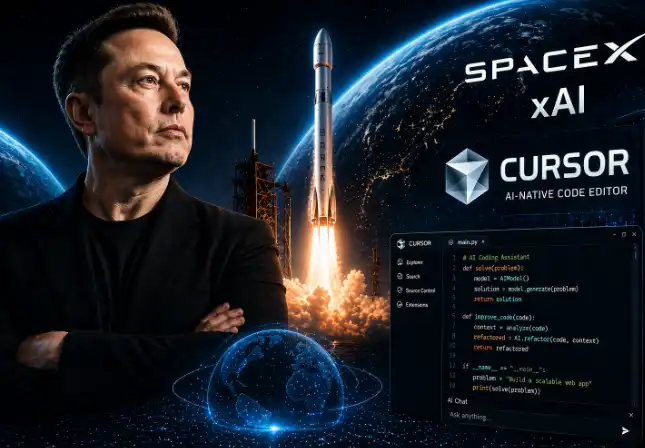
SpaceX has secured an option to acquire AI programming company Cursor for $60 billion, with an alternative clause requiring a $10 billion collaboration fee if the acquisition does not proceed. This structure is not merely a potential acquisition but a strategic move to control core access points in the AI era. The deal is designed as a flexible, dual-path arrangement, allowing SpaceX to either fully acquire Cursor or maintain a binding partnership through high-cost collaboration. This "option-style" approach minimizes immediate regulatory and integration risks while ensuring long-term alignment between the two companies. At its core, the transaction exchanges critical AI-era resources: SpaceX provides its Colossus supercomputing cluster—one of the world’s most powerful AI training infrastructures—while Cursor contributes its AI-native developer environment and strong product adoption. This synergy connects compute power, models, and application layers, forming a closed-loop AI capability stack. Cursor, founded in 2022, has achieved rapid growth with over $1 billion in annual revenue and widespread enterprise adoption. Its value lies in transforming software development through AI agents capable of coding, debugging, and system design—positioning it as a gateway to future software production. For SpaceX, this move is part of a broader strategy to evolve from a aerospace company into an AI infrastructure empire, integrating xAI, supercomputing, and chip manufacturing. Controlling Cursor fills a gap in its developer tooling layer, strengthening its AI narrative ahead of a potential IPO. The deal reflects a shift in AI competition from model superiority to ecosystem and entry-point control. With programming tools as a key battleground, securing developer loyalty becomes crucial for dominating the software production landscape. Risks include questions around Cursor’s valuation, technical integration challenges, and potential regulatory scrutiny. Nevertheless, the deal underscores a strategic bet: controlling both compute and software development access may redefine power dynamics in the AI-driven future.

marsbit1 saat önce

SpaceX Ties Up with Cursor: A High-Stakes AI Gambit of 'Lock First, Acquire Later'

marsbit1 saat önce

İşlemler

Spot
Futures

Popüler Makaleler

WAR Nasıl Satın Alınır

HTX.com’a hoş geldiniz! WeStarter (WAR) satın alma işlemlerini basit ve kullanışlı bir hâle getirdik. Adım adım açıkladığımız rehberimizi takip ederek kripto yolculuğunuza başlayın. 1. Adım: HTX Hesabınızı OluşturunHTX'te ücretsiz bir hesap açmak için e-posta adresinizi veya telefon numaranızı kullanın. Sorunsuzca kaydolun ve tüm özelliklerin kilidini açın. Hesabımı Aç2. Adım: Kripto Satın Al Bölümüne Gidin ve Ödeme Yönteminizi SeçinKredi/Banka Kartı: Visa veya Mastercard'ınızı kullanarak anında WeStarter (WAR) satın alın.Bakiye: Sorunsuz bir şekilde işlem yapmak için HTX hesap bakiyenizdeki fonları kullanın.Üçüncü Taraflar: Kullanımı kolaylaştırmak için Google Pay ve Apple Pay gibi popüler ödeme yöntemlerini ekledik.P2P: HTX'teki diğer kullanıcılarla doğrudan işlem yapın.Borsa Dışı (OTC): Yatırımcılar için kişiye özel hizmetler ve rekabetçi döviz kurları sunuyoruz.3. Adım: WeStarter (WAR) Varlıklarınızı SaklayınWeStarter (WAR) satın aldıktan sonra HTX hesabınızda saklayın. Alternatif olarak, blok zinciri transferi yoluyla başka bir yere gönderebilir veya diğer kripto para birimlerini takas etmek için kullanabilirsiniz.4. Adım: WeStarter (WAR) Varlıklarınızla İşlem YapınHTX'in spot piyasasında WeStarter (WAR) ile kolayca işlemler yapın.Hesabınıza erişin, işlem çiftinizi seçin, işlemlerinizi gerçekleştirin ve gerçek zamanlı olarak izleyin. Hem yeni başlayanlar hem de deneyimli yatırımcılar için kullanıcı dostu bir deneyim sunuyoruz.

137 Toplam GörüntülenmeYayınlanma 2024.12.11Güncellenme 2025.02.23

WAR Nasıl Satın Alınır

Tartışmalar

HTX Topluluğuna hoş geldiniz. Burada, en son platform gelişmeleri hakkında bilgi sahibi olabilir ve profesyonel piyasa görüşlerine erişebilirsiniz. Kullanıcıların WAR (WAR) fiyatı hakkındaki görüşleri aşağıda sunulmaktadır.

活动图片