Gold manages to recover from weekly low, rising to $4350

cryptonews.ru2026-08-19 tarihinde yayınlandı2026-08-19 tarihinde güncellendi

Özet

On Wednesday, gold prices rebounded from a sharp drop as U.S. Treasury yields declined and the dollar weakened, providing some respite for the precious metal. Spot gold rose to around $4,361 per ounce after falling nearly 2% on Tuesday, recovering from a weekly low. The recovery was supported by falling 10-year Treasury yields and a pullback in the U.S. dollar index, which made gold cheaper for holders of other currencies. Traders are now awaiting the release of the Federal Reserve's July meeting minutes for clues on future policy direction. While the Fed held rates steady at 3.50–3.75% last month, three members favored a hike, prompting market speculation about tighter policy. Currently, CME FedWatch suggests about a two-thirds probability of unchanged rates. Despite remaining below its January peak, gold has gained significantly in August, buoyed by weak U.S. economic data and shifting interest rate expectations.

Gold prices rose on Wednesday as US Treasury yields fell, providing the precious metal some respite after a sharp drop due to traders' anticipation of the release of the July Federal Reserve meeting minutes.
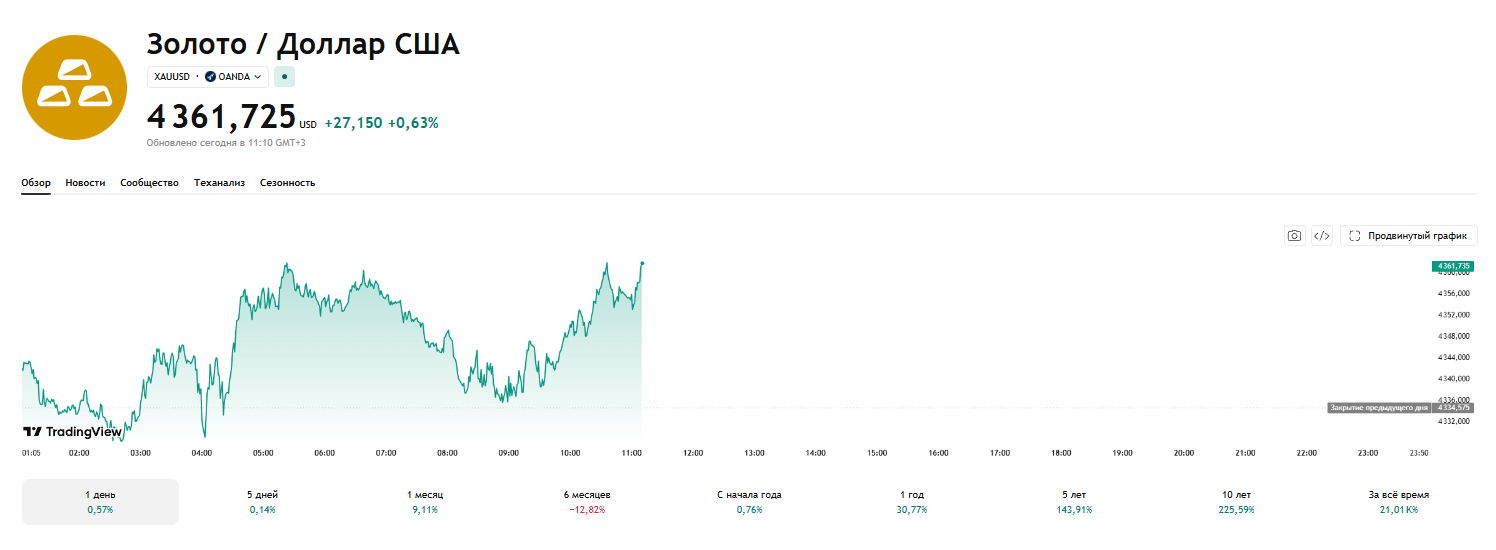
Source: TradingView

Spot gold traded around $4,350 per ounce during Asian trading hours after falling nearly 2% on Tuesday. At the time of writing, it had risen to $4,361, according to Tradingview. The recovery came against a backdrop of a decline in the 10-year Treasury yield to 4.70% and a 30-year bond yield near a 19-year high.

The US Dollar Index retreated from recent highs, which was a favorable factor for gold, the price of which is tied to the US currency. A weaker dollar makes gold cheaper for holders of other currencies and often leads to increased demand.

Investors are now awaiting the release of the minutes from the US Federal Reserve meeting held on July 28-29. At that time, the financial regulator kept the rate in the 3.50-3.75% range, with three committee members voting for an increase. Therefore, market participants are now looking for signals about the level of support for a more hawkish policy.

According to the latest CME FedWatch quotes, the probability of rates remaining unchanged is approximately two-thirds. While gold is still trading significantly below its January high, it has risen considerably in August as weak US economic data and interest rate expectations have prompted investors to return to the precious metal.

end-content

İlgili Sorular

QWhat happened to the price of gold on Wednesday according to the article?

AThe price of gold rose on Wednesday after a sharp drop, recovering to around $4,350 per ounce.

QWhat were the two key factors mentioned that contributed to the rise in gold prices?

AThe two key factors were a decline in US Treasury bond yields and a weakening of the US Dollar Index.

QWhat are investors currently awaiting, as mentioned in the article?

AInvestors are awaiting the release of the minutes from the Federal Reserve's July 28-29 meeting.

QWhat was the key interest rate decision made by the Fed at its July meeting?

AAt the July meeting, the Fed kept its key interest rate unchanged in the range of 3.50–3.75%.

QHow has gold performed in August despite trading below its January peak?

AGold has posted significant gains in August due to weak US economic data and shifting interest rate expectations.

İlgili Okumalar

SEC Proposal a ‘Significant’ Step Forward From ‘Ill-Suited’ Crypto Rules: Commissioner Peirce

A U.S. Securities and Exchange Commission (SEC) commissioner, Hester M. Peirce, has called a new SEC proposal a significant improvement over what she termed a "misfit" set of crypto rules. Peirce stated that a whole generation has struggled due to the SEC's insistence on applying unsuitable regulations to cryptocurrencies, but the new proposal moves toward "clear, sensible, and enforceable rules for crypto offerings." SEC Chairman Paul S. Atkins also welcomed the initiative, noting in a separate statement that the agency's previous enforcement-heavy approach had driven investment overseas, limiting investor protections domestically. The proposal, announced on Tuesday, outlines new rules aimed at creating a clear and purposeful framework for certain investment contracts involving crypto assets, designed to allow organizations to raise capital while protecting investors. This move comes shortly after the U.S. Senate failed to advance the comprehensive Digital Asset Market Clarity (CLARITY) Act. Atkins had previously stated the SEC was prepared to develop rules for digital assets if the Senate could not pass the CLARITY Act. Meanwhile, Galaxy Digital has lowered its estimated odds of the CLARITY Act passing by 2026 to just 10%, citing numerous unresolved policy questions and the Senate's limited time—only about two to three weeks after reconvening on September 14—to pass it.

cryptonews.ru14 dk önce

SEC Proposal a ‘Significant’ Step Forward From ‘Ill-Suited’ Crypto Rules: Commissioner Peirce

cryptonews.ru14 dk önce

13F Reveals New Signal: AI Has Not Faded, Wall Street Is Just Getting 'Pickier'

Title: 13F New Signal: AI Is Not Receding, Wall Street Just Became "Selective" Analysis of 13F filings from the second quarter of 2026, which disclose institutional holdings, reveals a key trend: the AI investment theme persists, but Wall Street is now scrutinizing opportunities more selectively rather than chasing the sector broadly. While nearly 44% of the 6,371 institutions analyzed reduced holdings in the "Magnificent Seven" tech giants, semiconductors saw net buying from 48% of institutions. This indicates the core AI infrastructure thesis remains intact. However, significant internal shifts are occurring as major funds prioritize "risk-reward" or "betting odds" over simple sector exposure. Four prominent investors exemplify this new selectivity: 1. **Berkshire Hathaway** made a major new bet on Alphabet, valuing its strong cash flow and core businesses despite AI-related uncertainties. 2. **Tiger Global** reduced crowded mega-cap tech positions (e.g., Alphabet, NVIDIA) but increased exposure to other AI-related names like AMD and semiconductor manufacturing, rebalancing within the theme. 3. **Third Point** fully exited several first-wave AI winners (NVIDIA, Broadcom) to lock in gains, reallocating to names like Alphabet and Taiwan Semiconductor, and diversifying into media and industrials. 4. **Duquesne Family Office** (Stanley Druckenmiller) also sold some semiconductor holdings while buying others (e.g., Taiwan Semiconductor), focusing on individual companies' valuation and expectation gaps rather than the sector beta. Key conclusions from the filings: * **Alphabet is becoming a "divisive asset"** with significant institutional disagreement, representing a potential source of alpha. * The **"buy any chip stock" phase is over**. Semiconductor investing is now an alpha game, requiring stock-specific analysis over blanket sector bets. * **Non-AI assets are reappearing** in portfolios (e.g., airlines, homebuilders, media) as diversification and correlation-management tools. In summary, the AI investment cycle has not ended, but the phase of easy, broad-based gains is concluding. The next phase will be defined by selective stock-picking and precise calculation of risk versus reward within the AI ecosystem.

marsbit38 dk önce

13F Reveals New Signal: AI Has Not Faded, Wall Street Is Just Getting 'Pickier'

marsbit38 dk önce

İşlemler

Spot
活动图片