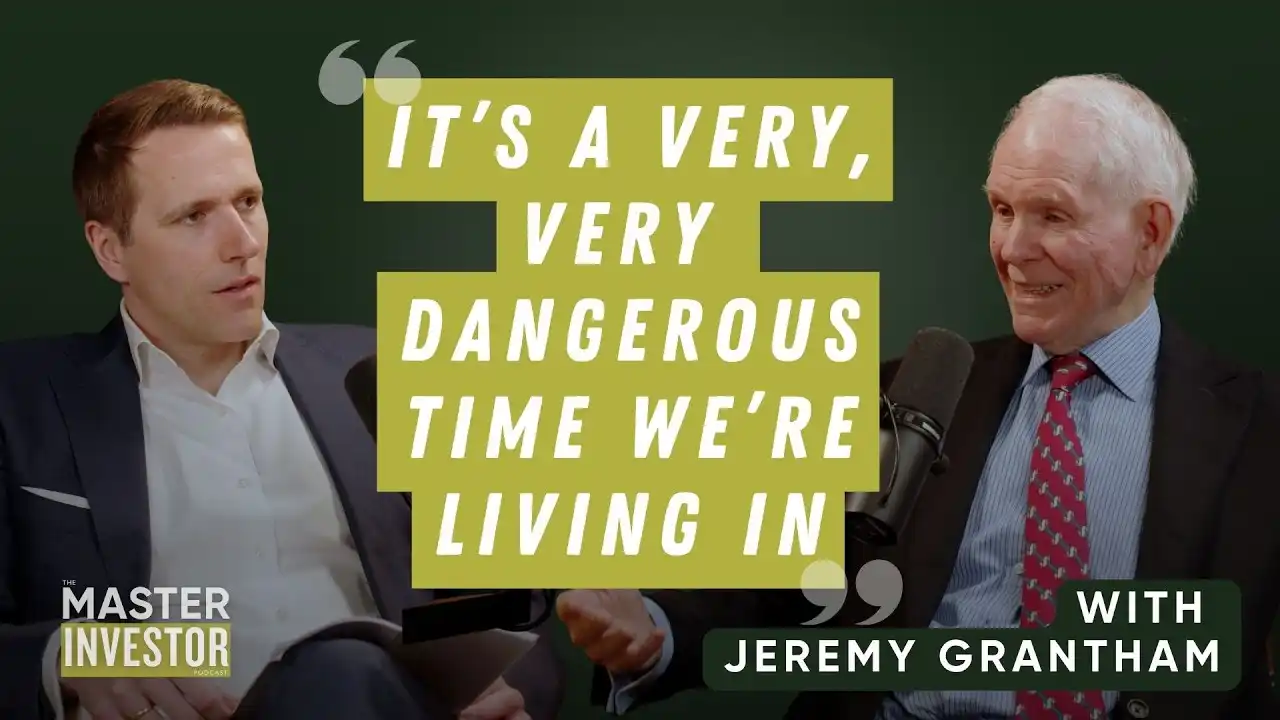
GMO Legendary Prophet Shorts Again: AI Can't Save U.S. Stocks, Current Market as Dangerous as 2000

marsbit2026-04-21 tarihinde yayınlandı2026-04-21 tarihinde güncellendi

Özet

Jeremy Grantham, co-founder of GMO and renowned for identifying major market bubbles, warns that the current U.S. stock market resembles the dangerous conditions of 2000, arguing that AI hype cannot prevent a significant downturn. He emphasizes that high valuations historically precede difficult periods, not higher growth, and cautions that despite AI-driven enthusiasm, underlying economic challenges—including geopolitical instability, climate costs, and demographic decline—are being ignored. Grantham notes that while non-U.S. equities appear reasonably priced, the U.S. market is excessively valued. He compares today’s AI narrative to the internet boom of 1999, stressing that expensive markets eventually correct. His approach relies on value investing principles, avoiding overpriced assets and focusing on long-term fundamentals rather than market timing. Grantham also highlights structural market inefficiencies, such as the persistent outperformance of high-quality stocks, and criticizes the financial industry for promoting optimism despite clear risks.

Source:"The Master Investor Podcast with Wilfred Frost" Podcast

Compiled by: Felix, PANews

Jeremy Grantham founded and led the Boston investment firm Grantham Mayo Van Otterloo (GMO) for decades. At the peak of his career, the assets under management reached $150 billion. In his nearly 60-year investment career, Jeremy accurately predicted almost all major stock market bubbles of the past 60 years, along with the subsequent rebounds, achieving long-term excess returns.

Recently, Jeremy was a guest on the "The Master Investor Podcast with Wilfred Frost" podcast. He focused on the current market environment, assessed the impact of the Iran war on oil prices, AI, meme stocks, and the "Magnificent Seven," and compared it to the boom periods of the 1970s, 1999, 2007, and the post-pandemic era. PANews has compiled the highlights of this conversation.

Host: Jeremy, welcome back to the podcast, great to see you in person.

Jeremy: Pleasure to be here. However, I must object to the word "prediction" you mentioned earlier. I am not predicting bubbles; I am merely pointing them out when they arrive. If I could foresee their arrival out of thin air, that would be convenient, but all I can do is wait for them to appear—and they always seem obvious. Then I say, "Look, it's there."

Host: Your book published this January, "The Making of a Permabear," mentions that you are also a Yorkshireman. Every qualified Yorkshireman is born knowing that "cheap is always better than expensive," which gave you a keen eye for finding good value. You also talked about your "butterfly effect" thinking pattern, where ideas and thoughts flit around like butterflies in a garden, seemingly lacking focus. Can you explain why this was important for you to become an investment thinker?

Jeremy: This might be a form of self-justification. I find it hard to stay on one specific topic for too long; I always tend to shift to another, which often annoys my colleagues. But the key is that I am quite persistent. Anyone who has observed gardening will see that this is exactly how butterflies work: you think they've flown away, but they might return to the same flower repeatedly over a day or two. I find brainstorming should work the same way. If you fixate too hard on one topic, you just make your brain rigid, like banging your head against a wall. The best method is to move around and then return to the original topic; then your brain is more open, and perhaps an epiphany will occur.

Host: You also wrote that working very hard can actually hinder thinking because you are too busy receiving new data. You rarely have time to truly think. Do today's investment professionals spend too much time on Excel spreadsheets or AI modeling? What do you mean by "truly thinking"?

Jeremy: Truly thinking is not about typing numbers into a spreadsheet. Truly thinking is taking a walk through Boston Common, or while showering, letting your brain operate at a comfortable walking pace, thinking about where we are now? What's happening? See what it concludes. In the past, when I arrived at the office, I usually already had two or three ideas (though most of my colleagues thought these ideas were stupid). I was lucky to have a colleague named Chris Darnell, the only person in the world who could convince me in 20 seconds that an idea was foolish. You really need such a combination: someone who generates a lot of absurd or superficial ideas, plus an "idea crusher" who can instantly spot fatal flaws and keep you moving forward. We would review 10 to 20 ideas to find one worth further research.

Host: On this point, you said in your book: "Getting the big picture right is everything. One or two good ideas a year is enough." Is this what gave you your legendary investment status?

Jeremy: Yes, there were many years when I didn't even have one good idea. But if your thinking is high-level enough, like "Will small-cap stocks win this year?", you don't need to be right too many times. Just knowing that small-cap stocks are strengthening is enough to support outperforming the market for three or four years. As long as you get the big direction right, it's actually not difficult.

Host: From a micro perspective, if I'm not mistaken, the real winning formula for you is basically the dividend discount model, plus some adjustments you make. This is the core of your focus, right?

Jeremy: Yes, the dividend discount model is just a tool we use to measure the quality of other ideas. It gives the ratio of relative fair value for different stocks, used to test if our intuition is correct. We have a dividend discount ratio for each stock. What is the ratio to fair value? If it's 0.79, it's undervalued by 21%. If it's 1.12, it's overvalued by 12%. Then we add them up and find that the sum of all small-cap stocks is very cheap, and vice versa. It provides us with a measuring tool to test if our intuition is correct. Very convenient.

Host: Here you obviously weigh value more heavily than other factors like growth and momentum. I imagine you also appreciate the importance of those other factors.

Jeremy: No, actually I have a secret respect for anything that works, no matter how absurd. Of course, momentum is a fairly simple inefficiency. It really shouldn't work. But it has been very effective throughout my entire investment career, and for a long time before that. And it still works in many forms today. It just shows that an object in motion tends to stay in motion for a while. Market efficiency scholars like the author of "A Random Walk Down Wall Street" said that price alone provides no information. That is completely wrong. I think the biggest inefficiency has always been the pricing of "quality". High quality means less debt, higher returns, stronger stability, and a smaller chance of bankruptcy. No matter how you torture the data, you cannot convince anyone that "quality" is a risk factor.

From an academic perspective, lower risk should mean lower returns; but in fact, quality stocks always outperform the market. Due to lower risk, they should underperform by about one percentage point per year, right? AAA-rated bonds yield about one percentage point less per year than B-rated bonds. Based on the same low-risk logic, AAA-rated stocks should too. But they don't; they outperform the market by about 0.5% per year. Therefore, due to market inefficiency, there is about 1.5% of free excess return per year. You get the privilege return of holding these high-quality large-cap stocks, and academia hasn't discovered and made a big deal about this for decades.

Host: Has the market become more efficient over time? Has your job become harder?

Jeremy: As my career has progressed, I tend to focus on increasingly grand problems, from individual stocks to sectors to the entire market. To talk about those absurd inefficiencies and bubbles, like those meme stocks that soar 6 times in a year, the market might be a bit worse now than ever before.

Host: Regarding your investment method, you once mentioned: "We could never make big money without first suffering painful losses. You need the confidence to hold positions when they go against you and to add weight when they become more attractive. It is value that gives you this confidence." This must be very difficult.

Jeremy: It is indeed very difficult; you must believe in the data. If you want to capture those once-in-a-century super bubbles, you often have to go through an ordinary bubble that appears every 15 years first. If you want to make big money, you must watch the market go from "overpriced" to "extremely overpriced" to "oh my god, ridiculously overpriced." Only at that turning point can you make big money. But before that, you will endure immense pain. For example, in 2000, the market fell 50%, but our portfolio achieved substantial gains over three years.

Host: Many people say it's impossible to time the market. I think that's true at the individual stock level, but I admire the bold positions you take.

Jeremy: No, I don't think this is timing the market. I think this is just exiting obviously overpriced stocks and always focusing on those that are cheap. Every time you buy a small-cap stock, someone might say, "Oh, you're timing that stock. Is that it? Or is it that if you hold cheaper stocks, you will always win in the long run?" So, don't hold your ground in a severely overpriced stock market unless you eventually want to take a heavy punch. Of course, others will outperform you during this period, but in the long run, you will win.

Host: In the first 9 years after founding GMO, you achieved an excess return of 8% per year, which is amazing performance.

Jeremy: Compared to Buffett achieving 9% excess returns over a longer period, our results only make one realize how incredible Buffett is. Buffett made making money a simple and fun goal. And Jack Bogle (father of index funds) got the medal for "doing the most useful thing in investing" for saving tens of billions of dollars for millions of investors.

Host: Compare the historical bubbles. In 1999, clients complained to you about underperformance. At that time, you said "value is off the charts, TIPS yields are 4%, real estate investment trusts (REITs) are trading at a discount." Can you apply all this to today?

Jeremy: No. The 2000 one was great because it gave you many safe havens. Real estate investment trusts (REITs) were selling for even less than construction costs. Right at the market peak, the S&P 500's yield dropped to 1.6%, a low level not even seen in 1929. That was the situation then. Small-cap stocks were cheap then.

Then you look at other markets, like the 2007 real estate bubble, there was almost nowhere to hide. That was a risk bubble. All risky assets were overpriced. In 2008, there were no obviously cheap assets. The current market is somewhere in between; it's more like 2000. Half the time during bubbles you have excellent alternatives, the other half you don't. For this time, I remember saying on a podcast early last year that we have no bias against non-US stocks. We won't touch the US stock market, but the rest of the world: emerging markets, Europe, Australia, Canada, their stock market valuations are extremely reasonable.

Host: In 1999, many people talked about the productivity and GDP boost from the internet, just like everyone talks about AI today. Why is this bullish logic foolish?

Jeremy: There is no necessary relationship between high market prices in the past and future growth. In every bull market, people say the future must be bright, otherwise market prices wouldn't be so high, but the opposite is true. If you ask what the three or four worst periods in history were, they are not randomly distributed; they came right after huge bubbles. The Great Depression came right after the famous 1929 peak. Japan's "Lost Decade," "Lost Two Decades" came right after the astonishing 65 P/E ratio in 1989. There is no historical example where a high P/E ratio meant higher profits, faster growth, or higher productivity. What they truly预示 (portend) is the arrival of difficult times. If there ever was a possibility of this happening, it is now.

The current situation is that we are doing everything wrong. We are doing our utmost to mess up the beautiful growth of post-war international trade with tariffs and trade wars. We are doing our utmost to破坏 (undermine) geopolitical stability,破坏 (undermine) our relations with countries like Russia and China. I'm sure these relations have been worse at some times and with one side, but getting worse with both sides simultaneously is distinctly unsettling. Billion-dollar losses from floods, droughts, and fires are so frequent that they might shave 0.5% off global GDP annually, and the situation keeps worsening; then population begins to decline, in some countries like Japan, South Korea, China, the population is falling like a stone, and this trend will remain visible. So, the world will have to get used to slowing labor force growth.

Host: With the outbreak of the Iran conflict and its obvious impact on oil prices and inflation, does it remind you of some challenges from the 1970s?

Jeremy: Yes, as a species, humans have a tendency to wishful thinking. We are very good at wishful thinking. If you study the stock market now and in the past, you will conclude that given half a chance, we will interpret the future generously and say how good things will be. If economic data is bad, we say "Great, this gives the Fed an excuse to cut rates," and the market rises. If economic growth is good, we say "Great, profits will be high," and the market rises again. So the market is always looking for optimistic excuses and overinterprets good news.

We tend to extrapolate linearly and persistently. For example, in the summer of 1929, the economic situation was good; if you extrapolated persistently, people would expect an outrageously high P/E ratio. Then in 2000, profit margins reached historical highs, the P/E ratio was 35, and stock prices even rose to four times book value. These phenomena are not complicated, but most people failed to notice them. Why didn't these warnings make front-page news? Because it's not a business strategy. Any large company in the financial领域 (sector) must always tell you everything is fine, then lead everyone off the cliff and make as much money as possible cleaning up the mess. Goldman Sachs, JPMorgan Chase, Morgan Stanley—these companies would never tell you to get out of the market because market pricing is terrifyingly high. And they can all see that the pricing is terrifyingly high. So don't think the market is priced reasonably just because no professionals are telling you to sell; that is not the actual situation.

I often use an analogy: it's like dropping a bag of feathers from a high-rise in Miami on a hurricane day. In the short term, you absolutely don't know where those feathers will be blown. But you can be absolutely sure of one thing: eventually every single feather will fall to the ground. For me, "value" is equivalent to gravity. No matter how high you fly now, sooner or later, being expensive will make you pay the price.

Host: You wrote in your book about the strangest condition for a bubble burst: "When the previous market leaders fall sharply, but the broader market led by blue chips continues to rise." This happened in 1929, 1972, and 2000. Considering the MAG 7 (Magnificent Seven tech giants) have lost upward momentum in the past few months, but the rest of the market remains firm, would you add late 2025, early 2026 to that list?

Jeremy: Perhaps I should add it. Although I haven't added it before, I think I've been busy with the book tour. But I would also add 2021 to that list. Many speculative and unprofitable stocks started falling after their strong performance post the COVID-19 low, while the broader market kept rising, leading to a 25% drop in the S&P 500 in 2022 and a 40% drop in MAG 7 stocks. But then ChatGPT appeared. Without the AI investment frenzy, we might have already fallen into a mild or moderate recession, and the broader market might have fallen 40% or more. AI was like discovering railroads in 1930, forcibly扼杀 (strangling) a real bear market.

Host: In March 2009, you published the famous "Reinvesting in Fear." How did you judge when to enter the market when there was extreme panic?

Jeremy: That's because I was familiar with the panic of 1974, the fear that put the market in "ultimate paralysis." In 2009, I advocated making a plan, even a bad plan is better than paralysis. You must understand: the market's turning point does not appear when people see "light at the end of the tunnel," but when "everything looks pitch black, but just a tiny bit less black than the day before." Although it didn't reach the absolute low valuation of 1974, according to our dividend discount model, it was very cheap, destined to provide丰厚 (rich) returns far exceeding historical averages over the next 7 years (actual return reached 12%).

Related reading:Dialogue with Bitwise Advisor: From K-Shaped Economy to AI Stealing Jobs, How Can Bitcoin Save Young People?


Trend Kriptolar

İlgili Sorular

QAccording to Jeremy Grantham, why is the current market environment similar to the year 2000?

AHe states that the current market is similar to 2000 because, like then, there are excellent alternative investment opportunities outside of the overpriced US market, such as in emerging markets, Europe, Australia, and Canada, which have extremely reasonable valuations.

QWhat is Jeremy Grantham's view on the role of AI in the current market rally?

AGrantham believes that the AI investment boom has artificially propped up the market. He suggests that without the AI hype, the market might have already fallen into a moderate or even severe recession, with the S&P 500 potentially dropping 40% or more.

QHow does Jeremy Grantham describe the process of 'real thinking' in investing?

AHe describes 'real thinking' as not inputting numbers into a spreadsheet, but rather letting the mind work at a comfortable walking pace, such as by taking a walk through a park or during a shower, to contemplate the current situation and see what insights emerge.

QWhat does Jeremy Grantham identify as the greatest market inefficiency throughout his career?

AHe identifies the mispricing of 'quality' as the greatest inefficiency. High-quality stocks, which are less risky with lower debt and higher returns, consistently outperform the market, contrary to academic theory which suggests lower risk should yield lower returns.

QAccording to Grantham, when is the best time to enter the market during a crash?

AThe best time to enter is not when people see 'light at the end of the tunnel,' but at the moment when 'everything looks pitch black but is just a tiny bit less black than the day before.' This is the turning point when fear is at its peak and valuations are very cheap.

İlgili Okumalar

After Three Consecutive Quarters of Decline, Can the Crypto Market Find a Window for Stabilization in Q3?

The cryptocurrency market has just concluded its worst-performing quarter since 2022, with total capitalization dropping 12.6% to $2.1 trillion. All core metrics indicate capital is leaving the sector, not just rotating within it. Bitcoin fell 14.2% and Ethereum dropped 25.4% in Q2, breaking their previous correlation with US tech stocks. A key driver is the reversal in US spot Bitcoin ETF flows, which saw a net outflow of approximately $4.67 billion in Q2, including a record monthly outflow near $4.5 billion in June. While recent data suggests long-term holders are accumulating again, sustained ETF outflows mean continued selling pressure. Market focus is now singularly on the Federal Reserve. The upcoming July FOMC meeting is seen as the most critical event for Q3. A dovish signal could support Bitcoin reclaiming a $68,000-$84,000 range, while a hawkish stance might establish a new trading band around $50,000-$56,000. Additionally, regulatory uncertainty persists, with the progress of the crucial *CLARITY Act* stalling in the Senate, reducing its perceived 2026 passage probability to 40-45%. Despite the broad downturn, a few sectors showed growth. Prediction markets saw nominal volume surge 48.7% year-over-year to $113.8 billion, and tokenized collectibles transaction volume rose 143% quarterly to $1.4 billion. The Real-World Asset (RWA) tokenization sector also continued steady growth, now representing ~$28.1 billion in on-chain value. The market's foundation for an extreme crash appears limited, with Bitcoin price hovering near its 200-week moving average. However, the trading paradigm has shifted from narrative-driven speculation to decisions based on price action, policy developments, and interest rate expectations, making a broad sentiment-driven rally unlikely in the near term.

marsbit1 saat önce

After Three Consecutive Quarters of Decline, Can the Crypto Market Find a Window for Stabilization in Q3?

marsbit1 saat önce

BIT Trading Moment: BTC Still Suppressed by Weekly 200 EMA, Rejection May Restart Decline; Storage and Semiconductors that Surged Last Night Begin Falling in Evening Trading

**Crypto & Stock Market Wrap: Bitcoin Tests Resistance, Stocks Retreat After AI Surge** Bitcoin consolidates around $66,000, facing key resistance near $68,000—an area seen as a major psychological and technical hurdle where previous rallies have failed. Analysts note the cryptocurrency is caught between its 200-week moving average (~$63,333) and 200-week EMA (~$68,328). A clear break above $68k is needed to signal a stronger bullish trend, while a rejection could lead to a retest of $63k support. Market sentiment remains cautious, with low futures open interest pointing to a low-liquidity rebound rather than a full bull market. Bitcoin spot ETFs saw another $203 million inflow. US stock futures pointed lower after a strong Tuesday session led by a massive rebound in semiconductors and memory stocks. The rally was fueled by renewed optimism about AI-driven hardware demand, with Micron, SanDisk, and SK Hynix surging. However, those gains reversed in pre-market trading. Super Micro Computer (SMCI) soared over 20% after hours on strong guidance and a record backlog. Other standouts included Rocket Lab and nuclear energy plays Oklo and X-Energy. Rising oil prices (Brent above $91) and climbing Treasury yields (10-year near 4.64%), however, are reigniting inflation concerns and acting as a headwind for equities. In Asia, markets were mixed. South Korea's KOSPI pared early gains to close slightly higher as semiconductor stocks like SK Hynix gave back initial surges. Japan's Nikkei edged lower as the yen hit a fresh 38-year low against the dollar, raising fears of potential market intervention. Key events to watch include the Samsung Galaxy launch, AMD's AI event, and a slew of major tech earnings from Alphabet, Tesla, and IBM after the close on Wednesday, followed by the ECB meeting and Intel's earnings on Thursday.

marsbit1 saat önce

BIT Trading Moment: BTC Still Suppressed by Weekly 200 EMA, Rejection May Restart Decline; Storage and Semiconductors that Surged Last Night Begin Falling in Evening Trading

marsbit1 saat önce

Former CFTC Chairman, Circle President Tarbert: Preaching Long-Termism While Cashing Out $30 Million Himself

Former CFTC Chairman and Circle President Heath Tarbert has consistently advocated for a long-term vision in public, urging patience from investors as Circle’s stock price has fallen significantly from its peak. However, it has been revealed that since Circle’s IPO, Tarbert has continuously sold his CRCL shares through pre-arranged trading plans, cashing out approximately $30 million, without making any public market purchases. This contrast between his public messaging and personal actions has drawn criticism. Tarbert joined Circle in July 2023 as Chief Legal Officer, leveraging his regulatory experience to help guide the company through its IPO and expansion. Despite promoting stablecoins as long-term infrastructure, he established a 10b5-1 trading plan just before Circle went public, leading to substantial stock sales over the following year. In March 2026, he initiated another plan to sell more shares. His career trajectory highlights a pattern of moving between high-level regulatory roles and influential positions in the financial sector. After resigning as CFTC Chairman in early 2021, he joined Citadel Securities as Chief Legal Officer just 27 days later, during a period of intense regulatory scrutiny for the firm. He later joined Circle, aiding its efforts to navigate regulatory challenges for its public listing. While Tarbert's expertise in policy and compliance is valuable to companies like Circle, his actions—advocating long-term confidence while personally divesting—raise questions about the alignment between his public statements and his private financial decisions, leaving investors who followed his advice to bear the market risks.

marsbit1 saat önce

Former CFTC Chairman, Circle President Tarbert: Preaching Long-Termism While Cashing Out $30 Million Himself

marsbit1 saat önce

Gate Research Institute: The 'Wall Street-ization' Wave of Crypto Financial Products – Competition or Integration?

The article titled "Gate Research Institute: Are Crypto Financial Products Sparking a 'Wall Street' Wave—Competition or Convergence?" explores the evolving relationship between the crypto ecosystem and traditional finance (TradFi). The piece begins by reflecting on Bitcoin's original 2009 vision of decentralization, disintermediation, and moving away from banks. It then contrasts this with the 2024 landscape, where key crypto assets like Bitcoin are increasingly held through Wall Street products like ETFs issued by giants like BlackRock. The article questions whether this signifies that TradFi is systematically taking over the rights to issue, price, custody, and distribute crypto financial assets. The core argument is that this is not a zero-sum takeover but rather a bidirectional convergence where each side addresses the other's weaknesses. Crypto offers 24/7 global markets, programmable settlement, and open access but lacks compliant channels, institutional-grade custody, deep fiat liquidity, and mainstream distribution. TradFi possesses these but is constrained by legacy systems, limited operating hours, and slow settlement. Two primary convergence paths are highlighted: * **Path A (CEX to TradFi):** Exemplified by Gate, which has progressed from offering tokenized stocks and CFDs to providing direct, real stock trading (US, Hong Kong, South Korea) within its platform, using USDT. * **Path B (TradFi to Crypto):** Exemplified by Robinhood, which has integrated crypto trading, acquired exchanges like Bitstamp, and is moving traditional assets like stocks onto the blockchain via tokenization and its own Layer 2. Both paths are ultimately competing to become the next-generation, unified financial account—a "super account" where users can seamlessly trade cryptocurrencies, stocks, ETFs, RWA (Real World Assets), and tokenized treasury products in one interface. The growth of RWA and tokenized treasuries (e.g., BlackRock's BUIDL) is presented as the asset-layer fusion, providing stable, yield-bearing assets on-chain and acting as a bridge between the two worlds. In conclusion, the "Wall Street-ization" of crypto is framed as a mutual transformation. Decentralized ideals persist in the protocol layer, while at the application layer, a more efficient, global, and accessible unified capital market is emerging from this convergence. The future competition lies not between crypto exchanges and stockbrokers, but between platforms vying to offer the most comprehensive asset coverage, liquidity, and user experience within a single account.

marsbit2 saat önce

Gate Research Institute: The 'Wall Street-ization' Wave of Crypto Financial Products – Competition or Integration?

marsbit2 saat önce

İşlemler

Spot

Popüler Makaleler

GROK AI Nedir

Grok AI: Web3 Döneminde Konuşma Teknolojisini Devrim Niteliğinde Yenilik Giriş Hızla gelişen yapay zeka alanında, Grok AI, ileri teknoloji ve kullanıcı etkileşimi alanlarını birleştiren dikkate değer bir proje olarak öne çıkıyor. Ünlü girişimci Elon Musk'ın liderliğindeki xAI tarafından geliştirilen Grok AI, yapay zeka ile etkileşim şeklimizi yeniden tanımlamayı hedefliyor. Web3 hareketi devam ederken, Grok AI, karmaşık sorgulara yanıt vermek için konuşma yapay zekasının gücünden yararlanmayı amaçlıyor ve kullanıcılara sadece bilgilendirici değil, aynı zamanda eğlenceli bir deneyim sunuyor. Grok AI Nedir? Grok AI, kullanıcılarla dinamik bir şekilde etkileşimde bulunmak üzere tasarlanmış sofistike bir konuşma yapay zeka sohbet botudur. Birçok geleneksel yapay zeka sisteminin aksine, Grok AI, genellikle uygunsuz veya standart yanıtların dışında kabul edilen daha geniş bir sorgu yelpazesini benimsemektedir. Projenin temel hedefleri şunlardır: Güvenilir Akıl Yürütme: Grok AI, bağlamsal anlayışa dayalı mantıklı yanıtlar sağlamak için sağduyu akıl yürütmeyi vurgular. Ölçeklenebilir Denetim: Araç yardımı entegrasyonu, kullanıcı etkileşimlerinin hem izlenmesini hem de kalite için optimize edilmesini sağlar. Resmi Doğrulama: Güvenlik en önemli önceliktir; Grok AI, çıktılarının güvenilirliğini artırmak için resmi doğrulama yöntemlerini entegre eder. Uzun Bağlam Anlayışı: AI modeli, kapsamlı konuşma geçmişini saklama ve hatırlama konusunda mükemmel bir performans sergileyerek anlamlı ve bağlamsal olarak farkında tartışmaların yapılmasını kolaylaştırır. Saldırgan Dayanıklılık: Manipüle edilmiş veya kötü niyetli girdilere karşı savunmalarını geliştirmeye odaklanarak, Grok AI kullanıcı etkileşimlerinin bütünlüğünü korumayı hedefler. Özünde, Grok AI sadece bir bilgi alma cihazı değil; dinamik diyalogu teşvik eden, etkileyici bir konuşma partneridir. Grok AI'nın Yaratıcısı Grok AI'nın arkasındaki beyin, otomotiv, uzay yolculuğu ve teknoloji gibi çeşitli alanlarda yenilikle özdeşleşen Elon Musk'tır. Yapay zeka teknolojisini faydalı yollarla geliştirmeye odaklanan xAI çatısı altında, Musk'ın vizyonu, yapay zeka etkileşimlerinin anlaşılmasını yeniden şekillendirmeyi amaçlıyor. Liderlik ve temel etik, Musk'ın teknolojik sınırları zorlamaya olan bağlılığı tarafından derinden etkilenmektedir. Grok AI'nın Yatırımcıları Grok AI'yi destekleyen yatırımcılarla ilgili spesifik detaylar sınırlı kalmakla birlikte, projenin kuluçka merkezi olan xAI'nin, esasen Elon Musk tarafından kurulduğu ve desteklendiği kamuya açık bir şekilde kabul edilmektedir. Musk'ın önceki girişimleri ve mülkleri, Grok AI'nın güvenilirliğini ve büyüme potansiyelini daha da artıran sağlam bir destek sağlar. Ancak, şu anda Grok AI'yı destekleyen ek yatırım fonları veya kuruluşlarıyla ilgili bilgiye kolayca erişim sağlanamamaktadır; bu da potansiyel gelecekteki keşif alanını işaret etmektedir. Grok AI Nasıl Çalışır? Grok AI'nın operasyonel mekanikleri, kavramsal çerçevesi kadar yenilikçidir. Proje, benzersiz işlevselliklerini kolaylaştıran birkaç son teknoloji ürünü teknolojiyi entegre eder: Sağlam Altyapı: Grok AI, konteyner orkestrasyonu için Kubernetes, performans ve güvenlik için Rust ve yüksek performanslı sayısal hesaplama için JAX kullanılarak inşa edilmiştir. Bu üçlü, sohbet botunun verimli çalışmasını, etkili bir şekilde ölçeklenmesini ve kullanıcılara zamanında hizmet vermesini sağlar. Gerçek Zamanlı Bilgi Erişimi: Grok AI'nın ayırt edici özelliklerinden biri, X platformu (önceden Twitter olarak biliniyordu) aracılığıyla gerçek zamanlı verilere erişim yeteneğidir. Bu yetenek, yapay zekaya en son bilgilere erişim sağlar ve diğer yapay zeka modellerinin gözden kaçırabileceği zamanında yanıtlar ve öneriler sunmasına olanak tanır. İki Etkileşim Modu: Grok AI, kullanıcılara “Eğlenceli Mod” ve “Normal Mod” arasında seçim yapma imkanı sunar. Eğlenceli Mod, daha eğlenceli ve mizahi bir etkileşim tarzı sağlarken, Normal Mod, kesin ve doğru yanıtlar vermeye odaklanır. Bu çok yönlülük, çeşitli kullanıcı tercihlerine hitap eden özelleştirilmiş bir deneyim sağlar. Özünde, Grok AI performansı etkileşimle birleştirerek, hem zenginleştirici hem de eğlenceli bir deneyim yaratmaktadır. Grok AI'nın Zaman Çizelgesi Grok AI'nın yolculuğu, gelişim ve dağıtım aşamalarını yansıtan önemli dönüm noktalarıyla işaretlenmiştir: İlk Geliştirme: Grok AI'nın temel aşaması, modelin ilk eğitim ve ince ayarının yapıldığı yaklaşık iki ay boyunca gerçekleşmiştir. Grok-2 Beta Yayını: Önemli bir ilerleme olarak, Grok-2 beta duyurulmuştur. Bu sürüm, sohbet etme, kodlama ve akıl yürütme yetenekleriyle donatılmış iki versiyon—Grok-2 ve Grok-2 mini—sunmuştur. Halka Açık Erişim: Beta geliştirmesinin ardından, Grok AI X platformu kullanıcılarına sunulmuştur. Telefon numarasıyla doğrulanan ve en az yedi gün aktif olan hesap sahipleri, sınırlı bir versiyona erişim sağlayarak teknolojiyi daha geniş bir kitleye ulaştırmaktadır. Bu zaman çizelgesi, Grok AI'nın kuruluşundan kamu etkileşimine kadar sistematik büyümesini kapsar ve sürekli iyileştirme ve kullanıcı etkileşimine olan bağlılığını vurgular. Grok AI'nın Ana Özellikleri Grok AI, yenilikçi kimliğine katkıda bulunan birkaç ana özelliği kapsamaktadır: Gerçek Zamanlı Bilgi Entegrasyonu: Güncel ve ilgili bilgilere erişim, Grok AI'yı birçok statik modelden ayırarak, etkileyici ve doğru bir kullanıcı deneyimi sağlar. Çeşitli Etkileşim Tarzları: Farklı etkileşim modları sunarak, Grok AI çeşitli kullanıcı tercihlerine hitap eder ve yapay zeka ile konuşurken yaratıcılığı ve kişiselleştirmeyi teşvik eder. Gelişmiş Teknolojik Altyapı: Kubernetes, Rust ve JAX kullanımı, projeye güvenilirlik ve optimal performans sağlamak için sağlam bir çerçeve sunar. Etik Tartışma Dikkati: Görüntü üreten bir işlevin dahil edilmesi, projenin yenilikçi ruhunu sergiler. Ancak, aynı zamanda tanınabilir figürlerin saygılı bir şekilde tasvir edilmesi ve telif hakkı ile ilgili etik konuları da gündeme getirir—bu, yapay zeka topluluğunda süregelen bir tartışmadır. Sonuç Konuşma yapay zekası alanında öncü bir varlık olarak Grok AI, dijital çağda dönüştürücü kullanıcı deneyimlerinin potansiyelini kapsar. xAI tarafından geliştirilen ve Elon Musk'ın vizyoner yaklaşımıyla yönlendirilen Grok AI, gerçek zamanlı bilgiyi gelişmiş etkileşim yetenekleriyle birleştirir. Yapay zekanın neler başarabileceği konusunda sınırları zorlamayı hedeflerken, etik konulara ve kullanıcı güvenliğine odaklanmayı sürdürmektedir. Grok AI, sadece teknolojik ilerlemeyi değil, aynı zamanda Web3 manzarasında yeni bir konuşma paradigmasını da temsil eder ve kullanıcılara hem yetkin bilgi hem de eğlenceli etkileşim sunma vaadinde bulunur. Proje gelişmeye devam ederken, teknolojinin, yaratıcılığın ve insan benzeri etkileşimin kesişim noktasında nelerin başarılabileceğinin bir kanıtı olarak durmaktadır.

468 Toplam GörüntülenmeYayınlanma 2024.12.26Güncellenme 2024.12.26

GROK AI Nedir

ERC AI Nedir

Euruka Tech: $erc ai ve Web3'teki Hedefleri Üzerine Bir Genel Bakış Giriş Blockchain teknolojisi ve merkeziyetsiz uygulamaların hızla gelişen manzarasında, her biri benzersiz hedefler ve metodolojilerle yeni projeler sıkça ortaya çıkmaktadır. Bu projelerden biri, kripto para ve Web3 alanında faaliyet gösteren Euruka Tech'tir. Euruka Tech'in, özellikle $erc ai token'ının ana odak noktası, merkeziyetsiz teknolojinin büyüyen yeteneklerinden yararlanmak için tasarlanmış yenilikçi çözümler sunmaktır. Bu makale, Euruka Tech'in kapsamlı bir genel görünümünü, hedeflerini, işlevselliğini, yaratıcısının kimliğini, potansiyel yatırımcılarını ve Web3'teki daha geniş bağlam içindeki önemini keşfetmeyi amaçlamaktadır. Euruka Tech, $erc ai Nedir? Euruka Tech, Web3 ortamının sunduğu araçlar ve işlevsellikleri kullanan bir proje olarak tanımlanmaktadır ve operasyonlarında yapay zekayı entegre etmeye odaklanmaktadır. Projenin çerçevesine dair spesifik detaylar biraz belirsiz olsa da, kullanıcı etkileşimini artırmayı ve kripto alanındaki süreçleri otomatikleştirmeyi amaçlamaktadır. Proje, yalnızca işlemleri kolaylaştırmakla kalmayıp, aynı zamanda yapay zeka aracılığıyla öngörücü işlevsellikleri de entegre eden merkeziyetsiz bir ekosistem yaratmayı hedeflemektedir; bu nedenle token'ının adı $erc ai'dir. Amaç, büyüyen Web3 alanında daha akıllı etkileşimleri ve verimli işlem işleme süreçlerini kolaylaştıran sezgisel bir platform sunmaktır. Euruka Tech'in Yaratıcısı Kimdir, $erc ai? Şu anda, Euruka Tech'in arkasındaki yaratıcı veya kurucu ekip hakkında bilgi verilmemiştir ve bu durum biraz belirsizdir. Bu veri eksikliği, ekibin geçmişi hakkında bilgi sahibi olmanın genellikle blockchain sektöründe güvenilirlik oluşturmak için gerekli olduğu endişelerini doğurmaktadır. Bu nedenle, somut detaylar kamuya sunulana kadar bu bilgiyi bilinmeyen olarak sınıflandırdık. Euruka Tech'in Yatırımcıları Kimlerdir, $erc ai? Benzer şekilde, Euruka Tech projesinin yatırımcıları veya destekleyen organizasyonları hakkında mevcut araştırmalarla kolayca sağlanan bir bilgi yoktur. Euruka Tech ile etkileşimde bulunmayı düşünen potansiyel paydaşlar veya kullanıcılar için kritik bir unsur, kurumsal finansal ortaklıklar veya saygın yatırım firmalarından gelen destekle sağlanan güvencedir. Yatırım ilişkileri hakkında açıklamalar olmadan, projenin finansal güvenliği veya sürdürülebilirliği hakkında kapsamlı sonuçlar çıkarmak zordur. Bulunan bilgilere paralel olarak, bu bölüm de bilinmeyen durumundadır. Euruka Tech, $erc ai Nasıl Çalışır? Euruka Tech için detaylı teknik spesifikasyonların eksik olmasına rağmen, yenilikçi hedeflerini göz önünde bulundurmak önemlidir. Proje, yapay zekanın hesaplama gücünden yararlanarak kripto para ortamında kullanıcı deneyimini otomatikleştirmeyi ve geliştirmeyi hedeflemektedir. AI'yi blockchain teknolojisiyle entegre ederek, Euruka Tech otomatik ticaret, risk değerlendirmeleri ve kişiselleştirilmiş kullanıcı arayüzleri gibi özellikler sunmayı amaçlamaktadır. Euruka Tech'in yenilikçi özü, kullanıcılar ile merkeziyetsiz ağların sunduğu geniş olanaklar arasında kesintisiz bir bağlantı yaratma hedefinde yatmaktadır. Makine öğrenimi algoritmaları ve AI kullanarak, ilk kez kullanıcı zorluklarını en aza indirmeyi ve Web3 çerçevesindeki işlem deneyimlerini düzene sokmayı amaçlamaktadır. AI ve blockchain arasındaki bu simbiyoz, $erc ai token'ının önemini vurgulamakta ve geleneksel kullanıcı arayüzleri ile merkeziyetsiz teknolojilerin gelişmiş yetenekleri arasında bir köprü işlevi görmektedir. Euruka Tech, $erc ai Zaman Çizelgesi Maalesef, Euruka Tech hakkında mevcut olan sınırlı bilgiler nedeniyle, projenin yolculuğundaki önemli gelişmeler veya kilometre taşları hakkında detaylı bir zaman çizelgesi sunamıyoruz. Genellikle bir projenin evrimini haritalamak ve büyüme eğrisini anlamak için değerli olan bu zaman çizelgesi şu anda mevcut değildir. Önemli olaylar, ortaklıklar veya işlevsel eklemeler hakkında bilgiler belirgin hale geldikçe, güncellemeler kesinlikle Euruka Tech'in kripto alanındaki görünürlüğünü artıracaktır. Diğer “Eureka” Projeleri Üzerine Açıklama Birden fazla projenin ve şirketin “Eureka” benzeri bir isimlendirmeye sahip olduğunu belirtmek önemlidir. Araştırmalar, robotlara karmaşık görevler öğretmeye odaklanan NVIDIA Research'ten bir AI ajanı gibi girişimleri, ayrıca eğitim ve müşteri hizmetleri analitiğinde kullanıcı deneyimini geliştiren Eureka Labs ve Eureka AI'yi tanımlamıştır. Ancak, bu projeler Euruka Tech'ten farklıdır ve hedefleri veya işlevleri ile karıştırılmamalıdır. Sonuç Euruka Tech, $erc ai token'ı ile birlikte, Web3 manzarasında umut verici ancak şu anda belirsiz bir oyuncuyu temsil etmektedir. Yaratıcısı ve yatırımcıları hakkında detaylar açıklanmamış olsa da, yapay zekayı blockchain teknolojisiyle birleştirme konusundaki temel hedefi ilgi odağı olmaktadır. Projenin, gelişmiş otomasyon aracılığıyla kullanıcı etkileşimini teşvik etme konusundaki benzersiz yaklaşımları, Web3 ekosistemi ilerledikçe onu farklı kılabilir. Kripto piyasası gelişmeye devam ederken, paydaşların Euruka Tech etrafındaki gelişmelere dikkat etmeleri önemlidir; belgelenmiş yeniliklerin, ortaklıkların veya tanımlanmış bir yol haritasının gelişimi, önümüzdeki dönemde önemli fırsatlar sunabilir. Şu an itibarıyla, Euruka Tech'in potansiyelini ve rekabetçi kripto manzarasındaki konumunu açığa çıkarabilecek daha somut içgörüler beklemekteyiz.

443 Toplam GörüntülenmeYayınlanma 2025.01.02Güncellenme 2025.01.02

ERC AI Nedir

DUOLINGO AI Nedir

DUOLINGO AI: Dil Öğrenimini Web3 ve AI İnovasyonu ile Entegre Etmek Teknolojinin eğitimi yeniden şekillendirdiği bir çağda, yapay zeka (AI) ve blok zinciri ağlarının entegrasyonu dil öğrenimi için yeni bir ufuk açmaktadır. DUOLINGO AI ve ona bağlı kripto para birimi $DUOLINGO AI ile tanışın. Bu proje, önde gelen dil öğrenme platformlarının eğitimsel yeteneklerini merkeziyetsiz Web3 teknolojisinin faydalarıyla birleştirmeyi hedefliyor. Bu makale, DUOLINGO AI'nın temel yönlerini, hedeflerini, teknolojik çerçevesini, tarihsel gelişimini ve gelecekteki potansiyelini incelerken, orijinal eğitim kaynağı ile bu bağımsız kripto para girişimi arasındaki netliği korumaktadır. DUOLINGO AI Genel Görünümü DUOLINGO AI'nın temelinde, öğrenicilerin dil yeterliliğinde eğitimsel kilometre taşlarına ulaşmaları için kriptografik ödüller kazanabilecekleri merkeziyetsiz bir ortam oluşturma hedefi yatmaktadır. Akıllı sözleşmeler uygulayarak, proje beceri doğrulama süreçlerini ve token tahsislerini otomatikleştirmeyi amaçlamakta, şeffaflık ve kullanıcı sahipliğini vurgulayan Web3 ilkelerine uymaktadır. Model, dil edinimindeki geleneksel yaklaşımlardan ayrılarak, token sahiplerinin kurs içeriği ve ödül dağıtımları üzerinde iyileştirmeler önermesine olanak tanıyan topluluk odaklı bir yönetişim yapısına dayanmaktadır. DUOLINGO AI'nın bazı dikkat çekici hedefleri şunlardır: Oyunlaştırılmış Öğrenme: Proje, dil yeterlilik seviyelerini temsil etmek için blok zinciri başarıları ve değiştirilemez tokenleri (NFT'ler) entegre ederek, katılımcıları motive eden dijital ödüller sunmaktadır. Merkeziyetsiz İçerik Üretimi: Eğitmenler ve dil meraklılarının kendi kurslarını katkıda bulunmalarına olanak tanıyarak, tüm katkıda bulunanların fayda sağladığı bir gelir paylaşım modeli oluşturmaktadır. AI Destekli Kişiselleştirme: Gelişmiş makine öğrenimi modellerini kullanarak, DUOLINGO AI dersleri bireysel öğrenme ilerlemesine uyacak şekilde kişiselleştirmekte, köklü platformlarda bulunan uyarlamalı özelliklere benzer bir deneyim sunmaktadır. Proje Yaratıcıları ve Yönetişim Nisan 2025 itibarıyla, $DUOLINGO AI'nın arkasındaki ekip takma isimler kullanmaktadır; bu, merkeziyetsiz kripto para alanında sıkça görülen bir uygulamadır. Bu anonimlik, bireysel geliştiricilere odaklanmak yerine kolektif büyümeyi ve paydaş katılımını teşvik etmek amacıyla tasarlanmıştır. Solana blok zincirinde dağıtılan akıllı sözleşme, geliştiricinin cüzdan adresini not etmekte, bu da yaratıcıların kimliğinin bilinmemesine rağmen işlemlerle ilgili şeffaflık taahhüdünü simgelemektedir. Yol haritasına göre, DUOLINGO AI, Merkeziyetsiz Otonom Organizasyon (DAO) haline gelmeyi hedeflemektedir. Bu yönetişim yapısı, token sahiplerinin özellik uygulamaları ve hazine tahsisleri gibi kritik konularda oy kullanmalarına olanak tanımaktadır. Bu model, çeşitli merkeziyetsiz uygulamalarda bulunan topluluk güçlendirme ethosu ile uyumlu olup, kolektif karar verme sürecinin önemini vurgulamaktadır. Yatırımcılar ve Stratejik Ortaklıklar Şu anda, $DUOLINGO AI ile bağlantılı olarak kamuya açık tanımlanabilir kurumsal yatırımcılar veya risk sermayedarları bulunmamaktadır. Bunun yerine, projenin likiditesi esas olarak merkeziyetsiz borsa (DEX) kaynaklıdır ve bu, geleneksel eğitim teknolojisi şirketlerinin finansman stratejileriyle keskin bir zıtlık oluşturmaktadır. Bu tabandan gelen model, merkeziyetsizliğe olan bağlılığını yansıtan topluluk odaklı bir yaklaşımı işaret etmektedir. DUOLINGO AI, beyaz kitabında, kurs tekliflerini zenginleştirmeyi amaçlayan belirsiz “blok zinciri eğitim platformları” ile işbirlikleri kurmayı planladığını belirtmektedir. Belirli ortaklıklar henüz açıklanmamış olsa da, bu işbirlikçi çabalar, blok zinciri yeniliğini eğitim girişimleri ile birleştirmeyi amaçlayan bir stratejiyi ima etmektedir ve çeşitli öğrenme yollarında erişimi ve kullanıcı katılımını genişletmektedir. Teknolojik Mimari AI Entegrasyonu DUOLINGO AI, eğitimsel tekliflerini geliştirmek için iki ana AI destekli bileşen içermektedir: Uyarlanabilir Öğrenme Motoru: Bu sofistike motor, kullanıcı etkileşimlerinden öğrenmekte olup, büyük eğitim platformlarından gelen özel modellere benzer. Belirli öğrenici zorluklarını ele almak için ders zorluğunu dinamik olarak ayarlamakta ve zayıf alanları hedeflenmiş alıştırmalarla pekiştirmektedir. Konuşma Ajanları: GPT-4 destekli sohbet botlarını kullanarak, DUOLINGO AI kullanıcıların simüle edilmiş konuşmalara katılmalarına olanak tanıyarak, daha etkileşimli ve pratik bir dil öğrenme deneyimi sunmaktadır. Blok Zinciri Altyapısı $DUOLINGO AI, Solana blok zincirinde inşa edilmiş kapsamlı bir teknolojik çerçeve kullanmaktadır: Beceri Doğrulama Akıllı Sözleşmeleri: Bu özellik, yeterlilik testlerini başarıyla geçen kullanıcılara otomatik olarak token ödülleri vermekte, gerçek öğrenim sonuçları için teşvik yapısını güçlendirmektedir. NFT Rozetleri: Bu dijital tokenler, öğrenicilerin kurslarının bir bölümünü tamamlamak veya belirli becerileri ustalaşmak gibi ulaştıkları çeşitli kilometre taşlarını simgelemekte ve bunları dijital olarak takas etmelerine veya sergilemelerine olanak tanımaktadır. DAO Yönetişimi: Token sahibi topluluk üyeleri, anahtar öneriler üzerinde oy kullanarak yönetişime katılabilir, bu da kurs teklifleri ve platform özelliklerinde yeniliği teşvik eden katılımcı bir kültürü kolaylaştırmaktadır. Tarihsel Zaman Çizelgesi 2022–2023: Kavramsallaştırma DUOLINGO AI için temel, dil öğrenimindeki AI ilerlemeleri ile blok zinciri teknolojisinin merkeziyetsiz potansiyeli arasındaki sinerjiyi vurgulayan bir beyaz kağıdın oluşturulmasıyla başlar. 2024: Beta Lansmanı Sınırlı bir beta sürümü, popüler dillerdeki teklifleri tanıtarak, erken kullanıcıları token teşvikleri ile ödüllendirir ve projenin topluluk katılım stratejisinin bir parçası olarak sunulmaktadır. 2025: DAO Geçişi Nisan ayında, tokenlerin dolaşıma girmesiyle tam bir ana ağ lansmanı gerçekleşir ve topluluk, Asya dillerine ve diğer kurs gelişmelerine olası genişlemeler hakkında tartışmalara başlar. Zorluklar ve Gelecek Yönelimleri Teknik Engeller Hırslı hedeflerine rağmen, DUOLINGO AI önemli zorluklarla karşı karşıyadır. Ölçeklenebilirlik, AI işleme ile merkeziyetsiz bir ağı sürdürme maliyetleri arasında denge kurma konusunda sürekli bir endişe kaynağıdır. Ayrıca, merkeziyetsiz bir teklif arasında kaliteli içerik üretimi ve moderasyonu sağlamak, eğitim standartlarını koruma konusunda karmaşıklıklar yaratmaktadır. Stratejik Fırsatlar İleriye dönük olarak, DUOLINGO AI, akademik kurumlarla mikro yeterlilik ortaklıkları kurma potansiyeline sahiptir ve dil becerilerinin blok zinciri ile doğrulanmış onaylarını sağlamaktadır. Ayrıca, çapraz zincir genişlemesi, projenin daha geniş kullanıcı tabanlarına ve ek blok zinciri ekosistemlerine erişim sağlamasına olanak tanıyabilir, böylece birlikte çalışabilirliğini ve erişimini artırabilir. Sonuç DUOLINGO AI, yapay zeka ve blok zinciri teknolojisinin yenilikçi bir birleşimini temsil etmekte olup, geleneksel dil öğrenim sistemlerine topluluk odaklı bir alternatif sunmaktadır. Takma isimli geliştirme süreci ve ortaya çıkan ekonomik modeli bazı riskler taşısa da, projenin oyunlaştırılmış öğrenme, kişiselleştirilmiş eğitim ve merkeziyetsiz yönetişim konusundaki taahhüdü, Web3 alanında eğitim teknolojisi için bir yol haritası aydınlatmaktadır. AI gelişmeye devam ederken ve blok zinciri ekosistemi evrim geçirirken, DUOLINGO AI gibi girişimler, kullanıcıların dil eğitimi ile etkileşim biçimlerini yeniden tanımlayabilir, toplulukları güçlendirebilir ve yenilikçi öğrenme mekanizmaları aracılığıyla katılımı ödüllendirebilir.

484 Toplam GörüntülenmeYayınlanma 2025.04.11Güncellenme 2025.04.11

DUOLINGO AI Nedir

Tartışmalar

HTX Topluluğuna hoş geldiniz. Burada, en son platform gelişmeleri hakkında bilgi sahibi olabilir ve profesyonel piyasa görüşlerine erişebilirsiniz. Kullanıcıların AI (AI) fiyatı hakkındaki görüşleri aşağıda sunulmaktadır.

活动图片












