Global debt markets show dollar dominance moves in cycles, US Fed says

cointelegraph2025-12-18 tarihinde yayınlandı2025-12-18 tarihinde güncellendi

Özet

A new Federal Reserve discussion paper reveals that the U.S. dollar’s dominance in global debt markets has moved in cycles over the past 60 years, with no clear long-term trend toward either dollarization or de-dollarization. The study identifies three distinct "dollarization waves" since the 1960s, showing currency usage shifts are cyclical rather than structural. As of 2024, emerging markets still rely heavily on dollar-denominated debt, which makes up about 80% of their international bonds. Meanwhile, the rise of dollar-pegged stablecoins like USDT and USDC—which together represent 85% of the $309.6 billion stablecoin market—has reinforced dollar dominance. These stablecoins are backed significantly by U.S. Treasury holdings, making their issuers major holders of U.S. government debt. The report concludes that despite vulnerabilities, the dollar’s global role remains unchallenged due to a lack of alternatives. Efforts to internationalize other currencies, including the Chinese renminbi, have seen limited success. European policymakers have expressed concern over the growing influence of dollar-backed stablecoins.

A new Federal Reserve discussion paper finds that the US dollar’s role in global bond markets has risen and fallen in cycles over the past six decades, with no clear long-term trend toward either greater dollar dominance or de-dollarization.

Using the Bank for International Settlements’ (BIS) international debt securities database, the authors identify three distinct “dollarization waves” since the 1960s, showing that shifts in currency use have followed cyclical patterns rather than a steady structural change in global financing.

“We find no monotonic dollarization or de-dollarization trend; instead, the dollar’s share exhibits a wavelike pattern,” the paper says.

The most recent wave emerged after the 2008 global financial crisis, when the dollar regained market share in international bond issuance, climbing back toward levels seen before the surge in euro-denominated bond issuance in the early 2000s, according to the report.
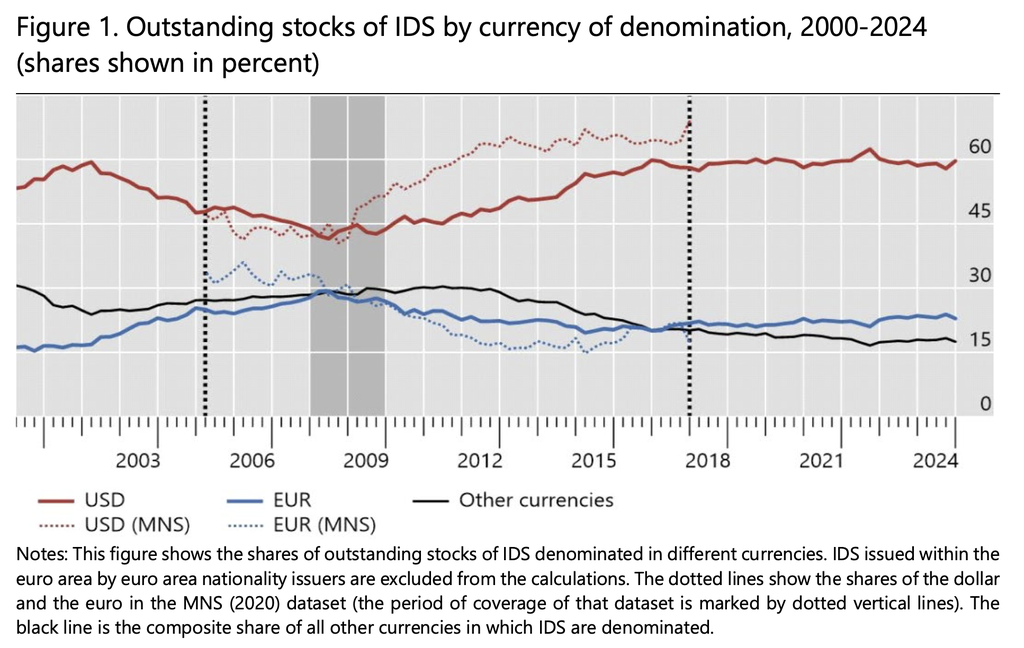
Share of international debt issued by currency, 2000–2024. Source: Federalreserve.gov

The study also found that, as of 2024, emerging market issuers still rely predominantly on dollar-denominated debt, which accounts for about 80% of their outstanding international bonds, while efforts by China begun in 2010 to internationalize its currency, the renminbi, have produced only modest gains.

“While the dollar’s eminence rests on vulnerable foundations, the absence of viable alternatives has left the dollar’s primacy unchallenged,” the report said.

Related: Intuit to use Circle’s stablecoin for financial platforms

Stablecoins back US Treasurys

The global stablecoin market has expanded sharply over the past year, growing to roughly $309.6 billion from $205.5 billion in December 2024, according to DefiLlama data.

Most of that growth has been concentrated in US dollar-pegged tokens, with Tether’s USDt (USDT) and Circle’s USDC (USDC) together accounting for about 85% of total stablecoin supply, or roughly $264 billion of the market at the time of writing.
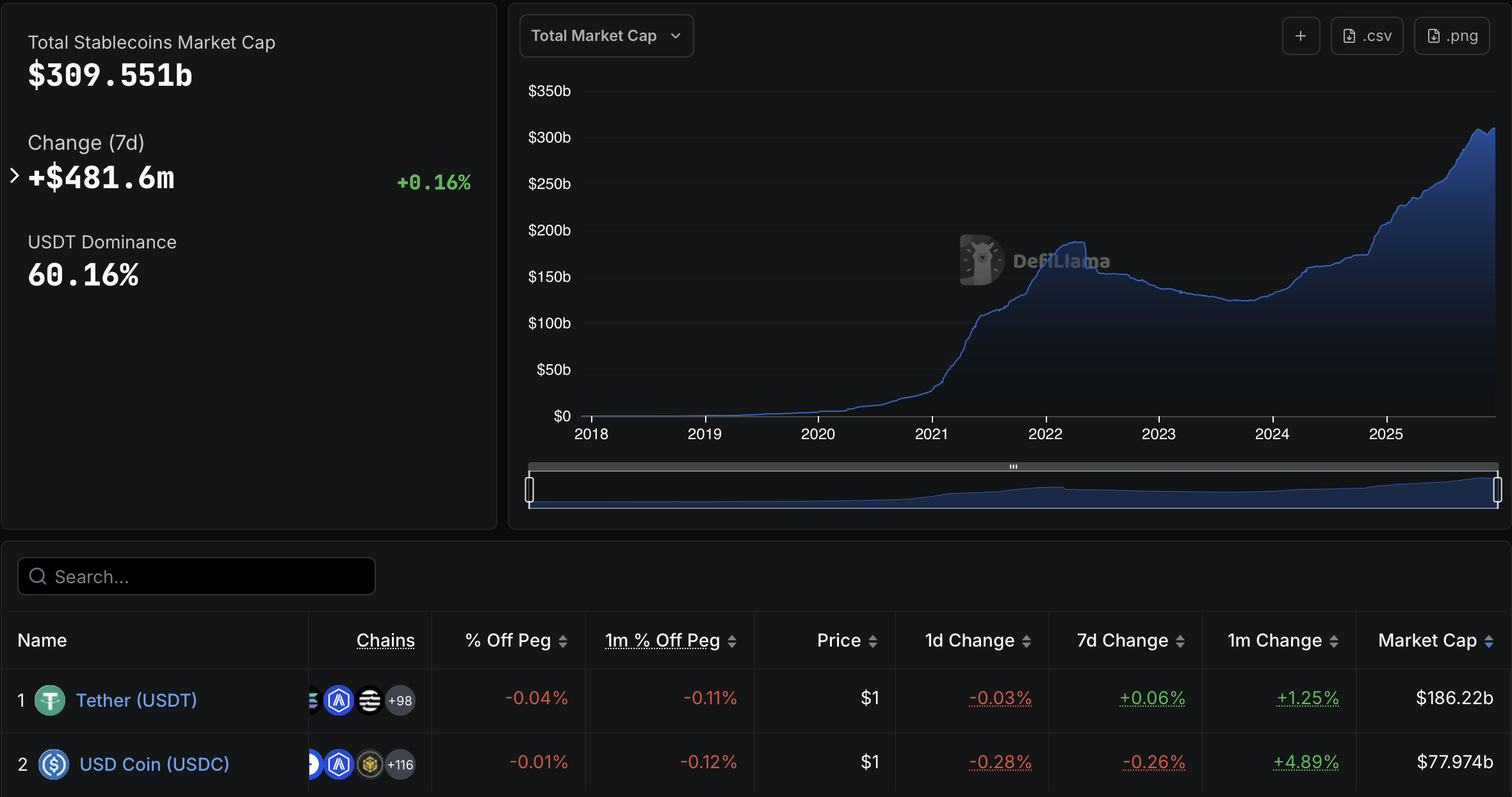
Stablecoin market cap. Source: DefiLlama

As dollar-pegged stablecoins have expanded, issuers have become significant holders of short-term US government debt.

In its second-quarter 2025 reserve report, Tether said its exposure to US Treasurys exceeded $127 billion, including $105.5 billion held directly and $21.3 billion held indirectly. According to the company, that level of Treasury holdings places Tether among the largest holders of US government debt.

Circle’s latest transparency report, dated Dec. 15, shows USDC is also backed largely by US government debt instruments, including $49.7 billion in overnight reverse Treasury repos and $18.5 billion in short-term Treasurys.
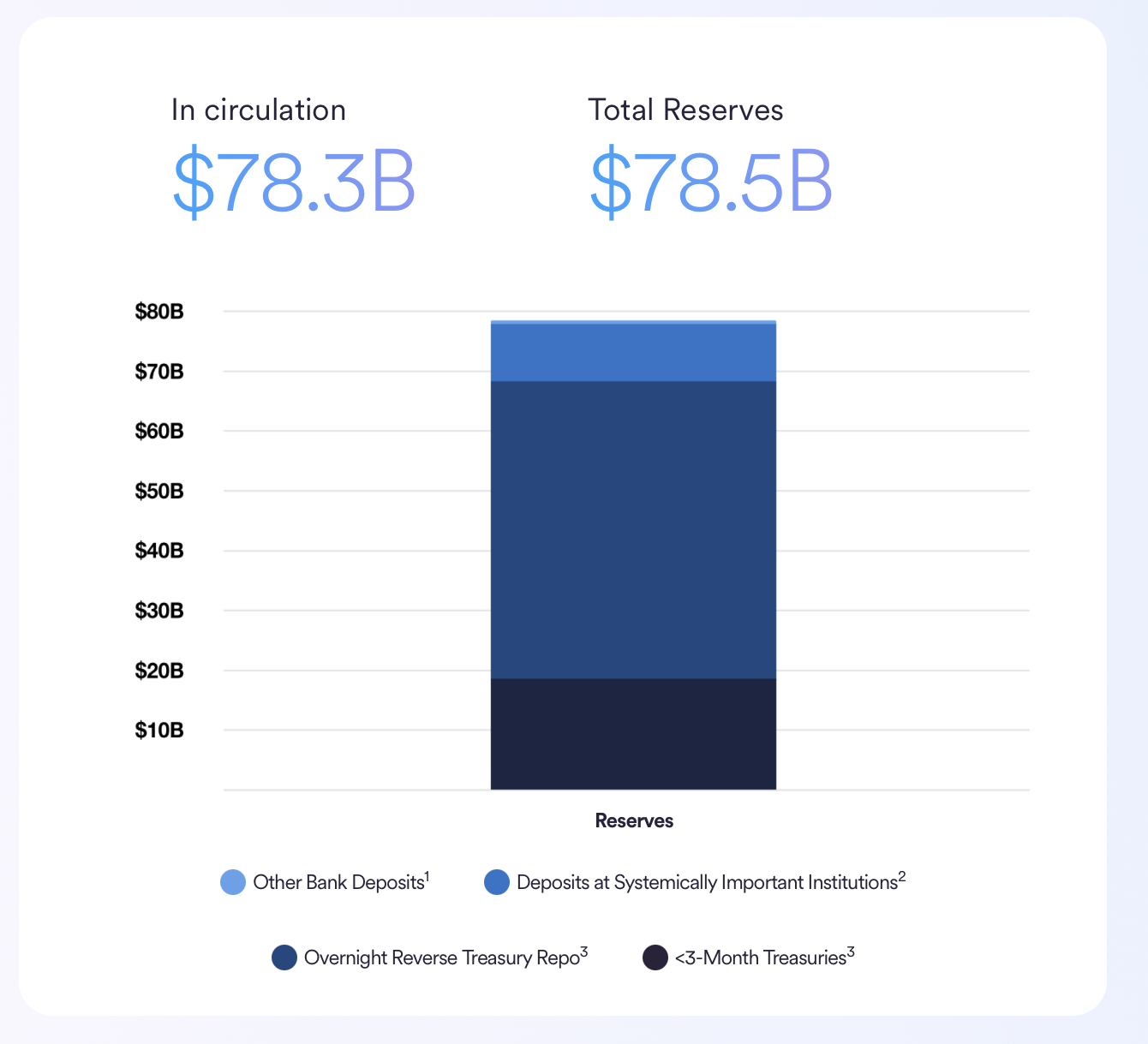
Circle’s reserves composition. Dec. 15, 2025. Source: Circle

A July report from digital asset bank Sygnum said the US government sees dollar-pegged stablecoins as a means to reinforce the dollar’s role as a global reserve currency and is backing their growth through legislation.

Other countries have taken notice. In April, Italy’s Economy and Finance Minister Giancarlo Giorgetti warned that US policies supporting dollar-backed stablecoins pose a greater long-term risk to Europe’s financial system than trade tariffs, citing their potential to erode the euro’s role in cross-border payments.

In December, a group of 10 European banks said they plan to launch a euro-pegged stablecoin in the second half of 2026.

Magazine: Meet the onchain crypto detectives fighting crime better than the cops

İlgili Sorular

QWhat is the main finding of the Federal Reserve discussion paper regarding the US dollar's role in global debt markets?

AThe paper finds that the US dollar's role in global bond markets has risen and fallen in cyclical waves over the past six decades, with no clear long-term trend toward either greater dollar dominance or de-dollarization.

QAccording to the report, what percentage of emerging market issuers' outstanding international bonds are denominated in US dollars as of 2024?

AAs of 2024, dollar-denominated debt accounts for about 80% of emerging market issuers' outstanding international bonds.

QWhich two stablecoins dominate the stablecoin market, and what is their combined market share?

ATether's USDt (USDT) and Circle's USDC (USDC) together account for about 85% of the total stablecoin supply.

QHow significant is Tether's holding of US Treasurys, according to its Q2 2025 reserve report?

ATether's exposure to US Treasurys exceeded $127 billion, a level that places it among the largest holders of US government debt.

QWhat concern did Italy's Economy and Finance Minister raise regarding US policies on dollar-backed stablecoins?

AHe warned that US policies supporting dollar-backed stablecoins pose a greater long-term risk to Europe's financial system than trade tariffs, citing their potential to erode the euro's role in cross-border payments.

İlgili Okumalar

Casper Network Publishes the Casper Manifest, a Multi-Year Roadmap to Power Regulated Real-World Assets and the Machine Economy

The Casper Association has published "The Casper Manifest," a multi-year technical roadmap for Casper Network. Introduced at the Digital Finance Forum in Bermuda, the roadmap outlines nine coordinated initiatives designed to position the layer-1 blockchain as the infrastructure for regulated real-world asset (RWA) tokenization and the machine-to-machine economy. Key initiatives focus on: 1. **Developer Access:** Adding full Ethereum Virtual Machine (EVM) compatibility alongside its existing WebAssembly (Wasm) execution layer. 2. **User Experience:** Implementing gasless transactions, batch operations, and smart accounts with biometric authentication. 3. **Institutional Compliance & Privacy:** Building compliant security tokens aligned with the ERC-3643 standard and a multi-phase roadmap for confidential transactions with built-in audit tools. 4. **Machine Economy:** Implementing the X402 open payment standard to enable AI agents and machines to make autonomous, programmatic micropayments. 5. **Token Infrastructure:** Creating a Native Token Registry to give all tokens protocol-level status with fixed, predictable costs. 6. **Quantum Safety:** Developing hybrid accounts with both classical and quantum-resistant keys. The first initiative, X402 micropayments, is expected within weeks. Subsequent releases through 2026 and 2027 will include EVM compatibility, compliant security tokens, the Native Token Registry, gasless transactions, and quantum-safe features. The goal is to create a blockchain that is frictionless for users, trusted by institutions, and native for machines.

TheNewsCrypto29 dk önce

Casper Network Publishes the Casper Manifest, a Multi-Year Roadmap to Power Regulated Real-World Assets and the Machine Economy

TheNewsCrypto29 dk önce

TechFlow Intelligence: Trump-Linked Companies Transfer $12 Million in Assets Before China Visit, 'The Big Short' Protagonist Warns of Stock Market Bubble Again

The article reports multiple developments across tech, crypto, and finance. In AI, Mozilla used AI for large-scale code review, Google confirmed hackers used AI to find zero-day exploits, and OpenAI deployed GPT-5.5 to find errors in math benchmarks. A court ruled Anthropic's scanning and destroying books for AI training as fair use, while its Claude platform launched on AWS. Google's new video model 'Omni' was leaked. In crypto/Web3, Trump-linked companies transferred $12M in crypto assets before a China visit. BlackRock chose Ethereum for tokenized funds, and a hacker stole $174k via a malicious NFT that tricked an AI. Jack Dorsey's first tweet NFT plummeted from $2.9M to under $5. In chips/hardware, TSMC approved an additional $20B for its Arizona plant. Apple's Tim Cook and Elon Musk will accompany Trump to China, while Nvidia's Jensen Huang is notably absent. For markets, Michael Burry warned of parabolic stock rises and suggested near-total sell-offs, with online discussions comparing current sentiment to the 1999 bubble. Other notes include WTI oil surpassing $100, a 20% price hike for Beijing-Shanghai high-speed rail, and new products like Unitree's $26.9k humanoid robot. The underlying theme suggests AI is becoming infrastructure, creating pressure on old systems while a new order is not yet ready, leaving investors anxious.

marsbit57 dk önce

TechFlow Intelligence: Trump-Linked Companies Transfer $12 Million in Assets Before China Visit, 'The Big Short' Protagonist Warns of Stock Market Bubble Again

marsbit57 dk önce

İşlemler

Spot
Futures

Popüler Makaleler

US Nasıl Satın Alınır

HTX.com’a hoş geldiniz! Talus Network (US) satın alma işlemlerini basit ve kullanışlı bir hâle getirdik. Adım adım açıkladığımız rehberimizi takip ederek kripto yolculuğunuza başlayın. 1. Adım: HTX Hesabınızı OluşturunHTX'te ücretsiz bir hesap açmak için e-posta adresinizi veya telefon numaranızı kullanın. Sorunsuzca kaydolun ve tüm özelliklerin kilidini açın. Hesabımı Aç2. Adım: Kripto Satın Al Bölümüne Gidin ve Ödeme Yönteminizi SeçinKredi/Banka Kartı: Visa veya Mastercard'ınızı kullanarak anında Talus Network (US) satın alın.Bakiye: Sorunsuz bir şekilde işlem yapmak için HTX hesap bakiyenizdeki fonları kullanın.Üçüncü Taraflar: Kullanımı kolaylaştırmak için Google Pay ve Apple Pay gibi popüler ödeme yöntemlerini ekledik.P2P: HTX'teki diğer kullanıcılarla doğrudan işlem yapın.Borsa Dışı (OTC): Yatırımcılar için kişiye özel hizmetler ve rekabetçi döviz kurları sunuyoruz.3. Adım: Talus Network (US) Varlıklarınızı SaklayınTalus Network (US) satın aldıktan sonra HTX hesabınızda saklayın. Alternatif olarak, blok zinciri transferi yoluyla başka bir yere gönderebilir veya diğer kripto para birimlerini takas etmek için kullanabilirsiniz.4. Adım: Talus Network (US) Varlıklarınızla İşlem YapınHTX'in spot piyasasında Talus Network (US) ile kolayca işlemler yapın.Hesabınıza erişin, işlem çiftinizi seçin, işlemlerinizi gerçekleştirin ve gerçek zamanlı olarak izleyin. Hem yeni başlayanlar hem de deneyimli yatırımcılar için kullanıcı dostu bir deneyim sunuyoruz.

273 Toplam GörüntülenmeYayınlanma 2025.12.11Güncellenme 2025.12.11

US Nasıl Satın Alınır

Tartışmalar

HTX Topluluğuna hoş geldiniz. Burada, en son platform gelişmeleri hakkında bilgi sahibi olabilir ve profesyonel piyasa görüşlerine erişebilirsiniz. Kullanıcıların US (US) fiyatı hakkındaki görüşleri aşağıda sunulmaktadır.

活动图片













