Global Crypto Reporting Expands As 48 Countries Prep For CARF 2027

bitcoinist2026-01-02 tarihinde yayınlandı2026-01-02 tarihinde güncellendi

Özet

A coordinated effort among 48 jurisdictions to implement the Crypto-Asset Reporting Framework (CARF) has begun, with standardized crypto transaction and user data collection starting January 1, 2026. The first automatic cross-border exchanges between tax authorities are expected in 2027. Service providers, including exchanges, brokers, and crypto ATMs, must collect account details, transaction histories, and users’ tax residency information. This framework aims to enhance tax transparency and enforcement of existing rules, not create new taxes. While larger platforms are adapting systems, smaller ones face operational burdens, and privacy concerns have been raised regarding data storage and access. An additional 27 jurisdictions plan to begin collection in 2027, with exchanges following in 2028. For users, this means more detailed onboarding processes and clearer record-keeping requirements from providers.

A coordinated effort to gather crypto tax records has begun in a group of jurisdictions preparing to take part in the Crypto-Asset Reporting Framework (CARF).

According to official monitoring from the Organization for Economic Co-operation and Development (OECD), 48 jurisdictions committed to start collecting standardized crypto transaction and user data from January 1, 2026, with the first automatic cross-border exchanges expected to take place in 2027.

Countries Begin Collecting Data

Based on reports, service providers such as major exchanges, some broker platforms, crypto ATMs and certain custody services will be obliged to record account details, transaction histories and users’ tax residency information for reporting to domestic tax authorities.

That information will be formatted so it can be shared automatically with partner tax offices once the exchange phase starts. The OECD monitoring update lays out the kinds of fields that must be gathered and stored for future reporting.
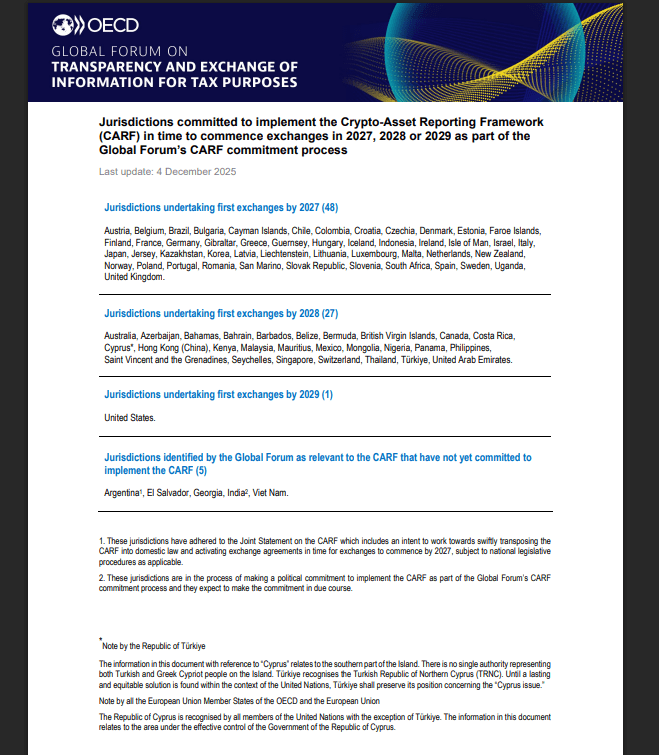
Source: OECD

What Exchanges Must Report

According to news outlets tracking the rollout, exchanges are already adjusting onboarding forms and internal compliance systems to verify customers’ tax residency and capture wallet-level activity.

Some jurisdictions, led by the United Kingdom, have moved faster to require platforms to keep detailed purchase and sale records for users in scope. Tax authorities will then receive yearly reports covering balances, transfers and gains for listed accounts.

Operational Strain And Privacy Questions

The new rules create practical burdens. Smaller platforms will need to upgrade systems or hire compliance staff to track the new data points.

Based on reports, privacy advocates and parts of the crypto industry are warning that the depth of data collection could raise concerns about how long sensitive transaction records are held and who can access them.

Some legal teams are already studying how domestic data-privacy laws interact with automatic information exchange.

Total crypto market cap currently at $2.99 trillion. Chart: TradingView

Middle Nations Join The Second Wave

A further group of jurisdictions has said it will begin domestic collection later. Reports note that an additional 27 jurisdictions have timelines that target January 1, 2027 for starting to collect, with exchanges of information to follow in 2028 for that batch.

At least one analysis of national updates also indicates that a handful of countries are planning to stagger implementation because of local legislative calendars.

How This Will Play Out For Users

For ordinary crypto users, the immediate change will be more questions during account setup and clearer record-keeping demands from providers.

Based on official guidance, CARF itself does not create new taxes; rather, it gives tax offices the data they need to enforce existing rules. For some investors, that means past reporting gaps will be easier for authorities to spot.

Reports have disclosed that implementation will vary by country. Some tax administrations are ready to receive standardized files in 2027, while others are still finishing domestic law changes.

Observers say the rollout marks a major step toward treating crypto transactions like other financial accounts when it comes to cross-border tax transparency.

Featured image from Unsplash, chart from TradingView

İlgili Sorular

QWhat is the Crypto-Asset Reporting Framework (CARF) and when will the first automatic cross-border exchanges begin?

AThe Crypto-Asset Reporting Framework (CARF) is a coordinated effort to gather standardized crypto tax records. According to the OECD, the first automatic cross-border exchanges of this data are expected to take place in 2027.

QHow many jurisdictions have committed to start collecting standardized crypto transaction data from January 1, 2026?

A48 jurisdictions have committed to start collecting standardized crypto transaction and user data from January 1, 2026.

QWhat specific information will crypto service providers be obliged to record and report under CARF?

AService providers such as exchanges, broker platforms, crypto ATMs, and custody services will be obliged to record account details, transaction histories, and users' tax residency information for reporting to domestic tax authorities.

QWhat are two major concerns or challenges raised by the implementation of CARF?

ATwo major concerns are the practical burden and operational strain on smaller platforms, which will need to upgrade systems or hire compliance staff, and the privacy concerns regarding how long sensitive transaction records are held and who can access them.

QHow will the CARF implementation affect ordinary crypto users according to the article?

AFor ordinary crypto users, the immediate change will be more questions during account setup and clearer record-keeping demands from their service providers. CARF does not create new taxes but gives tax offices the data to enforce existing rules, making it easier for authorities to spot past reporting gaps.

İlgili Okumalar

Not Speculation but a Necessity: The 4 Unique Values of Prediction Markets

Polymarket's recent $4 billion funding round and soaring valuation of $15 billion highlight the explosive growth of prediction markets, with trading volume reaching $25.7 billion in March 2026—a 10.6% monthly increase. This analysis argues that prediction markets serve critical non-speculative functions, positioning them as essential tools rather than mere gambling platforms. Prediction markets offer four unique values: entertainment consumption, insurance-like protection, risk hedging, and truth discovery. Firstly, they stimulate economic activity by engaging users in event-based betting, similar to the broader sports industry. Secondly, they act as a form of decentralized insurance, allowing users to hedge against specific, well-defined risks (e.g., weather events) transparently and without traditional overhead costs. Thirdly, institutions and individuals use these markets to hedge against geopolitical and commodity price risks, as demonstrated during the U.S.-Iran conflict and the launch of 24/7 commodity markets on platforms like Kalshi. Finally, prediction markets counter media bias by aggregating crowd-sourced information, often achieving 30% higher accuracy than surveys due to users' vested interests. Experts like Bitwise’s Jeff Park and SIG’s Jeff Yass emphasize the markets' role in risk transfer and financial innovation. As these platforms evolve, they are poised to become trillion-dollar markets, offering more reliable, decentralized mechanisms for information pricing and risk management.

marsbit2 saat önce

Not Speculation but a Necessity: The 4 Unique Values of Prediction Markets

marsbit2 saat önce

İşlemler

Spot
Futures
活动图片





