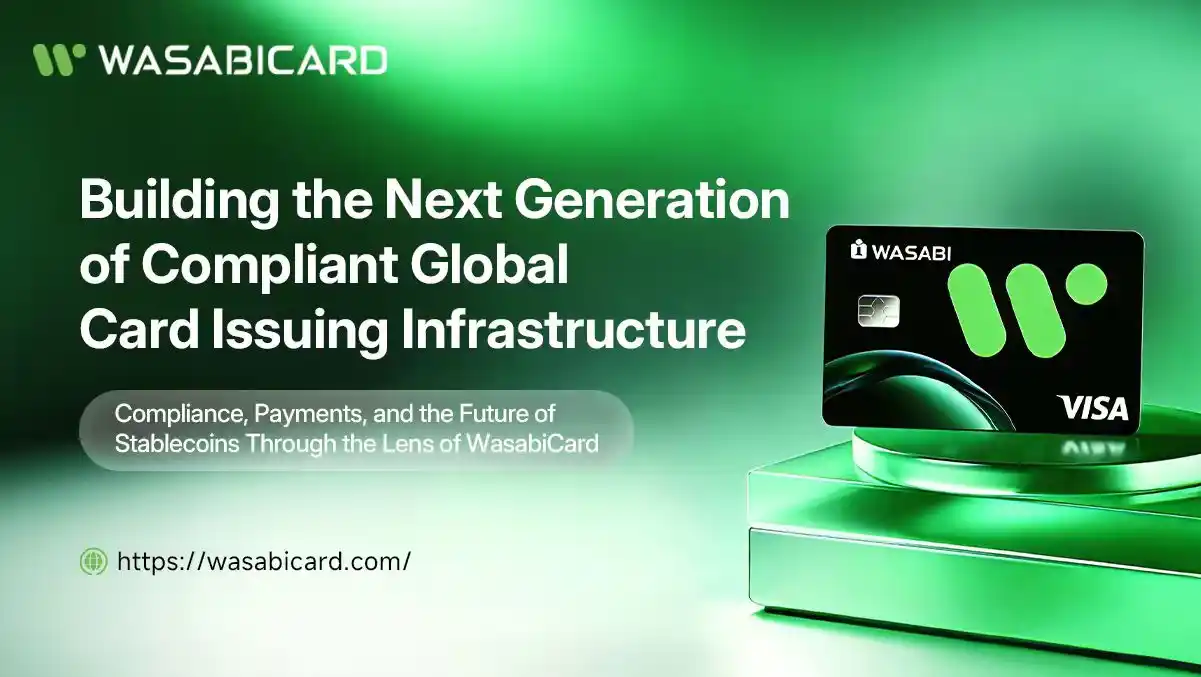
Global Card Issuance Enters a Compliance-Driven Era: WasabiCard is Building the Next-Generation Payment Infrastructure

marsbit2026-06-02 tarihinde yayınlandı2026-06-02 tarihinde güncellendi

Özet

Global card issuance is entering a compliance-driven era, with WasabiCard building next-generation payment infrastructure. The platform asserts that as stablecoins increasingly enter cross-border payments, corporate settlements, and global commerce, the industry is shifting focus from "availability" and "growth-driven" models to long-term, compliant operation under global frameworks. Competition will center on sustainable compliance and global infrastructure capabilities. Stablecoins are evolving from on-chain assets into key payment tools in global business, with card issuance acting as critical infrastructure connecting digital assets to traditional payment networks like Visa and Mastercard. This expansion has revealed structural issues, including cross-regional issuance, BIN resource management, and insufficient AML and risk controls. In response, the industry is moving away from reliance on "grey efficiency" towards prioritizing compliance, risk management, and long-term operational stability. WasabiCard outlines its strategy: collaborating with licensed principals and local partners for localized operations, building robust KYC/AML systems, strictly separating commercial and consumer BIN usage, and enhancing global issuance, payment, and cross-border fund flow infrastructure. The goal is to build stable, scalable payment infrastructure amid evolving global regulations, shifting industry competition from scale to infrastructure capability. As stablecoins integrate furt...

Recently, WasabiCard released its latest industry perspective on the global card issuance sector and stablecoin payment infrastructure, stating that as stablecoins gradually enter cross-border payments, corporate settlements, and global business scenarios, the global card issuance industry is transitioning from a "growth-driven" phase to a "compliance-driven" stage.

WasabiCard indicated that in the past few years, the core issue in the stablecoin payment industry has largely revolved around "availability," whereas future industry competition will gradually shift its focus to "whether it can operate stably and sustainably under global compliance frameworks."

Ray, Co-founder of WasabiCard, stated: "Stablecoins are evolving from on-chain assets into important payment vehicles in global commerce. The competition in the next phase is no longer just about product efficiency or growth speed, but about whether companies possess the capacity for long-term compliant operations and the capability of globalized infrastructure."

As stablecoin applications extend from trading scenarios into the real business world, global card issuance capabilities are also becoming crucial infrastructure connecting digital assets with traditional payment networks. Through global payment networks like Visa and Mastercard, stablecoins and digital assets are further integrated into daily consumption, corporate payments, and cross-border capital flow scenarios.

Meanwhile, WasabiCard believes that the industry's rapid expansion has exposed increasingly structural issues, including risks related to cross-regional card issuance, BIN resource management, anonymous issuance, and insufficient anti-money laundering and risk control capabilities.

Against this backdrop, the industry is gradually shifting from a growth model reliant on "grey-area efficiency" to a development path that places greater emphasis on compliance, risk control, and long-term operational capabilities.

Centered on this trend, WasabiCard also disclosed its long-term infrastructure strategy, which includes: establishing localized operational systems through collaboration with licensed principal members and local partners; building robust KYC and AML risk control systems; strictly distinguishing between commercial BIN and consumer BIN usage scenarios; and continuously enhancing capabilities in global card issuance, payments, and cross-border capital flow infrastructure.

WasabiCard stated that the core objective of these strategies is not merely to improve short-term efficiency but to build payment infrastructure with long-term stability and scalability amid the evolving global regulatory landscape. The competitive logic of the future global card issuance industry will also gradually shift from "scale competition" to "infrastructure capability competition." As stablecoins further integrate with global commerce, payment infrastructure will no longer be just a financial tool but will gradually become an underlying capability embedded in internet commerce. Companies with global compliant operations, resource integration, and platformization capabilities will occupy more significant positions in the industry's next phase of development.

In the future, WasabiCard will continue to enhance its infrastructure capabilities, focusing on global card issuance, stablecoin payments, cross-border capital flows, and API-driven financial workflows.

About WasabiCard

WasabiCard is a stablecoin payment infrastructure platform for global business scenarios, dedicated to providing secure, reliable, and scalable global payment and capital flow capabilities for enterprises and individual users through the integration of stablecoins and the traditional financial system.

Addressing the needs for global payments and cross-border capital management, WasabiCard has built an integrated capability system covering card issuance, payments, and fund distribution, supporting enterprises in achieving a complete process from consumption to fund management across different usage scenarios.

Through its API-driven payment system, WasabiCard helps businesses and users quickly access global payment networks and continuously promotes the large-scale application of stablecoins in the real business world.

Read the full article:"Global Card Issuance Industry Enters a Compliance-Driven Era"

Disclaimer

This content is for informational purposes only and does not constitute any legal, tax, or professional advice provided by WasabiCard, nor should it substitute for seeking relevant professional advice independently. WasabiCard makes no express or implied representations, warranties, or commitments regarding the accuracy, completeness, or timeliness of the content herein.

If you wish to suggest updates to the relevant content, please contact us via the following email: [email protected]


İlgili Sorular

QWhat does WasabiCard identify as the main shift in the global card issuance industry, according to the article?

AWasabiCard states that the global card issuance industry is shifting from a 'growth-driven' phase to a 'compliance-driven' phase.

QAccording to WasabiCard co-founder Ray, what will the next stage of competition in the stablecoin industry focus on?

ARay states that the next stage of competition will focus on whether enterprises possess the capability for long-term compliant operations and global infrastructure, not just product efficiency or growth speed.

QWhat structural problems did the rapid expansion of the industry expose, as mentioned in the article?

AThe rapid expansion exposed structural problems including cross-regional card issuance, BIN resource management, anonymous card issuance, and insufficient AML and risk control capabilities.

QWhat are the core goals of WasabiCard's long-term infrastructure strategy?

AThe core goals are to build a payment infrastructure with long-term stability and scalability in the evolving global regulatory environment, not merely to improve short-term efficiency.

QWhat business does WasabiCard describe itself as?

AWasabiCard describes itself as a stablecoin payment infrastructure platform for global commercial scenarios, dedicated to integrating stablecoins with the traditional financial system to provide safe, reliable, and scalable global payment and capital flow capabilities for enterprises and individual users.

İlgili Okumalar

Why Not Short Even When Bearish? Munger Did the Math on a 'Losing Trade'

Why Not Short Even When Bearish? Charlie Munger's Calculated "Loss-Making Account" Many traders, drawn to speculative tools like futures contracts, often face repeated failures. As the article notes, unless one is a genius, such instruments should be avoided for long-term profit-seeking. Similarly, the practice of short selling is viewed with caution. The author firmly states a policy of not shorting, even when bearish, preferring to simply wait. The core reason? Successful short selling requires exceptionally difficult conditions to profit. Legendary investors Warren Buffett and Charlie Munger have themselves reflected on painful short-selling experiences. Munger highlights two critical flaws in the mathematical logic of shorting: 1. Asymmetrical Risk/Reward: A long position has a maximum loss of 100% but unlimited upside. A short position caps profit at 100% (if a stock falls to zero) but carries theoretically unlimited loss potential. 2. The "Promoter" Problem: Fraudulent or struggling companies can prolong their decline. As Munger said, "You can run out of money before the promoter runs out of ideas," meaning short sellers may be forced to cover positions at a loss before the company's true fate unfolds. The article cites Stanley Druckenmiller, a famed hedge fund manager. He once shorted 12 companies that all eventually went bankrupt. However, intense market rallies forced him to cover his positions within three weeks, resulting in massive losses—$200 million of his capital plus an additional $600 million. He concluded he likely never made money shorting in his career. His experience perfectly illustrates Munger's points: facing unlimited losses and being wiped out before being proven right. The conclusion is clear: for most investors, complex instruments like short selling and derivatives are not viable paths to stable, long-term gains. Self-reflection is advised before repeatedly wasting time and capital on such speculative strategies.

marsbit50 dk önce

Why Not Short Even When Bearish? Munger Did the Math on a 'Losing Trade'

marsbit50 dk önce

İşlemler

Spot
Futures

Popüler Makaleler

ERA Nasıl Satın Alınır

HTX.com’a hoş geldiniz! Caldera (ERA) satın alma işlemlerini basit ve kullanışlı bir hâle getirdik. Adım adım açıkladığımız rehberimizi takip ederek kripto yolculuğunuza başlayın. 1. Adım: HTX Hesabınızı OluşturunHTX'te ücretsiz bir hesap açmak için e-posta adresinizi veya telefon numaranızı kullanın. Sorunsuzca kaydolun ve tüm özelliklerin kilidini açın. Hesabımı Aç2. Adım: Kripto Satın Al Bölümüne Gidin ve Ödeme Yönteminizi SeçinKredi/Banka Kartı: Visa veya Mastercard'ınızı kullanarak anında Caldera (ERA) satın alın.Bakiye: Sorunsuz bir şekilde işlem yapmak için HTX hesap bakiyenizdeki fonları kullanın.Üçüncü Taraflar: Kullanımı kolaylaştırmak için Google Pay ve Apple Pay gibi popüler ödeme yöntemlerini ekledik.P2P: HTX'teki diğer kullanıcılarla doğrudan işlem yapın.Borsa Dışı (OTC): Yatırımcılar için kişiye özel hizmetler ve rekabetçi döviz kurları sunuyoruz.3. Adım: Caldera (ERA) Varlıklarınızı SaklayınCaldera (ERA) satın aldıktan sonra HTX hesabınızda saklayın. Alternatif olarak, blok zinciri transferi yoluyla başka bir yere gönderebilir veya diğer kripto para birimlerini takas etmek için kullanabilirsiniz.4. Adım: Caldera (ERA) Varlıklarınızla İşlem YapınHTX'in spot piyasasında Caldera (ERA) ile kolayca işlemler yapın.Hesabınıza erişin, işlem çiftinizi seçin, işlemlerinizi gerçekleştirin ve gerçek zamanlı olarak izleyin. Hem yeni başlayanlar hem de deneyimli yatırımcılar için kullanıcı dostu bir deneyim sunuyoruz.

473 Toplam GörüntülenmeYayınlanma 2025.07.17Güncellenme 2026.06.02

ERA Nasıl Satın Alınır

Tartışmalar

HTX Topluluğuna hoş geldiniz. Burada, en son platform gelişmeleri hakkında bilgi sahibi olabilir ve profesyonel piyasa görüşlerine erişebilirsiniz. Kullanıcıların ERA (ERA) fiyatı hakkındaki görüşleri aşağıda sunulmaktadır.

活动图片












