Global Asset Rotation: Why Does Liquidity Drive the Cryptocurrency Cycle? (Part 1)

marsbit2025-12-26 tarihinde yayınlandı2025-12-26 tarihinde güncellendi

Özet

This article introduces a new series on global asset allocation and rotation, arguing that liquidity—not new narratives—is the primary driver of cryptocurrency market cycles. While narratives like RWA or X-402 can attract attention, they are triggers, not fundamental drivers. The real force is capital flow: ample liquidity amplifies even weak narratives, while liquidity contraction undermains the most compelling ones. The framework begins by mapping global assets not by traditional labels (stocks, bonds, commodities) but by their roles and dependencies within economic and liquidity cycles. Cryptocurrency is reclassified not as a traditional risk asset (like equities, which have cash flows and valuation models) but as a non-cash-flow alternative asset. Its price action is driven primarily by capital inflows and outflows, making it highly sensitive to liquidity and risk appetite. Five key macro indicators are identified as core drivers: interest rates (especially real rates), inflation metrics (CPI, PCE), economic growth indicators (PMI, GDP), systemic liquidity (central bank balance sheets, money supply), and risk appetite (volatility indices, credit spreads). A causal chain is proposed: inflation influences interest rates, which affect liquidity, which then drives risk preference and ultimately asset prices. The U.S. remains the anchor for global capital flows, and understanding its monetary policy cycle is crucial. During loose monetary conditions, risk assets like crypto...

This article marks the beginning of a new series of research on global asset allocation and rotation. After delving deeply into this topic, we discovered one of the most unexpected yet crucial facts: what ultimately determines a cryptocurrency bull market is not the emergence of new narratives.

Whether it's RWA, X402, or any other concept, these themes are often triggers, not the true driving forces. They can attract attention but do not, in themselves, provide energy. The real power comes from capital. When liquidity is abundant, even weak arguments can be amplified into market consensus. And when liquidity dries up, the most powerful arguments struggle to maintain their momentum.

This first part focuses on building the foundation: how to construct a global asset allocation and rotation framework that places cryptocurrency in the proper macro context. The latter part of the framework will be explained in subsequent articles.

Step 1: Step Outside Crypto, Map Global Assets

The first step is to deliberately step outside the cryptocurrency market and construct a panoramic view of global assets. Traditional classifications—stocks, bonds, commodities—are useful but insufficient for understanding capital rotation across different cycles.

Instead, we can classify assets based on the roles they play during different phases of the economic and liquidity cycles. What matters is not whether an asset is labeled "equity" or "commodity," but rather what it depends on and what it is vulnerable to. Some assets benefit from falling real rates, some from inflation uncertainty, and others from outright risk aversion.

Building an "asset spectrum map" does not require deep expertise in every market. What it truly requires is an intuitive understanding of the interdependencies of each asset: which conditions support it and which conditions weaken it. This mental map will become the reference system for all subsequent decisions.

Within this framework, cryptocurrency deserves special treatment.
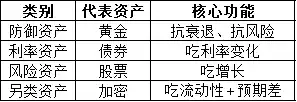
Why Crypto is an Alternative Asset, Not a Traditional Risk Asset?

Cryptocurrencies are often grouped with stocks (especially U.S. tech stocks) because their price movements are highly correlated. Superficially, this classification seems reasonable. Cryptocurrencies exhibit extreme volatility, high beta, and significant drawdowns—all characteristics similar to risk assets.

However, correlation itself does not define economic essence.

From a capital structure perspective, stocks have cash flows. Companies generate earnings, distribute dividends, and can be valued using discounted cash flow models or valuation multiples. Even when prices deviate from fundamentals, the anchoring logic is still based on cash flows.

Crypto assets operate on a fundamentally different logic. They do not generate dividends, nor do they have intrinsic cash flow that can be discounted. Therefore, traditional valuation frameworks simply do not apply.

Instead, cryptocurrencies behave like a purely liquidity-sensitive asset. Their price movements are primarily driven by capital inflows and outflows, rather than changes in fundamental productivity. Narratives help explain *why* capital flows, but they do not determine *that* it flows. Capital flows regardless.

Thus, cryptocurrency is best understood as a non-cash-flow alternative asset, positioned at the extreme end of the risk appetite spectrum. It performs best when liquidity is abundant and risk appetite is high; it underperforms when capital prioritizes safety and yield.

Liquidity is the Core Driver of Crypto Performance

Once you view cryptocurrency as a liquidity asset rather than a valuation asset, its behavior across cycles becomes easier to explain.

In equity research, price targets often stem from a structured process: forecasting future revenue, applying valuation multiples, and discounting the result to present value. This works because the asset itself generates measurable economic output.

Cryptocurrency lacks this anchoring effect. Its upside depends on whether new capital is willing to enter the market and accept higher prices. And this capital almost always comes from outside the crypto ecosystem—from stocks, credit, or cash sitting idle due to low yields.

Therefore, understanding the source and timing of liquidity is more important than tracking individual protocols or events. When capital begins seeking higher volatility and convexity, cryptocurrency becomes one of the most attractive destinations. And when capital prioritizes capital preservation, crypto is often the first asset to be sold.

In short, liquidity is the decisive factor; everything else is secondary.

Step 2: Focus on Macro Drivers First, Asset Details Second

The second pillar of this framework is macro analysis. It is more efficient to first identify the variables influencing price movements rather than starting with the study of specific assets. All assets are integrated together.

At the highest level, five macro indicators play a central role:

  • Interest rates, especially the distinction between nominal and real rates.

  • Inflation indicators, such as the Consumer Price Index (CPI) and Personal Consumption Expenditures (PCE).

  • Economic growth indicators, such as Purchasing Managers' Index (PMI) and Gross Domestic Product (GDP) trends.

  • Systemic liquidity, often reflected in central bank balance sheets and money supply measures.

  • Risk appetite, typically measured by volatility indices and credit spreads.

Many crypto participants closely watch Federal Reserve meetings but often focus solely on the rate decision. However, institutional capital places greater importance on real rates (nominal rates adjusted for inflation) because real rates determine the true opportunity cost of holding a non-yielding asset.

Inflation data is widely discussed in crypto circles, but liquidity and risk appetite receive little attention. This is a blind spot. Monetary supply dynamics and volatility regimes often explain overall market behavior before narratives even emerge.

A useful mental model is a simple chain of transmission:

  1. Inflationary pressures influence interest rates.
  2. Interest rates influence liquidity conditions.
  3. Liquidity conditions influence risk appetite.
  4. Risk appetite drives asset prices.

Understanding where the economy is positioned in this chain provides deeper insight than analyzing assets in isolation.

Step 3: Build a Cycle-Based Mental Model

The economic cycle is a familiar concept, but it remains crucial. At a macro level, economic cycles tend to alternate between expansion and contraction, easing and tightening.

Simply put, the pattern often looks like this:

Periods of monetary easing favor risk assets, including cryptocurrencies and small-cap stocks.

Periods of monetary tightening favor defensive assets like cash, government bonds, and gold.

This framework is not meant to be applied mechanically. Each asset's reaction will vary based on timing, expectations, and positioning. Nonetheless, a cycle-based reference helps avoid emotional decision-making during shifts in the market landscape.

An important nuance is that the global economic cycle is not synchronized. The world does not operate as a single economy.

As growth momentum slows, the U.S. might be transitioning from late-cycle high rates towards easing. Japan might be cautiously ending decades of ultra-loose monetary policy. China continues its structural adjustments in a low-inflation environment, while parts of Europe still grapple with economic stagnation.

Despite this divergence, the United States remains the anchor for global capital flows. Dollar liquidity and U.S. interest rates still exert the strongest influence on global capital movements. Therefore, any global asset rotation framework should start with the U.S. and expand outward.

Conclusion: Framework Before Forecast

This first half of the framework emphasizes structure over prediction. The goal is not to forecast short-term price movements but to understand the factors that make certain assets competitive at specific points in time.

By redefining crypto as a liquidity-driven alternative asset, focusing on macro drivers before narratives, and basing decisions on cycle awareness, investors can avoid many common analytical pitfalls.

The next article will build upon this, delving into the sequence of capital flows, real-world indicators, and how to identify when liquidity is shifting towards high-risk assets.

Some of the above viewpoints are referenced from @Web3___Ace

Original article link

İlgili Sorular

QWhat is the primary driver of cryptocurrency bull markets according to the article?

ALiquidity, not new narratives, is the primary driver of cryptocurrency bull markets. Capital flows are the true source of energy, while narratives are merely triggers that can amplify market consensus when liquidity is abundant.

QHow does the article suggest classifying assets for a global asset allocation framework?

AThe article suggests classifying assets based on the roles they play in different phases of the economic and liquidity cycle, focusing on what conditions support or weaken them, rather than traditional labels like 'equities' or 'commodities'.

QWhy is cryptocurrency considered an alternative asset rather than a traditional risk asset in the framework?

ACryptocurrency is considered a non-cash-flow alternative asset because it lacks intrinsic cash flows (like dividends) and cannot be valued using traditional discounted cash flow models. Its price is primarily driven by capital inflows and outflows, making it a pure liquidity-sensitive asset at the extreme end of the risk preference spectrum.

QWhat are the five core macro indicators that the article identifies as crucial for understanding price movements?

AThe five core macro indicators are: 1) Interest rates, particularly the distinction between nominal and real rates; 2) Inflation indicators like CPI and PCE; 3) Economic growth indicators like PMI and GDP trends; 4) Systemic liquidity, reflected in central bank balance sheets and money supply; 5) Risk appetite, measured by volatility indices and credit spreads.

QWhat is the simple transmission chain model described in the article for understanding how macro factors drive asset prices?

AThe simple transmission chain model is: 1) Inflationary pressures influence interest rates; 2) Interest rates influence liquidity conditions; 3) Liquidity conditions influence risk appetite; 4) Risk appetite drives asset prices.

İlgili Okumalar

Dalio Warns: AI Boom Shows Signs of a Bubble, Day of Reckoning Will Be the Time of Burst

Ray Dalio, founder of Bridgewater Associates, warns that the current artificial intelligence investment boom shows classic signs of a bubble, which he expects will eventually burst. In a Bloomberg Television interview, he noted that great technological revolutions often lead to capital inflows that create bubbles, making it difficult for investors and companies to calibrate their spending accurately—either overspending to capture market share or underspending and losing their competitive position. This caution comes amid significant rallies in AI-related assets, particularly chipmakers, driven by soaring demand for data centers and high-bandwidth chips, raising debates about overheating valuations. In contrast, Nvidia CEO Jensen Huang recently asserted that investors embracing the AI wave would see "crazy" returns and dismissed concerns over return on investment for data center spending as outdated. Dalio, however, focuses on the risks in the profit realization phase. He argues that bubbles tend to show signs of破裂 when markets transition from investment to the need for tangible returns, describing the burst as a process of converting paper wealth into cash. While acknowledging AI's intrinsic value, he expressed concern over the future profitability of some AI companies, suggesting the market is repeating a familiar pattern. The 76-year-old billionaire, who fully exited Bridgewater in 2025, has a net worth estimated at $21.5 billion according to the Bloomberg Billionaires Index.

marsbit22 dk önce

Dalio Warns: AI Boom Shows Signs of a Bubble, Day of Reckoning Will Be the Time of Burst

marsbit22 dk önce

Privacy Coin Crisis of Confidence! ZEC Plunges Over 56% in a Single Day

Zcash (ZEC), a leading privacy-focused cryptocurrency, experienced a severe crash on June 5th, plummeting over 56% in a single day and erasing nearly two months of gains. The flash crash was triggered by the disclosure of a critical zero-knowledge proof vulnerability within Zcash's Orchard privacy pool, which had existed since the pool's launch in May 2022. The flaw theoretically allowed an attacker to forge unlimited ZEC undetectably due to the pool's privacy features. The vulnerability was discovered on May 29th by independent security researcher Taylor Hornby during a proactive audit commissioned by Shielded Labs, utilizing AI-assisted analysis. The Zcash development team responded swiftly, implementing an emergency soft fork to disable Orchard transactions on June 2nd and executing a permanent hard fork fix (NU6.2) on June 3rd. Despite the technical fix, a major crisis of confidence emerged. The core issue is that Orchard's privacy design makes it cryptographically impossible to prove whether the vulnerability was exploited over the past four years, casting permanent doubt on the historical supply integrity of ZEC. While Shielded Labs argues exploitation was unlikely, the inability to provide definitive proof has severely damaged market trust. This sentiment was exacerbated when BitMEX co-founder Arthur Hayes, a prominent ZEC supporter, announced he was selling his entire position. He stated that privacy assets require "perfect security" rather than "probable safety." The combined effect of the disclosure and Hayes's exit ignited widespread panic selling, leading to massive liquidations and significant price decline. Analysts note the event highlights a fundamental tension within privacy coins: the conflict between verifiable supply and cryptographic privacy.

链捕手25 dk önce

Privacy Coin Crisis of Confidence! ZEC Plunges Over 56% in a Single Day

链捕手25 dk önce

İşlemler

Spot
Futures

Popüler Makaleler

BILL Nasıl Satın Alınır

HTX.com’a hoş geldiniz! Billions Network (BILL) satın alma işlemlerini basit ve kullanışlı bir hâle getirdik. Adım adım açıkladığımız rehberimizi takip ederek kripto yolculuğunuza başlayın. 1. Adım: HTX Hesabınızı OluşturunHTX'te ücretsiz bir hesap açmak için e-posta adresinizi veya telefon numaranızı kullanın. Sorunsuzca kaydolun ve tüm özelliklerin kilidini açın. Hesabımı Aç2. Adım: Kripto Satın Al Bölümüne Gidin ve Ödeme Yönteminizi SeçinKredi/Banka Kartı: Visa veya Mastercard'ınızı kullanarak anında Billions Network (BILL) satın alın.Bakiye: Sorunsuz bir şekilde işlem yapmak için HTX hesap bakiyenizdeki fonları kullanın.Üçüncü Taraflar: Kullanımı kolaylaştırmak için Google Pay ve Apple Pay gibi popüler ödeme yöntemlerini ekledik.P2P: HTX'teki diğer kullanıcılarla doğrudan işlem yapın.Borsa Dışı (OTC): Yatırımcılar için kişiye özel hizmetler ve rekabetçi döviz kurları sunuyoruz.3. Adım: Billions Network (BILL) Varlıklarınızı SaklayınBillions Network (BILL) satın aldıktan sonra HTX hesabınızda saklayın. Alternatif olarak, blok zinciri transferi yoluyla başka bir yere gönderebilir veya diğer kripto para birimlerini takas etmek için kullanabilirsiniz.4. Adım: Billions Network (BILL) Varlıklarınızla İşlem YapınHTX'in spot piyasasında Billions Network (BILL) ile kolayca işlemler yapın.Hesabınıza erişin, işlem çiftinizi seçin, işlemlerinizi gerçekleştirin ve gerçek zamanlı olarak izleyin. Hem yeni başlayanlar hem de deneyimli yatırımcılar için kullanıcı dostu bir deneyim sunuyoruz.

248 Toplam GörüntülenmeYayınlanma 2026.05.07Güncellenme 2026.06.02

BILL Nasıl Satın Alınır

ATWO Nedir

I. Proje TanıtımıArena Two, hayranların gerçek zamanlı etkinlik sonuçlarında aktif, tokenleştirilmiş bir rol oynamasına olanak tanıyan merkeziyetsiz bir etkileşimli platformdur. Hayranları pasif izleyicilere indirgeyen geleneksel yayıncılık modellerinin aksine, Arena Two, hayranların doğrudan gerçek zamanlı oy kullanmalarını ve sahadaki sonuçları etkilemelerini sağlamak için blok zinciri teknolojisini kullanır.II. Token BilgileriToken adı: ATWO(Arena Two)III. İlgili BağlantılarWeb sitesi:https://arenatwo.com/Keşif araçları:https://basescan.org/token/0x499D35eBE6cEe9B2Ac35Fd003fcBbeeB9CFc7B32Twitter:https://x.com/arenatwoXNot: Proje tanıtımı, resmi proje ekibi tarafından yayınlanan veya sağlanan materyallerden gelmektedir ve yalnızca referans amaçlıdır, yatırım tavsiyesi niteliği taşımaz. HTX, ortaya çıkan doğrudan veya dolaylı kayıplardan sorumluluk kabul etmez.

229 Toplam GörüntülenmeYayınlanma 2026.05.18Güncellenme 2026.06.02

ATWO Nedir

ATWO Nasıl Satın Alınır

HTX.com’a hoş geldiniz! Arena Two (ATWO) satın alma işlemlerini basit ve kullanışlı bir hâle getirdik. Adım adım açıkladığımız rehberimizi takip ederek kripto yolculuğunuza başlayın. 1. Adım: HTX Hesabınızı OluşturunHTX'te ücretsiz bir hesap açmak için e-posta adresinizi veya telefon numaranızı kullanın. Sorunsuzca kaydolun ve tüm özelliklerin kilidini açın. Hesabımı Aç2. Adım: Kripto Satın Al Bölümüne Gidin ve Ödeme Yönteminizi SeçinKredi/Banka Kartı: Visa veya Mastercard'ınızı kullanarak anında Arena Two (ATWO) satın alın.Bakiye: Sorunsuz bir şekilde işlem yapmak için HTX hesap bakiyenizdeki fonları kullanın.Üçüncü Taraflar: Kullanımı kolaylaştırmak için Google Pay ve Apple Pay gibi popüler ödeme yöntemlerini ekledik.P2P: HTX'teki diğer kullanıcılarla doğrudan işlem yapın.Borsa Dışı (OTC): Yatırımcılar için kişiye özel hizmetler ve rekabetçi döviz kurları sunuyoruz.3. Adım: Arena Two (ATWO) Varlıklarınızı SaklayınArena Two (ATWO) satın aldıktan sonra HTX hesabınızda saklayın. Alternatif olarak, blok zinciri transferi yoluyla başka bir yere gönderebilir veya diğer kripto para birimlerini takas etmek için kullanabilirsiniz.4. Adım: Arena Two (ATWO) Varlıklarınızla İşlem YapınHTX'in spot piyasasında Arena Two (ATWO) ile kolayca işlemler yapın.Hesabınıza erişin, işlem çiftinizi seçin, işlemlerinizi gerçekleştirin ve gerçek zamanlı olarak izleyin. Hem yeni başlayanlar hem de deneyimli yatırımcılar için kullanıcı dostu bir deneyim sunuyoruz.

156 Toplam GörüntülenmeYayınlanma 2026.05.18Güncellenme 2026.06.02

ATWO Nasıl Satın Alınır

Tartışmalar

HTX Topluluğuna hoş geldiniz. Burada, en son platform gelişmeleri hakkında bilgi sahibi olabilir ve profesyonel piyasa görüşlerine erişebilirsiniz. Kullanıcıların A (A) fiyatı hakkındaki görüşleri aşağıda sunulmaktadır.

活动图片