Glassnode on Snowflake: Digital Asset Data Delivered Directly to your Warehouse

insights.glassnode2026-06-04 tarihinde yayınlandı2026-06-04 tarihinde güncellendi

Özet

Glassnode has launched a data sharing environment on Snowflake, making comprehensive on-chain and market data directly accessible within institutional data warehouses. This eliminates the need for custom API pipelines and ETL management. The offering includes on-chain analytics, derivatives, spot & exchange data, ETF & corporate treasury metrics, with multiple time resolutions. A key feature is point-in-time (PiT) data to ensure historical accuracy and eliminate look-ahead bias in backtesting. Designed for quantitative trading, risk management, and macro research, the integration allows users to query data via SQL alongside other datasets. Access is provisioned through private Snowflake Marketplace listings.

The most sophisticated institutional teams don't just need better data. They need it inside the environments where their research and execution workflows already run.

We've launched Glassnode's Snowflake Data Sharing environment, becoming the first provider to bring comprehensive on-chain analytics into the Snowflake ecosystem.

To get started or learn more about Glassnode Data Shares, talk to our product experts.

Request access

Access Trusted Digital Asset Data Directly in Your Environment

Snowflake is the data warehouse of choice for institutional finance. But until now, integrating digital asset data into these workflows meant building custom API ingestion pipelines, managing ETL jobs, and reconciling data updates. That's engineering overhead that should be spent on alpha generation.

Our Snowflake integration eliminates all of it. Through Snowflake Marketplace private listings, our data shares deliver the full history of every trusted Glassnode metric directly into your environment.

You query it like any other table in your warehouse, because that's exactly what it is.

What's Included

This is the same data that powers the research workflows of the world's leading crypto-native institutions, now accessible without a single API call.

On-Chain Analytics | Address activity, entity behavior, supply dynamics, exchange flows, miner metrics, and advanced clustering-based insights across Bitcoin, Ethereum, and beyond.

Derivatives | Futures open interest, funding rates, liquidations, plus our recently expanded options suite: premiums, taker flows, combo strategies, implied volatility surfaces, and more.

Spot & Exchange Data | Exchange balances, inflow/outflow dynamics, and venue-level breakdowns showing capital rotation in real time.

ETFs & Corporate Treasuries | Bitcoin and Ethereum ETF flows, AUM dynamics, and corporate treasury holdings.

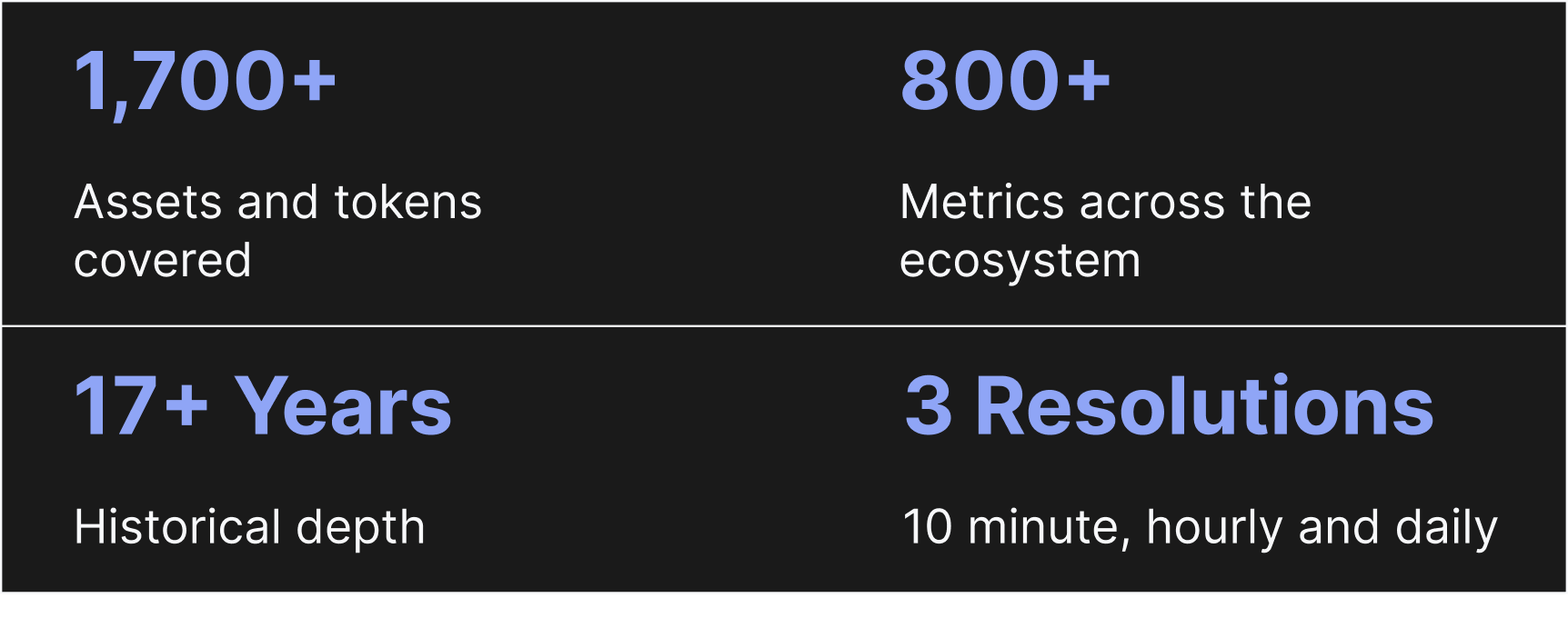
Multiple Resolutions | 10-minute, hourly, and daily granularity for everything from intraday signals to long-horizon macro research.
Built For The Workflows You Run

Quantitative & Systematic Trading | Query the full depth of on-chain, derivatives, and market data in SQL alongside your proprietary signals. PiT variants for backtesting fidelity. Sub-hourly resolution for intraday signals. No rate limits, no pagination.

Risk & Portfolio Construction | A unified view of exchange concentration, leverage dynamics, ETF flows, and supply overhangs. Native Snowflake delivery means direct integration with existing risk dashboards.

Multi-Strategy & Macro Research | Join Glassnode data with equity, fixed income, and macro datasets already in your warehouse. Same query layer, no middleware.

Fund Operations & Compliance | No bespoke pipelines means less operational risk. Snowflake's access controls and audit logging handle governance out of the box. Point-in-time timestamps provide data lineage for regulatory requirements and internal governance.

Eliminate Look-Ahead Bias from Backtests

For quantitative teams, historical data integrity is non-negotiable. Backtesting on retroactively revised data isn't backtesting. It's overfitting.

Glassnode is the first to offer point-in-time (PiT) blockchain data in Snowflake. PiT metrics are append-only and historically immutable. Each data point reflects exactly what was known when it was computed. No retroactive corrections, no look-ahead bias.

This matters because on-chain data is inherently mutable. Clustering improvements, late-reported exchange data, and refined labeling can all trigger revisions to standard metrics. PiT variants freeze the record, so your backtests reflect the information that was actually available to participants at each point in time. Every PiT data point includes a computed_at timestamp for full auditability.

Getting Started

Whether you're building backtested systematic models, integrating crypto into a cross-asset framework, or standing up institutional-grade risk infrastructure, Glassnode on Snowflake is the fastest path from blockchain data to production.

To request a trial or to learn more about Glassnode Data Shares, reach out to our institutional team at sales@glassnode.com.

The setup for Glassnode on Snowflake

  1. Retrieve your Snowflake account identifier via Snowflake's standard process or a simple SQL query.
  2. Share it with the Glassnode team. We provision access through Snowflake Marketplace private listings.
  3. Accept the listing. After initial replication, the data is live in your warehouse.

Data shares are organized by package (on-chain, market, signals, common, metadata), so you subscribe to what you need. Updates flow automatically.

Alternatively, you can initiate a trial via the Snowflake listing.

i️
Find the full setup documentation in Glassnode docs.

Glassnode Delivers the Analytical Depth That Drives Alpha

Coverage alone doesn't differentiate. What sets us apart is analytical depth built over nearly a decade of institutional-grade data engineering.

Proprietary entity adjustment | Our clustering technology identifies real-world entities (exchanges, institutions, long-term holders, miners) rather than raw addresses. Noisy blockchain data becomes actionable intelligence.

Full-stack derivatives | On-chain, futures, options, and spot from a single provider with unified methodology and consistent quality.

Expanding coverage | New chains, instruments, and products get added continuously. Your Snowflake environment reflects every update automatically.

* Default historical data during the trial is limited to 14 days and 1h/24h resolutions - contact sales@glassnode.com to request a trial with higher resolution and extended history.


  • Follow us on X for timely market updates and analysis
  • Join our Telegram channel for regular market insights
  • For on-chain metrics, dashboards, and alerts, visit Glassnode Studio

İlgili Sorular

QWhat problem does the Glassnode Snowflake Data Sharing environment aim to solve for institutional teams?

AIt aims to eliminate the engineering overhead of building custom API ingestion pipelines, managing ETL jobs, and reconciling data updates, allowing institutional teams to access comprehensive on-chain and market data directly within their Snowflake data warehouse for seamless integration into their existing research and execution workflows.

QAccording to the article, what is a key feature of Glassnode's data offering on Snowflake that is specifically important for quantitative backtesting?

AA key feature is the provision of point-in-time (PiT) blockchain data, which is append-only and historically immutable. This eliminates look-ahead bias by ensuring each data point reflects exactly what was known at the time it was computed, with no retroactive corrections.

QWhat types of data categories are included in the Glassnode Data Shares accessible via Snowflake?

AThe data categories include: On-Chain Analytics (address activity, entity behavior, supply dynamics, etc.), Derivatives (futures, options metrics), Spot & Exchange Data (exchange balances, flows), ETFs & Corporate Treasuries data, and data at Multiple Resolutions (10-minute, hourly, daily).

QWhat are the primary institutional use cases or workflows mentioned as being supported by Glassnode on Snowflake?

AThe primary use cases are: Quantitative & Systematic Trading, Risk & Portfolio Construction, Multi-Strategy & Macro Research, and Fund Operations & Compliance. It supports these by allowing direct SQL querying alongside other datasets, providing unified views, and integrating with existing dashboards and governance controls.

QWhat are the initial steps required to set up and access Glassnode Data Shares through Snowflake?

AThe steps are: 1. Retrieve your Snowflake account identifier. 2. Share it with the Glassnode team, who will provision access via Snowflake Marketplace private listings. 3. Accept the listing, after which the data will be live in your warehouse after initial replication. Alternatively, a trial can be initiated directly via the Snowflake listing.

İlgili Okumalar

7 Months After the Collapse of Huiwang, Southeast Asia's Escrow Platforms Undergo a Major Reshuffle

Following the collapse of Huione Pay—dubbed the "Alipay of Southeast Asia"—seven months ago, the region's underground financial guarantee platform sector is undergoing a significant reshuffle. This power vacuum has been swiftly filled by emerging platforms such as XinBi, Tiger/Navigator, JinBei (renamed JinBo), Dali/Tiancheng, and FullyLight. These platforms, operating largely via Telegram and offering services like escrow for illicit transactions, have absorbed the vast user base and markets left behind by Huione. While positioning themselves as "trust intermediaries," their primary clientele consists of networks involved in online scams, money laundering, illegal gambling, and even human trafficking. For instance, the Tiger/Navigator platform explicitly provides "escrow" services for kidnapping-for-ransom operations ("强押车交易"). Data underscores the immense scale: Huione alone processed over $103 billion in cryptocurrency payments and facilitated over $31 billion through its escrow market before its downfall, linking it to Cambodia's notorious Prince Group. Since its collapse, competitors have seen explosive growth. For example, the XinBi platform has accumulated over $1.6 billion in total USDT revenue, while platforms like NewPay, OkPay (under Dali), and FullyLight Wallet collectively processed over $4.8 billion in USDT in a single year. This ecosystem thrives in regions like Cambodia and Myanmar, where regulatory gaps allow these platforms to act as critical financial infrastructure for sprawling cybercrime industries, from scam compounds to online casinos. The article concludes that the moniker "Southeast Asian Alipay" is a misnomer, obscuring the platforms' fundamental role in enabling serious criminal enterprises rather than representing legitimate financial innovation.

Odaily星球日报17 dk önce

7 Months After the Collapse of Huiwang, Southeast Asia's Escrow Platforms Undergo a Major Reshuffle

Odaily星球日报17 dk önce

The Changing Landscape: What Are Crypto VCs Experiencing?

Title: The Shifting Landscape of Crypto Venture Capital The era of dedicated crypto venture capital funds is undergoing a significant transformation. Once essential for navigating the sector's complexity and high risk, these specialized funds are now facing an identity crisis as the market matures. This shift mirrors historical patterns in other specialized investment classes like cleantech and SPACs, where initial information advantages dissipate as technologies become mainstream and integrated into existing industry frameworks. The article argues that crypto is reaching a critical inflection point, transitioning from a "building phase" to an "integration phase." Major players like Stripe, BlackRock, and Visa now engage with crypto not for its novel mechanics but as a foundational financial infrastructure. Their needs—regulatory compliance, banking partnerships, distribution channels—align with traditional fintech, a domain easily understood by large, generalist funds like Sequoia and Founders Fund. This evolution creates a "barbell effect" within the VC landscape. On one end are massive, diversified platforms that can incorporate crypto as one vertical among many. On the other are small, nimble funds focused on niche, experimental projects. The middle ground—medium-sized dedicated crypto funds—is being squeezed out. Their typical fund size makes it impossible to generate sufficient returns solely from early-stage crypto bets, yet they cannot compete with giants for later-stage deals. Consequently, leading crypto-native firms like Paradigm and Framework Ventures are expanding into AI, robotics, and other sectors, driven partly by LP pressure for better returns amid a broader VC DPI crisis. Others, like Dragonfly and a16z, have narrowed their crypto focus predominantly to financial infrastructure like stablecoins, reframing the sector's core narrative. For crypto entrepreneurs, this consolidation presents challenges. While generalist funds offer larger checks and broader resources, crypto projects now compete fiercely with AI for attention and capital within these firms. Furthermore, the long-term, non-commercial foundational work that built the ecosystem—funded by dedicated crypto VCs—is less likely to attract generalist capital focused on direct returns. The conclusion is that "crypto investor" as a standalone category is becoming obsolete, akin to "internet investor." Crypto is becoming a baseline infrastructure layer. The future will see a barbell structure: large-scale growth financing handled by generalist funds, while pioneering, speculative projects are funded by small, specialized vehicles. The dedicated crypto funds of the 2017-2021 boom, which incubated core infrastructure, are giving way to this new, bifurcated reality.

Foresight News35 dk önce

The Changing Landscape: What Are Crypto VCs Experiencing?

Foresight News35 dk önce

As Consensus Accelerates, What Are Young Investors Betting On?

Title: As Consensus Forms Faster, What Are Young Investors Betting On? In the rapid evolution of tech investment, a new generation of young investors is navigating a landscape where AI, robotics, commercial aerospace, and quantum computing are advancing simultaneously. Traditional investment logic based on financial models is giving way to a need for deep technical understanding and the ability to act before industry consensus forms. An analysis of trends from the "WAIC FUTURE TECH" list of young investment leaders reveals key shifts in focus. The first major trend is the movement of AI from the digital screen into the physical world. Investment is shifting from large language models and chatbots towards embodied AI, robotics, AI hardware, and edge computing. While demonstrations generate excitement, the real challenge lies in achieving scalable, reliable, and cost-effective delivery in complex real-world environments like factories and logistics. Success depends not just on algorithms but on the integration of sensors, actuators, and control systems. Second, the competitive focus for large models is moving beyond raw capability toward building an "intelligence flywheel." The goal is to create self-reinforcing systems where user interaction generates data, improving the model, which in turn enhances the user experience and attracts more engagement. Companies that successfully embed AI into workflows to create these closed-loop systems can build lasting value that isn't easily erased by the next model upgrade. Third, facing a potential bottleneck in high-quality human-generated data, investors are looking at new underlying technologies. Reinforcement learning and self-play, as demonstrated by AlphaGo Zero, offer paths for AI to generate its own experience. Scientific foundation models, which aim to build general AI capabilities for fields like life sciences and materials discovery, represent a non-consensus direction that could unlock new frontiers of knowledge and data. Finally, in deep-tech areas like quantum computing, commercial aerospace, and space-based infrastructure, patient capital is essential. These fields have long, uncertain development and validation cycles involving complex engineering, supply chains, and regulations. Investment here requires a long-term view, focusing on foundational team capabilities and the eventual emergence of market demand, even if commercial returns are distant. Collectively, these trends illustrate how young investors are adapting to a new era. They are learning to make earlier, technically-informed judgments, balance hype with real-world viability, and provide the patient capital needed to build the deep-tech foundations of the future.

marsbit1 saat önce

As Consensus Accelerates, What Are Young Investors Betting On?

marsbit1 saat önce

İşlemler

Spot
活动图片





