Glassnode on Snowflake: Digital Asset Data Delivered Directly to your Warehouse

insights.glassnode2026-06-04 tarihinde yayınlandı2026-06-04 tarihinde güncellendi

Özet

Glassnode has launched a data sharing environment on Snowflake, making comprehensive on-chain and market data directly accessible within institutional data warehouses. This eliminates the need for custom API pipelines and ETL management. The offering includes on-chain analytics, derivatives, spot & exchange data, ETF & corporate treasury metrics, with multiple time resolutions. A key feature is point-in-time (PiT) data to ensure historical accuracy and eliminate look-ahead bias in backtesting. Designed for quantitative trading, risk management, and macro research, the integration allows users to query data via SQL alongside other datasets. Access is provisioned through private Snowflake Marketplace listings.

The most sophisticated institutional teams don't just need better data. They need it inside the environments where their research and execution workflows already run.

We've launched Glassnode's Snowflake Data Sharing environment, becoming the first provider to bring comprehensive on-chain analytics into the Snowflake ecosystem.

To get started or learn more about Glassnode Data Shares, talk to our product experts.

Request access

Access Trusted Digital Asset Data Directly in Your Environment

Snowflake is the data warehouse of choice for institutional finance. But until now, integrating digital asset data into these workflows meant building custom API ingestion pipelines, managing ETL jobs, and reconciling data updates. That's engineering overhead that should be spent on alpha generation.

Our Snowflake integration eliminates all of it. Through Snowflake Marketplace private listings, our data shares deliver the full history of every trusted Glassnode metric directly into your environment.

You query it like any other table in your warehouse, because that's exactly what it is.

What's Included

This is the same data that powers the research workflows of the world's leading crypto-native institutions, now accessible without a single API call.

On-Chain Analytics | Address activity, entity behavior, supply dynamics, exchange flows, miner metrics, and advanced clustering-based insights across Bitcoin, Ethereum, and beyond.

Derivatives | Futures open interest, funding rates, liquidations, plus our recently expanded options suite: premiums, taker flows, combo strategies, implied volatility surfaces, and more.

Spot & Exchange Data | Exchange balances, inflow/outflow dynamics, and venue-level breakdowns showing capital rotation in real time.

ETFs & Corporate Treasuries | Bitcoin and Ethereum ETF flows, AUM dynamics, and corporate treasury holdings.

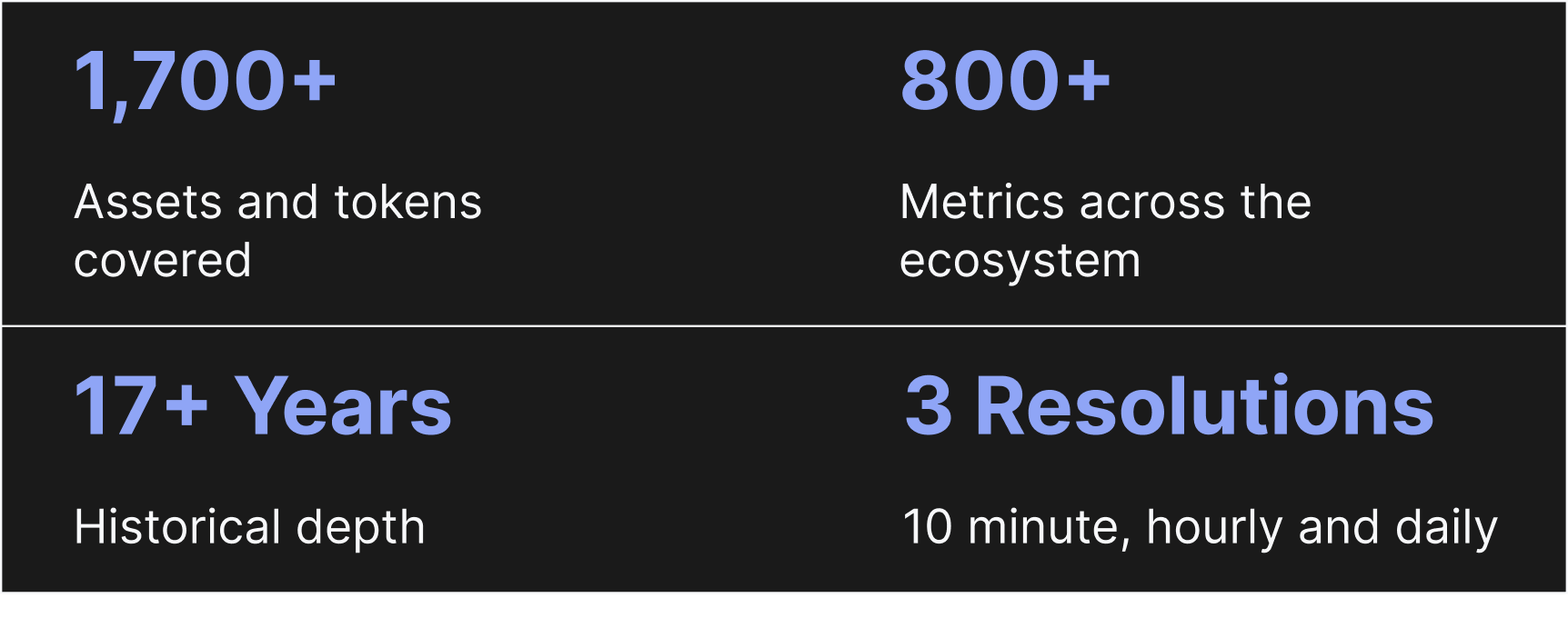
Multiple Resolutions | 10-minute, hourly, and daily granularity for everything from intraday signals to long-horizon macro research.
Built For The Workflows You Run

Quantitative & Systematic Trading | Query the full depth of on-chain, derivatives, and market data in SQL alongside your proprietary signals. PiT variants for backtesting fidelity. Sub-hourly resolution for intraday signals. No rate limits, no pagination.

Risk & Portfolio Construction | A unified view of exchange concentration, leverage dynamics, ETF flows, and supply overhangs. Native Snowflake delivery means direct integration with existing risk dashboards.

Multi-Strategy & Macro Research | Join Glassnode data with equity, fixed income, and macro datasets already in your warehouse. Same query layer, no middleware.

Fund Operations & Compliance | No bespoke pipelines means less operational risk. Snowflake's access controls and audit logging handle governance out of the box. Point-in-time timestamps provide data lineage for regulatory requirements and internal governance.

Eliminate Look-Ahead Bias from Backtests

For quantitative teams, historical data integrity is non-negotiable. Backtesting on retroactively revised data isn't backtesting. It's overfitting.

Glassnode is the first to offer point-in-time (PiT) blockchain data in Snowflake. PiT metrics are append-only and historically immutable. Each data point reflects exactly what was known when it was computed. No retroactive corrections, no look-ahead bias.

This matters because on-chain data is inherently mutable. Clustering improvements, late-reported exchange data, and refined labeling can all trigger revisions to standard metrics. PiT variants freeze the record, so your backtests reflect the information that was actually available to participants at each point in time. Every PiT data point includes a computed_at timestamp for full auditability.

Getting Started

Whether you're building backtested systematic models, integrating crypto into a cross-asset framework, or standing up institutional-grade risk infrastructure, Glassnode on Snowflake is the fastest path from blockchain data to production.

To request a trial or to learn more about Glassnode Data Shares, reach out to our institutional team at sales@glassnode.com.

The setup for Glassnode on Snowflake

  1. Retrieve your Snowflake account identifier via Snowflake's standard process or a simple SQL query.
  2. Share it with the Glassnode team. We provision access through Snowflake Marketplace private listings.
  3. Accept the listing. After initial replication, the data is live in your warehouse.

Data shares are organized by package (on-chain, market, signals, common, metadata), so you subscribe to what you need. Updates flow automatically.

Alternatively, you can initiate a trial via the Snowflake listing.

i️
Find the full setup documentation in Glassnode docs.

Glassnode Delivers the Analytical Depth That Drives Alpha

Coverage alone doesn't differentiate. What sets us apart is analytical depth built over nearly a decade of institutional-grade data engineering.

Proprietary entity adjustment | Our clustering technology identifies real-world entities (exchanges, institutions, long-term holders, miners) rather than raw addresses. Noisy blockchain data becomes actionable intelligence.

Full-stack derivatives | On-chain, futures, options, and spot from a single provider with unified methodology and consistent quality.

Expanding coverage | New chains, instruments, and products get added continuously. Your Snowflake environment reflects every update automatically.

* Default historical data during the trial is limited to 14 days and 1h/24h resolutions - contact sales@glassnode.com to request a trial with higher resolution and extended history.


  • Follow us on X for timely market updates and analysis
  • Join our Telegram channel for regular market insights
  • For on-chain metrics, dashboards, and alerts, visit Glassnode Studio

İlgili Sorular

QWhat problem does the Glassnode Snowflake Data Sharing environment aim to solve for institutional teams?

AIt aims to eliminate the engineering overhead of building custom API ingestion pipelines, managing ETL jobs, and reconciling data updates, allowing institutional teams to access comprehensive on-chain and market data directly within their Snowflake data warehouse for seamless integration into their existing research and execution workflows.

QAccording to the article, what is a key feature of Glassnode's data offering on Snowflake that is specifically important for quantitative backtesting?

AA key feature is the provision of point-in-time (PiT) blockchain data, which is append-only and historically immutable. This eliminates look-ahead bias by ensuring each data point reflects exactly what was known at the time it was computed, with no retroactive corrections.

QWhat types of data categories are included in the Glassnode Data Shares accessible via Snowflake?

AThe data categories include: On-Chain Analytics (address activity, entity behavior, supply dynamics, etc.), Derivatives (futures, options metrics), Spot & Exchange Data (exchange balances, flows), ETFs & Corporate Treasuries data, and data at Multiple Resolutions (10-minute, hourly, daily).

QWhat are the primary institutional use cases or workflows mentioned as being supported by Glassnode on Snowflake?

AThe primary use cases are: Quantitative & Systematic Trading, Risk & Portfolio Construction, Multi-Strategy & Macro Research, and Fund Operations & Compliance. It supports these by allowing direct SQL querying alongside other datasets, providing unified views, and integrating with existing dashboards and governance controls.

QWhat are the initial steps required to set up and access Glassnode Data Shares through Snowflake?

AThe steps are: 1. Retrieve your Snowflake account identifier. 2. Share it with the Glassnode team, who will provision access via Snowflake Marketplace private listings. 3. Accept the listing, after which the data will be live in your warehouse after initial replication. Alternatively, a trial can be initiated directly via the Snowflake listing.

İlgili Okumalar

On-Chain Figures on the Eve of Kickoff: 1.6 Billion Traded Before the World Cup Even Begins

"On-Chain Numbers on the Eve of the World Cup: $1.6 Billion Traded Before Kick-off" Analysis of on-chain markets before the 2026 FIFA World Cup reveals significant crypto integration into football. The most striking figure is the approximately **$1.6 billion** in total trading volume on the single "World Cup Winner" contract on the Polymarket prediction market platform, accumulated before a single match was played. This represents explosive growth for a sector whose annual volume surged from ~$16B in 2024 to ~$64B in 2025. The ecosystem is maturing beyond speculation. Key developments include: 1) **Infrastructure upgrades** like Polymarket's migration to native, regulated USDC stablecoin for settlements; 2) **Reliable data oracles**, such as Chainlink, being used to resolve real-world match outcomes on-chain; and 3) **Official recognition**, with FIFA appointing its first-ever "Prediction Markets" partner. Over 100 contracts now cover everything from the outright winner to individual match results and even non-sporting risks like venue relocation. This evolution marks a fundamental shift. While crypto firms are absent from FIFA's top-tier sponsor list, the technology has deeply penetrated the tournament's financial and predictive infrastructure through regulated stablecoin settlements, decentralized oracles, and new official partnership categories. The regulatory landscape remains complex and varies by jurisdiction, but on-chain markets for the World Cup are already a multi-billion-dollar reality.

marsbit5 dk önce

On-Chain Figures on the Eve of Kickoff: 1.6 Billion Traded Before the World Cup Even Begins

marsbit5 dk önce

From SpaceX's IPO to the Future of Crypto: Which Crypto Sectors Will Host the Trillion-Dollar Narrative?

From the SpaceX IPO, which targets a $750 billion raise at a $1.77 trillion valuation, we can extrapolate capital flow trends relevant to crypto. The focus shifts from speculative narratives to foundational infrastructure and real-world asset (RWA) integration. Key crypto sectors poised to benefit include: 1. **AI Infrastructure**: The narrative is moving from consumer-facing AI applications to underlying, scarce resources like compute power and decentralized GPU networks (e.g., TAO, RENDER, AKT, IO). These protocols are positioning as the essential "picks and shovels" providers for the AI economy. 2. **Real-World Assets (RWA)**: Beyond tokenized treasury bonds, RWA's future lies in on-chain equity and pre-IPO assets like SpaceX. This could democratize access to high-growth assets and reshape global capital flows, benefiting infrastructure projects like ONDO, LINK, and Plume that facilitate issuance, data, and liquidity. 3. **Core Financial Infrastructure**: Stablecoins, payment networks, and DePIN (Decentralized Physical Infrastructure Networks) are critical for settling the future on-chain economy. Their role expands from internal trading tools to foundational layers for global finance, AI systems, and real-world asset networks, leading to potential value reassessment. In summary, the next cycle may prioritize long-term infrastructure value—AI compute, asset tokenization networks, and settlement layers—over short-lived application hype, mirroring the broader market's shift towards funding the foundational systems of the future.

marsbit25 dk önce

From SpaceX's IPO to the Future of Crypto: Which Crypto Sectors Will Host the Trillion-Dollar Narrative?

marsbit25 dk önce

Tech Stocks Plunge and Bitcoin Slumps, Retail Investors Face Ultimate Test Ahead of SpaceX IPO

Technology stocks suffered their biggest drop in months, and Bitcoin fell below the $60,000 mark, coinciding with the eve of SpaceX's massive IPO plans. The sell-off was triggered by strong U.S. jobs data, dashing hopes for Fed rate cuts and reviving fears of further hikes. High-valuation sectors like AI and semiconductors led the declines, with the Nasdaq plunging over 4%. Cryptocurrencies, sensitive to higher interest rates and a strong dollar, also tumbled sharply. This market stress test raises critical questions about the limits of retail investor capital and its next destination. SpaceX's upcoming IPO, which plans to allocate an unusually high 30% of shares to retail investors, now faces a more uncertain landscape. Analysts warn that to buy SpaceX,散户 may need to sell existing holdings, with Tesla seen as a potential source of funds. The market is saturated with speculative options—from crypto and meme stocks to zero-day options and AI-themed ETFs—all competing for the same pool of retail attention and capital. While SpaceX's listing could inject fresh excitement, it also enters a fiercely competitive environment where investor loyalty is fleeting. The ease of zero-commission trading and lower barriers to margin trading accelerate capital rotation between narratives, making it difficult for any single story, even a historic IPO like SpaceX's, to dominate for long.

华尔街日报1 saat önce

Tech Stocks Plunge and Bitcoin Slumps, Retail Investors Face Ultimate Test Ahead of SpaceX IPO

华尔街日报1 saat önce

İşlemler

Spot
Futures
活动图片





