Ghana Crypto Sandbox: SEC Kicks Off 12‑Month Regulated Trading Pilot

bitcoinist2026-03-11 tarihinde yayınlandı2026-03-11 tarihinde güncellendi

Özet

Ghana's Securities and Exchange Commission (SEC) has launched a 12-month regulatory sandbox for Virtual Asset Service Providers (VASPs), marking the country's first operational step to formalize crypto trading. The pilot allows 11 approved firms—including exchanges, custodians, and tokenization projects—to operate under close regulatory supervision. Over the 12-month period, the SEC will monitor participant performance, investor behavior, and compliance with anti-money laundering standards. Firms deemed "market ready" after six months may transition to full licenses, while others can continue testing. The initiative aims to balance innovation with investor protection and market integrity, using real-world data to shape future crypto regulations in Ghana.

Ghana is launching a 12-month virtual-asset sandbox, the country’s first operational step to formalize crypto trading and related services.

A Regulatory Crypto Sandbox

On March 10, the Securities and Exchange Commission of Ghana (SEC) announced that it has finalized its regulatory sandbox framework for Virtual Asset Service Providers (VASPs), Bloomberg reports. The framework will allow 11 approved firms to pilot their products and services in a controlled environment under the direct oversight of the Commission, the announcement states. This new sandbox sits under Ghana’s recently enacted Virtual Asset Service Providers Act, 2025 (Act 1154), which sets the legal basis for licensing and monitoring crypto‐asset businesses in the country.

How The Sandbox Will Work

The official announcement details that the sandbox will run for 12 months, during which a limited group of approved Virtual Asset Service Providers (VASPs) can offer real products and services to users under close regulatory supervision. After the first 6 months, firms that are considered “market ready” and fully compliant may start transitioning toward full activity‐based licenses or registrations, while others can continue testing for the remainder of the period.

What It Means For Regulators

From the regulator’s perspective, the sandbox is a way to encourage innovation without sacrificing core objectives such as investor protection, market integrity, and AML/CFT standards. As stated in the announcement:

This sandbox period aims to support responsible innovation while strengthening investor protection, market integrity, and compliance with anti-money laundering and counter-terrorism financing standards.

Instead of relying only on theoretical impact assessments or industry lobbying, regulators can use the sandbox to gather real‐world data on investor behavior, platform resilience, and market abuse risks. The pilot will also allow the SEC to validate and refine detailed guidelines for each licensing category defined under the Virtual Asset Service Providers Act, 2025 (Act 1154), before opening the regime to the wider market. The announcements claims that “lessons from the pilot will inform future policy and licensing frameworks for virtual assets services”.

By limiting participation to a small, vetted group, the SEC can respond quickly to issues (e.g., security incidents, mis‐selling, liquidity problems) and adjust rules or technical requirements before granting full licenses.

What It Means For Participants

The SEC press released details the 11 firms that have been admitted in the pilot. The list includes tokenization projects, custodial services and exchanges, such as WhiteBit, a centralized exchange with spot trading, custody and fiat/crypto gateways.

The 11 participants must operate within predefined risk, disclosure, and compliance parameters, giving the regulator a controlled environment to observe how their trading, custody, and tokenization models behave in practice. The successful sandbox participants will effectively become the reference models for what a “good” licensed VASP should look like.

The 12‐month sandbox is a probation period: if they perform well, they move to full licensing; if they fall short, they risk being shut out of a regulated Ghanaian market once the framework is fully rolled out.

Ghana In The African Crypto Context

Multiple African countries are rolling out new crypto laws and sandbox regimes, with Ghana now joining peers like Zambia that are already testing crypto regulation technology to supervise services before they enter the market, signaling a broader African shift toward sandbox‐style oversight. Ghana, one of Africa’s biggest gold producers, is seeing a rapid virtual‐asset uptake, with local estimates suggesting millions of adults already trade crypto. Bitcoinist has also covered how Ghana’s central bank has been working on draft crypto rules to move the sector into a formal regulatory framework.

If the sandbox delivers clean data and limited incidents, Ghana could fast‐track a fully regulated environment for exchanges and tokenization platforms.
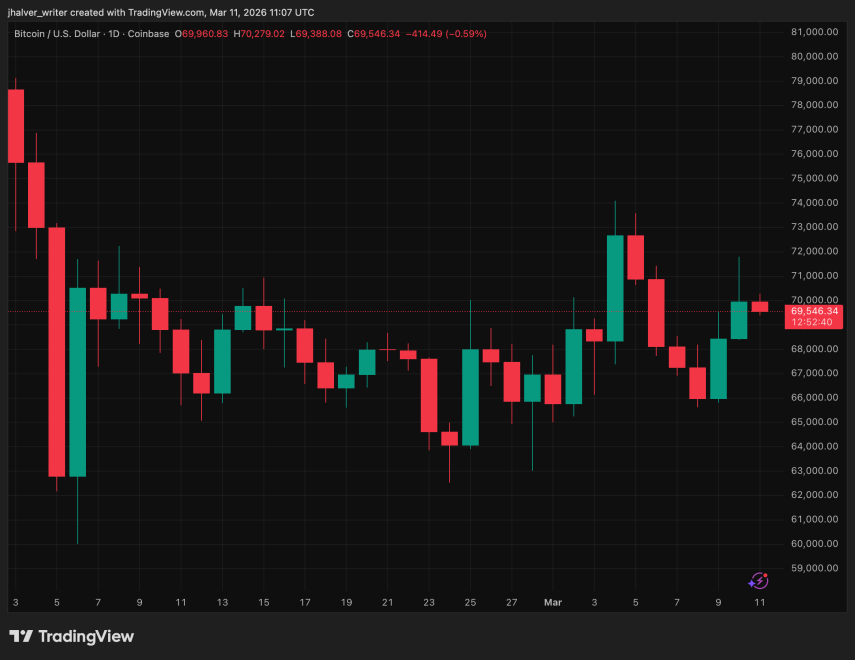
BTC’s price trends to the downside on the daily chart. Source: BTCUSD on Tradingview

Cover image from Perplexity, BTCUSD chart from Tradingview

İlgili Sorular

QWhat is the main purpose of Ghana's 12-month virtual-asset sandbox?

AThe main purpose is to formalize crypto trading and related services by allowing approved Virtual Asset Service Providers (VASPs) to pilot their products in a controlled environment under regulatory oversight, while ensuring investor protection, market integrity, and compliance with AML/CFT standards.

QHow many firms have been approved to participate in Ghana's crypto sandbox pilot?

A11 firms have been approved to participate in the crypto sandbox pilot.

QWhat happens to firms that are considered 'market ready' after the first 6 months of the sandbox?

AFirms considered 'market ready' and fully compliant after the first 6 months may start transitioning toward full activity-based licenses or registrations.

QWhich African country is mentioned as already testing crypto regulation technology similar to Ghana's approach?

AZambia is mentioned as a peer country that is already testing crypto regulation technology to supervise services before they enter the market.

QWhat legislation provides the legal basis for Ghana's Virtual Asset Service Providers sandbox?

AThe Virtual Asset Service Providers Act, 2025 (Act 1154) provides the legal basis for licensing and monitoring crypto-asset businesses and the regulatory sandbox in Ghana.

İlgili Okumalar

Low Investment Isn't Apple's Immunity Pass

While Meta and Google face investor scrutiny over ballooning AI capital expenditures, Apple's minimal AI investment has paradoxically become a strength. Its market cap recently reclaimed the global top spot, surpassing $5 trillion. The irony is deep: Apple's own AI efforts have lagged, with "Apple Intelligence" delayed and core talent lost, forcing reliance on partners like Google Gemini and Alibaba's Qianwen. Its Q3 FY2026 (Q2 CY) earnings initially seemed stellar. Revenue hit $109.4B (up 16% YoY), with iPhone and Mac sales, growing 22% and 29% respectively, driving most of the growth. However, the stock fell over 8% post-earnings. The primary concern was a weaker Q4 revenue growth forecast of 9-11%, below expectations, due to looming supply chain constraints. Apple is feeling the indirect cost of the AI boom. Soaring memory and chip prices, fueled by massive data center investments from Microsoft, Amazon, and others, are forcing Apple to raise Mac and iPad prices significantly. The upcoming iPhone launch is also expected to see substantial price hikes. Despite avoiding heavy AI infrastructure spending—its capital expenditures are actually down 28%—Apple cannot escape the industry-wide supply and cost pressures. While Apple's operating cash flow remains robust, its substantial R&D spending (up 32% YoY) has yet to yield major AI breakthroughs. As Tim Cook prepares to step down as CEO, Apple faces a challenging transition: balancing its premium hardware success against the strategic and cost pressures of the AI era it has so far cautiously navigated.

marsbit18 dk önce

Low Investment Isn't Apple's Immunity Pass

marsbit18 dk önce

PA Graphics Explanation | One Chart to Understand the Major Web3 Events in August 2026

**PANews Crypto Calendar: Key Web3 Events in August 2026** PANews introduces its revamped crypto calendar, featuring comprehensive coverage, flexible filtering, and easy export options. The market in August will be shaped by multiple key events across macroeconomics, regulation, tokenomics, and project developments: * **Macro & Policy:** Key US economic data releases (July Non-Farm Payrolls, CPI), the Federal Reserve meeting minutes, and the Jackson Hole Economic Symposium will be in focus. On the regulatory front, the US Senate plans to release a new draft of the *CLARITY Act*, while the EU's expanded crypto ban against Belarus comes into effect. * **Token Unlocks:** Significant token unlocks are scheduled for assets including ENA, AVAX, CONX, ZRO, and KAITO, which may influence market volatility. * **Project Updates & Shutdowns:** Several services, including Exchange Art, Ctrl Wallet, Zapper, NFTfi, and Summer.fi, are set to cease operations or undergo major adjustments. Users are advised to manage their assets accordingly. * **Corporate Activity:** Q2 earnings reports from companies like SpaceX, Circle, and Nvidia are due. Unitree Robotics will initiate its IPO subscription on the STAR Market, and Moonshot AI plans to begin a Pre-IPO financing round. * **Industry Events:** Major conferences such as Bitcoin Asia 2026 and the 2026 Digital Expo will take place. The overarching market narrative for August will revolve around macroeconomic expectations, regulatory developments, token unlock schedules, and ongoing industry consolidation.

marsbit28 dk önce

PA Graphics Explanation | One Chart to Understand the Major Web3 Events in August 2026

marsbit28 dk önce

Wall Street's Most Famous 'Cassandra' Now Has His Sights Set on Nvidia

Michael Burry, the famed "Big Short" investor, has once again captured Wall Street's attention with a series of short positions against major tech and semiconductor stocks, most notably Nvidia. In late June and July, through his "Cassandra Unchained" newsletter, Burry disclosed short bets against Nvidia, Tesla, Applied Materials, Caterpillar, the SOXX semiconductor ETF, and later, Micron Technology. His core thesis revolves around potential distortions in the AI infrastructure boom, specifically questioning whether extended depreciation schedules (e.g., 6 years vs. a realistic 2-3 years for AI chips) by cloud giants like Microsoft and Google artificially inflate profits. He also raises concerns about possible "off-balance-sheet circular financing," where chip demand might be propped up by vendor-backed funding to clients. Nvidia's stock experienced volatility following these disclosures, briefly dipping but largely holding near Burry's reported entry points, leaving his positions roughly flat or slightly underwater as of late July. This move is part of a pattern for Burry, whose track record since his legendary 2008 bet is mixed. He has faced notable losses, such as on Tesla in 2021, while scoring on broader market turns like the 2020 pandemic crash. His methodology focuses intensely on free cash flow and scrutinizing original financial documents to spot overvaluation and structural risks, but it often struggles with timing the market. The article contrasts Burry's stance with other prominent investors. Steve Eisman, another "Big Short" figure, is not shorting Nvidia, citing strong fundamentals but expressing nervousness about sustainability. Jim Chanos agrees with the broad "accounting mismatch" concern—comparing it to the dot-com bubble—but targets financial leverage in private equity firms rather than the chip stocks themselves. While Nvidia's short interest remains relatively low at 1.3-1.4% of float, the massive stock size means absolute short losses have been significant, exceeding $5 billion earlier this year. The piece concludes that for ordinary investors, the key takeaway is not replicating specific short bets but learning from the critical frameworks these investors use: questioning rosy accounting, identifying structural vulnerabilities, and maintaining skepticism during market euphoria, even if pinpointing the exact catalyst for a downturn remains elusive.

marsbit53 dk önce

Wall Street's Most Famous 'Cassandra' Now Has His Sights Set on Nvidia

marsbit53 dk önce

Weekly Selection丨Epic Stock Market Volatility, Changxin Tech's IPO Reshapes Storage Landscape, Saylor Aims to Re-Anchor STRC Around September 8th

PANews Weekly Digest: Market Turmoil, Tech Breakthroughs, and Crypto Developments. The week saw significant volatility across global markets. South Korea's KOSPI index experienced extreme turbulence, including multiple trading halts, largely driven by sharp declines in AI hardware stocks like SK Hynix. In contrast, China's Changxin Xinqiao (CXC) achieved a landmark IPO with a market cap surpassing 4 trillion yuan, marking a major success for the domestic DRAM industry after a decade of losses. In the crypto and Web3 space, several key narratives emerged. AI is driving demand for new infrastructure, with projects like AI agent wallets and programmable payments gaining traction, attracting interest from firms like Coinbase. The Bitcoin mining sector is pivoting, with companies like MARA focusing on energy management as electricity becomes a core AI-era asset. Meanwhile, the RWA (Real World Assets) sector faces a "utilization puzzle," with hundreds of billions in on-chain assets remaining dormant. Notable market movements included a historic single-day surge of over 17% for the KOSPI index and a significant migration of $16.5 billion in staked ETH within the Lido ecosystem. Michael Saylor announced a target to re-peg the STRC stablecoin around September 8th. Other highlights include discussions on Ethereum's ambitious 2030 roadmap for scaling and privacy, analysis showing high protocol revenues not always translating to token price gains, and warnings from Citi about potential extreme commodity price shocks by late 2026.

marsbit59 dk önce

Weekly Selection丨Epic Stock Market Volatility, Changxin Tech's IPO Reshapes Storage Landscape, Saylor Aims to Re-Anchor STRC Around September 8th

marsbit59 dk önce

When the Market Begins to Question AI Capex: A Full Analysis of Q2 Earnings Reports from Five Tech Giants

In late July 2026, five major US tech giants—Alphabet, Intel, Microsoft, Meta, and Apple—released their Q2 earnings reports. While all companies exceeded revenue and profit expectations, driven by strong AI-related business growth, investor reactions diverged sharply due to concerns over escalating AI capital expenditures (capex) and their impact on free cash flow. Alphabet reported strong revenue growth and a surging cloud business, but its stock fell after announcing a doubled year-on-year capex and negative quarterly free cash flow for the first time. Intel posted its strongest revenue growth in over 15 years, but its stock experienced volatile trading after significantly raising its full-year capex guidance. Microsoft saw its stock surge after beating estimates and, crucially, lowering its capex forecast while projecting positive free cash flow. Meta faced the most severe sell-off as its profits declined despite revenue beats, with free cash flow plunging over 90% and its capex guidance raised. Apple reported record June-quarter results, but its stock plummeted after providing Q4 revenue guidance that fell short of expectations, citing supply chain constraints and forex headwinds. The overall takeaway is that the market's focus has shifted from validating AI demand to scrutinizing the timeline for returns on massive AI investments. Companies demonstrating a clearer path to managing capex and preserving free cash flow, like Microsoft, were rewarded, while those signaling continued aggressive spending faced investor skepticism.

Odaily星球日报1 saat önce

When the Market Begins to Question AI Capex: A Full Analysis of Q2 Earnings Reports from Five Tech Giants

Odaily星球日报1 saat önce

İşlemler

Spot
活动图片