Geopolitical Earthquake in the Middle East: Deciphering Safe-Haven Capital Flows and BTC Pricing Logic Through Options Data

marsbit2026-03-02 tarihinde yayınlandı2026-03-02 tarihinde güncellendi

Özet

In an unprecedented geopolitical shock on March 1, 2026, a direct U.S.-Israel military strike resulted in the death of Iran’s Supreme Leader, triggering a global repricing of risk across asset classes. While traditional safe-havens like crude oil and gold surged, Bitcoin exhibited a dual narrative—oscillating between "digital gold" and high-risk asset behavior. BTC held key support near $67,000 with robust spot market activity ($1.74B in 24h volume), indicating strong institutional accumulation despite initial volatility. Deribit options data revealed critical insights: the March 27 expiry期权 had a max pain of $76,000—12% above spot—suggesting pre-event bullish positioning remained largely intact. Implied volatility spiked to 51.3%, reflecting heightened hedging demand. The put/call open interest ratio stood at 0.75 (call-heavy), while the volume ratio reached 1.37, indicating tactical put buying for short-term protection. A breakdown below $65,000 could trigger negative gamma feedback toward $60,000. Conversely, stabilization above $70,000 may induce a gamma squeeze, accelerating a move toward max pain near $76,000. Medium-term outlook suggests a broad range between $62k–$70k with violent swings. However, as panic subsides, BTC’s structural role as a non-sovereign, uncorrelated asset may strengthen, with a high probability of a rebound toward $75k–76k by late March. This event underscores Bitcoin’s evolving function in global macro portfolios amid escalating geopolitical f...

On March 1, 2026, global macro markets were hit by an epic "black swan" event: a direct military strike by the United States and Israel against Iran resulted in the death of Iran's Supreme Leader, Ayatollah Khamenei.

This extreme tail-risk event instantly reshaped the risk premium models for global asset classes. The complete ignition of the Middle East powder keg not only triggered violent fluctuations in traditional crude oil and safe-haven assets but also pushed the cryptocurrency market, at a critical juncture of博弈 (game theory/strategic interplay), to a crossroads of liquidity and pricing power.

Combining Binance spot market data with Deribit options data, this analysis provides an in-depth examination of the immediate impact of this geopolitical crisis on the cryptocurrency market from a quantitative and derivatives博弈 perspective, along with a forward-looking projection of future volatility paths and market trends.

The essence of geopolitical conflict is the reshaping of global supply chains, energy prices, and the ensuing inflation expectations. The financial market transmission path of this surprise US-Israel attack on Iran manifested as a textbook risk-aversion pattern: crude oil and gold within commodities became the preferred safe havens, while high-risk assets faced indiscriminate selling in the first instance.
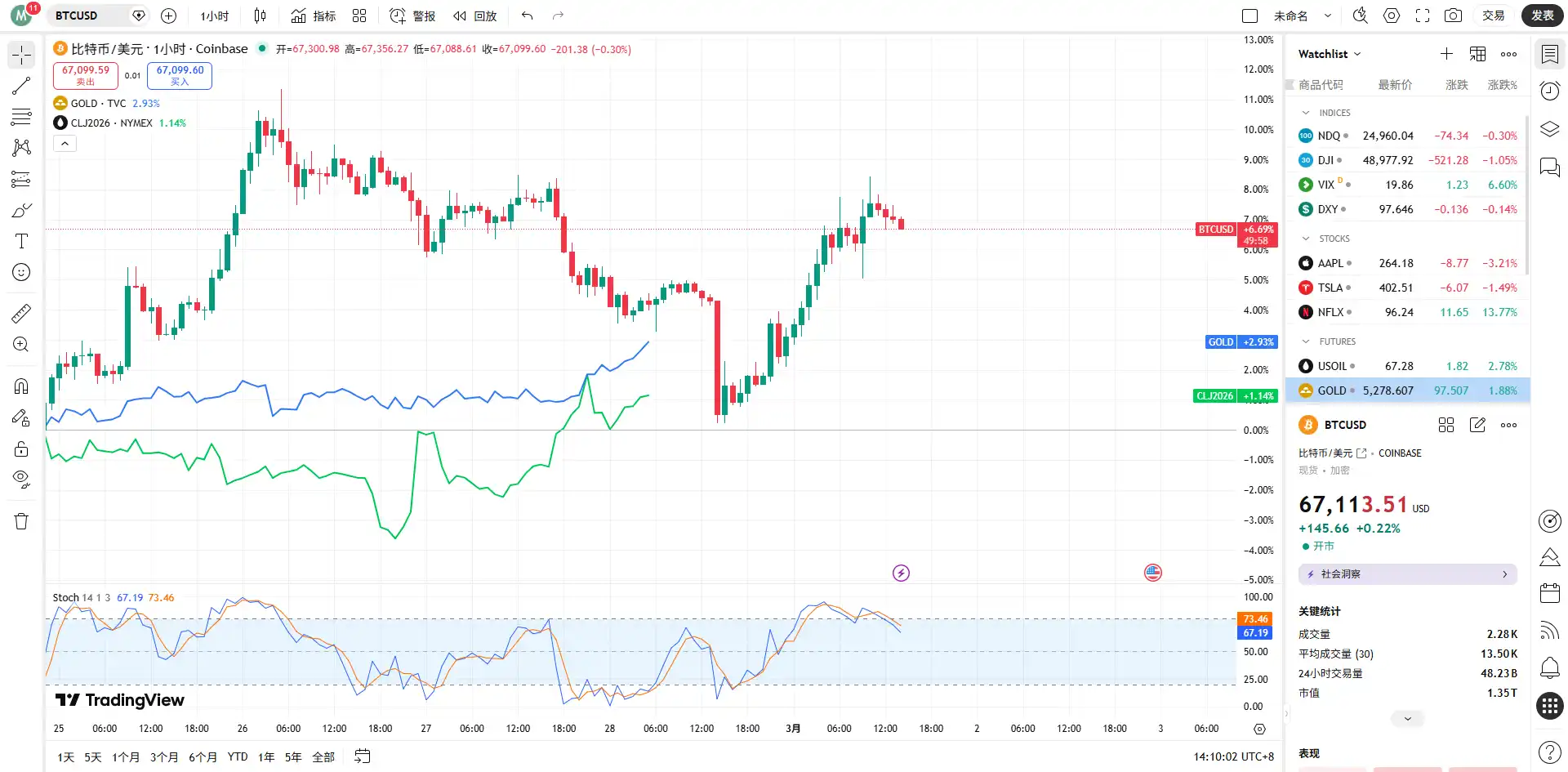
High-intensity conflict erupting in the Middle East first and foremost triggers避险 (safe-haven) sentiment towards the global energy supply chain and the fiat currency credit system. In traditional financial markets, Brent crude oil is highly likely to gap up on open due to panic over potential supply disruptions, and traditional safe-haven assets like gold will also see intensive position building by institutional funds. However, in the crypto asset space, BTC's "digital gold" narrative and its "high-beta risk asset"属性 (attributes) are experiencing intense internal conflict.

From a macro liquidity perspective, panic induced by geopolitics (a soaring VIX index) typically triggers cross-asset indiscriminate selling in the first instance to obtain US dollar liquidity. But after a brief liquidity squeeze, Bitcoin, which is不受 (not subject to) control by any specific sovereign state and possesses censorship-resistant and portable properties, often attracts capital fleeing from high-risk emerging market fiat currencies.

Combining Binance's spot and contract market data (as of 14:00 on March 1, 2026), the BTC/USDT spot price is consolidating around $67,392. In the initial phase of such a major geopolitical crisis, BTC did not experience a crash similar to the "312" event of 2020 but tenaciously held the key support level of $67,000.

The 24-hour trading volume reached a high of $1.74 billion, indicating significant disagreement and turnover between bulls and bears at this level. The moving average system in the price chart shows a pattern of high consolidation following a bullish alignment, suggesting that under the impact of sudden news, the承接盘 (buying support)力量 (force) in the spot market is exceptionally resilient, and the long-term allocation core positions of institutional funds have not fundamentally shifted.
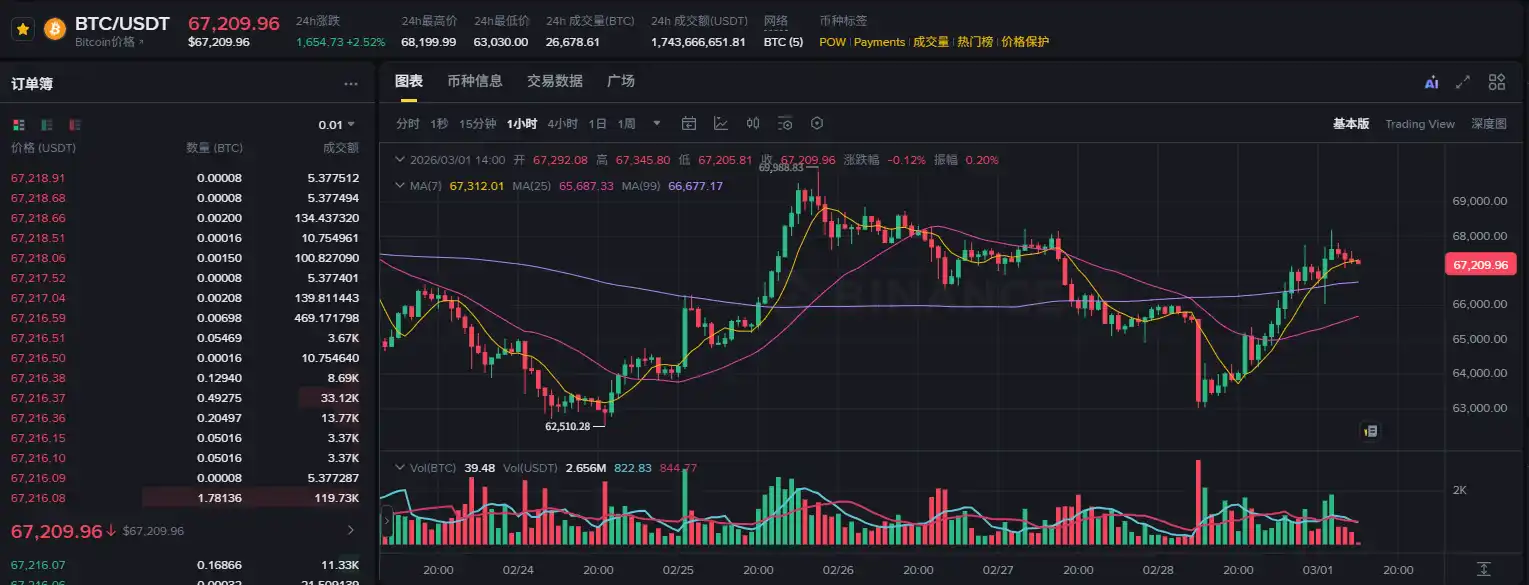
To透视 (see through) the true intentions of smart money, the derivatives market, especially options data, provides the most直观的量化截面 (intuitive quantitative cross-section). By analyzing the current BTC options data expiring on March 27, 2026, on the Deribit platform, we can clearly delineate the path projection of major institutions for the next month.

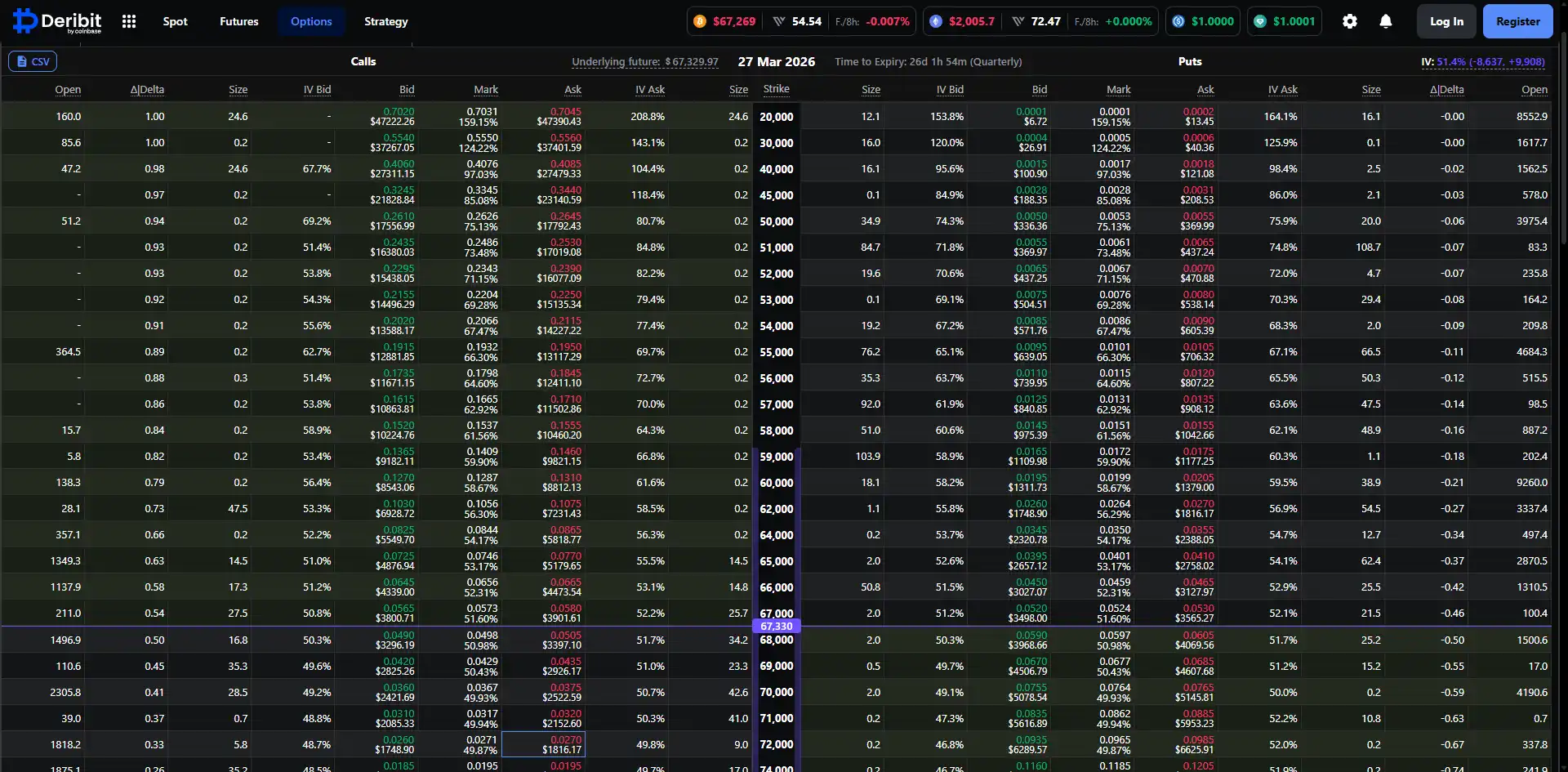
The current implied volatility (IV) for BTC options expiring on March 27 has reached a relatively high level of 51.3%. Against the backdrop of the geopolitical crisis, options sellers quickly raised the volatility surface to hedge against the Gamma exposure risk potentially brought by extreme price movements. An IV above 51% indicates the market is hedging against the possibility of wide swings over the next two to three weeks. For quantitative traders, the risk-reward ratio for selling volatility is extremely poor at this time; the market as a whole is in a frenzy of "buying straddles" or constructing tail-risk protection.
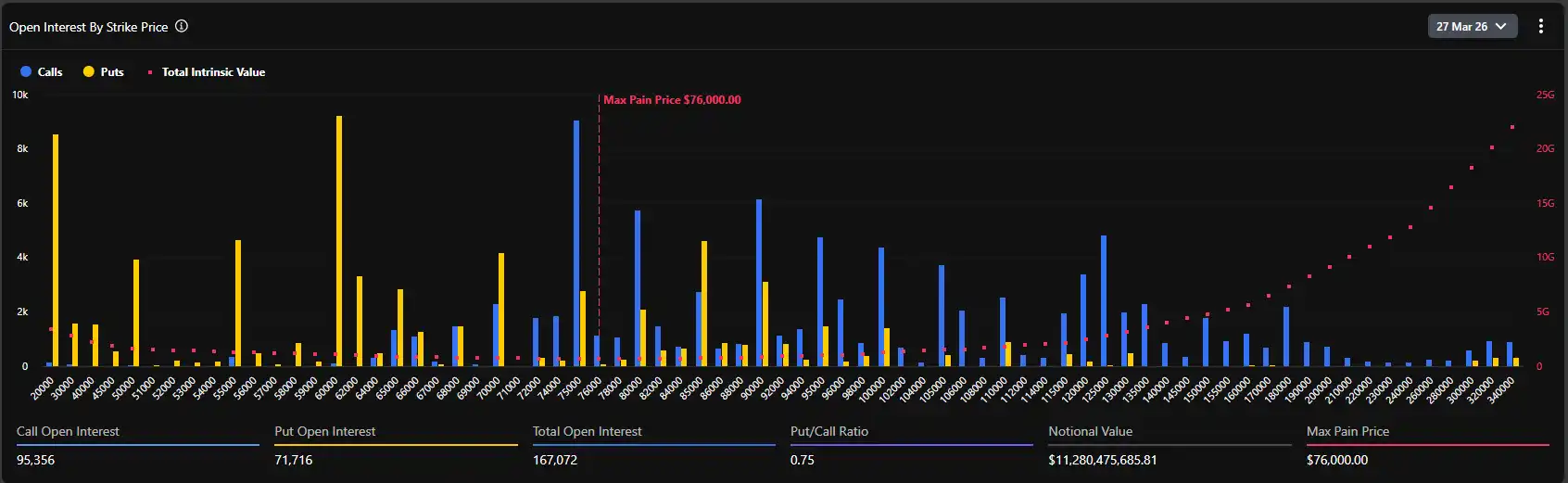
According to the open interest (OI) distribution chart for options, the current global max pain point is as high as $76,000. This is a highly forward-looking and controversial data point.

Typically, as expiration approaches, the underlying asset price tends to gravitate towards the max pain point to minimize the overall value for options buyers. However, the current spot price (around $67,400) is at a discount of nearly 12% or more to the max pain point ($76,000). This significant deviation reveals two core logics:

First, the market was in an extremely optimistic bullish sentiment before the crisis erupted, with substantial funds betting on breaking through the all-time high (the $75,000–$80,000 range) by the end of March, which directly pushed up the max pain level.

Second, the outbreak of the geopolitical crisis constituted a strong external shock, suppressing the upward momentum of the spot price. But judging from the total open interest of 167,072 BTC (notional value exceeding $11.2 billion), long positions did not experience large-scale unwinding and stampedes due to the war news.

Data shows the current put/call ratio (based on OI) is 0.75. A value below 1 indicates that, in terms of overall存量 (stock/volume), call option holdings still dominate absolutely. Particularly at strike prices of $75,000, $80,000, and even $100,000, there are massive accumulations of call holdings (with single strike prices reaching close to 10k BTC in size).

However, it is worth noting that the 24-hour volume PCR (Put/Call Volume Ratio) reached 1.37. The divergence between存量偏多 (stock bias towards calls, 0.75) and增量偏空 (flow bias towards puts, 1.37) perfectly captures the current market psychology: long-term institutions maintain their original long exposure (not selling spot, not closing long calls), but in the short term following the outbreak of war in the Middle East, substantial funds rushed in to buy out-of-the-money (OTM) put options for tactical hedging, causing a surge in short-term put trading volume.

Combining detailed options data from Deribit, we observe that the distribution of Delta values is extremely dense in the $67,000 to $70,000 range. The current spot price of $67,495 is right in the "meat grinder" zone of the bull-bear battle.

If the geopolitical situation further deteriorates, causing macro funds to withdraw en masse, and the spot price breaks below $65,000 (a strong support level), market makers, to hedge their short put exposure, will be forced to sell in the spot or futures market, potentially triggering a wave of localized negative liquidity feedback, testing the psychological barrier of $60,000 downwards.

Conversely, if the Middle East situation enters a stalemate stage with major power mediation after a brief violent conflict, and market panic peaks and recedes, the rebound in the crypto market could be extremely fierce. Due to the massive accumulation of call options in the $70,000 to $76,000 range above, once the spot price stabilizes and breaks through the $70,000 resistance level, market makers will be forced to buy spot to hedge their negative Gamma exposure. This classic "Gamma Squeeze" effect could propel the BTC price towards the max pain point around $76,000 at an unprecedented speed.

The aftershocks of the Middle East geopolitical tremor will continue to发酵 (ferment/develop). The subsequent actions of the US and Iran will determine the final destination of global避险 (safe-haven) capital. In the foreseeable short term, BTC spot will experience violent spikes within a wide range of $62,000~$70,000. Leverage in the contract market will be反复清洗 (repeatedly washed out) in this process. Quantitative strategies should focus on "reducing leverage and capitalizing on volatility," suitable for constructing calendar spreads or grid trading around key support and resistance levels, avoiding exposure to directional trends.

Judging from the options holding structure, the massive expiration on March 27th is a gravitational center the market cannot avoid. Unless a global, uncontrollable World War III-level liquidity drought occurs, as panic sentiment marginally decreases, BTC's "safe-haven属性 (attribute)" and "inflation-hedge属性 (attribute)" will be repriced. In mid-to-late March, the market is highly likely to initiate a restorative rebound, with the spot price having a strong incentive to move towards the $75,000–$76,000 range (the max pain point and dense call strike zone).
This event marks the entry of geopolitics into a more dangerous phase. Whether it's the rekindling of inflation expectations brought by war (soaring crude oil) or the crisis of confidence in fiat currencies triggered by financial sanctions against specific countries, the strategic value of Bitcoin as a "borderless, non-sovereign hard asset" is being fundamentally strengthened. For large institutions such as family offices and macro hedge funds, the traditional 60/40 portfolio of US bonds + US stocks can no longer cope with current tail risks. The allocation proportion of BTC as an "uncorrelated asset" in investment portfolios will see a systematic increase following this crisis.

The US and Israeli strike on Iran is the first thunderclap reshaping the global financial landscape in early 2026. Beneath the surface of panic, the data from the crypto options market冷静地揭示 (calmly reveals) the hand of institutional funds: "short-term defensive hedging, long-term still bullish."

For professional financial practitioners, stripping away emotional noise and closely monitoring the trends in implied volatility and the transfer of market makers' Gamma exposure are the core codes to穿透 (pierce through) the fog of war and grasp the pricing power of the next round of assets. With the $76,000 options max pain point standing like a beacon, every deep pullback caused by panic is accumulating potential energy for a future breakout.


İlgili Sorular

QWhat immediate impact did the US-Israel military strike on Iran have on global financial markets according to the article?

AThe strike triggered a classic risk-aversion pattern: a flight to safe-haven assets like crude oil and gold, and an indiscriminate sell-off of high-risk assets.

QHow did the BTC price react initially to the geopolitical crisis, and what does the trading volume suggest?

AThe BTC price held firm around the $67,000 key support level without a crash. The high 24-hour trading volume of $1.74 billion indicates significant disagreement and position turnover between bulls and bears.

QWhat does the high Implied Volatility (IV) of 51.3% for the March 27th BTC options indicate about market expectations?

AThe high IV indicates the market is pricing in and hedging against the potential for wide price swings (high volatility) over the next few weeks due to the geopolitical crisis, making shorting volatility an unattractive strategy.

QWhat is the significance of the large discrepancy between the current BTC spot price (~$67,400) and the options Max Pain point ($76,000)?

AThe large ~12% discrepancy shows that the market was extremely bullish before the crisis (pushing Max Pain high), but the external shock suppressed the spot price. The massive open interest suggests long-term bullish positions were not liquidated en masse.

QHow could the market's path diverge based on the evolution of the Middle East situation, according to the options data analysis?

AIf the situation worsens, a break below $65,000 could trigger a negative feedback loop down to $60,000. If the situation stabilizes and panic subsides, a break above $70,000 could trigger a Gamma Squeeze, rapidly pushing the price toward the $76,000 Max Pain point.

İlgili Okumalar

Only 153 Venture Capital Firms Invested in July: Is the Crypto VC Industry Experiencing a 'Mass Extinction'?

In July 2026, only 153 unique venture capital firms participated in disclosed crypto funding rounds, marking the lowest monthly count since November 2020. This figure represents an 87% decline from the peak of 1,177 firms in 2022. Overall, the first seven months of 2026 saw crypto projects raise approximately $11.78 billion across 481 rounds. This crypto VC contraction contrasts sharply with the broader venture capital landscape, where global VC investment reached a record $560.4 billion in H1 2026, heavily fueled by major AI company financings. This shift in capital allocation has drawn funds away from the crypto sector. Within crypto, funding is highly concentrated. Trading platforms, prediction markets, and payment sectors absorbed 53% of the total capital. While early-stage deals remain frequent, the largest sums flow to a few late-stage rounds and mergers & acquisitions, which surged to $7.23 billion in Q2 2026. The market is consolidating around top funds like a16z crypto and Dragonfly, which successfully raised new multi-billion dollar funds, while many smaller firms have retreated. Analysts describe this as a "great extinction" for crypto VCs, where capital is becoming more selective, favoring proven business models and assets over early-stage speculation. This raises the bar for project quality, funding efficiency, and viable exit paths.

marsbit21 dk önce

Only 153 Venture Capital Firms Invested in July: Is the Crypto VC Industry Experiencing a 'Mass Extinction'?

marsbit21 dk önce

Strategy's Loss in the Second Quarter Reaches $8.22 Billion Amid Bitcoin Decline

Strategy, the largest corporate holder of Bitcoin, reported a net loss of $8.22 billion for the second quarter. This loss was primarily driven by an $8.32 billion unrealized loss on its Bitcoin holdings due to a decline in the asset's price during the period. Despite these paper losses, the company increased its Bitcoin holdings to 843,775 BTC, a 25% growth since the start of the year. As part of a new monetization strategy, Strategy sold approximately $218.4 million worth of Bitcoin, mainly to fund dividends for preferred shareholders, with $216 million of that sold after Q2 ended. The company also built a $3.75 billion cash reserve, which it claims is sufficient to cover over two years of dividend and interest payments, aiming to insulate itself from Bitcoin's volatility while meeting obligations. Following the earnings release, Strategy's stock (MSTR) rose 4.7% in regular trading but corrected slightly after-hours. This pattern reflects how the company's accounting results are heavily tied to Bitcoin's price swings, even as its long-term strategy remains unchanged. The report indicates that Strategy is maintaining its core strategy of accumulating Bitcoin while building a financial buffer. This quarterly loss follows a recognizable pattern, with the company posting significant unrealized losses in previous quarters (e.g., $12.4 billion in Q4 2025 and ~$12.5 billion in Q1 2026) due to fair-value accounting. A key technical shift is its new monetization program, which introduces periodic selling pressure on the market, transitioning Strategy from a pure accumulator to a participant that occasionally adds supply. A critical question remains: how long can the cash reserve cover dividend obligations if a Bitcoin price downturn persists beyond two years?

cryptonews.ru41 dk önce

Strategy's Loss in the Second Quarter Reaches $8.22 Billion Amid Bitcoin Decline

cryptonews.ru41 dk önce

Will Terrorist Durov Ban Russian Officials?

Telegram founder Pavel Durov publicly reacted to being labeled a "terrorist" by Russian authorities, stating the designation came after he refused demands for mass surveillance and censorship on the platform. In a Telegram post, he highlighted that this status formally bans him from "publishing information online." Durov concluded with a statement widely circulated: Russian officials "clearly don't understand who can ban whom on the internet." This remark suggests Durov could potentially restrict official Russian government and officials' channels on Telegram, which continue to operate on the platform despite its formal blocking in Russia. The situation parallels previous, slow-moving state directives, like switching officials to domestic cars, contrasted with the current push to migrate all government communication to the Russian-made messenger MAX by 2030. However, reports indicate many officials still use Telegram via workarounds, fearing surveillance on MAX, while alternatives like BiP and KakaoTalk recently became inaccessible in Russia without a VPN. Durov has not specified any immediate actions against state channels. His statement is an initial response, with further developments depending on the authorities' reaction. The dynamic differs from 2020 when Russian regulators lifted a block on Telegram; now, Durov implies control from within the platform itself over the official accounts that persisted through that earlier blockade.

cryptonews.ru41 dk önce

Will Terrorist Durov Ban Russian Officials?

cryptonews.ru41 dk önce

DeepSeek V4 Official Version Arrives, New Capabilities Emerge, Value-for-Money King Enters the Fray

On July 31st, DeepSeek officially launched the public API beta for its DeepSeek-V4-Flash model. A key highlight is its performance on multiple Agent benchmark tests, reportedly nearing or even surpassing the level of the V4-Pro preview version from three months ago. Notably, the Flash model achieves this with significantly smaller scale (130B active parameters vs. Pro's 490B), suggesting that post-training optimization and data quality may be as crucial as raw model size. DeepSeek emphasized that the V4-Flash-0731 uses the same model architecture and size as its preview version, with improvements attributed solely to "re-trained post-training." The update also marks the official debut of DeepSeek's self-developed Agent framework, "Harness." The move signals DeepSeek's strategic push to position its cost-effective Flash model as a competitive base for Agent applications—scenarios requiring autonomous planning, tool usage, and complex task execution—where inference speed and cost are critical. By natively supporting OpenAI's Responses API format and adapting for code-generation scenarios, DeepSeek aims not just to be a cheaper alternative but to establish its own ecosystem in the Agent era. This release follows DeepSeek's record-breaking ~$50 billion fundraising round roughly two months prior, underscoring market confidence in its technology and commercialization prospects. The company is reportedly preparing for another funding round at a valuation of approximately $71 billion. The Flash model's advancement represents a step in fulfilling the high expectations that come with this valuation, setting the stage for the impending release of the V4-Pro official version and intensifying competition in the global Agent landscape.

marsbit45 dk önce

DeepSeek V4 Official Version Arrives, New Capabilities Emerge, Value-for-Money King Enters the Fray

marsbit45 dk önce

İşlemler

Spot
活动图片